Solana’s Price Plunges. Will Solaxy’s Layer-2 Solution Revive the Ecosystem?

bitcoinistОпубликовано 2025-04-14Обновлено 2025-04-14

Введение

Solana's price declined sharply to begin April, declining 60% from its all-time high of $294.33 in mid-January. The sudden drop...

Trusted Editorial content, reviewed by leading industry experts and seasoned editors. Ad Disclosure

Solana’s price declined sharply to begin April, declining 60% from its all-time high of $294.33 in mid-January.

The sudden drop has raised concerns about the scalability and resilience of Solana, a leading meme coin ecosystem, and its native token $SOL, one of the top altcoins – but created an opportunity for Solaxy.

Is the latest plunge just another part of $SOL’s particularly volatile nature? Or are there deeper concerns resting beneath the surface?

Time for a closer analysis of $SOL’s performance, and a look at how Solaxy could be just the Layer-2 solution that Solana needs to succeed.

Solana’s Recent Challenges

In mid-January, $SOL reached an all-time high of $295.

By April 7, it briefly traded below $100 before recovering. It currently sits at roughly $133.

What caused the downturn? $SOL has seen wide swings before – the recent all-time-high was just barely higher than the previous one, which came two years earlier.
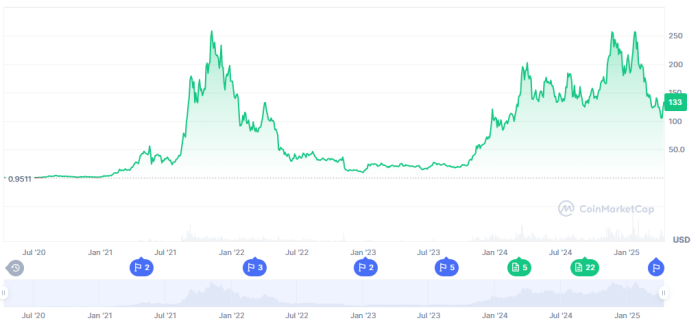
Solana all-time-price performance

On the broader market front, Donald Trump’s escalating trade war continues to send shockwaves through the market. Broader economic uncertainties have impacted investor confidence, leading to sell-offs.

One of the major drivers in Solana’s success as a network was new meme coins. $BONK, back in 2022, helped to kick-start $SOL’s price surge. But increased trading and speculation can lead to congestion of the Solana mainnet, causing transaction delays and failures.

In addition, Solana’s relationship with meme coins has cooled decidedly. Trading volume on the popular meme coin launchpad Pump.fun fell dramatically in Q1 2025, from $3B in January to $170M in early March; it was a paltry $38M in early April.

Top top it all, Ethereum founder Vitalik Buterin criticized Pump.fun for bringing projects with little to no value, hurting blockchain’s ‘social philosophy.’
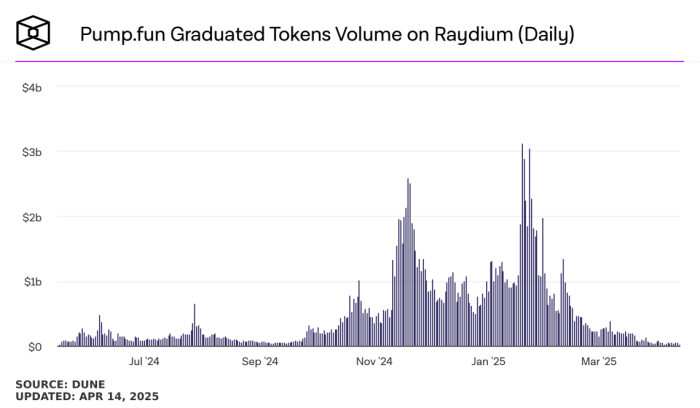
Pump.fun graduated tokens daily volume

To solve its meme coin blues – and perhaps reverse the price plunge – Solana needs some fresh innovation in the ecosystem.

Solaxy: Improved Scalability on Solana’s First-Ever Layer-2

Solaxy ($SOLX) is Solana’s first true Layer-2 (L2) scaling solution, designed to address the network’s congestion and scalability challenges and reinvigorate its meme coin ecosystem.

Solaxy handles transactions off the main chain, alleviating congestion and enhancing throughput with a rollup architecture much like Ethereum’s L2s.

Even better, Solaxy supports a cross-chain infrastructure connecting Solana and Ethereum, blending the latter’s reliability and scalability with Solana’s speed and lower transaction fees.
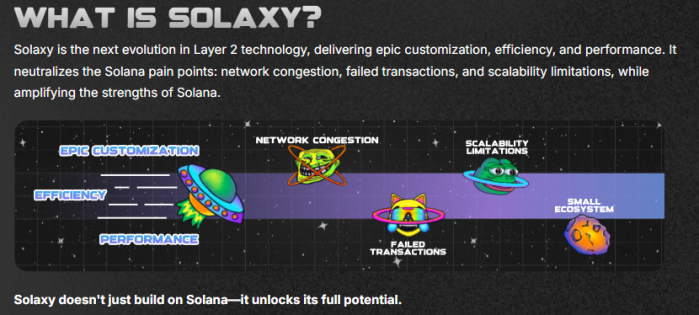
What is Solaxy

The utility token for Solaxy, $SOLX, is currently in the presale stage. You can learn how to buy $SOLX with our guide, but don’t delay – the presale continues to gain steam rapidly. It just passed the $30M mark, with tokens priced at $0.001694.

Solaxy’s ability to deploy a sophisticated Layer-2 solution comes at an ideal time. Our own analysis indicates that, on the back of a successful presale, $SOLX token price could reach $0.032 by the end of 2025.

Visit the Solaxy presale page to learn more.

Continued Interest in Solana Supports Solaxy’s Development

Solaxy deployment could have great timing. Despite the recent losses, at least one company – Renover – plans to build a Solana reserve. They’ve been buying the dip, with a recent purchase of over $11M bringing their total $SOL holdings to over 83K tokens.

The company’s CEO, Joseph Onorati, explained the rationale behind the move. He called Solana the ‘foundation of a high-performance financial system’ and a key strategic asset.

Renover aims to raise a total of $42M to fund a Solana reserve for the company. It’s proof of the positive reputation Solana has as both a cryptocurrency and a blockchain ecosystem.

It’s worth remembering that US President Donald Trump also included $SOL in the planned US Digital Assets Stockpile alongside other best altcoins like $XRP and $ETH.

Short-term losses shouldn’t hinder Solana’s continued ecosystem growth, and Solaxy could be in a perfect position to accelerate that expansion.

The Potential Impact of Solaxy on Solana’s Ecosystem

Solaxy’s development comes at a critical time for Solana. By addressing the network’s scalability issues, Solaxy could play a pivotal role in restoring confidence and attracting new projects to the Solana ecosystem, making it one of the best crypto to buy now.

All the information provided here is just that – information. Do your own research before making any investment decisions; this is not financial advice.

Solaxy could position Solana as a more robust platform, capable of supporting a resurgence of meme coins and high-demand applications, including DeFi and NFT projects.

Editorial Process for bitcoinist is centered on delivering thoroughly researched, accurate, and unbiased content. We uphold strict sourcing standards, and each page undergoes diligent review by our team of top technology experts and seasoned editors. This process ensures the integrity, relevance, and value of our content for our readers.

Bitcoinist is the ultimate news and review site for the crypto currency community!

Похожее

A 10,000-Word Interpretation of the "Optical Interconnect" Industry Chain: The AI Infrastructure Bottleneck Obscured by GPU Glare

**Summary: The Rise of Optical Interconnect in AI Infrastructure** This analysis explores the critical, yet often overlooked, role of optical interconnects in large-scale AI data centers. While GPUs provide raw computational power, the efficiency of AI clusters depends heavily on high-speed data transfer between thousands of cooperating GPUs during both training and inference tasks. Copper-based electrical connections are hitting physical limits in bandwidth, distance, and power consumption. Fiber optics, using light signals, offer a superior solution with exponentially higher bandwidth and lower energy use over longer distances. This shift is driving rapid growth in the optical interconnect market. The core translation device is the pluggable optical transceiver (or module), which converts electrical signals from GPUs into optical signals for fiber transmission and vice versa. Its manufacturing involves two distinct semiconductor domains: indium phosphide (InP) for optical chips (lasers, modulators, detectors) and silicon for digital signal processing (DSP) chips. A transformative next-generation technology is Co-Packaged Optics (CPO). CPO moves the optical engine (a silicon photonic integrated circuit, or PIC) much closer to the GPU or switch inside the same chip package, drastically reducing power loss and latency. CPO necessitates an external laser source and relies on silicon photonics (using Silicon-on-Insulator/SOI wafers) for integration with silicon chips. The optical interconnect ecosystem is highly fragmented, unlike the concentrated GPU market. Key bottlenecks and players span the entire supply chain: InP substrates (e.g., AXT), epitaxial wafers (e.g., IQE), laser chips (e.g., Sivers, Lumentum, Coherent), silicon photonics foundries (e.g., Tower Semiconductor), SOI wafers (e.g., Soitec), DSP/switch chips (e.g., Broadcom, Marvell), and underlying fiber (e.g., Corning). The article posits that AI infrastructure competition is extending from "who has more GPUs" to "who can secure the scarce optical interconnect supply chain." CPO represents the largest potential growth variable, with projections suggesting it could become a market worth tens of billions of dollars by 2028. Investment opportunities vary from conservative (large, diversified players) to aggressive (small, high-beta companies focused on specific bottleneck technologies), but the sector carries significant volatility and execution risks.

marsbit30 мин. назад

A 10,000-Word Interpretation of the "Optical Interconnect" Industry Chain: The AI Infrastructure Bottleneck Obscured by GPU Glare

marsbit30 мин. назад

a16z: RWA Has Passed the Proof of Concept, but the Real Challenges Are Just Beginning

a16z highlights that the tokenized real-world asset (RWA) market, excluding stablecoins, has grown tenfold in under two years to roughly $340 billion. This surge is primarily driven by US Treasury bonds and gold, offering investors yield on idle stablecoins and providing institutions with more efficient settlement and collateral flows. However, the core insight is that most tokenized assets today are simply digital certificates for off-chain holdings—used for ownership and transfer but not deeply integrated into DeFi as composable financial building blocks. For instance, only about 5% of tokenized bonds ($8B) are actively used in DeFi protocols. Smaller categories like reinsurance tokens show much higher DeFi utilization (84%), indicating they were designed for on-chain composability from the start. The market remains concentrated, with US Treasuries and commodities comprising two-thirds of the total. Gold dominates the commodities segment. While Ethereum holds over half the market, activity is spreading across multiple chains like BNB Chain and Solana. Predictions for the market's future size vary widely (from $2 trillion to over $30 trillion by 2030/2034), reflecting different definitions of what constitutes tokenization. All agree on significant growth. The current market is minuscule compared to traditional finance (e.g., tokenized bonds are 0.01% of the global bond market). The key takeaway is that the initial "proof-of-concept" phase for moving familiar assets on-chain is proving successful. The next, harder challenge is moving more complex financial instruments onto blockchains and enabling true on-chain composability, where these assets become programmable components within a native digital financial system, rather than just digitized records.

marsbit1 ч. назад

a16z: RWA Has Passed the Proof of Concept, but the Real Challenges Are Just Beginning

marsbit1 ч. назад

The Wind of 'Proactive' AI Blows into Silicon Valley: Hark Secures $700 Million in Funding

Hark, an AI startup founded in late 2025, has raised $700 million in Series A funding at a $6 billion valuation. Led by Parkway Venture Capital with participation from NVIDIA, AMD Ventures, Intel Capital, Qualcomm Ventures, and Salesforce Ventures, the company aims to develop next-generation human-computer interfaces using a combination of proprietary foundational models and custom-built AI-native hardware. Founded by serial entrepreneur Brett Adcock, Hark envisions a system of multimodal devices equipped with agentic capabilities, end-to-end voice models, and personalized memory. This "active" AI approach seeks to move beyond passive chatbots, creating collaborative companions that anticipate needs and interact naturally within the real world. Adcock's experience with Figure, a humanoid robotics company, informs this hardware-focused venture. The article argues that while current AI is powerful, it remains confined to screens and traditional interfaces like chat. The next paradigm shift requires dedicated hardware that is always-on, possesses persistent memory, and enables intuitive interaction, potentially rivaling the impact of the iPhone. Hark is assembling a team with talent from Apple, Meta, Google, and Tesla to tackle this complex engineering challenge across models, hardware, and interaction design. Finally, the piece suggests Chinese startups may have an advantage in this "active" AI hardware space due to strong manufacturing ecosystems, a vast domestic market, and supportive government policies, framing the competition as one that requires integrated progress in models, operating systems, and devices.

marsbit1 ч. назад

The Wind of 'Proactive' AI Blows into Silicon Valley: Hark Secures $700 Million in Funding

marsbit1 ч. назад

Торговля

Спот
Фьючерсы

Популярные статьи

Как купить LAYER

Добро пожаловать на HTX.com! Мы сделали приобретение Solayer (LAYER) простым и удобным. Следуйте нашему пошаговому руководству и отправляйтесь в свое крипто-путешествие.Шаг 1: Создайте аккаунт на HTXИспользуйте свой адрес электронной почты или номер телефона, чтобы зарегистрироваться и бесплатно создать аккаунт на HTX. Пройдите удобную регистрацию и откройте для себя весь функционал.Создать аккаунтШаг 2: Перейдите в Купить криптовалюту и выберите свой способ оплатыКредитная/Дебетовая Карта: Используйте свою карту Visa или Mastercard для мгновенной покупки Solayer (LAYER).Баланс: Используйте средства с баланса вашего аккаунта HTX для простой торговли.Третьи Лица: Мы добавили популярные способы оплаты, такие как Google Pay и Apple Pay, для повышения удобства.P2P: Торгуйте напрямую с другими пользователями на HTX.Внебиржевая Торговля (OTC): Мы предлагаем индивидуальные услуги и конкурентоспособные обменные курсы для трейдеров.Шаг 3: Хранение Solayer (LAYER)После приобретения вами Solayer (LAYER) храните их в своем аккаунте на HTX. В качестве альтернативы вы можете отправить их куда-либо с помощью перевода в блокчейне или использовать для торговли с другими криптовалютами.Шаг 4: Торговля Solayer (LAYER)С легкостью торгуйте Solayer (LAYER) на спотовом рынке HTX. Просто зайдите в свой аккаунт, выберите торговую пару, совершайте сделки и следите за ними в режиме реального времени. Мы предлагаем удобный интерфейс как для начинающих, так и для опытных трейдеров.

658 просмотров всегоОпубликовано 2025.02.11Обновлено 2025.03.21

Как купить LAYER

Обсуждения

Добро пожаловать в Сообщество HTX. Здесь вы сможете быть в курсе последних новостей о развитии платформы и получить доступ к профессиональной аналитической информации о рынке. Мнения пользователей о цене на LAYER (LAYER) представлены ниже.

活动图片