Will Dogecoin Hit A New All-Time High Again At $80 Billion Market Cap?

bitcoinistОпубликовано 2025-04-14Обновлено 2025-04-14

Введение

Back in 2021, the Dogecoin price reached its $0.7376 all-time high after having a legendary run spurred on by billionaire...

Trusted Editorial content, reviewed by leading industry experts and seasoned editors. Ad Disclosure

Back in 2021, the Dogecoin price reached its $0.7376 all-time high after having a legendary run spurred on by billionaire Elon Musk shilling the meme coin on X (formerly Twitter). At the time, the meme coin hit this peak price after touching an $80 billion market cap. However, things have changed since then and due to the inflationary nature of Dogecoin, hitting this market cp again would not see it hit this peak price again.

Dogecoin Supply Rises By 40% In 3 Years

Unlike Bitcoin, the Dogecoin supply is designed in a way that it is infinite. This means that that there is an endless supply of DOGE tokens to be mined, and this comes back to the fact that the altcoin was created as a joke. So, over the years, the supply has continued to rise as mining has continued.

Back in 2021, the total circulating Dogecoin supply was a little above 108 billion when it hit its $0.7376 all-time high. This put the market cap at all-time high at just a little over $80 billion. Fast forward to 2025 and the DOGE circulating supply has risen steadily risen, recording an over 40% increase in the past three years. At the time of writing, the Dogecoin supply is sitting at 148.83 billion DOGE.

With this increase in supply, it means that the Dogecoin market cap would have to be significantly higher for it to reach the same $0.7376 peak from 2021. Using the current circulating supply and multiplying it by the all-time high price, the market cap would have to hit approximately $110 billion to reach the same highs from 2021.

Furthermore, as already explained above, the DOGE supply is designed to keep increasing and miners receive more rewards from their activities. This means that the market cap that DOGE would have to reach to clock its previous highs will continue to rise with the passage of time.

Dogecoin price chart from TradingView.com
DOGE pushes for higher highs | Source: DOGEUSDT pn TradingView.com

DOGE Price Hitting $1 At $148 Billion

For this cycle, the major target for the Dogecoin price has been the $1 target, but so far, the meme coin has only managed to go halfway to $0.5 before being pulled down by the market crash. This expectation has been spurred by major developments for the altcoin such as the launch of a potential Dogecoin ETF.

AI predictions have also become increasingly popular and once of those if the Grok AI prediction that the Dogecoin price will likely hit $1 in 2026. But interestingly, the CoinCodex algorithm predicts that the Dogecoin price will not hit $1 until 2029, giving another 3-year runway of low price expectations.
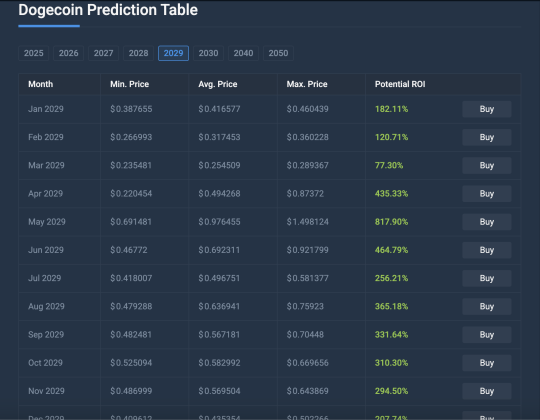
Dogecoin price
Source: CoinCodex

Featured image from Dall.E, chart from TradingView.com

Editorial Process for bitcoinist is centered on delivering thoroughly researched, accurate, and unbiased content. We uphold strict sourcing standards, and each page undergoes diligent review by our team of top technology experts and seasoned editors. This process ensures the integrity, relevance, and value of our content for our readers.

Scott Matherson is a leading crypto writer at Bitcoinist, who possesses a sharp analytical mind and a deep understanding of the digital currency landscape. Scott has earned a reputation for delivering thought-provoking and well-researched articles that resonate with both newcomers and seasoned crypto enthusiasts. Outside of his writing, Scott is passionate about promoting crypto literacy and often works to educate the public on the potential of blockchain.

Похожее

Competitors Going Public, Kimi Can't Sit Still

Competitors Go Public, Kimi Feels the Pressure Yue Zhi An Mian (Moonshot AI), the company behind the AI assistant Kimi, has begun dismantling its VIE and red-chip structure, clearing a key obstacle for a potential Hong Kong IPO. This marks a significant shift from six months ago when founder Yang Zhilin stated the company was in "no hurry" to list. The move comes as rivals like Zhipu AI and MiniMax have successfully listed on the Hong Kong Stock Exchange in early 2026, experiencing massive surges in market value. This has reset valuation logic for AI companies, turning "going public" from an end goal into a competitive necessity. Analysts suggest Kimi is both seizing a favorable market window and responding to competitive pressure. Kimi's valuation has skyrocketed from around $3 billion at its 2023 founding to over $20 billion by May 2026. Capital is betting on its potential as a future AI platform and gateway, though some caution this "emotional valuation" depends on sustained technological leadership and successful commercialization. Traditionally focused on core model R&D over user growth, Kimi has recently pivoted strategy. While its monthly active users declined through 2025, it shifted focus to Agent development and reducing marketing spend. The release of its K2.5 model in early 2026 reportedly generated substantial revenue, with annual recurring revenue reaching $200 million by April, driven by subscriptions and API services. A $2 billion D-round financing in May signaled investor approval of this commercial shift. However, listing will bring new pressures. Experts predict a listed Kimi would face stricter scrutiny on financial controls, compliance, and R&D efficiency. The narrative must evolve from pure technological breakthroughs to demonstrating clear commercialization paths, sustainable income, and a defensible valuation, balancing model superiority with business performance.

marsbit9 мин. назад

Competitors Going Public, Kimi Can't Sit Still

marsbit9 мин. назад

End of the 'Gray Era' for Hong Kong and US Stock Trading Accounts: Where Can Your Money Go Now?

Hong Kong and US stock “grey account opening era” ends, where can your money go? In a coordinated regulatory crackdown starting May 22nd, Hong Kong's SFC and China's securities regulator have targeted the previously common but legally ambiguous practice of mainland Chinese investors opening accounts with Hong Kong brokers to trade Hong Kong and US stocks. The SFC issued a stern circular after a review of 12 brokerages, citing major deficiencies including inadequate due diligence, acceptance of suspicious or forged documents, and weak management of cross-border relationships. New requirements mandate mainland clients to submit a written declaration confirming their investment funds originate from *outside* mainland China, the account has never been closed for using suspicious documents, and agreeing to information disclosure. Brokers must immediately close accounts opened with suspicious documents and dormant accounts. Simultaneously, Chinese authorities launched a two-year campaign to rectify illegal cross-border securities activities. Key internet brokers like Futu, Tiger Brokers, and Longbridge are facing penalties, with existing accounts allowed only to sell/withdraw funds, not add new ones. The impact is immediate. Reports from social media and financial news outlets confirm that individuals traveling to Hong Kong to open accounts are now required to sign the new declaration. However, even after signing, applications are frequently rejected. The declaration shifts compliance responsibility to the client and acts as a filter, as most mainland investors' funds do not legally meet the "from outside China" criterion. Major brokers like Futu and Tiger have stopped accepting new mainland clients. A few, such as uSmart Securities, Fosun Wealth, and Cheerful Investment, still offer limited channels, but approvals have tightened significantly. Crucially, funding must now come exclusively from the investor's own bank account in Hong Kong or a qualified jurisdiction, blocking previous workarounds like using money changers or stablecoins. For mainland investors, compliant pathways still exist but are narrower. Individuals with overseas status (students, work visa holders) and verifiable offshore funds may still qualify. Official channels like Stock Connect, QDII, and the Cross-boundary Wealth Management Connect remain fully compliant options, albeit with product and quota limitations. On-chain alternatives exist but carry their own regulatory uncertainties and often exclude mainland users. The crackdown signals the end of the lax expansion period for Hong Kong brokers targeting mainland clients. While investment opportunities persist, the era of easy, low-compliance access is over. Investors must now carefully assess their eligibility and understand that signing the new declaration carries personal legal liability.

Odaily星球日报56 мин. назад

End of the 'Gray Era' for Hong Kong and US Stock Trading Accounts: Where Can Your Money Go Now?

Odaily星球日报56 мин. назад

SpaceX's $1.75 Trillion IPO: A Quick Guide to 17 Related Stocks

**Title: SpaceX's $1.75 Trillion IPO: Analysis of 17 Related Stocks** SpaceX is set to IPO on Nasdaq with a $1.75 trillion valuation. The real value driver is Starlink, contributing 61% of Q1 revenue with high margins. Its valuation heavily depends on future execution, including user growth despite falling ARPU. Key stocks have already surged pre-IPO. Tesla (TSLA, +10%) is a primary beneficiary due to deep integration with SpaceX in chip design and AI. Rocket Lab (RKLB, +89%) is seen as a "mini-SpaceX," but faces risk from potential Neutron rocket delays. AST SpaceMobile (ASTS) competes in the same satellite-to-phone market as Starlink. Firefly (FLY, +70%) is a strong government contractor in lunar services. Partners like EchoStar (SATS), Planet Labs (PL), and T-Mobile (TMUS) will see revaluation. Suppliers like Qualcomm (QCOM, +57%) are critical ecosystem "picks and shovels." Investment vehicles like DXYZ (+80%) hold significant SpaceX stakes but trade at high premiums, which may collapse post-IPO. Redwire (RDW) is highlighted as an under-the-radar "pick and shovel" play in space components, with growth in defense contracts and microgravity pharmaceuticals. The article warns that much of the positive news is already priced in, and a post-IPO sell-off is possible. Large IPOs often underperform initially. Key risks include Starship delays, ARPU decline, and unforeseen black swan events affecting Elon Musk or space operations. Investors are advised to focus on companies with solid fundamentals and manage overall sector exposure carefully.

marsbit58 мин. назад

SpaceX's $1.75 Trillion IPO: A Quick Guide to 17 Related Stocks

marsbit58 мин. назад

Торговля

Спот
Фьючерсы
活动图片