Dogecoin Price Gears Up For 75% Rally As Long As It Stays Inside This Channel

bitcoinistОпубликовано 2025-02-28Обновлено 2025-02-28

Введение

Crypto analyst Olivier has provided a bullish outlook for the Dogecoin price amid the market downtrend, which has led to...

Crypto analyst Olivier has provided a bullish outlook for the Dogecoin price amid the market downtrend, which has led to a massive decline for DOGE. The analyst predicts that the foremost meme coin could be gearing up for a 75% rally, which could send its price above $0.3. 

Dogecoin Price Gears Up For 75% Rally If It Stays Inside This Channel

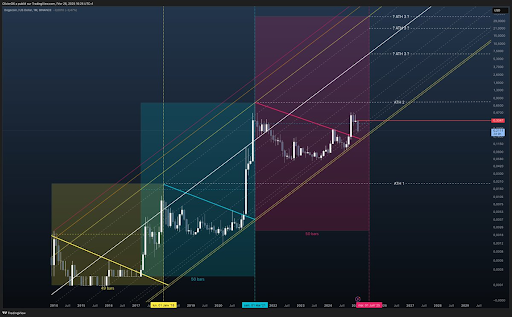
In an X post, crypto analyst Olivier predicted that the Dogecoin price could enjoy a 75% rally as long as it stays within a parallel channel, which he highlighted on his accompanying chart. Alluding to DOGE’s monthly chart, the analyst asserted that the trend for the foremost meme coin is clear as long as it stays inside the channel.

This 75% rally for the Dogecoin price could just be the start, as the analyst assured that the uptrend will resume above $0.3350. His accompanying chart showed that the foremost meme coin could rally to a new all-time high (ATH) and even hit $6 in this market cycle. Based on the chart, DOGE could also reach $30 as it rallies to the upper boundary of this channel. 
Dogecoin
DOGE parallel channel points to a rally | Source: Olivier on X

In the meantime, as the analyst suggests, the Dogecoin price needs to hold above the lower boundary of this boundary. The accompanying chart shows that a break below $0.15 could invalidate this bullish setup for DOGE. Given the current downtrend in the broader crypto market, the foremost meme coin is still at risk of dropping to this price level. 

Crypto analyst David Perk recently predicted that the Dogecoin price could crash further to $0.15. However, the analyst expects DOGE to bounce from that price level, which is still bullish for the meme coin. Staying above $0.15 still puts DOGE within this channel, which could send its price to new ATHs. 

DOGE To $10 Still In Play

Meanwhile, amid the market downtrend, crypto analyst DOGECAPITAL has reaffirmed that the Dogecoin price could still rally to as high as $10 in this market cycle. The analyst highlighted the price action of the previous two cycles to explain why the meme coin could reach this level and even rally above it. 

He indicated that the current price action was mirroring that of the previous two cycles and that the Dogecoin price was about to start the second phase of its parabolic rally. DOGECAPITAL expects DOGE to hold around $0.20 on the weekly timeframe. 

The analyst added that once this consolidatioin is complete, Dogecoin could move towards $1.70. The rally to this level is then expected to pave the way for the third phase of the parabolic move which would send the foremost meme coin to $10 and above. 

At the time of writing, the Dogecoin price is trading at around $0.2, down in the last 24 hours, according to data from CoinMarketCap.

Dogecoin
DOGE trading at $0.21 on the 1D chart | Source: SOLUSDT on Tradingview.com
Featured image from iStock, chart from Tradingview.com
Scott Matherson

Scott Matherson

Scott Matherson is a leading crypto writer at Bitcoinist, who possesses a sharp analytical mind and a deep understanding of the digital currency landscape. Scott has earned a reputation for delivering thought-provoking and well-researched articles that resonate with both newcomers and seasoned crypto enthusiasts. Outside of his writing, Scott is passionate about promoting crypto literacy and often works to educate the public on the potential of blockchain.

Похожее

DeFi Has Reached Its Most Dangerous Moment: The Real Vulnerabilities Are Not in the Code

DeFi in Peril: The Real Vulnerability Isn't in the Code April 2026 marked a paradigm shift in DeFi security, with over $625 million lost across 30 incidents—the worst month in crypto history by event count. Crucially, none of the major exploits (Drift Protocol: $285M, KelpDAO: $292M, Wasabi Protocol: $4.5M) resulted from smart contract vulnerabilities. Instead, failures occurred in the operational "plumbing": social engineering to compromise multi-signature councils, a single-point-of-failure 1-of-1 bridge validator, and stolen admin private keys. These events expose a fundamental misalignment: the industry's security model has long focused on code audits, while the actual attack surface has shifted to privileged access points and off-chain infrastructure. The article introduces the term "OpenFi" to describe this reality: permissionless, on-chain, yet operationally dependent on trusted third parties (admins, validators, oracles) at key junctures. The KelpDAO exploit vividly demonstrated asymmetric "contagion risk." A configuration error in a smaller protocol triggered a panic, causing approximately $13.2 billion in outflows from larger, unaffected protocols like Aave within 48 hours, as users fled uncertain collateral. The core dilemma is the double-edged sword of centralization. Operational levers like emergency councils (e.g., Arbitrum freezing stolen funds post-KelpDAO) enable crisis response but also create catastrophic attack surfaces if compromised (e.g., Drift). The path forward demands radical honesty: protocols must clearly disclose their trust assumptions, operational levers, and failure modes. The industry must treat operational security (key management, configurations, incident response) with the same rigor as code security. Survival depends on building systems whose risks can be understood, priced, and insured, moving beyond the outdated "code is law" mantra to a mature model of disclosed and managed trust.

链捕手5 ч. назад

DeFi Has Reached Its Most Dangerous Moment: The Real Vulnerabilities Are Not in the Code

链捕手5 ч. назад

Vitalik's Article Emphasizes Ethereum Must Be 'Amazing', But Foundation Is Not the Center

Vitalik Buterin has published a lengthy response to recent community criticism directed at the Ethereum Foundation (EF). Acknowledging a sense of "unease," he addresses concerns about the EF's strategic direction, its perceived disconnect from ETH's price performance, and calls for its reduced central role. Vitalik rejects the notion that the EF should be the central governing body of Ethereum, framing it instead as one "node with a clear mandate" among many within the ecosystem. He highlights the EF's limited ETH holdings (≈0.16% of supply) compared to other blockchain foundations and states it will no longer sell significant amounts of ETH. Its future focus will be on long-term, critical projects that align with Ethereum's core values of censorship-resistance and decentralization, which might not otherwise happen. A core argument is that Ethereum must be "amazing," but not by merely chasing higher transaction speeds at the cost of decentralization. He proposes focusing on the "CROPS" dimensions: creating a Cryptographically provable, Reliable, Open, Private, and Secure network. This includes pursuing goals like a formally verifiable, bug-free Ethereum client and minimizing protocol-level reliance on intermediaries. The article concludes by noting that while Vitalik clarifies the EF's refocused role, he does not directly address community suggestions for creating a new organization explicitly aligned with ETH's economic interests. This "alignment gap" is presented as a key challenge for Ethereum's future.

链捕手5 ч. назад

Vitalik's Article Emphasizes Ethereum Must Be 'Amazing', But Foundation Is Not the Center

链捕手5 ч. назад

Galxe: How a Quest Platform Evolved into Web3's Growth Infrastructure

Galxe, once perceived as a simple Web3 quest platform, has evolved into a core growth infrastructure within the Web3 ecosystem. It addresses a fundamental Web3 growth dilemma: the lack of a mature, systematic user acquisition and retention system akin to Web2's advertising and analytics platforms. While users complete quests (social tasks, on-chain interactions) for rewards, Galxe's true innovation lies in transforming these fragmented, one-off actions into lasting, verifiable identity credentials. This process of *behavioral assetization* creates a persistent record of a user's activities across projects and chains. For users, their wallet accumulates a valuable history that can unlock future access and rewards, fostering a "profile-building" mentality. For projects, Galxe provides a pre-screened user pool with rich behavioral data, enabling targeted outreach to users based on their specific on-chain history and community engagement. Galxe employs a gamefied growth path, guiding users from low-friction social tasks into deeper, valuable on-chain interactions through a structured progression of quests. This solves the incentive-behavior mismatch common in Web3, filtering users by their willingness to engage. Beyond quests, products like Passport (identity verification) and Starboard (community analytics) position Galxe as a comprehensive growth operating system. The platform's defensible advantage is its self-reinforcing data and network flywheel: more projects attract more users, enriching behavioral data; richer data enables better user targeting, attracting more projects. Ultimately, Galxe is shifting Web3's growth logic from short-term "reward-driven" traffic towards a long-term "identity-driven" relationship model, where a user's accumulated on-chain履历 becomes a core asset.

marsbit5 ч. назад

Galxe: How a Quest Platform Evolved into Web3's Growth Infrastructure

marsbit5 ч. назад

Торговля

Спот
Фьючерсы
活动图片