Futures are to Crypto What the iPhone is to Apple

bitcoinistОпубликовано 2025-02-24Обновлено 2025-02-24

Введение

Crypto exchanges are evolving into super apps while also prioritizing specialized products for broader adoption, particularly in futures trading. “Futures...

Crypto exchanges are evolving into super apps while also prioritizing specialized products for broader adoption, particularly in futures trading.

“Futures trading plays a role in crypto, similar to the iPhone for Apple,” said Vivien Lin, Chief Product Officer at BingX. “These flagship products drive both popularity, innovation and user adoption,” Lin says, perfectly summarizing the transformative role of futures trading in the crypto industry.

Futures trading for crypto, similar to how the iPhone transformed mobile technology, makes digital assets more accessible and attractive to both retail and institutional investors. Enabling interaction without direct ownership drives market maturity and financial innovation.

Market data reinforces this shift. The total futures trading volume in 2024 reached $58.5 trillion, a record milestone for the crypto derivatives sector.

2024 Annual Crypto Industry Report. Source: CoinGecko

However, alongside growth, key challenges surface. Price slippage in high volatility poses a major risk. Futures contracts remain complex, intimidating newcomers. Additionally, weak risk management leaves traders vulnerable to liquidation, while opaque pricing creates an unfair trading environment.

Enter BingX, a top-five global crypto derivatives platform that tackles key challenges in futures trading by utilizing blockchain infrastructure to enhance fairness, transparency and efficiency. By addressing market pain points, the platform enables both new and experienced traders to engage with confidence.

Leading in Futures Trading Innovation

BingX’s futures trading platform emphasizes accessibility, innovation and automation, equipping traders with a diverse set of effective tools. Its perpetual and standard futures enable users to manage positions with flexibility, catering to both long-term investors and short-term traders.

To simplify trading for beginners, BingX offers copy trading, enabling users to replicate strategies from experienced traders. Meanwhile, its automated bot trading system helps users execute strategies efficiently without constant monitoring.
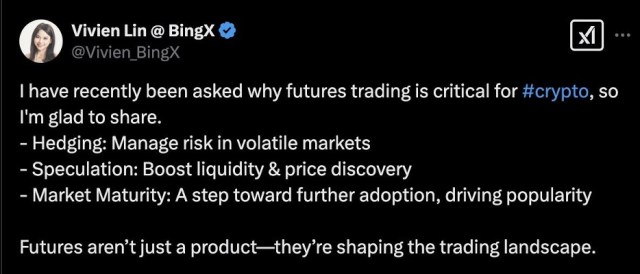
Source: Vivien Lin, Chief Product Officer at BingX

One of the most critical issues in futures trading is price slippage, which can significantly impact trade execution during volatile market conditions. BingX addresses this with its Guaranteed Price Feature, allowing traders to execute orders at pre-set prices regardless of market fluctuations. To further ensure fairness, BingX employs a Dual Price Mechanism, which protects traders from unfair liquidations due to sudden price swings.

Perpetual futures contracts can be intimidating, but BingX simplifies the experience by offering a user-friendly trading interface that caters to traders of all levels. From standard and perpetual futures to advanced tools such as grid trading and dollar-cost averaging (DCA), the platform enables users to trade efficiently, whether they are entering the market for the first time or executing sophisticated strategies.

Market Position and Global Recognition

BingX’s success in the futures market extends beyond trading volume. According to prominent aggregators like CoinGecko and Coinglass, its strategic brand evolution and commitment to innovation have earned it recognition as a top-five global crypto derivatives platform in 2024. The ranking highlights BingX’s ability to anticipate market shifts and continuously enhance its product offerings to meet evolving trader needs.

According to CoinGecko, BingX’s futures trading platform reports an average daily trading volume of over $5 billion, with open interest reaching around $2 billion. The most actively traded pair, BTC/USDT, contributes nearly $1.5 billion to the daily volume, reflecting its dominant role in the platform’s liquidity.

Source: CoinGecko

Further reinforcing its industry standing, Coinglass ranks BingX among the top global crypto derivatives exchanges, acknowledging its sustained market impact.

The Future of Crypto Futures Trading

Chief Product Officer Vivien Lin emphasizes that BingX’s long-term success is built on more than just trading volume. The company prioritizes continuous product innovation, staying ahead of market trends, and evolving to meet the needs of modern traders.

According to Lin, BingX will expand these efforts even further in 2025, reinforcing its position as a leading platform in the derivatives space. By making complex financial tools more accessible, the company is advancing its vision of a more inclusive trading environment.

As the crypto industry matures, futures trading will become increasingly central to its evolution. However, for sustained growth, the market needs secure, transparent, and accessible trading solutions. BingX is not just competing in the futures market — it is actively shaping the future of the crypto derivatives industry.

If the iPhone revolutionized people’s interaction with technology, crypto futures might be the driving force propelling digital assets into mainstream financial markets. With its commitment to innovation and user-centric solutions, BingX is emerging as one of the most influential players in this transformation.

Image by Pete Linforth from Pixabay

Bitcoinist

Bitcoinist

Bitcoinist is the ultimate news and review site for the crypto currency community!

Похожее

DeFi Has Reached Its Most Dangerous Moment: The Real Vulnerabilities Are Not in the Code

DeFi in Peril: The Real Vulnerability Isn't in the Code April 2026 marked a paradigm shift in DeFi security, with over $625 million lost across 30 incidents—the worst month in crypto history by event count. Crucially, none of the major exploits (Drift Protocol: $285M, KelpDAO: $292M, Wasabi Protocol: $4.5M) resulted from smart contract vulnerabilities. Instead, failures occurred in the operational "plumbing": social engineering to compromise multi-signature councils, a single-point-of-failure 1-of-1 bridge validator, and stolen admin private keys. These events expose a fundamental misalignment: the industry's security model has long focused on code audits, while the actual attack surface has shifted to privileged access points and off-chain infrastructure. The article introduces the term "OpenFi" to describe this reality: permissionless, on-chain, yet operationally dependent on trusted third parties (admins, validators, oracles) at key junctures. The KelpDAO exploit vividly demonstrated asymmetric "contagion risk." A configuration error in a smaller protocol triggered a panic, causing approximately $13.2 billion in outflows from larger, unaffected protocols like Aave within 48 hours, as users fled uncertain collateral. The core dilemma is the double-edged sword of centralization. Operational levers like emergency councils (e.g., Arbitrum freezing stolen funds post-KelpDAO) enable crisis response but also create catastrophic attack surfaces if compromised (e.g., Drift). The path forward demands radical honesty: protocols must clearly disclose their trust assumptions, operational levers, and failure modes. The industry must treat operational security (key management, configurations, incident response) with the same rigor as code security. Survival depends on building systems whose risks can be understood, priced, and insured, moving beyond the outdated "code is law" mantra to a mature model of disclosed and managed trust.

链捕手3 ч. назад

DeFi Has Reached Its Most Dangerous Moment: The Real Vulnerabilities Are Not in the Code

链捕手3 ч. назад

Vitalik's Article Emphasizes Ethereum Must Be 'Amazing', But Foundation Is Not the Center

Vitalik Buterin has published a lengthy response to recent community criticism directed at the Ethereum Foundation (EF). Acknowledging a sense of "unease," he addresses concerns about the EF's strategic direction, its perceived disconnect from ETH's price performance, and calls for its reduced central role. Vitalik rejects the notion that the EF should be the central governing body of Ethereum, framing it instead as one "node with a clear mandate" among many within the ecosystem. He highlights the EF's limited ETH holdings (≈0.16% of supply) compared to other blockchain foundations and states it will no longer sell significant amounts of ETH. Its future focus will be on long-term, critical projects that align with Ethereum's core values of censorship-resistance and decentralization, which might not otherwise happen. A core argument is that Ethereum must be "amazing," but not by merely chasing higher transaction speeds at the cost of decentralization. He proposes focusing on the "CROPS" dimensions: creating a Cryptographically provable, Reliable, Open, Private, and Secure network. This includes pursuing goals like a formally verifiable, bug-free Ethereum client and minimizing protocol-level reliance on intermediaries. The article concludes by noting that while Vitalik clarifies the EF's refocused role, he does not directly address community suggestions for creating a new organization explicitly aligned with ETH's economic interests. This "alignment gap" is presented as a key challenge for Ethereum's future.

链捕手3 ч. назад

Vitalik's Article Emphasizes Ethereum Must Be 'Amazing', But Foundation Is Not the Center

链捕手3 ч. назад

Galxe: How a Quest Platform Evolved into Web3's Growth Infrastructure

Galxe, once perceived as a simple Web3 quest platform, has evolved into a core growth infrastructure within the Web3 ecosystem. It addresses a fundamental Web3 growth dilemma: the lack of a mature, systematic user acquisition and retention system akin to Web2's advertising and analytics platforms. While users complete quests (social tasks, on-chain interactions) for rewards, Galxe's true innovation lies in transforming these fragmented, one-off actions into lasting, verifiable identity credentials. This process of *behavioral assetization* creates a persistent record of a user's activities across projects and chains. For users, their wallet accumulates a valuable history that can unlock future access and rewards, fostering a "profile-building" mentality. For projects, Galxe provides a pre-screened user pool with rich behavioral data, enabling targeted outreach to users based on their specific on-chain history and community engagement. Galxe employs a gamefied growth path, guiding users from low-friction social tasks into deeper, valuable on-chain interactions through a structured progression of quests. This solves the incentive-behavior mismatch common in Web3, filtering users by their willingness to engage. Beyond quests, products like Passport (identity verification) and Starboard (community analytics) position Galxe as a comprehensive growth operating system. The platform's defensible advantage is its self-reinforcing data and network flywheel: more projects attract more users, enriching behavioral data; richer data enables better user targeting, attracting more projects. Ultimately, Galxe is shifting Web3's growth logic from short-term "reward-driven" traffic towards a long-term "identity-driven" relationship model, where a user's accumulated on-chain履历 becomes a core asset.

marsbit3 ч. назад

Galxe: How a Quest Platform Evolved into Web3's Growth Infrastructure

marsbit3 ч. назад

Торговля

Спот
Фьючерсы
活动图片