Machine Learning Algorithm Predicts Double-Digit Crash For Dogecoin Price In January 2025

bitcoinistОпубликовано 2024-12-28Обновлено 2024-12-28

Введение

Coincodex’s machine learning (ML) algorithm has provided a bearish outlook for the Dogecoin price. The ML algorithm predicted that the...

Coincodex’s machine learning (ML) algorithm has provided a bearish outlook for the Dogecoin price. The ML algorithm predicted that the meme coin would suffer a double-digit crash in January 2025. 

Dogecoin Price To Suffer A Double-Digit Crash? 

Coincodex predicted that the Dogecoin price would suffer a 10.62% crash by January 27, 2025. This projected price crash will cause Dogecoin to drop to $0.28 from its current price level. This price prediction is based on technical indicators showing that the current sentiment towards the foremost meme coin is bearish. 

The Fear and Greed Index for the Dogecoin price is showing 74, which indicates greed. Coincodex noted that Dogecoin has recorded 14/30 (47%) green days with 11.78% price volatility over the last 30 days. Based on this DOGE price forecast, the ML algorithm stated that now is a bad time to buy the meme coin. 

Coincodex’s Dogecoin price prediction for February 2025 is also bearish, as the ML algorithm predicts that the foremost meme coin will continue to range around $0.28 that month. However, things could change in March as the algorithm predicts that Dogecoin could finally rally above the much-anticipated psychological $1 level.

Specifically, Coincodex predicted that the Dogecoin price could rally to as high as $1.3 in March 2025. While this is bullish for Dogecoin, further predictions suggested that the $1.3 price level would mark the top for the foremost meme coin in this market cycle. 

DOGE is currently trading at $0.31. Chart: TradingView

This is contrary to predictions made by several analysts, such as Trader Tardigrade, who predicted that the meme coin could rally to double digits in this market cycle. Trader Tardigrade predicted that the Dogecoin price could reach as high as $30 by March 2025 if it replicates the 2021 bull run. 

Rally To $11 On The Cards 

In an X post, crypto analyst Dima James predicted that the Dogecoin price would rally to $11 in 2025. This came as he analyzed Dogecoin’s monthly chart with a focus on the meme coin’s fourth year in each cycle. The analyst noted that in the first cycle, DOGE’s year four started at $0.00023 and ended at $0.000851, representing a 37 times price increase. 
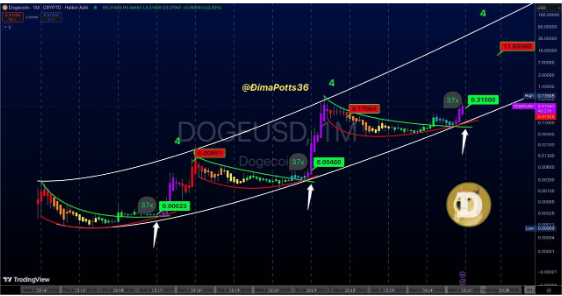
Something similar happened in year four of the second cycle as the Dogecoin price started at $0.00460 and ended at $0.17064, representing a 37 times price increase. In line with this, Dima James predicted that Dogecoin will end 2025, this cycle’s year four, at around $11.65 if 2024 closes at around $0.315 and history repeats itself with the 37x price rally. 

At the time of writing, the Dogecoin price is trading at around $0.31, down in the last 24 hours, according to data from CoinMarketCap. 

Featured image from Pixabay, chart from TradingView

Scott Matherson

Scott Matherson

Scott Matherson is a leading crypto writer at Bitcoinist, who possesses a sharp analytical mind and a deep understanding of the digital currency landscape. Scott has earned a reputation for delivering thought-provoking and well-researched articles that resonate with both newcomers and seasoned crypto enthusiasts. Outside of his writing, Scott is passionate about promoting crypto literacy and often works to educate the public on the potential of blockchain.

Похожее

Why Did Zhipu Surge Nearly 30% in a Single Day?

"Global AI Model Unicorn" Zhipu's stock surged nearly 30% in a single day, reaching a new market cap high. The catalyst was the launch of its GLM-5.1-highspeed API, boasting a generation speed of **400 tokens per second**, setting a new global benchmark. This speed, roughly 3-5 times faster than industry leaders like OpenAI's GPT-4o and Anthropic's Claude, is achieved **without compromising the full-scale model's capabilities**. In the era of AI Agents requiring dozens of self-calls, such latency reduction is critical, transforming speed from a system metric into a determinant of intelligence limits. The breakthrough stems from a three-layer technical overhaul: 1. **TileRT Inference Engine**: Compiles the entire model into a continuous, always-on computation pipeline using "Warp Specialization," minimizing GPU idle time by having different processor groups handle data loading, computation, and communication in parallel. 2. **Heterogeneous Parallelism for MLA**: To efficiently run the GLM-5.1 model using the MLA attention mechanism, TileRT employs a heterogeneous strategy. One GPU handles sparse indexing/routing, while the others perform dense computation, optimizing for MLA's unique workflow. 3. **ZCube Network Architecture**: Replaces the standard Spine-Leaf (ROFT) network topology with a flat, dual-group interconnect. This design creates a single optimal path between any two GPUs, eliminating network congestion at scale and reducing latency. The business impact is significant: a 15% increase in cluster throughput (free extra capacity), a 40.6% reduction in tail latency (improved stability), and a one-third cut in networking hardware costs. Long-term, this innovation challenges the dominance of NVIDIA's integrated hardware-software stack (GPU+NVLink+InfiniBand), potentially benefiting manufacturers of high-density Leaf switches and optical modules while lowering the software barrier for domestic AI chips like Huawei's Ascend. The innovation proves that more can be achieved with the same compute, reshaping the infrastructure beyond just GPUs.

marsbit27 мин. назад

Why Did Zhipu Surge Nearly 30% in a Single Day?

marsbit27 мин. назад

The Powell Era Concludes: Warsh Takes Over the Fed, What It Means for Global Finance and the Crypto Market?

The podcast discusses the implications of Jerome Powell's departure and Kevin Warsh's appointment as Federal Reserve Chair for global markets and crypto. It highlights a significant divergence between bond markets, which price in global tightening and persistent inflation, and equity markets, driven by AI hype—a disparity reminiscent of the dot-com bubble. The analysis introduces the "Bliss Trade" concept, a structural expectation of government stimulus during crises, which underpins risk asset valuations and currency debasement trades. Inflation is seen as sticky, driven by deglobalization and further complicated by geopolitical tensions, unlikely to fall quickly even if immediate crises subside. Powell's tenure is critiqued for misjudging inflation and overseeing the de-banking of crypto firms, despite defending Fed independence. Regarding crypto, Bitcoin is viewed as a macro asset and a hedge against currency debasement, but its current muted performance stems from competition with higher-beta assets like AI stocks. The potential Clarity Act is seen as more beneficial for Ethereum than Bitcoin, with concerns about tokenization innovation leading to pure speculation. A key warning signal is the widening gap between the market-cap-weighted and equal-weighted S&P 500 indices, suggesting underlying market fragility.

marsbit45 мин. назад

The Powell Era Concludes: Warsh Takes Over the Fed, What It Means for Global Finance and the Crypto Market?

marsbit45 мин. назад

Bidding Farewell to the 'Gray Gambling Game'! Polymarket Charges into the Compliance Track—How Will This Impact the Entire Crypto Industry?

From Gray to Regulated: How Polymarket’s Compliance Journey Reshapes Crypto The evolution of Polymarket, a decentralized prediction market platform, illustrates a critical trend in crypto: innovative, high-value sectors ultimately integrate into regulatory frameworks. Founded in 2020, Polymarket quickly gained traction by leveraging low-cost Layer 2 blockchain technology for event-based trading, notably during the 2024 US presidential election where its markets outperformed traditional polls. However, its "build first, comply later" approach led to a 2022 CFTC enforcement action, resulting in a $1.4 million fine and a ban from the US market. A pivotal shift occurred in 2025 under a new US administration. Polymarket strategically acquired CFTC-licensed derivatives exchange QCX for $112 million, securing a regulated pathway back into the US. This move coincided with a regulatory reversal, as the CFTC withdrew a prior proposal to ban political event contracts. The platform’s successful "regulatory acquisition" strategy, avoiding a lengthy independent licensing process, highlights a viable compliance path for crypto-native projects. Its journey from regulatory target to a CFTC-recognized entity—bolstered by a major data partnership and investment from Intercontinental Exchange (ICE)—signals the maturation of prediction markets from a "crypto novelty" into acknowledged financial infrastructure. The story underscores that genuine utility provides negotiating power with regulators and that embracing compliance does not necessarily mean sacrificing core technological advantages.

marsbit45 мин. назад

Bidding Farewell to the 'Gray Gambling Game'! Polymarket Charges into the Compliance Track—How Will This Impact the Entire Crypto Industry?

marsbit45 мин. назад

Торговля

Спот
Фьючерсы
活动图片