Dogecoin Price To $10: Similar Patterns That Led To Previous Parabolic Breakout Have Reappeared

bitcoinistОпубликовано 2024-10-18Обновлено 2024-10-18

Введение

The Dogecoin price is once again gearing up for a significant move to the upside. In a recent price analysis...

The Dogecoin price is once again gearing up for a significant move to the upside. In a recent price analysis of current price movement and previous price action, an analyst suggested Dogecoin is on track to repeat another parabolic run, potentially sending its price skyrocketing to $10.

Dogecoin Price Exhibiting Parabolic Pattern

Recent Dogecoin price movements have put the meme coin back in the spotlight, with a noticeable breakout over the past few days. The meme coin’s price increased to hit $0.129, its highest price point so far in October. This rally has allowed Dogecoin to outpace many other large market cap cryptocurrencies in both daily and weekly performance.

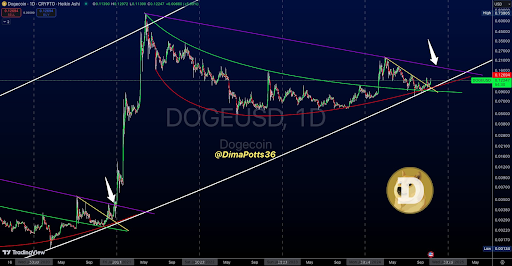
According to a price analysis posted on social media platform X, Dima James Potts noted that this recent breakout resembles the initial stages of Dogecoin’s parabolic breakout move in 2021. 

The daily candlestick timeframe chart shows the Dogecoin price broke above the upper trendline (yellow line) of a falling wedge in September. After briefly retesting this level during the first two weeks of October, it has since begun another upward climb. As Dima James Potts pointed out, this back-and-forth movement is similar to Dogecoin’s price action in January 2021 before it went on a parabolic run throughout the rest of the year until it peaked at its current all-time high of $0.7316.

Back then, the Dogecoin price broke above the upper trendline of a similar falling wedge on the daily candlestick timeframe chart, retested it, and then continued pushing up. If history were to repeat itself, this would lead to monumental gains for the Dogecoin price in the coming months.
Dogecoin
Source: X

What’s Next For Doge? A Move To $10?

The last time Dogecoin went on such a parabolic rally, it skyrocketed by over 16,000%. According to the analyst, Dogecoin is ready to repeat such a move, but it needs to close above $0.18 first. This $0.18 target represents a purple descending trendline drawn from Dogecoin’s all-time high, which has largely acted as resistance for the past few years.

Once the Dogecoin bulls are able to break above this trendline with a weekly close above $0.18, this would set the stage for massive upward moves, just like in the last cycle. This, in turn, would see Dogecoin breaking above its all-time high into new price territories. 

The analyst also speculates that Dogecoin could soar as high as $10 in this upcoming cycle, which would represent a monumental 8,110% increase from its current price. However, reaching such a lofty target would require a huge influx of capital from retail and institutional investors, far greater than the volume seen during the 2021 rally.

At the time of writing, the Dogecoin price is trading at $0.1228.

Dogecoin price chart from Tradingview.com
DOGE price still holding $0.12 | Source: DOGEUSDT on Tradingview.com
Featured image created with Dall.E, chart from Tradingview.com
Scott Matherson

Scott Matherson

Scott Matherson is a leading crypto writer at Bitcoinist, who possesses a sharp analytical mind and a deep understanding of the digital currency landscape. Scott has earned a reputation for delivering thought-provoking and well-researched articles that resonate with both newcomers and seasoned crypto enthusiasts. Outside of his writing, Scott is passionate about promoting crypto literacy and often works to educate the public on the potential of blockchain.

Похожее

Dumping US Bonds, Buying Japanese Bonds: Wall Street Prepares for 'Capital Repatriation to Japan'

Wall Street is bracing for a potential "great repatriation" of Japanese capital as yields on Japanese Government Bonds (JGBs) soar to multi-decade highs. The 10-year JGB yield recently hit 2.73%, its highest since 1997, while the 30-year yield broke 4% for the first time. This dramatic shift is causing global asset managers to reassess a long-ignored risk: that Japanese investors, who hold roughly $1 trillion in U.S. Treasury debt, could start bringing that money home. For decades, Japan's ultra-low interest rates pushed domestic insurers, pension funds, and banks to seek yield overseas, primarily in U.S. Treasuries. Now, with the Bank of Japan hiking rates and JGB yields climbing, the incentive is reversing. Firms like BlueBay Asset Management are preparing for this shift, believing new Japanese investments will be directed domestically rather than to foreign bonds. Early signs of repatriation are emerging, with record monthly inflows into Japanese sovereign bond funds in March. Some managers, like Ruffer's Matt Smith, hold yen as a hedge, anticipating that market stress could trigger a rapid acceleration of capital returning to Japan. However, analysts caution that a mass exodus hasn't begun yet. Japanese investors were still net buyers of foreign bonds over the past year. Uncertainty remains high as Japan's government fiscal plans could push JGB yields even higher, making investors hesitant to buy immediately. Furthermore, the Bank of Japan's withdrawal as a dominant bond buyer has increased market volatility. Nevertheless, the potential scale of Japanese selling poses a tangible risk to the U.S. Treasury market. As the largest foreign holder of U.S. debt, any sustained shift by Japanese institutions could materially impact supply and demand dynamics, pushing U.S. yields higher. Wall Street's current positioning is a forward-looking bet on this logic becoming increasingly compelling as Japanese yields continue to rise.

marsbit10 мин. назад

Dumping US Bonds, Buying Japanese Bonds: Wall Street Prepares for 'Capital Repatriation to Japan'

marsbit10 мин. назад

How Did Institutions Adjust Their Crypto Asset Holdings in Q1? Who Increased and Who Exited?

The Q1 2026 13F filings reveal a sharply divided picture of institutional activity in crypto assets. Sovereign wealth funds and bank capital increased exposure, while major endowment funds notably de-risked. The most significant buying came from the Abu Dhabi sovereign wealth fund Mubadala, which expanded its position in the iShares Bitcoin Trust (IBIT). JPMorgan Chase dramatically increased its IBIT exposure by 174%, with other global banks like RBC, Scotiabank, and Barclays also adding to Bitcoin ETF holdings, while using options for asymmetric protection. Conversely, the Harvard Management Company (Harvard University's endowment), once a major academic holder, cut its IBIT position by 43% and fully exited a BlackRock Ethereum ETF. The reallocated capital flowed into traditional assets like TSMC, Microsoft, and gold. Other Ivy League endowments showed varied strategies: Brown and Dartmouth maintained Bitcoin positions, with Dartmouth making a nuanced shift by moving Ethereum exposure to a staking ETF and adding a Solana staking ETF to capture yield. Hedge fund Jane Street significantly reduced Bitcoin ETF holdings, locking in profits, while Wells Fargo increased its Ethereum stake. Overall, institutions are deploying traditional capital market tactics—buying, selling, hedging, and rotating—within crypto via spot ETFs. The Q2 reports will be crucial to determine if Harvard's retreat is an outlier or the start of a broader trend among endowments.

marsbit41 мин. назад

How Did Institutions Adjust Their Crypto Asset Holdings in Q1? Who Increased and Who Exited?

marsbit41 мин. назад

Blockchain Capital Partner: Most People Have a Narrow Understanding of the On-Chain Economy

Author Spencer Bogart, a partner at Blockchain Capital, argues that most people have a narrow view of the on-chain economy, seeing it primarily as a faster, cheaper version of existing financial systems. While this represents a significant opportunity, he believes it's only a small part of the story. Bogart compares the current state of crypto to the early internet, where email was the obvious "faster mail" application. The truly transformative categories—like search, social media, and cloud computing—were entirely new and unimaginable beforehand. Similarly, the most profound innovations in crypto will not be incremental improvements but entirely new categories enabled by the core properties of public blockchains: atomic execution, shared global state, programmable custody, and composability. He cites the "flash loan" as a prime example of a "new verb"—a financial action structurally impossible before programmable assets and atomic settlement. It allows for uncollateralized, trustless borrowing of any size, provided repayment occurs within the same transaction, enabling novel strategies like arbitrage and collateral swaps. Bogart admits the difficulty in precisely predicting these future innovations, as human imagination tends to extrapolate from the past. He posits that the most exciting applications in ten years will be things that don't exist today and have no precedent—products only possible in a global, composable, always-on environment with programmable assets. While the exploration of this vast design space will involve many failures, the potential for transformative, category-defining breakthroughs is what makes the next decade so promising.

链捕手1 ч. назад

Blockchain Capital Partner: Most People Have a Narrow Understanding of the On-Chain Economy

链捕手1 ч. назад

Cloud PC Gets a Second Chance, Google/Alibaba/Microsoft Battle for Cloud AI Dominance

Google unexpectedly announced "Android Computer," a new high-end productivity-focused PC series, positioning cloud AI as its core rather than an add-on. This move signals a potential revival for the "cloud computer" concept in the AI era. The article argues that current "AI PCs" are essentially traditional Windows machines with AI features grafted on, heavily reliant on cloud AI for complex tasks due to limited local consumer-grade hardware capabilities. This reliance raises questions about the value of premium local AI hardware. Cloud computers, which struggled with latency-sensitive applications like cloud gaming, are seen as a natural fit for AI PCs due to AI's higher tolerance for response time. Google's Android Computer deeply integrates AI (powered by its Gemini model) into the OS interface, making it contextually available. Its hardware-agnostic approach (supporting both x86 and ARM chips) further underscores the shift towards cloud-centric AI. Other players are adapting: Cloud service providers like Alibaba are enhancing their AI cloud computer offerings; chipmakers (Intel, AMD) are focusing on data center AI chips; traditional PC brands are adding AI software layers; and Apple is leveraging its ecosystem and affordable hardware. Microsoft is defining AI PC standards, embedding Copilot (powered by GPT and Bing) into Windows, and also relying on cloud AI. In conclusion, Android Computer challenges the traditional PC form factor by proposing a "light local, heavy cloud" model. This approach appears promising amid rising hardware costs and local compute bottlenecks. The future PC market will involve a multifaceted competition around cloud integration, OS-level AI, and cross-device ecosystems, potentially redefining the PC as a screen and network conduit to cloud-based AI productivity.

marsbit1 ч. назад

Cloud PC Gets a Second Chance, Google/Alibaba/Microsoft Battle for Cloud AI Dominance

marsbit1 ч. назад

Торговля

Спот
Фьючерсы
活动图片