哈里斯在大选民调中与特朗普势均力敌

链捕手Опубликовано 2024-07-31Обновлено 2024-07-31

作者:约翰•伯恩-默多克,奥利弗•罗德

来源:FT中文网


美国副总统卡玛拉•哈里斯(左)和唐纳德•特朗普。自乔•拜登总统退出大选以来,哈里斯在几乎所有人口群体中都取得了进展

根据英国《金融时报》对最新数据的分析,美国副总统卡玛拉•哈里斯(Kamala Harris)在开始总统竞选不到一周的时间里,在民调中就追平了前总统唐纳德•特朗普(Donald Trump)。

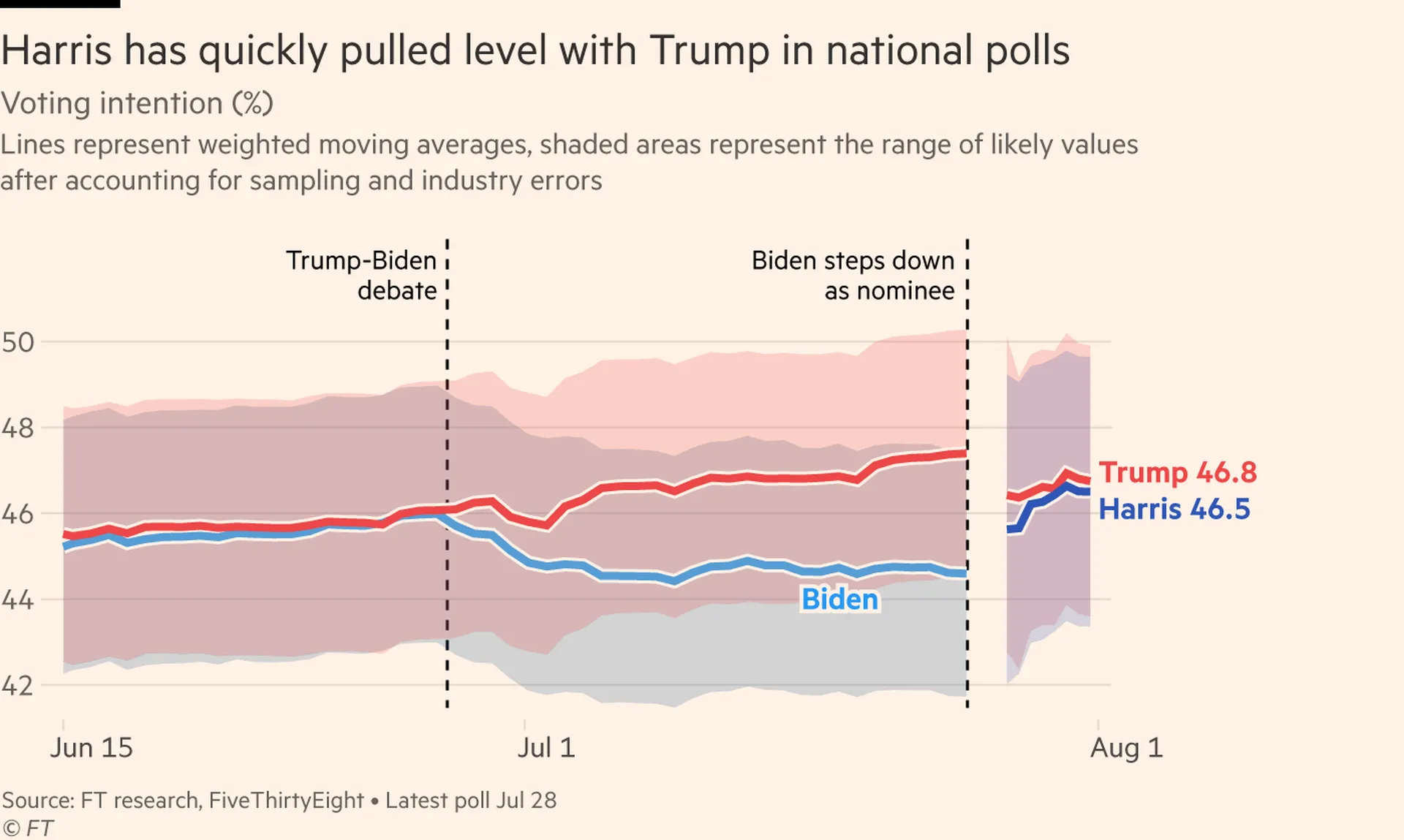
乔•拜登(Joe Biden)总统在几周前与特朗普的辩论中表现糟糕,于7月21日退出竞选,并立即表示支持哈里斯。根据英国《金融时报》对民调结果的平均统计,自那以来,她几乎抹平了民主党在全国民调中相对于竞争对手的劣势。

虽然拜登在退出总统竞选当天落后特朗普3个百分点,但哈里斯和这位前总统目前在全国的支持率不分上下。
美国大选最终由选举人团决定,因此也可以说是由一小部分赢者通吃的“战场”州决定的,包括亚利桑那州、佐治亚州、密歇根州、内华达州、宾夕法尼亚州和威斯康星州。

在所有六个关键战场上,哈里斯最近的民调都比拜登一周多前退出竞选前高出1到3个百分点。拜登退出竞选时,在这六个州都落后两个百分点或更多,而哈里斯现在在密歇根州和威斯康星州与特朗普50比50,在内华达州、宾夕法尼亚州和亚利桑那州与特朗普的差距在一个百分点以内。从统计数据来看,所有州都处于僵持状态。

根据众多民调机构的同类比较,自拜登退选以来,哈里斯在几乎所有人口群体中都取得了进展。特别是,她在黑人、拉丁裔、年轻选民和女性选民以及无党派人士中的支持率有所上升。只有一个群体——50岁以上的选民——的支持率略有下降。

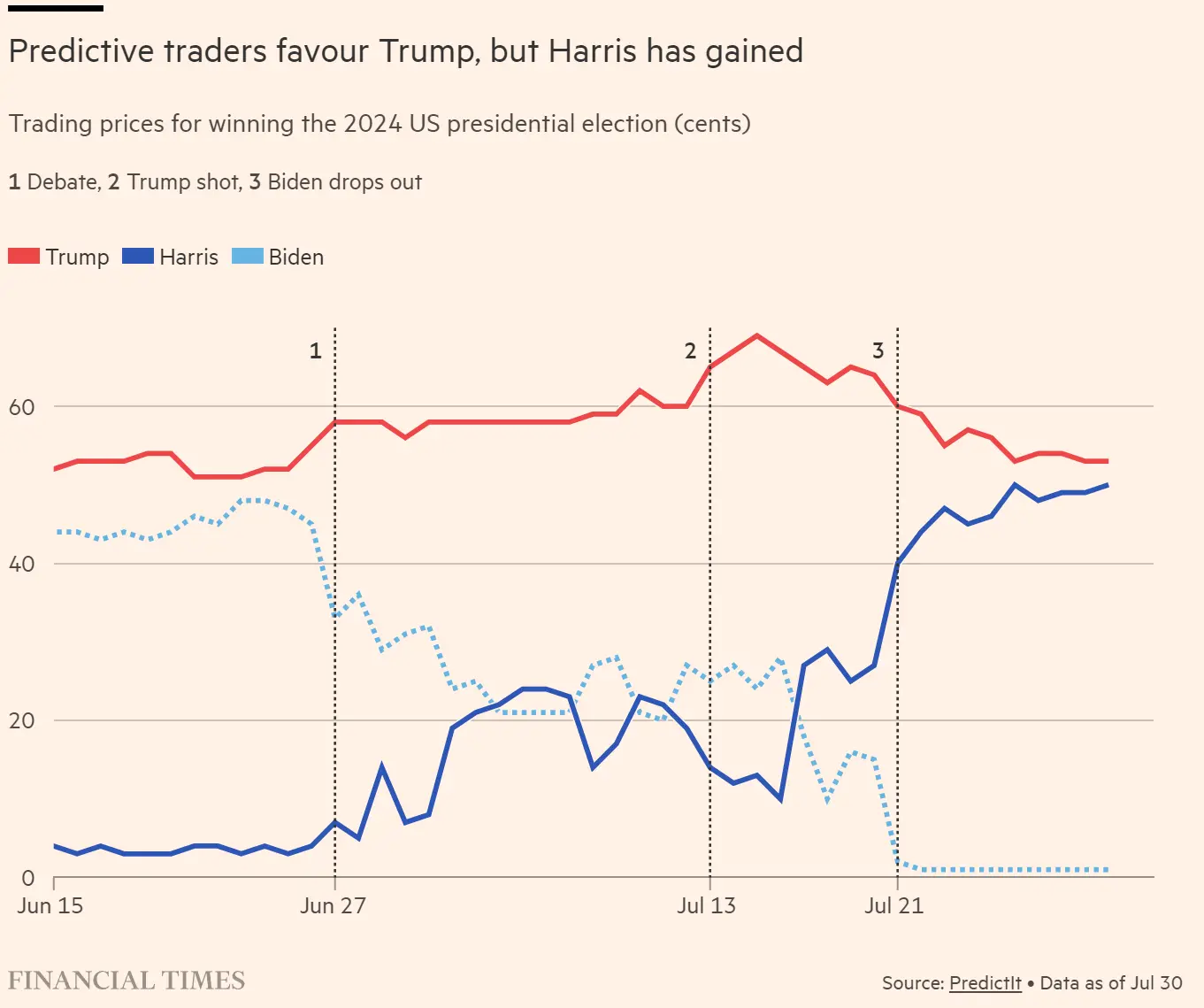
密切跟踪这场竞争的预测交易员注意到了这些变化。哈里斯在Polymarket和PredictIt这两个预测市场上的价格已经超过了拜登辩论前的价格,尽管它们仍然认为她比特朗普略逊一筹,特朗普的价格在7月13日暗杀未遂后飙升。
距离大选还有不到100天的时间,哈里斯为此前士气低落的民主党注入了显著的热情。

在这场投票率至关重要的竞选中,哈里斯的参选也重振了民主党选民的热情。英国《金融时报》对民调的分析显示,在2020年投票给拜登的人中,有73%表示对投票给哈里斯感到“兴奋”,而只有37%表示对再次投票给拜登感到兴奋。此外,2020年投票给拜登的选民中计划此次不投票的比例从10%降至3%。

伴随着重新燃起的热情而来的是慷慨的筹款。哈里斯的竞选团队上周日宣布,他们在不到一周的时间里筹集了2亿美元,其中三分之二来自首次捐款。


Похожее

A Hair Dryer Blows Away $34,000 from Polymarket

A hairdryer was used to manipulate a temperature sensor at Paris Charles de Gaulle Airport (LFPG) on April 6 and 15, 2026, causing short-lived artificial temperature spikes. These false readings were used to exploit a prediction market on Polymarket, where users bet on Paris’s daily maximum temperature. The attacker targeted low-probability high-temperature outcomes, which settled as "Yes" based on the corrupted data, netting a total of $34,000 in profit. The attacker’s a newly created anonymous account funded just two days before the first incident. After the successful manipulations, the funds were quickly moved through mixers and decentralized exchanges to avoid tracing. French meteorological experts and authorities confirmed the anomalies were inconsistent with actual weather conditions and nearby station data, pointing to physical intervention. Legal action was initiated for "disrupting automated data processing systems," which carries severe penalties under French law. Polymarket’s market rules relied solely on a single, publicly accessible sensor and did not account for subsequent data revisions, making the system vulnerable to such physical oracle attacks. In response, Polymarket silently switched its data source to Paris-Le Bourget Airport (LFPB) without public explanation or refunding the exploited funds. The incident highlights the risks of single-point data dependencies in prediction markets and the low-cost, high-reward potential of real-world manipulation.

marsbit4 мин. назад

A Hair Dryer Blows Away $34,000 from Polymarket

marsbit4 мин. назад

MetaMask Co-founder Departs, Leaving Behind a Little Fox Packaged in an IPO Prospectus

MetaMask co-founder Dan Finlay has left Consensys after a decade, citing burnout and a desire to spend more time with family. MetaMask, launched in 2016, is one of the most recognizable crypto wallets with over 100 million installs and 30 million monthly active users. Despite its dominant position, the wallet faces growing competition from newer entrants like Phantom, which has expanded beyond Solana and reportedly generates more than double MetaMask’s annual revenue. The timing of Finlay’s departure coincides with Consensys’s plans for an IPO, advised by J.P. Morgan and Goldman Sachs. The company, last valued at $7 billion in 2022, has undergone multiple rounds of layoffs amid slowing growth and internal challenges. Employee reviews on Glassdoor point to low morale and management issues. MetaMask’s delayed expansion into chains like Solana and the long-promised but unreleased $MASK token have also drawn criticism. While the wallet remains the default option for many Ethereum dApps, its product-market fit is weakening as new users increasingly choose alternatives. Consensys appears to be prioritizing monetizing MetaMask’s strong brand recognition through a public listing while its market position is still valuable. Finlay’s quiet exit reflects both personal fatigue and broader shifts in the competitive landscape of crypto wallets.

marsbit10 мин. назад

MetaMask Co-founder Departs, Leaving Behind a Little Fox Packaged in an IPO Prospectus

marsbit10 мин. назад

In-Depth Report on the On-Chain Lending Market: When Off-Chain Credit Meets On-Chain Liquidation

The on-chain lending market has evolved from a peripheral DeFi niche into core financial infrastructure. As of early 2026, total value locked (TVL) in on-chain lending protocols has reached $64.3 billion, accounting for 53.54% of total DeFi TVL, making it the largest and most mature vertical within decentralized finance. Aave dominates the sector with approximately $32.9 billion in TVL, commanding nearly half of the market—a leadership position that is unlikely to be challenged in the foreseeable future. However, the path of on-chain lending forward is not without risk. Liquidation cascades, credit defaults, and cross-chain vulnerabilities remain systemic threats hanging over the industry. At the same time, a deeper structural transformation is underway: on-chain lending is shifting from a “leverage tool for crypto-native users” to a “compliant gateway for institutional capital”. The scale of RWA (Real World Asset) lending has surpassed $18.5 billion, with U.S. Treasuries and government securities increasingly serving as core collateral. Institutional capital inflows are reshaping both the user base and risk appetite of the sector. This report systematically analyzes the evolution of on-chain lending definitions, competitive dynamics, core risks, and future trends, providing a comprehensive industry outlook for investors and trade practitioners. Key findings suggest that the “one dominant player with several strong challengers” structure will persist in the short term, while fixed-rate lending, compliant collateral, and institutional credit underwriting will define the next phase of competition. For investors focused on DeFi infrastructure, three key opportunity tracks stand out, namely, the Aave ecosystem (Morpho, Spark), RWA lending protocols (Ondo, Maple) and fixed-rate innovation (Notional, Pendle).

HTX Learn1 ч. назад

In-Depth Report on the On-Chain Lending Market: When Off-Chain Credit Meets On-Chain Liquidation

HTX Learn1 ч. назад

Торговля

Спот
Фьючерсы
活动图片