2026 Opening with Millions in Profit: 'God of War' Vida Reviews the Entire Trading Process of the BROCCOLI714 Incident

比推Опубликовано 2026-01-01Обновлено 2026-01-01

Введение

In January 2026, crypto trader Vida profited over $1 million during the BROCCOLI714 incident, which involved a suspected hacked market maker account on Binance. Vida’s pre-existing $200,000 long position in BROCCOLI714 and a $500,000 funding rate arbitrage position were already in place. Alert systems triggered when the token’s price surged abnormally and a massive spot-contract price gap emerged. Recognizing the order book showed a highly unusual $26 million in buy orders—indicating a hack or system error rather than legitimate market activity—Vida quickly closed his arbitrage positions for a $300,000 gain. He then capitalized on the volatility by adding long positions in Binance perpetual contracts during a brief “reduce-only” lift and later selling his holdings for $1.5 million as signs of the attacker’s withdrawal emerged. Anticipating a crash once Binance risk controls intervened, Vida opened $400,000 in short positions around $0.065 and closed near $0.02, further boosting profits. Key factors included his automated alert systems, real-time order book analysis, collaboration with other traders, and correctly predicting the attacker’s exit strategy.

Vida : Born after 2000, founder of Equation News, skilled in program trading. He has shared stories of making tens of millions of dollars in the crypto market.

Preliminary Context: At 01:23 AM Beijing Time on January 1, 2026, Equation News monitored: A market maker's Binance account was highly suspected to be compromised. The potential attacker was疑似 using approximately $10 million to $20 million from the account to集中 pump the price of the BROCCOLI714-USDT trading pair on the Binance spot market.

Below is the full text by Vida:

《Review: Making $1 Million in the Recent BROCCOLI714 Hack Incident》

Preconditions and Infrastructure:

- I had a long-term accumulated position of $200,000 in BROCCOLI714 at a cost of 0.016, purchased around early November this year. It included both spot and contract holdings. After buying, I was trapped and too afraid to even look at it.

- The market maker's manipulation style in October-November was to rapidly pump the price within a few hours and then immediately dump with a large bearish candle. So, I set up an alert for my small-cap holdings that would wake me up if the price increased by over 30% within 1800 seconds.

- I also had a Binance perpetual contract funding rate arbitrage position for BROCCOLI714USDT with an average entry price of around 0.015 and a size of $500,000.

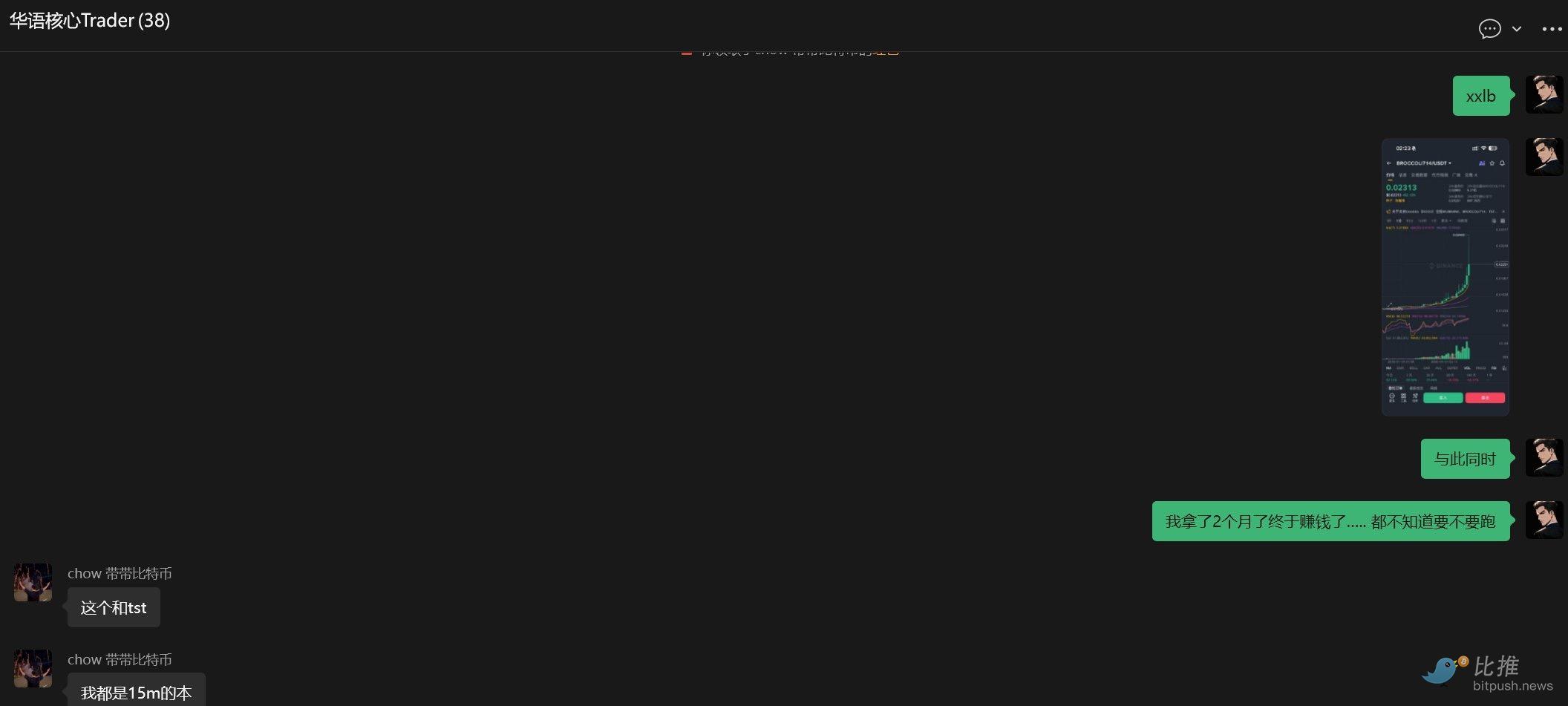
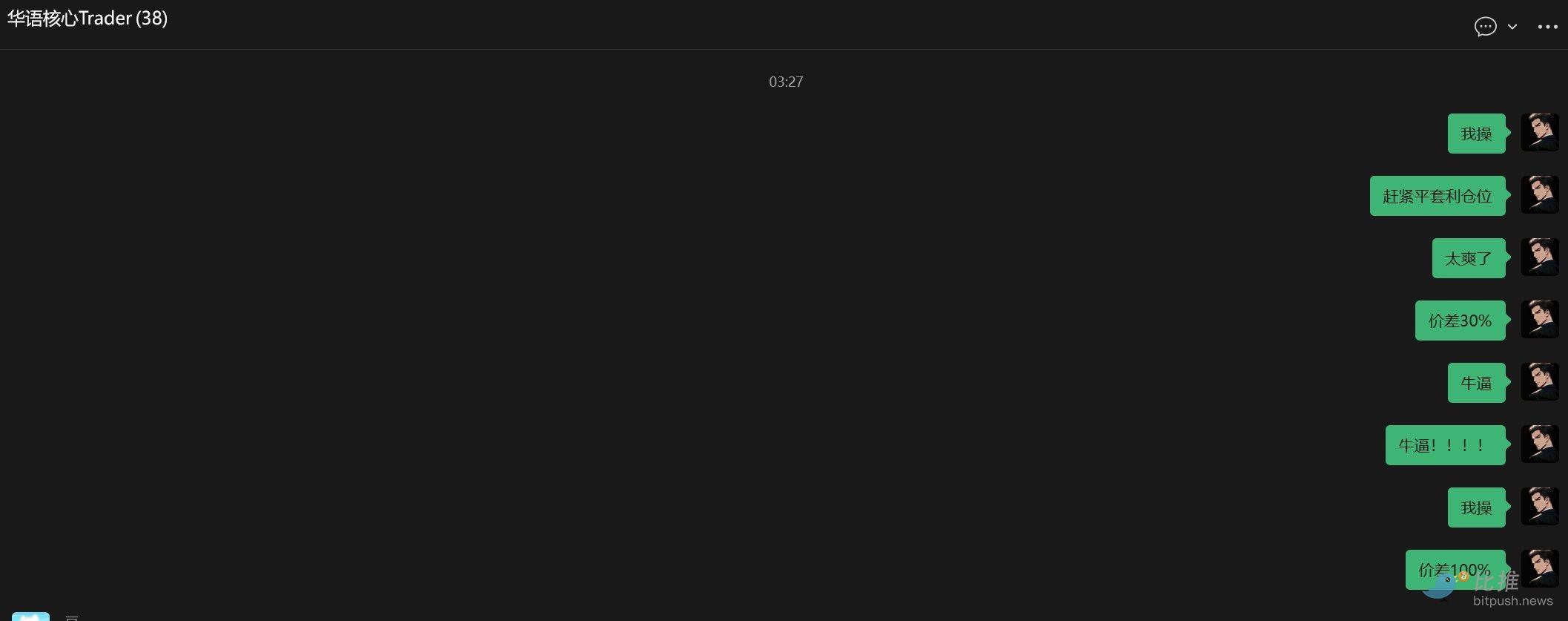
When the huge spot-contract price disparity occurred: My short-term surge alert program and my spot-contract spread alert program were both疯狂 alarming > prompting me to focus fully and rush to my computer to start working.

I第一时间 mentioned this situation in a core Chinese group on带带:

- My first reaction was to quickly close my funding rate arbitrage position. Because my original $500,000 arbitrage hedge position had become $800,000 in spot value and $500,000 in contracts. I immediately closed all arbitrage positions to lock in a profit of $300,000.

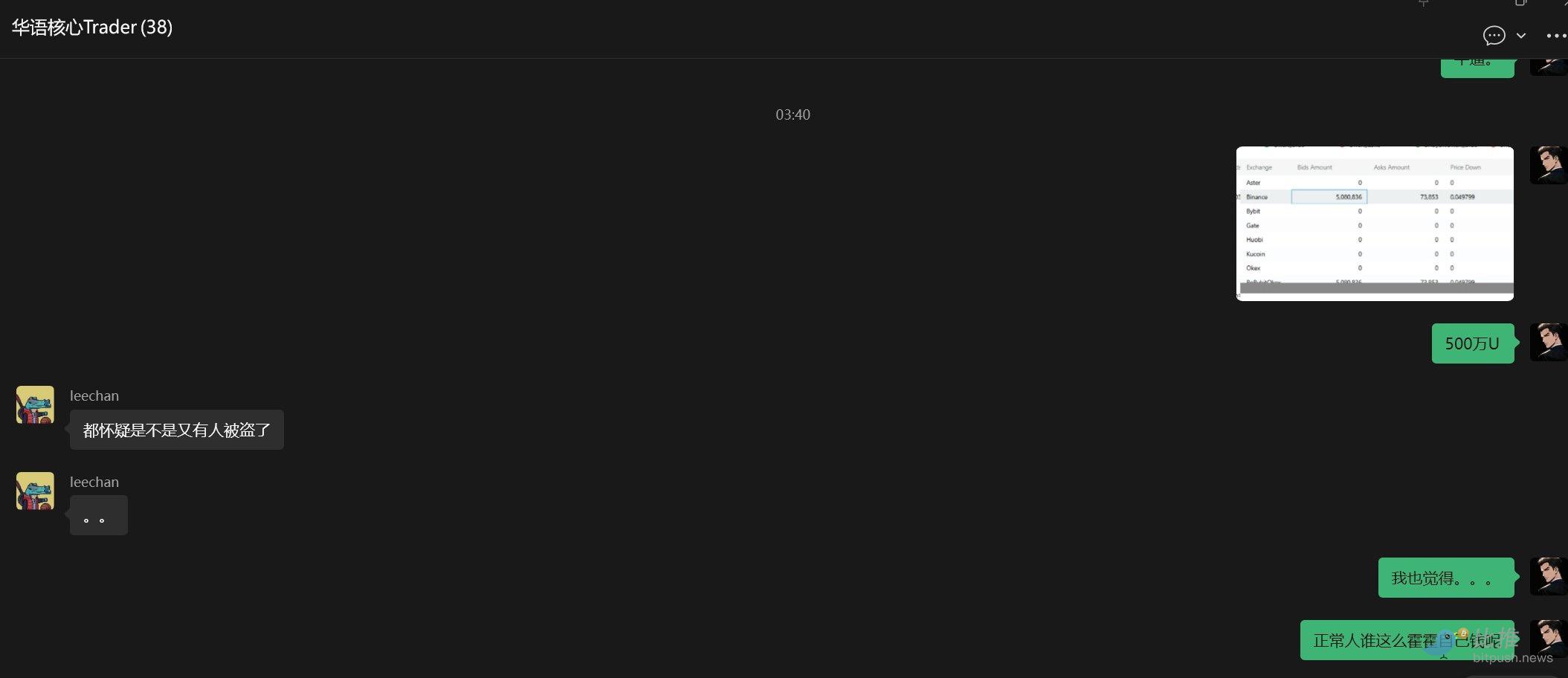
– But upon second thought, it felt very反常 because historically, no market maker would pump the spot market so violently regardless of the spread. I took a look at the order book depth and was震惊 to find that the bid-side 10% depth on Binance spot had $5 million in buy orders, while the contract side's bid 10% depth was only $50,000. Someone suggested a suspected Binance account hack, which I also found reasonable.

– I looked at the order book on the Binance main site again and was shocked to find that for BROCCOLI714, a coin with a market cap of $40m at the time, there were $26 million in bid orders. From this, I inferred that it must be either a hacked account or a market maker program bug, because no market maker would be foolish enough to play charity like this in the spot market.

- Seeing that the hacker had $26 million in ammunition on the spot order book, I knew his goal was to pump the spot market > lift the contract price > exit his position on the contracts.

So I monitored the changes in Binance's order book on one screen. I knew that as long as the hacker didn't withdraw the $20 million in buy orders on the spot market, the price of BROCCOLI714 would keep rising.

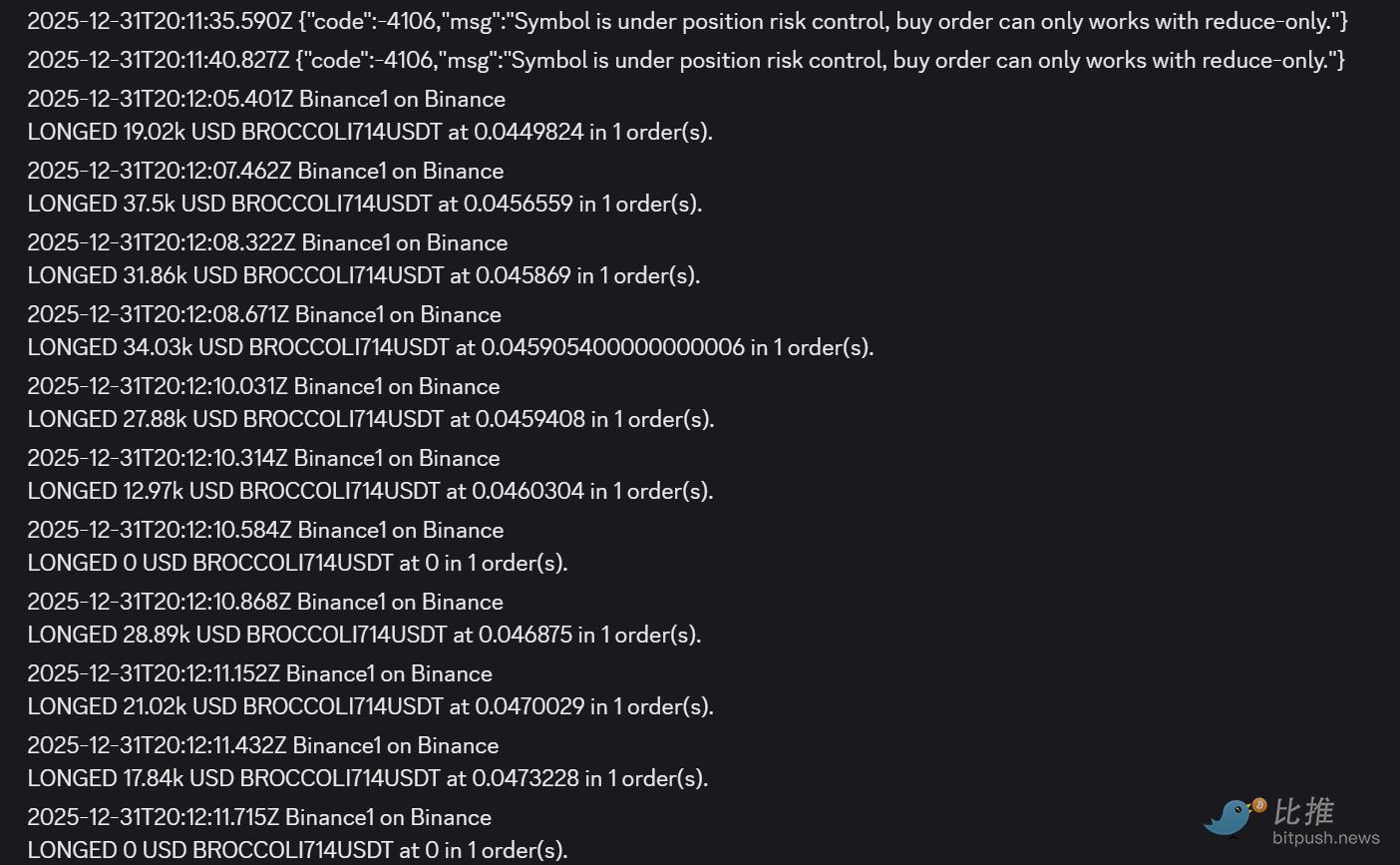
My first thought at this point was to go long on Binance contracts, but I found that the Binance contracts had already triggered the "circuit breaker protection mechanism" (reduce-only mode).

At that time, BROCCOLI spot was already at 0.07, while Binance contracts were capped at 0.038 by the circuit breaker mechanism, and Bybit contracts had risen to 0.055. So I chose to attempt a long position on the Binance BROCCOLI714USDT perpetual contract every 5-10 seconds on my trading terminal. If the order succeeded, it meant the circuit breaker period was over, meaning the Binance contract would pump.

I successfully蹲守到 this opportunity and added approximately $200,000 in long positions at a contract entry cost of 0.046.

- I knew this incident was必然 caused by a hacker or a market maker program bug, and the short-term surge was too high. The final outcome would inevitably be a complete mess.

So I kept watching the Binance spot order book.

The hacker withdrew his orders once midway, leading me to believe he had been sanctioned by Binance's risk control department. So, at Beijing Time 2026-01-01 04:20:52.732, I started using my trading program to疯狂 sell > liquidate all my previously held + later added long BROCCOLI714 spot and contract positions regardless of cost.

My original $200,000 accumulated position + the later added $200,000 roughly cashed out to $1.5 million. (A lot of the original accumulated position was opened in the contract market, so I didn't capture as much premium)

After being scared off by the hacker's withdrawal of buy orders at 4:21, the不讲武德 hacker挂回 the buy orders about 1 minute later and directly pumped the price to 0.15.

But I knew he would eventually be sanctioned by Binance's risk control department. And once his account was risk-controlled > bids withdrawn > broccoli would crash, it was just that the staff might be lazy at 1.1 AM so he hadn't been risk-controlled yet.

So I kept a close eye on the order book.

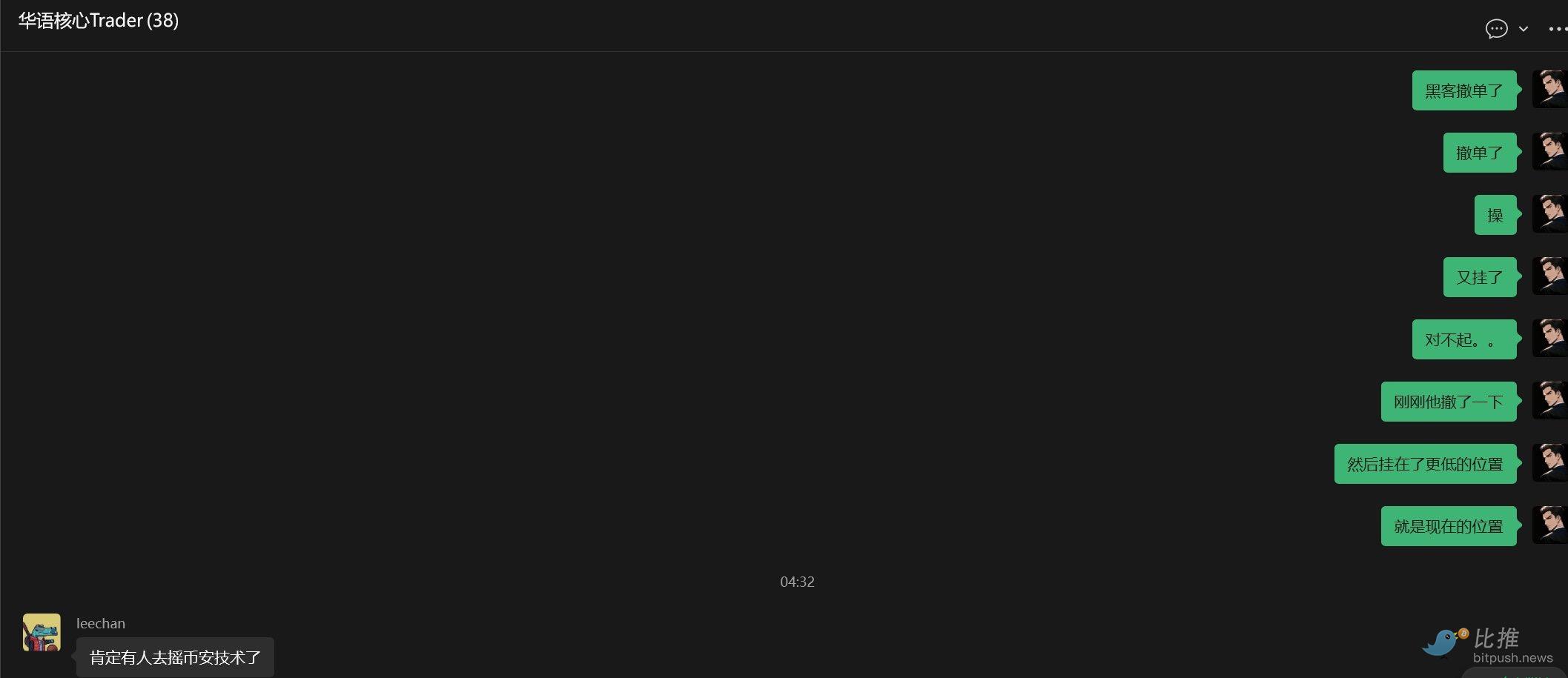
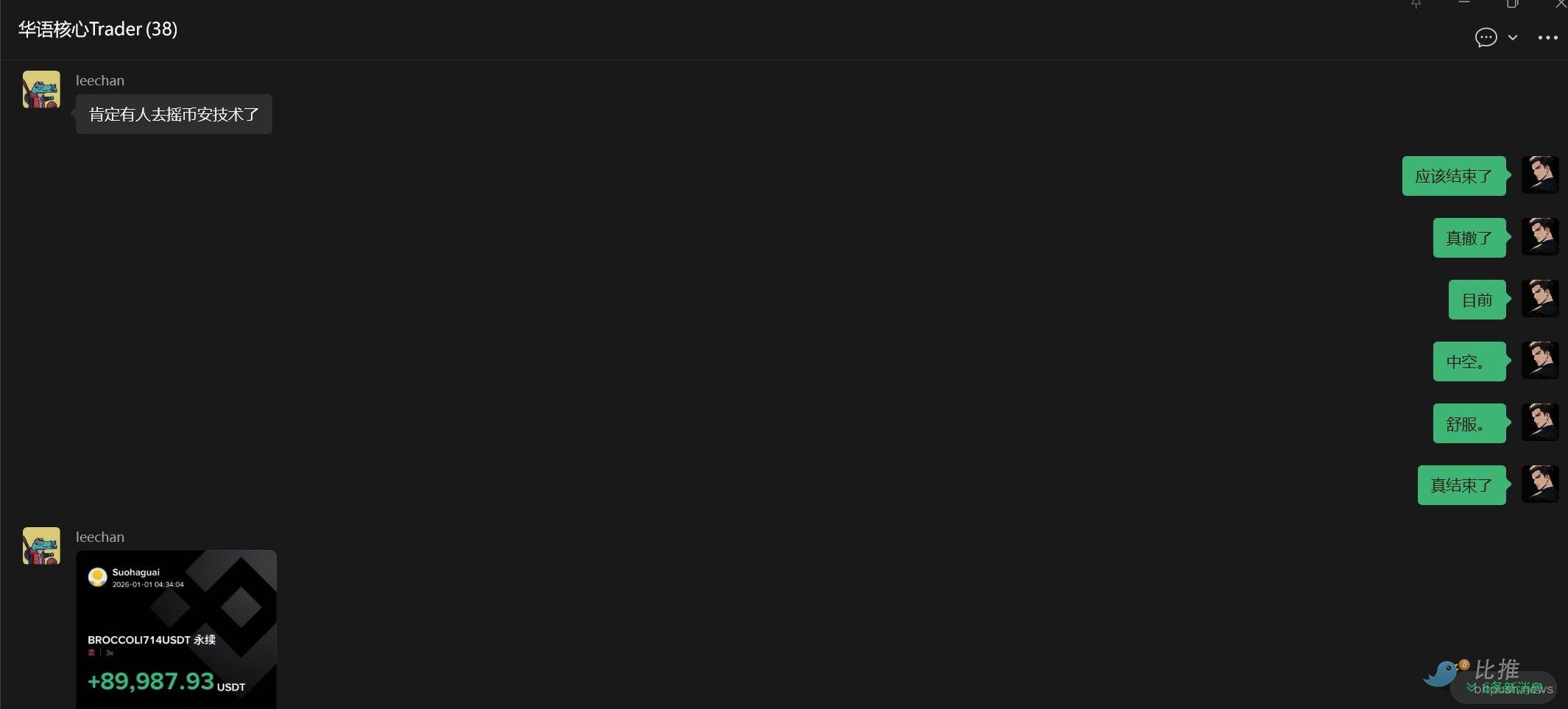
Later, at 4:31, I noticed the hacker really withdrew all the bids. At 4:32, they were completely withdrawn. And this time, they didn't reappear for a long time + group friends said someone probably contacted Binance tech, and he was likely sanctioned.

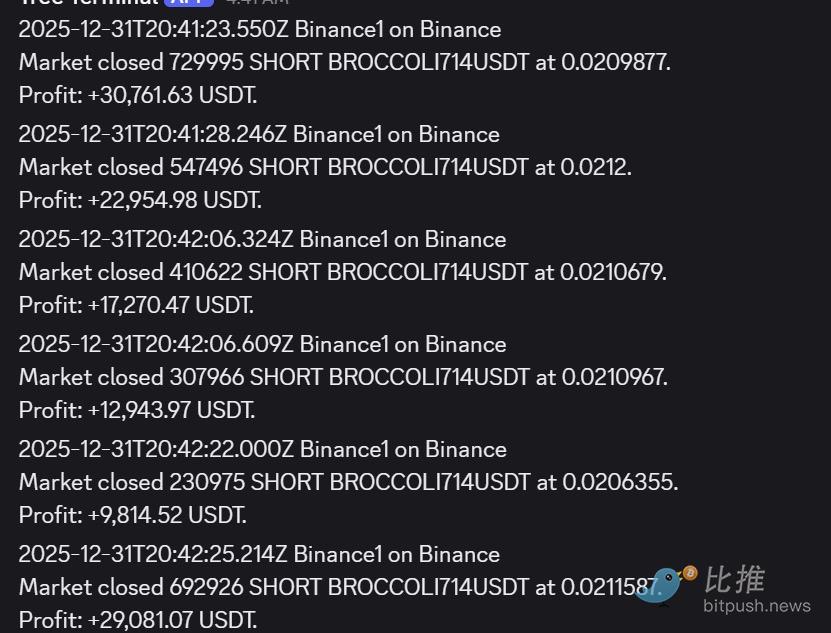
So I started shorting. I opened roughly $400,000 in short positions on Binance contracts at an average cost of around 0.065. The final closing price was approximately 0.02.

Revisiting why I was able to seize this opportunity:

1. Price anomaly alerts for small-cap strategies
- I set up short-term price surge alerts for small-cap strategies. As long as a held small-cap coin experiences an ultra-large price increase in a short time, it triggers a mandatory alert, 100% guaranteed to wake me up. – In the funding rate arbitrage strategy, I also set up monitoring: once a huge spread between spot and contract is detected, it triggers a mandatory alert.

2. Identifying反常 price action and verifying the order book
When I saw clearly反常 price action, the first thing I did was look at the order book to judge how much ammunition the "market maker" actually had. The result: For a coin with only a $30 million market cap, there were $20 million USDT in bids on the Binance spot side. From this, I judged this couldn't be normal market maker manipulation, but more like hacker behavior or a market maker's system bug (no market maker would pump the spot so recklessly and foolishly regardless of cost).

3. Still need to communicate more with experts. Brainstorming among several experts often helps figure out the entire剧本玩法 in the first moment.

4. I was very clear about the second phase玩法:
Wait for the hacker to be sanctioned by Binance's risk control department and withdraw the bid orders, then蹲守 this opportunity to short. So after completing the first phase of selling, I kept staring at the order book, waiting for this opportunity to appear. I waited over ten minutes and really managed to蹲守到 it.

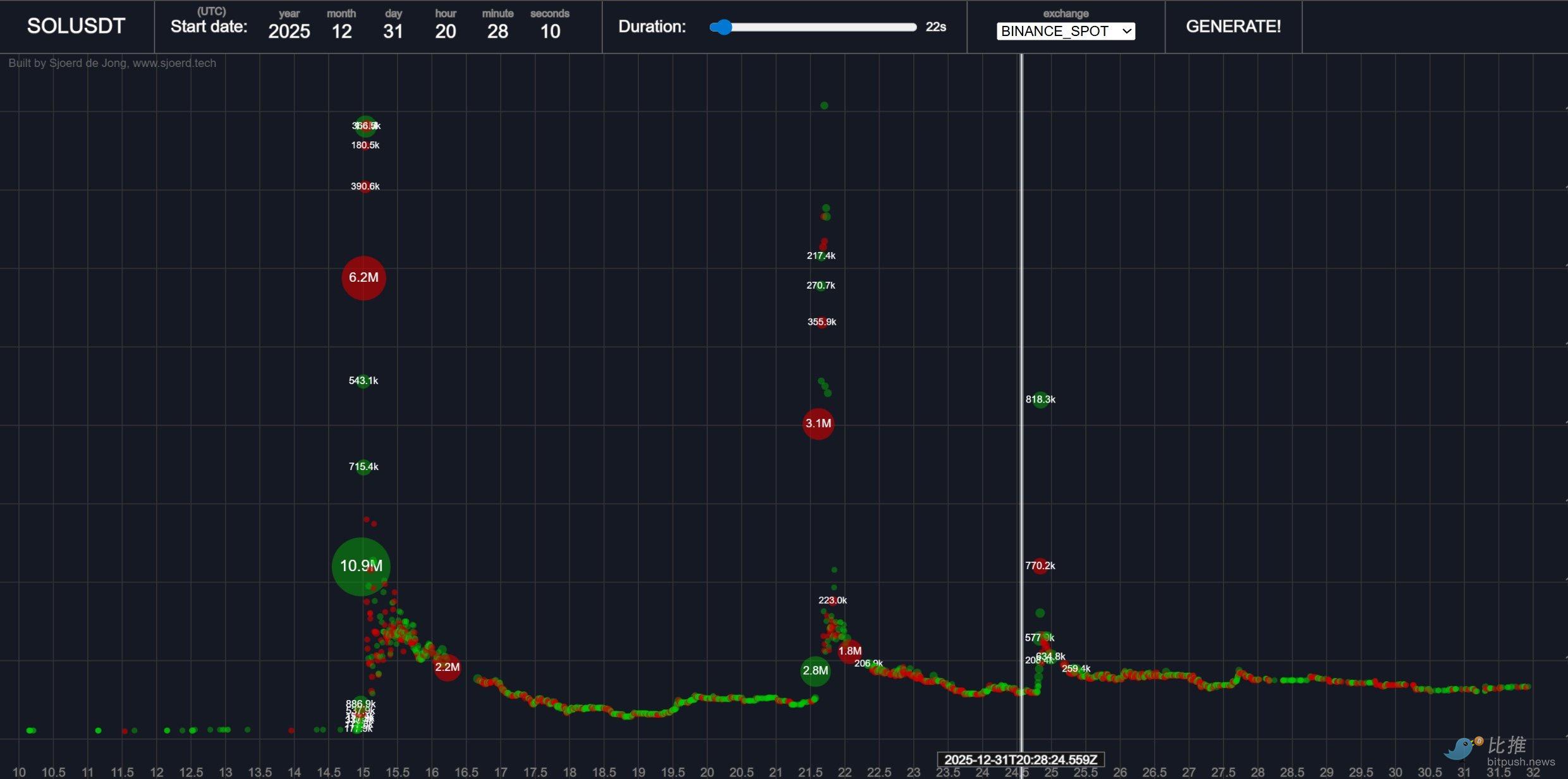
One behavior made me guess the BROCCOLI714 hacker was probably wrapping up, because at Beijing Time 4:28:15, he不计成本 bought SOLUSDT spot, pumping it by about 5% >>> which triggered my pre-set alert again, letting me know.

I guessed that his account might have been partially restricted by Binance from placing new orders in the BROCCOLI714 market, so he狗急跳墙 and bought SOL instead.

结果真的 (Sure enough), 3 minutes later the BROCCOLI price collapsed.


Twitter:https://twitter.com/BitpushNewsCN

Bitpush TG Discussion Group:https://t.me/BitPushCommunity

Bitpush TG Subscription: https://t.me/bitpush

Original article link:https://www.bitpush.news/articles/7599510

Связанные с этим вопросы

QWhat was the initial position and cost basis of Vida's long-term BROCCOLI714 holdings?

AVida had a long-term BROCCOLI714 position with a cost basis of $0.016, totaling $200,000, which was accumulated in early November.

QWhat two types of alerts did Vida have set up that helped him detect the unusual market activity?

AHe had two alerts: one for a price increase of over 30% within 1800 seconds for his small-cap holdings, and another for a significant spot-contract price difference in his funding rate arbitrage strategy.

QWhat observation in the order book led Vida to conclude this was not normal market maker activity but likely a hack or bug?

AHe observed that for a coin with a market cap of around $40 million, there was an unusually large bid of $26 million USDT on the Binance spot order book, which no rational market maker would place.

QWhy did Vida decide to short BROCCOLI714 after initially selling his long positions?

AHe anticipated that the hacker's buy orders would eventually be withdrawn after being sanctioned by Binance's risk control department, causing the price to crash, which would create an opportunity to profit from a short position.

QWhat final clue suggested to Vida that the hacker was being restricted and that the BROCCOLI714 price was about to collapse?

AThe hacker made an irrational large purchase of SOLUSDT, spiking its price by 5%, which Vida interpreted as the hacker being blocked from trading BROCCOLI714 and acting out of desperation. The price of BROCCOLI714 collapsed shortly after.

Похожее

Understanding CPO (Co-Packaged Optics) in One Article: Why Nvidia Is Willing to Spend $3.2 Billion on a Fiber?

NVIDIA and Corning announced a multi-year strategic partnership on May 6, 2026, with NVIDIA committing up to $3.2 billion to support Corning's U.S. expansion. This investment will triple Corning's manufacturing plants and significantly boost its optical fiber and communications production capacity. The core driver behind this massive investment is the fundamental shift from copper to optical interconnect technology within AI data centers. As GPU clusters scale, copper wires face critical limitations: severe signal attenuation over distance, high energy consumption for signal integrity, and excessive heat generation. Optical fiber, transmitting light instead of electrical signals, solves these issues with minimal loss, near-light speed, and lower power needs. The article outlines a three-stage evolution of data center interconnect: 1. **Traditional Copper Interconnects:** The mainstream solution of the 2010s, now being phased out due to scaling bottlenecks. 2. **Pluggable Optical Modules:** The current mainstream, where modules convert electrical signals to light externally. This process still introduces energy loss and latency. 3. **CPO (Co-Packaged Optics):** The next-generation technology where the optical engine is integrated directly with the GPU chip package. This drastically reduces the electrical signal travel distance to mere millimeters, slashing power consumption and latency while boosting data density. NVIDIA CEO Jensen Huang has identified CPO as an essential core technology for AI infrastructure. NVIDIA's investment signifies a strategic shift from being a buyer to actively controlling its supply chain for critical components. With demand for specialized optical fiber far outstripping supply—evidenced by soaring prices—securing long-term manufacturing capacity has become a competitive necessity. While Corning's expansion may pressure some suppliers, a projected global fiber supply gap of 5-15% over the next few years creates a significant opportunity window, particularly for Chinese manufacturers competitive in optical preforms, chips, and modules. Ultimately, NVIDIA's move is not about chasing a trend but an engineering imperative. The transition to light-based interconnects like CPO is driven by the physical limits of copper, marking a definitive step in the ongoing AI computing revolution.

marsbit2 мин. назад

Understanding CPO (Co-Packaged Optics) in One Article: Why Nvidia Is Willing to Spend $3.2 Billion on a Fiber?

marsbit2 мин. назад

KOL's Perspective: Why Is SOL Set to Rise from This Point?

**Summary: Why SOL is Positioned for Growth at This Level** The article argues that SOL is poised for an upward move from its current price point, citing several key factors. Primarily, SOL has just broken out of a 4-month consolidation phase. This breakout signals a return of risk appetite to the broader crypto market, as SOL is seen as a key indicator of overall crypto health. The token's ownership has reportedly shifted from short-term traders and tourists to long-term accumulators, leading to low volume. Any meaningful increase in trading activity could thus trigger significant upward momentum. Fundamental strengths include strong institutional adoption, integration with DeFi and RWAs (Real-World Assets), and the potential benefits from the Clarity Act. Despite its high volatility—having dropped 70% from its all-time high but still up 12x from its bear market low—SOL is highlighted as one of the few tokens from the last cycle to reach new highs. It boasts a robust ecosystem of applications, users, and protocols. Future catalysts include the expected influx of AI developers following the Miami Accelerate conference, which focused on AI on Solana. Furthermore, Solana is positioned as the premier chain for memecoin activity, a trend expected to continue and drive network usage and fees. The article concludes that recent price action reflects a healthy transfer to long-term holders, setting the stage for growth.

marsbit52 мин. назад

KOL's Perspective: Why Is SOL Set to Rise from This Point?

marsbit52 мин. назад

Those Pre-Bitcoin PoW Protocols Have Recently Been Reimplemented

This article details a recent surge in replicating pre-Bitcoin Proof-of-Work (PoW) protocols, specifically focusing on Hal Finney's 2004 RPOW (Reusable Proofs of Work). Within five days in May 2026, multiple independent builders in the Bitcoin/cypherpunk community launched projects inspired by this early electronic cash proposal. The initiative began with Fred Krueger's `rpow2.com`, a centralized but auditable system that replaced RPOW's original IBM 4758 hardware with Ed25519 signatures. Initially a faithful replica, it later adopted Bitcoin-like features (21M supply cap, difficulty adjustment) and a controversial 5.24% founder allocation. This sparked rapid forks, including `rpow4.com` which incorporated full Bitcoin parameters, a prediction market (`rpowmarket.com`), and a DEX (`rpow2swap.com`). Concurrently, Mike In Space created a prototype of Wei Dai's 1998 b-money proposal (`b-money.replit.app`), pushing the historical exploration even further back. The article contrasts these centralized, server-dependent experiments with Bitcoin's core innovation of decentralized, trustless consensus. It also highlights a parallel development: the `HASH` project on Ethereum, which uses smart contract hooks to enable a purely fair-launch, browser-mineable PoW token with 0% allocations to team or VCs. The collective activity is framed as a meme-driven, educational exploration of cypherpunk history rather than a serious financial movement, with all projects heavily disclaiming any investment value.

marsbit57 мин. назад

Those Pre-Bitcoin PoW Protocols Have Recently Been Reimplemented

marsbit57 мин. назад

South Korean Exchanges 'Battle' Regulators, Challenging the Boundaries of Enforcement and Legislation

South Korea's cryptocurrency industry is engaged in a rare, direct confrontation with regulators. The Financial Intelligence Unit (FIU), the primary anti-money laundering (AML) watchdog, has recently imposed heavy penalties on major exchanges like Upbit and Bithumb for alleged violations involving unregistered overseas VASPs and AML procedures. However, exchanges are now actively challenging these actions in court and through industry associations. In a significant shift, the Seoul Administrative Court ruled in favor of Upbit's operator, Dunamu, overturning part of an FIU-ordered business suspension. The court found the FIU's penalty criteria and justification insufficiently clear. Similarly, the court suspended the enforcement of a six-month business suspension against Bithumb pending a final ruling, citing potential irreversible harm to the exchange. Beyond legal battles, the industry is contesting proposed legislative amendments. The Digital Asset eXchange Alliance (DAXA) strongly opposes a draft rule that would mandate Suspicious Transaction Reports (STRs) for all crypto transfers over 10 million KRW (~$6,800). DAXA argues this "poison pill" clause violates legal principles and would overwhelm the STR system, increasing reports from 63,000 to an estimated 5.45 million annually for major exchanges, thereby crippling effective AML monitoring. This conflict highlights a structural tension in South Korea's crypto governance: comprehensive digital asset laws are still developing, while regulators rely heavily on AML enforcement. The industry's move from passive compliance to active legal and legislative challenges signifies a new phase, pressing for clearer rules and more proportionate enforcement. While short-term disputes may intensify, this clash could ultimately lead to a more mature and sustainable regulatory framework for South Korea's vibrant crypto market.

marsbit1 ч. назад

South Korean Exchanges 'Battle' Regulators, Challenging the Boundaries of Enforcement and Legislation

marsbit1 ч. назад

Торговля

Спот
Фьючерсы
活动图片