总流通量超 1.2 亿的以太坊都待在哪里?

Foresight NewsОпубликовано 2023-10-08Обновлено 2023-10-08

Введение

当前以太坊的总流通量大约比 1.2 亿多了 23.3 万,这一亿多枚代币现在散落在 Web3 世界的各个角落,交易所、DeFi、跨链桥、Layer 2、非 EVM 生态的链上,还有很多躺在黑客因为怕被定位不敢动的钱包里。

当前以太坊的总流通量大约比 1.2 亿多了 23.3 万,这一亿多枚代币现在散落在 Web3 世界的各个角落,交易所、DeFi、跨链桥、Layer 2、非 EVM 生态的链上,还有很多躺在黑客因为怕被定位不敢动的钱包里。

我们天天都在被各种数据刷屏,某某新 L2 上跨链的以太坊再创新高,交易所存量再创新低,但有没有人考虑过这些以太坊的分布如何,究竟哪里是以太坊们最爱去的地方?

X 平台上一位痴迷于以太坊,名为 Eth Wave(@TrueWaveBreak)的用户做了一个不能说漏了不少,只能说完全不完整的统计。虽然这份统计忽略了例如很多 WETH 的去向,以及逃出 EVM 生态之外的 ETH,但大体上勾勒出了一幅可以了解以太坊分布的图画:
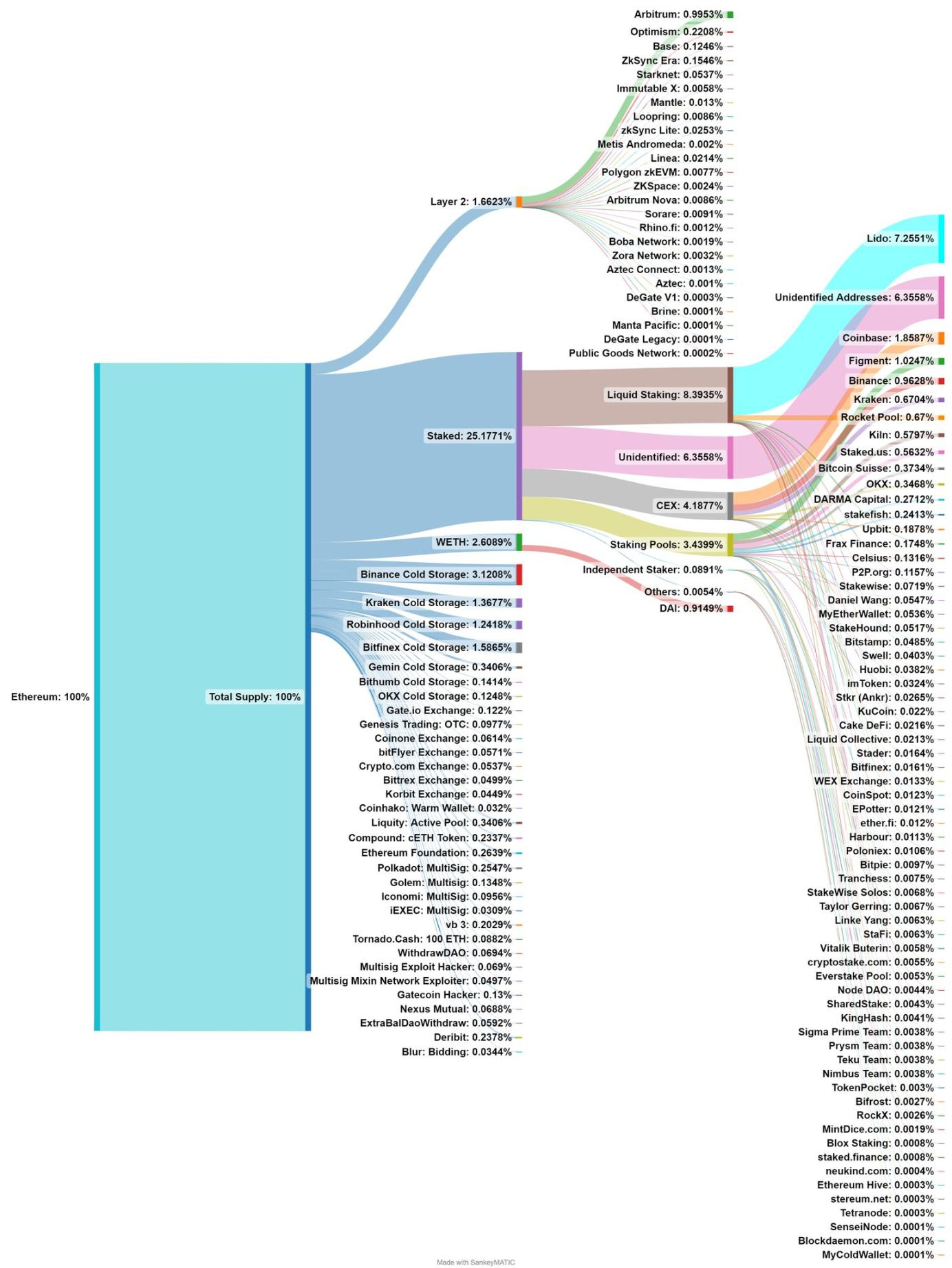
这张图上有不少值得单独聊一聊的有趣数据。

L2 上 ETH 仅占总量不到 2%

据图中数据显示,所有 L2 上 ETH 仅占 ETH 总流通量的 1.66% 左右,约为 199.2 万枚,以撰写本文时以太坊价格计算总价值 32.23 亿美元,占 L2 TVL 104.4 亿美元的 30.87%。

该图表中依据 ETH 存量的 L2 排名与 L2BEAT 中依据 TVL 的排名几乎一致。除了 Arbitrum 和 OP Mainnet 两大巨头之外,Base 近期的发展速度的确让很多人措手不及,其上 TVL 已超过了更早上线主网的 zkSync Era 与 Starknet。

但即便 L2 表现亮眼,通过对比也能得知所有 L2 上的 ETH 存量仅略微高于 Bitfinex 冷钱包存量,甚至只相当于币安冷钱包存量的一半左右。

据此我们也可以得出结论,作为大幅降低交易成本的以太坊替代方案,L2 至少目前还没有任何可以撼动以太坊地位的迹象。一方面可能是由于能熟练在各个链之间转移资产的用户基数仍然较低,另一方面也可能是因为主网上仍有很多无法替代的应用。

CEX 仍是 ETH 流动性主战场

据图中列出的数据计算,已识别到的交易所 ETH 存量超过了 7%。加上全球各地的小型交易所以及潜在未识别到的交易所地址,中心化交易所的 ETH 存量虽然近年来处于不断下降的趋势,但仍可能接近甚至超过 10%。

这就意味着 CEX 仍然是 ETH 流动性的主要聚集地,而当下我们肉眼观察到盘面体现出来的所谓「流动性不足」的情况很可能只是用户频繁交易的意愿下降了,大多可能是在按兵不动。

另外,包括 Robinhood 等并非加密货币交易所但有加密货币交易业务的机构也不容忽视。图中未提到的例如灰度,其以太坊基金被区块链数据分析平台 Arkham 识别出持有 303 万枚 ETH,也占到了总流通量的 2.5% 以上。

黑客手中的筹码不容忽视

图中也列出了部分黑客的持有量,例如攻击了波卡多签钱包攻、Mixin、Gatecoin 的黑客,还有未列出的例如臭名昭著的朝鲜黑客组织 Lazarus Group,不过未列出的可能已将盗取的资产存入的包括 Tornado.Cash 在内的混币器中,或是分散存储在不同的地址中,难以被短时间全部识别。

被质押的以太坊

被质押的以太坊已经占到了以太坊总流通量的 25% 以上,并且在可见的未来这个数字可能仍然会不断上升。在被质押的 ETH 中,1/3 被存入了流动性质押协议,而这 1/3 中有超过 86% 在 Lido 中。在质押这个领域,中心化交易所虽然也分得了一杯羹并推出了流动性质押代币(LST),但目前看来受欢迎程度远不及去中心化协议,质押量只有 LSD 协议的一半。

流动性质押是一个可能远比看起来要复杂的多的赛道,不单纯是质押后获得等量的代表质押份额的代币,如何更加去中心化以规避风险、如何降低用户存入的 ETH 数量、如何利用 LST 去维护其他网络的安全(再质押)等等都是值得深入研究的领域。

但另一方面,流动性质押本质上是一种加杠杆的行为,当下以 LST 作为抵押品进行借贷以及很多 LSD 协议通过 LST 发行去中心化稳定币的行为也进一步放大了杠杆。未来如果规模足够庞大之后再次出现市场极端行情时,是否有足够的流动性去清算这些资产也是我们需要未雨绸缪的问题。

正如作者本人所说,这张图并不完善,例如交易所、L2 上的 WETH、DEX 等未被统计。另外 DeFi 领域中,图中只展示了 Compound 的 cETH 以及通过抵押 WETH 铸造的 DAI(MakerDAO)的占比,另一些大型的 DeFi 协议例如 Aave、Curve、Uniswap 也未被收录其中。作者表示未来会不断完善这个图表,也期待经过完善的图表有更多值得挖掘的信息。


Похожее

Anthropic's IPO Launch: Commercial Miracle or Valuation Bubble?

Anthropic has confidentially filed for an IPO, led by Morgan Stanley and Goldman Sachs, potentially going public by October. Following its latest $650 billion funding round, its pre-IPO valuation stands at $965 billion, with projections reaching up to $2 trillion at listing, which would make it the highest-valued private company ever. The article, written by Fu Sheng, addresses skepticism that this represents an AI bubble akin to the 2000 dot-com crash. It argues the current situation differs fundamentally. Unlike the internet bubble era, which relied on speculative narratives with little revenue, Anthropic's valuation is backed by unprecedented, measurable financial performance. Key data points include: * **Revenue Growth:** ARR skyrocketed from $10 billion in early 2025 to $470 billion by May 2026, targeting $100 billion by year-end—a growth curve unmatched in business history. * **Profitability:** It achieved operating profitability in Q2 2026 with an estimated $5.6 billion profit. * **Efficiency:** With ~3,000 employees and ~$470 billion ARR, its revenue per employee exceeds $10 million. Products like Claude Code, launched less than a year ago, already generate $25 billion in annualized revenue. * **Enterprise Adoption:** It boasts a strong enterprise client base, with 8 of the Fortune 10 and over 1,000 large firms spending over $1 million annually on Claude. The valuation is framed using a traditional SaaS model (e.g., a 10x Price-to-Sales multiple on $100 billion revenue). The author contends the core question for analysts has shifted from "How big could this be?" to "How much is it earning and will earn next quarter?" The discussion extends beyond Anthropic to a broader paradigm shift: the transition from a "carbon-based" to a "silicon-based" economy. Companies are increasingly prioritizing investment in compute and AI capabilities over human resources, as these directly scale productivity and competitive advantage. Anthropic's IPO is thus positioned not just as a corporate milestone, but as a price anchor for this new economic era.

链捕手7 мин. назад

Anthropic's IPO Launch: Commercial Miracle or Valuation Bubble?

链捕手7 мин. назад

Near Returns to the AI Stage: Transformation into a Public Chain Due to 'Payroll Difficulties,' Agent and Privacy Emerge as New Growth Narratives

NEAR Returns to AI Origins: From Payroll Struggles to Blockchain, Now Focusing on AI Agents and Privacy NEAR Protocol's journey began not with grand blockchain ambitions, but from a practical hurdle: its AI startup founders, including Transformer paper co-author Illia Polosukhin, couldn't efficiently pay international developers in 2017. This led them to pivot and build a high-performance, scalable blockchain. After years navigating various crypto narratives like sharding and cross-chain interoperability, NEAR is now leveraging its AI roots to re-enter the AI arena. A key driver is its "NEAR Intents" layer, which abstracts complex cross-chain transactions. Users simply state their goal (e.g., swap BTC for ETH), and a solver network finds the optimal route. This system has processed over $20B in cross-chain volume, generating significant fee revenue. A major growth area is private transactions via "Confidential Intents/Swaps," which hide trade details until settlement to protect against MEV and front-running. Remarkably, private swaps recently accounted for over 40% of NEAR's transaction volume, highlighting strong demand but also potential regulatory scrutiny. With its AI-founder pedigree, NEAR is positioning itself at the intersection of blockchain, AI agents, and privacy, aiming to become infrastructure for the emerging agent economy while navigating the challenges of its rapid adoption.

marsbit2 ч. назад

Near Returns to the AI Stage: Transformation into a Public Chain Due to 'Payroll Difficulties,' Agent and Privacy Emerge as New Growth Narratives

marsbit2 ч. назад

From Ethereum to AI's 'CROPS': What Exactly is This Set of 'Slow Variables' That Vitalik Repeatedly Emphasizes?

In recent discussions, Vitalik Buterin has frequently emphasized the concept of "CROPS," a framework defining core values for Ethereum's development. CROPS stands for Censorship Resistance, Capture Resistance, Open Source, Privacy, and Security. Initially outlined in the Ethereum Foundation's "EF Mandate," it represents a commitment to user sovereignty, ensuring that the network resists external control, remains open, protects privacy, and prioritizes security. The relevance of CROPS extends beyond Ethereum's foundational principles, becoming crucial in the context of AI integration. As AI agents begin handling wallet operations and automated transactions, the risk increases that users may cede control over their digital assets, privacy, and intentions to centralized AI service providers. A "CROPS AI" would therefore emphasize local execution where possible, privacy-preserving remote model calls (e.g., using zero-knowledge proofs), and transparent, verifiable processes to maintain user agency. Vitalik highlights a significant convergence between "CROPS Ethereum access layer" and "CROPS AI." Both address the same fundamental challenge: how users can access powerful services—be it blockchain data via RPCs or AI models—without exposing sensitive information or relinquishing ultimate control. This intersection points toward a future digital entry point that is more private, secure, and user-controlled. Ultimately, CROPS is not merely an abstract ideal but a practical guidepost. It steers development—from protocol resilience and wallet design to AI agent safety—towards a future where users retain self-sovereignty even as digital systems grow more complex and powerful. In an era of accelerating AI adoption, these "slow variables" of censorship resistance, openness, privacy, and security may define Ethereum's enduring value.

marsbit2 ч. назад

From Ethereum to AI's 'CROPS': What Exactly is This Set of 'Slow Variables' That Vitalik Repeatedly Emphasizes?

marsbit2 ч. назад

Торговля

Спот
Фьючерсы

Популярные статьи

Как купить OP

Добро пожаловать на HTX.com! Мы сделали приобретение Optimism (OP) простым и удобным. Следуйте нашему пошаговому руководству и отправляйтесь в свое крипто-путешествие.Шаг 1: Создайте аккаунт на HTXИспользуйте свой адрес электронной почты или номер телефона, чтобы зарегистрироваться и бесплатно создать аккаунт на HTX. Пройдите удобную регистрацию и откройте для себя весь функционал.Создать аккаунтШаг 2: Перейдите в Купить криптовалюту и выберите свой способ оплатыКредитная/Дебетовая Карта: Используйте свою карту Visa или Mastercard для мгновенной покупки Optimism (OP).Баланс: Используйте средства с баланса вашего аккаунта HTX для простой торговли.Третьи Лица: Мы добавили популярные способы оплаты, такие как Google Pay и Apple Pay, для повышения удобства.P2P: Торгуйте напрямую с другими пользователями на HTX.Внебиржевая Торговля (OTC): Мы предлагаем индивидуальные услуги и конкурентоспособные обменные курсы для трейдеров.Шаг 3: Хранение Optimism (OP)После приобретения вами Optimism (OP) храните их в своем аккаунте на HTX. В качестве альтернативы вы можете отправить их куда-либо с помощью перевода в блокчейне или использовать для торговли с другими криптовалютами.Шаг 4: Торговля Optimism (OP)С легкостью торгуйте Optimism (OP) на спотовом рынке HTX. Просто зайдите в свой аккаунт, выберите торговую пару, совершайте сделки и следите за ними в режиме реального времени. Мы предлагаем удобный интерфейс как для начинающих, так и для опытных трейдеров.

780 просмотров всегоОпубликовано 2024.03.29Обновлено 2026.06.02

Как купить OP

Обсуждения

Добро пожаловать в Сообщество HTX. Здесь вы сможете быть в курсе последних новостей о развитии платформы и получить доступ к профессиональной аналитической информации о рынке. Мнения пользователей о цене на OP (OP) представлены ниже.

活动图片