Ethereum: Dencun Upgrade Likely Delayed To Early Next Year

BitcoinistОпубликовано 2023-12-11Обновлено 2023-12-11

Введение

The anticipated Ethereum upgrade, dubbed Dencun, amalgamating the consensus layer (Deneb) and the execution layer (Cancun), is poised for a...

The anticipated Ethereum upgrade, dubbed Dencun, amalgamating the consensus layer (Deneb) and the execution layer (Cancun), is poised for a likely delay to early next year. The discussions during the Ethereum All Core Developers Consensus Call (ACDC) #118, chaired by Danny Ryan from the Ethereum Foundation, signposted this potential delay amid discussions surrounding the pivotal Ethereum Improvement Proposals (EIPs) such as EIP-4844. In a recent blog post, Galaxy Digital Vice President of Research, Christine Kim, highlighted the developments.
Delay Concerns And Strategic Discussions
Tim Beiko of the Ethereum Foundation, during the ACDC call, raised the prospect of Dencun not launching on the mainnet before the close of 2023, considering its absence on public testnets and the approaching Devconnect conference in November 2023. “If we don’t launch a [public] testnet before DevConnect, it’s probably unlikely we can go live on the mainnet before the Christmas holidays,” Beiko stated, hinting at a plausible deployment in 2024.
Core developers have centered their deliberations on the strategic deployment of Dencun, scrutinizing the sequence of its launch on the testnets like Goerli and Holesky. The focus has been on utilizing the deprecated testnet Goerli, permitting developers to assiduously experiment with Dencun specifications before transiting to Holesky. The consensus during the call leaned towards prioritizing the launch on Goerli to preclude any adverse ramifications on the long-lived network like Holesky.
Developments On Devnet-9
Devnet-9, serving as a precursor for Dencun, is slated to instigate the test phase next week, featuring the full suite of the Dencun upgrade and acting as the first testing ground for the activation of EIP 7514 and 7516. Parithosh Jayanthi, a DevOps Engineer at Ethereum Foundation, conveyed the team’s readiness for this impending launch, with several Execution Layer (EL) and Consensus Layer (CL) clients such as Lodestar, EthereumJS, Lighthouse, and Geth confirming their preparedness.
However, developers acknowledged the necessity for flexibility, allowing for the launch of Devnet-9 even if all clients are not ready, with Jayanthi affirming, “We can still start the devnet as long as we have at least a couple of clients ready and we can add the rest post [launch].”
Implementation Of EIP-4844
EIP-4844, or proto-danksharding, forms the cornerstone of the Dencun upgrade, poised to enhance Ethereum’s scalability and augmenting the capabilities of Layer 2 solutions. The upgrade addresses both the temporary storage and retrieval of off-chain data and aims to alleviate transaction costs on Layer 2 rollup solutions, such as Optimism and Arbitrum.
This proposal necessitated a meticulous verification process dependent on a secret value generated through a multi-party ceremony that spanned from January to August 2023. The deployment strategy for this EIP is currently under rigorous testing on Devnet-9, with developers mulling over the incorporation of a trusted setup derived from the multi-party ceremony results.
Carl Beek from the Ethereum Foundation is spearheading the conversion of these results into a standardized format, although he communicated that the timing for this conversion is “very tight” for the upcoming Devnet-9.
In conclusion, the Dencun upgrade, combining Deneb and Cancun, marks a significant step in Ethereum’s evolution, integrating vital improvements and focusing on scalability. However, the intricate processes, strategic decisions on deployment, and extensive testing phases underscore the complexity of this upgrade.
The likelihood of Dencun seeing the light of day this year appears dim, with early 2024 emerging as a probable timeframe for its deployment.
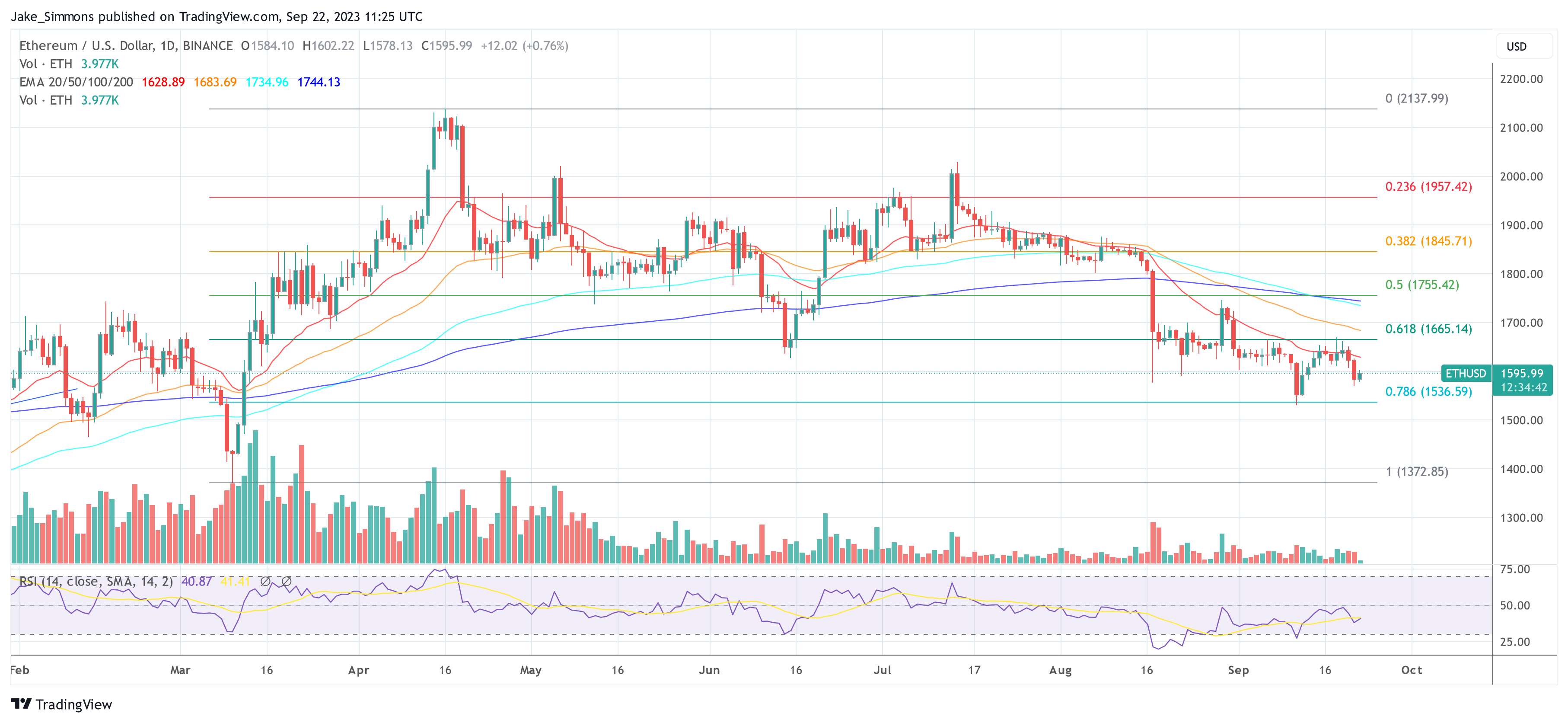
At press time, ETH traded at roughly $1,596.
Ethereum price

ETH price rejected at 61.8% Fib, 1-day chart | Source: ETHUSD on TradingView.com Featured image from Shutterstock, chart from TradingView.com

Похожее

How Blockchain Fills the Identity, Payment, and Trust Gaps for AI Agents?

AI Agents are rapidly evolving into autonomous economic participants, but they face critical gaps in identity, payment, and trust infrastructure. They currently lack standardized ways to prove who they are, what they are authorized to do, and how they should be compensated across different environments. Blockchain technology is emerging as a solution to these challenges by providing a neutral coordination layer. Public ledgers offer auditable credentials, wallets enable portable identities, and stablecoins serve as a programmable settlement layer. A key bottleneck is the absence of a universal identity standard for non-human entities—akin to "Know Your Agent" (KYA)—which would allow Agents to operate with verifiable, cryptographically signed credentials. Without this, Agents remain fragmented and face barriers to interoperability. Additionally, as AI systems take on governance roles, there is a risk that centralized control over models could undermine decentralized governance in practice. Cryptographic guarantees on training data, prompts, and behavior logs are essential to ensure Agents act in users' interests. Stablecoins and crypto-native payment rails are becoming the default for Agent-to-Agent commerce, enabling seamless, low-cost transactions for AI-native services. These systems support permissionless, programmable payments without traditional merchant onboarding. Finally, as AI scales, human oversight becomes impractical. Trust must be built into system architecture through verifiable provenance, on-chain attestations, and decentralized identity systems. The future of Agent economies depends on cryptographically enforced accountability, allowing users to delegate tasks with clearly defined constraints and transparent operation logs.

marsbit22 мин. назад

How Blockchain Fills the Identity, Payment, and Trust Gaps for AI Agents?

marsbit22 мин. назад

Six Years Since DeFi Summer, How Will the Decentralized Financial Revolution Continue?

In 2026, the DeFi sector faces a severe trust crisis following a series of high-profile security breaches, including a $292 million theft from KelpDAO’s rsETH, a $2.85 million exploit at Drift Protocol due to permission vulnerabilities, and a $14.9 million lending failure at Venus Protocol. These incidents triggered a withdrawal of approximately $10 billion from DeFi over a single weekend, highlighting systemic risks beyond smart contract flaws—such as governance, cross-chain complexity, and operational weaknesses. Despite these challenges, on-chain finance continues to grow, with capital shifting toward safer, regulated products. Stablecoins like USDT ($185B) and USDC ($78B) have reached a combined market cap of $263 billion, while tokenized U.S. Treasuries surged to $10.93 billion. Visa’s growing USDC settlement volume, now annualized at $3.5 billion, signals increasing institutional adoption of compliant blockchain-based financial infrastructure. The competition for the future of on-chain finance is intensifying. While native DeFi struggles with trust and capital outflows, regulated products—stablecoins, tokenized assets, and ETFs—are gaining dominance by offering programmable, 24/7 settlement without high DeFi risks. Over 80 crypto projects shut down in Q1 2026, reflecting dwindling patience for speculative ventures. The core challenge for open DeFi is to rebuild trust and demonstrate irreplaceable value—or risk ceding its role as the primary entry point to on-chain finance.

marsbit32 мин. назад

Six Years Since DeFi Summer, How Will the Decentralized Financial Revolution Continue?

marsbit32 мин. назад

Торговля

Спот
Фьючерсы

Популярные статьи

Как купить OP

Добро пожаловать на HTX.com! Мы сделали приобретение Optimism (OP) простым и удобным. Следуйте нашему пошаговому руководству и отправляйтесь в свое крипто-путешествие.Шаг 1: Создайте аккаунт на HTXИспользуйте свой адрес электронной почты или номер телефона, чтобы зарегистрироваться и бесплатно создать аккаунт на HTX. Пройдите удобную регистрацию и откройте для себя весь функционал.Создать аккаунтШаг 2: Перейдите в Купить криптовалюту и выберите свой способ оплатыКредитная/Дебетовая Карта: Используйте свою карту Visa или Mastercard для мгновенной покупки Optimism (OP).Баланс: Используйте средства с баланса вашего аккаунта HTX для простой торговли.Третьи Лица: Мы добавили популярные способы оплаты, такие как Google Pay и Apple Pay, для повышения удобства.P2P: Торгуйте напрямую с другими пользователями на HTX.Внебиржевая Торговля (OTC): Мы предлагаем индивидуальные услуги и конкурентоспособные обменные курсы для трейдеров.Шаг 3: Хранение Optimism (OP)После приобретения вами Optimism (OP) храните их в своем аккаунте на HTX. В качестве альтернативы вы можете отправить их куда-либо с помощью перевода в блокчейне или использовать для торговли с другими криптовалютами.Шаг 4: Торговля Optimism (OP)С легкостью торгуйте Optimism (OP) на спотовом рынке HTX. Просто зайдите в свой аккаунт, выберите торговую пару, совершайте сделки и следите за ними в режиме реального времени. Мы предлагаем удобный интерфейс как для начинающих, так и для опытных трейдеров.

730 просмотров всегоОпубликовано 2024.03.29Обновлено 2025.03.21

Как купить OP

Обсуждения

Добро пожаловать в Сообщество HTX. Здесь вы сможете быть в курсе последних новостей о развитии платформы и получить доступ к профессиональной аналитической информации о рынке. Мнения пользователей о цене на OP (OP) представлены ниже.

活动图片