Who Was GameFi’s Biggest Winner in March | March Monthly Report

cryptoslateОпубликовано 2022-04-14Обновлено 2022-04-14

Введение

GameFi projects showed strong resistance to the negative macro environment in February and March, with many areas of development not only growing steadily but breaking out against market trends. 

GameFi projects showed strong resistance to the negative macro environment in February and March, with many areas of development not only growing steadily but breaking out against market trends. 

Footprint Analytics data shows that the number of GameFi game projects went up to 1,406, up 5% MoM. Trading volume at the end of the month was $129 million, up 154% MoM. Active users increased 56% from February. It is worth noting that the two game projects, Par War Online and DeFi Kingdoms, have increased by more than 25,000% in active users in the past 30 days.

The following will analyze the overall situation for GameFi in March using data.

GameFi Market Overview

GameFi Project Count Up 5% MoM, BSC Project Count Up 1303% YoY

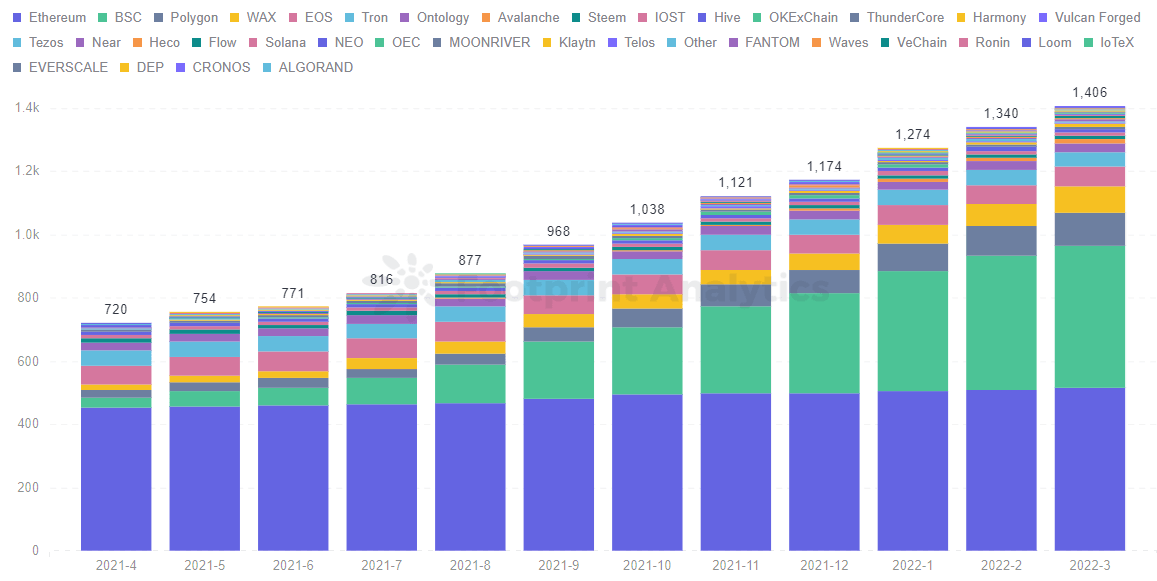
Looking at the overall development of GameFi, many blockchains and gaming projects have emerged in the past year. According to Footprint Analytics, as of March 31, there were 35 blockchains participating in the GameFi sector, with 1,406 game projects in total, up 5% MoM.
Footprint Analytics - Number of GameFi Protocols by Chains

Footprint Analytics – Number of GameFi Protocols by Chains

Although most of the early projects were concentrated on Ethereum, due to the impact of network congestion and high gas fees, the poor user experience slowed down the pace of development. Instead, on-chain gaming projects such as BSC, Polygon, WAX and EOS are gradually increasing.

Notably, BSC has the fastest growing project count, up 1303% YoY. It has low gas fees and a throughput 5 times higher than Ethereum, with 449 gaming projects deployed on BSC by the end of March.

At the same time, some chain’s have faced the problem of having one project driving the entire ecosystem. 

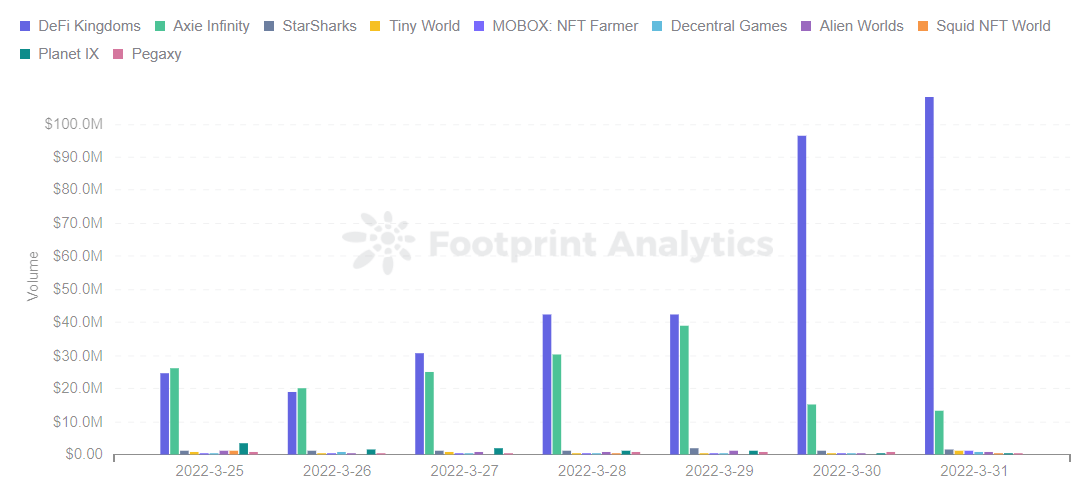
For example, Splinterlands has single-handedly driven the development of Hive, which has been a Top 5 GameFi project by number of users for the past three months. There is also DeFi Kingdoms on Harmony, which surpassed Axie Infinity multiple times in March in daily trading volume the become the largest project according to this metric.
Footprint Analytics - Top 10 Games Ranking by Volume

Footprint Analytics – Top 10 Games Ranking by Volume

GameFi’s Trading Volume Picks Up, Active Users Up 56% MoM

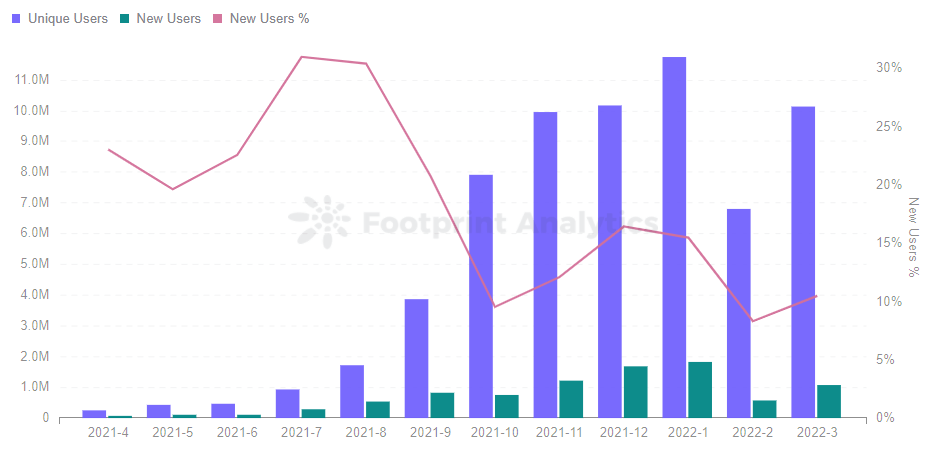
The number of users is the key to the healthy operation of the entire GameFi ecosystem. If there are no users, the game project will become worthless. As of March 31, the total number of active users was 10.96 million, including 1.27 million new users. Compared to February, the number of active users increased by 56%.
Footprint Analytics - Monthly Gamers Trend

Footprint Analytics – Monthly Gamers Trend
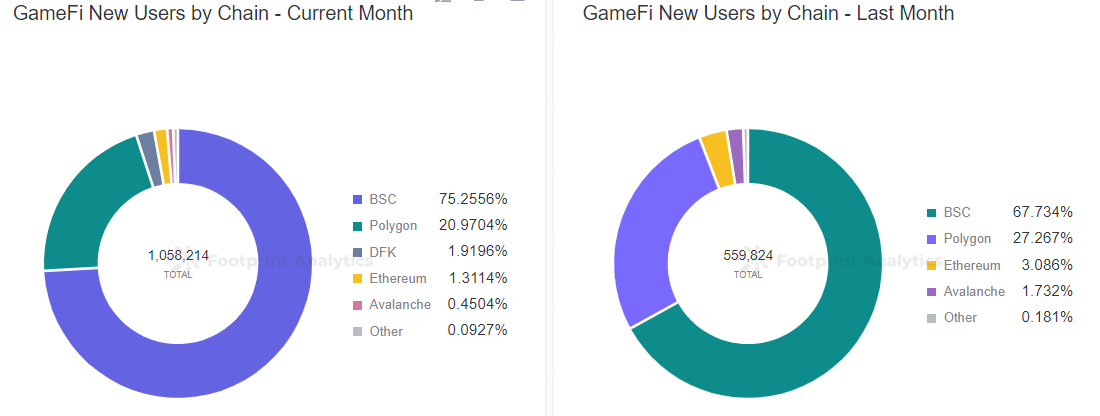
Footprint Analytics - GameFi New Users by Chain 

Footprint Analytics – GameFi New Users by Chain

Par War Online and DeFi Kingdoms are the games that are driving GameFi’s rapid growth in active users. In the last 30 days, active user growth has been 28,931% and 25,319%, respectively. These two games are attracting users primarily because of their high revenue generation opportunities, such as the 300% to 400% APY LP for DeFi Kingdoms.

According to Footprint Analytics data, GameFi’s trading volume has been on a downward trend due to the Russian-Ukrainian conflict. It was only after March 21 that volume picked up quickly, ending the month at $129 million, up 154 percent from February. It gradually recovered from a per capita volume of about $30 to $105 per capita.
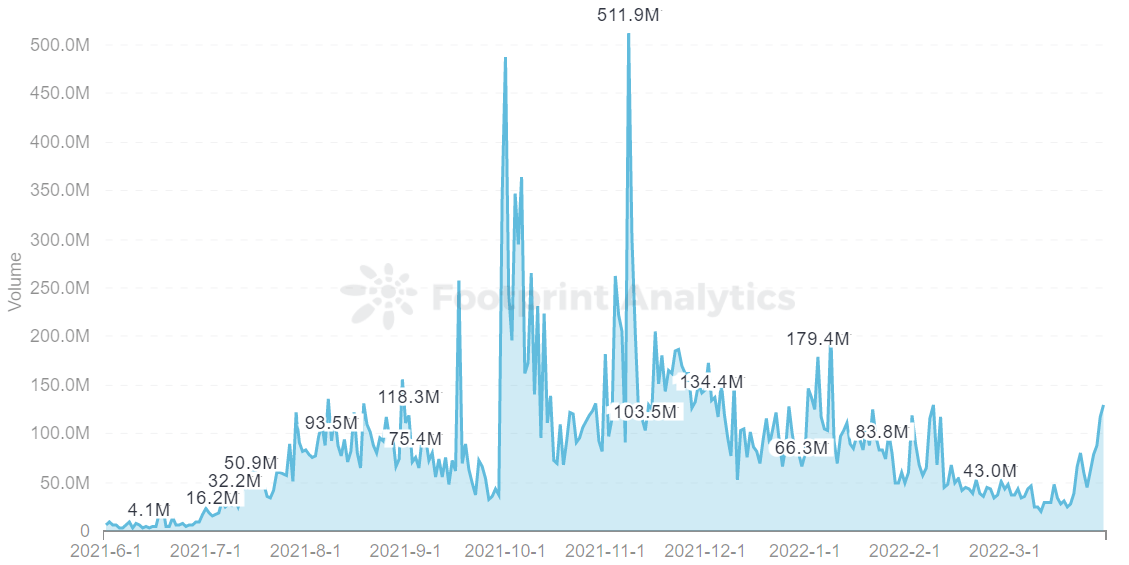
Footprint Analytics - GameFi of Volume Trend

Footprint Analytics – GameFi of Volume Trend
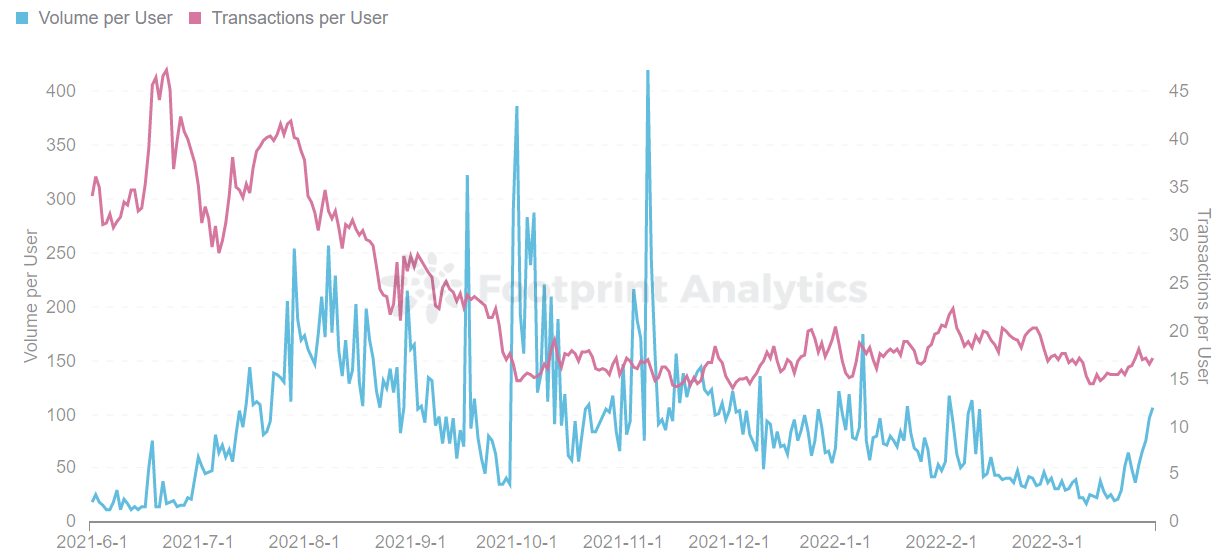
Footprint Analytics - GameFi Volume and Transactions per User

Footprint Analytics – GameFi Volume and Transactions per User

As can be seen, although the GameFi market showed a downward trend in transaction volume due to the macroeconomic impact, it quickly rebounded after late March with more new users engaging in the GameFi sector. This means that sensible tokenomics and products can create games that engage users.

GameFi Monthly Investment Volume Increased 307% MoM

The data shows that GameFi investments in March were $458 million, an increase of 307% compared to February. In terms of investment sector, NFT and Web3 in the GameFi category saw the largest increases. 

As the number of GameFi protocols increases, the influx of blockchains such as BSC has broken the slow pace of Ethereum in the GameFi sector, contributing to the continued inflow of funding.
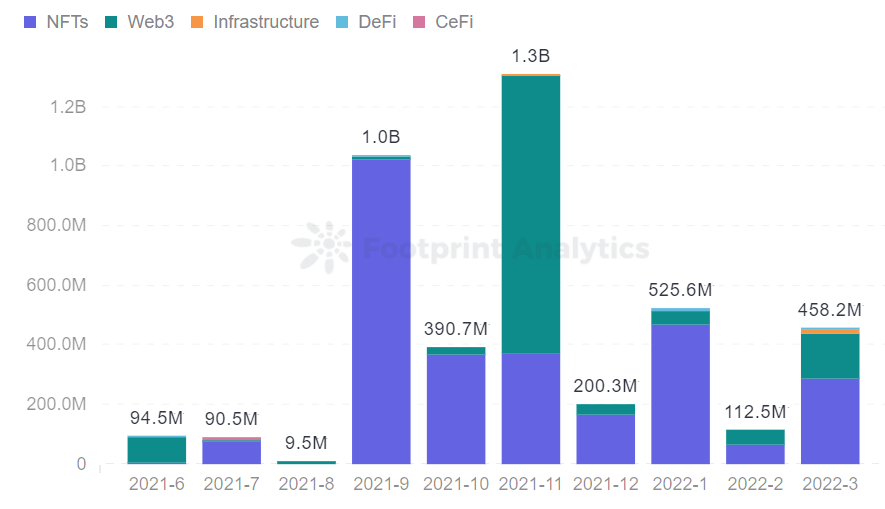
Footprint Analytics - Gaming Financing distribution

Footprint Analytics – Gaming Financing distribution

The financing received by GameFi projects mainly comes from seed rounds, the main reason behind this phenomenon is that the GameFi industry is in the early stage, and the development cycle of quality game projects is long, which is also the trend cycle for investors to observe the industry.
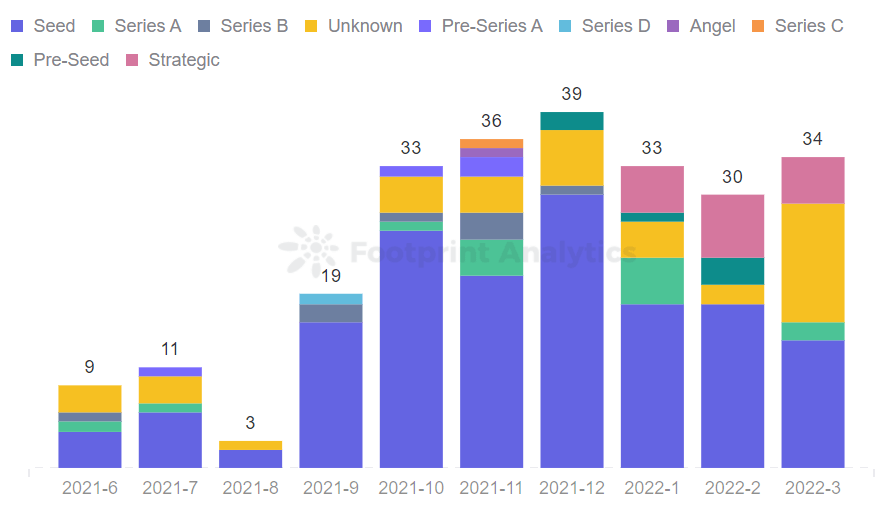
Footprint Analytics - Monthly Number of GameFi Projects Funded

Footprint Analytics – Monthly Number of GameFi Projects Funded

Game Projects That Accelerate GameFi’s out of the Circle in March

Footprint Analytics believes that GameFi is one of the most effective means of attracting new users into crypto. Opportunities with stronger gameplay and higher yields will become the main focus in GameFi in the future. 
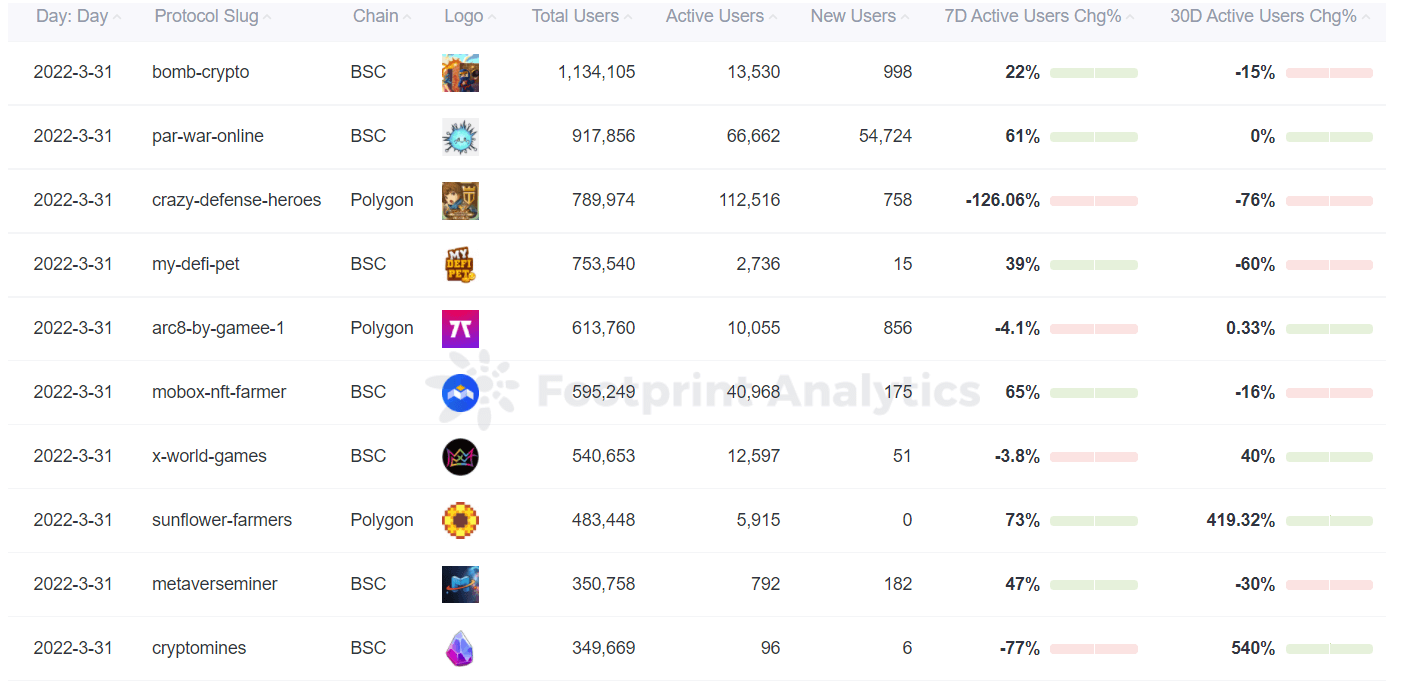
Footprint Analytics -  Ranking of Daily Gamers (March 31)

Footprint Analytics –  Ranking of Daily Gamers (March 31)

Hot Game Projects

Having a multi-game ecosystem and interoperability between games is more attractive for user participation. 

From the number of users and the number of transactions, it can be seen that in March, there were many GameFi projects in which users participated in transactions. But the more popular ones were DeFi Kingdoms, StarSharks and Thetan Arena. The number of users and transactions of the three game projects are on the rise.
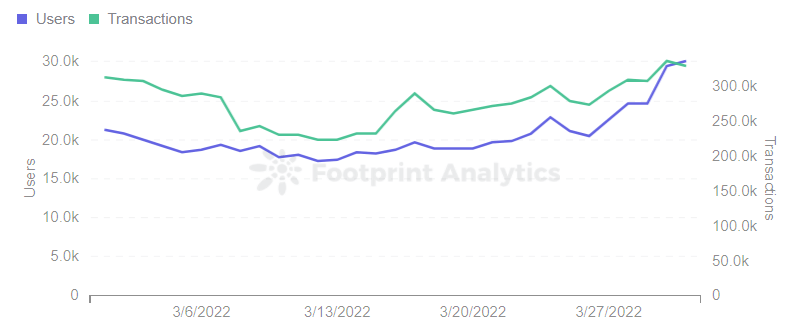
Footprint Analytics -  DeFi Kingdoms Users & Transactions

Footprint Analytics –  DeFi Kingdoms Users & Transactions

Thetan Arena has rapidly gained new users with its strong gameplay, mobile support, short game time (3 to 5 minutes per round), and low entry cost.
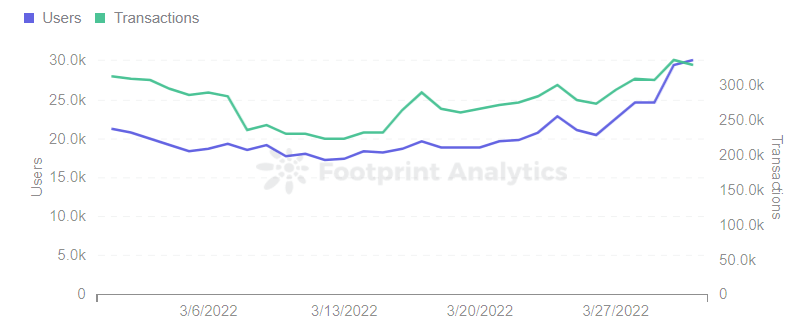
Footprint Analytics -  Thetan Arena Users & Transactions

Footprint Analytics –  Thetan Arena Users & Transactions

Starsharks is the BSC project with the largest user growth. It leverages the innovative Rent to Play model, where players can buy or rent NFTs through the platform’s native leasing feature to facilitate full utilization and liquidity of NFT assets.
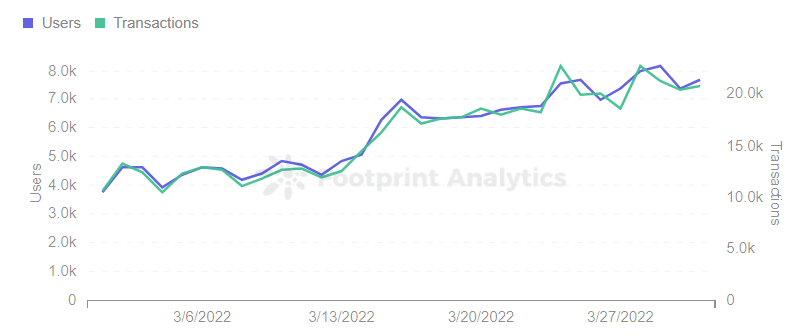
Footprint Analytics -  StarSharks Users & Transactions

Footprint Analytics –  StarSharks Users & Transactions

Starsharks’ retention rate in March was 13%, and the overall user retention rate is declining. By comparison. Cryptokitties (a popular Ethereum chain game) had a retention rate of 1.2% in March. 

This shows that innovation and project liquidity are important to retain users.
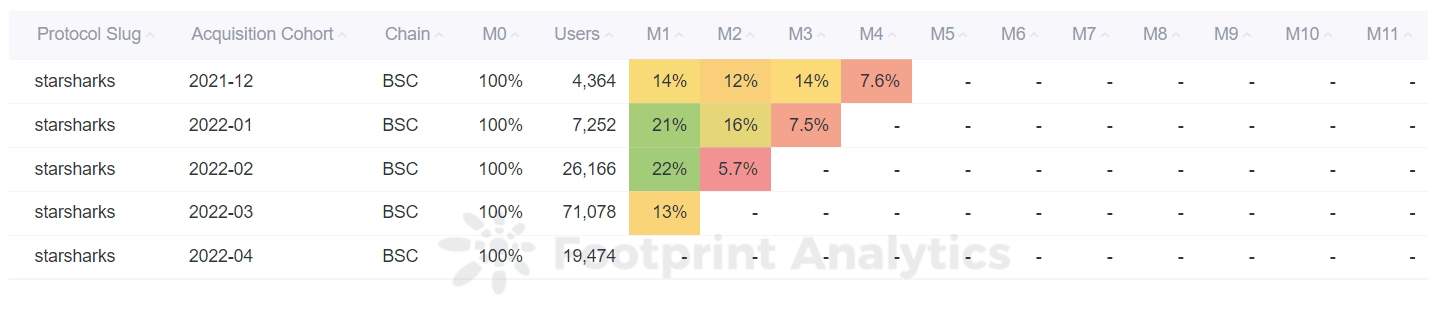
Footprint Analytics -  Starsharks Monthly Retention Analysis

Footprint Analytics –  Starsharks Monthly Retention Analysis
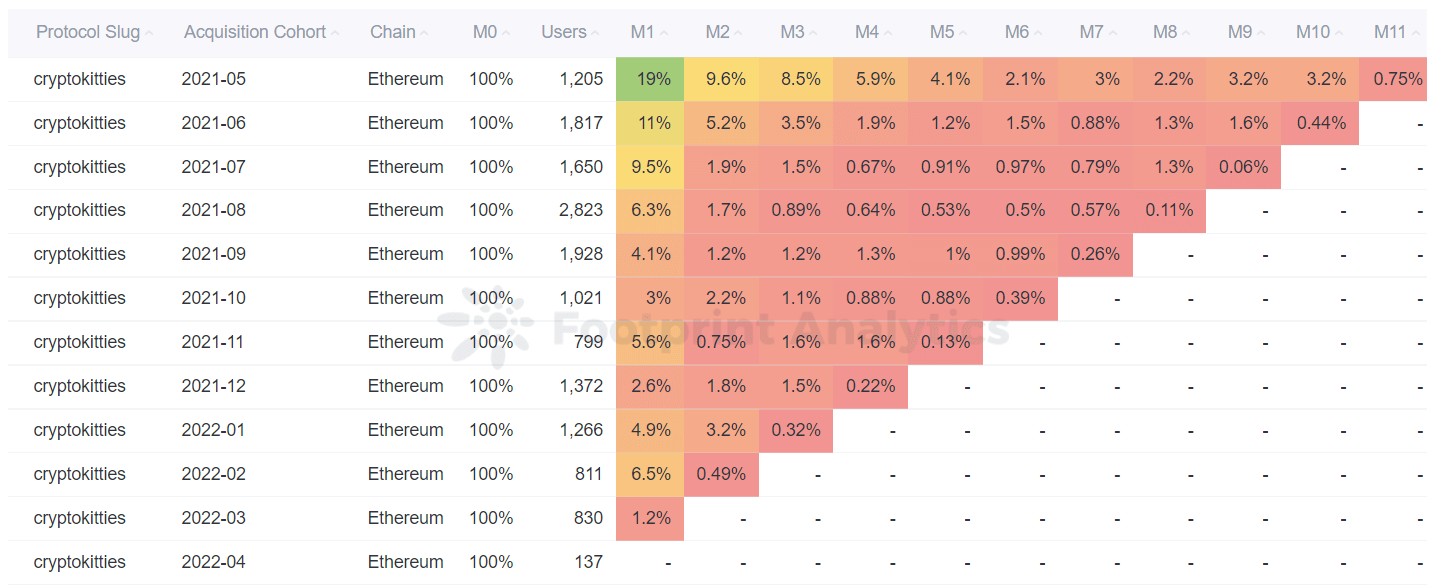
Footprint Analytics -  Cryptokitties Monthly Retention Analysis

Footprint Analytics –  Cryptokitties Monthly Retention Analysis

Game Items with a Crash in the Number of Users

According to Footprint Analytics data, MetaverseMiner’s user numbers and transactions are crashing. Once players earn less revenue (in terms of a stable token or fiat), highly experimental games like this often face the loss of traffic.
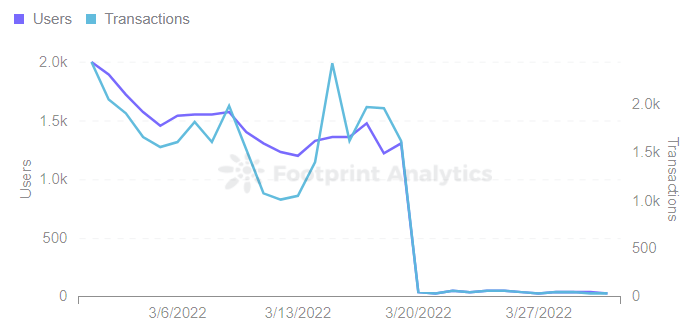
Footprint Analytics -  MetaverseMiner Users & Transactions

Footprint Analytics –  MetaverseMiner Users & Transactions

March also saw one of the largest security breaches in GameFi history. On March 23, cybercriminals stole $622 million from Axie Infinity users in cryptocurrency. As a result, the number of users decreased.
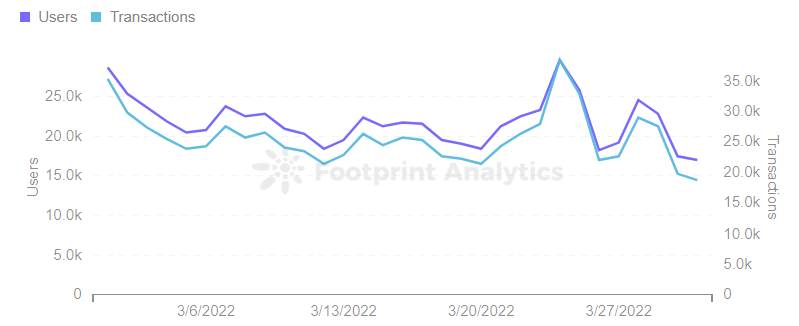
Footprint Analytics -  Axie Infinity Users & Transactions

Footprint Analytics –  Axie Infinity Users & Transactions

Похожее

China's First Embodied Data Compliance Outbound: How Does Paxini Become a Game-Changer for Industry Development?

"Embodied Intelligence Data Compliance Goes Global: A Breakthrough Moment. At the 2026 World Intelligent Industry Expo, Paxini, the sole Chinese company authorized for cross-border embodied data transfer, launched a pioneering project in Tianjin. This marks the first officially approved case of its kind in China, resolving a major industry bottleneck for compliant international data flow. As the ultimate direction of AI evolution, embodied intelligence relies on vast, multi-modal physical world interaction data. Despite booming global demand, stringent compliance had previously trapped the domestic industry. Paxini's breakthrough establishes a formal compliance framework, setting a benchmark for standardized development. The core of Paxini's success lies in its industry-leading data infrastructure and compliant security architecture, aligning with national data strategy. It operates a large-scale 'data collection factory' for high-quality, multi-modal data and has established a full-chain compliant pathway from 'collection-processing-certification-outbound transfer'. This dual advantage in data scale/quality and compliance secures its leadership. Beyond immediate commercial impact, the project signifies long-term strategic value: international market validation from top-tier financial institutions and the compounding benefits of ecosystem building. High-quality physical world data possesses enduring value. By solving fundamental infrastructure and compliance challenges, Paxini not only contributes a 'Chinese model' to the global embodied intelligence industry but also solidifies a key competitive moat for the long haul. This enables safe, efficient global flow of China's quality embodied data, amplifying its influence in the intelligent manufacturing landscape."

marsbitТолько что

China's First Embodied Data Compliance Outbound: How Does Paxini Become a Game-Changer for Industry Development?

marsbitТолько что

Macroeconomic Origins of the African Payments Market Structure

Africa’s payment landscape exhibits the world’s highest mobile money penetration and fastest cryptocurrency adoption. This is not a market anomaly but a macroeconomic inevitability driven by deep structural factors: a vast, young population, heavy reliance on commodity exports and remittances generating massive cross‑border payment needs, and a chronically underdeveloped formal banking system plagued by de‑risking, high inflation, and currency instability. This vacuum has allowed mobile money (e.g., M‑Pesa) to become the primary payment channel domestically, while cryptocurrencies—particularly stablecoins—serve as a store of value against local‑currency depreciation and a lower‑cost cross‑border medium. The key divide is the Sahara: North Africa integrates with the MENA oil‑centric financial system, while Sub‑Saharan Africa, facing acute dollar shortages and fragmented currencies, is the epicenter of this fintech surge. Structural reliance on dollars, driven by trade deficits and weak local currency credibility, creates persistent dollar scarcity, which crypto and mobile payments effectively address. Efforts like the Pan‑African Payment and Settlement System (PAPSS) aim at de‑dollarization, but these alternatives will remain essential as long as underlying economic constraints—commodity dependence, limited industrialization, and financial exclusion—persist.

marsbit12 мин. назад

Macroeconomic Origins of the African Payments Market Structure

marsbit12 мин. назад

AAOI Defies Trend with Over 10% Surge, 'New Stock God' Serenity Predicts Potential to Double Again

On June 4th, despite a significant sell-off in the broader AI and semiconductor sector triggered by Broadcom's disappointing guidance, Applied Optoelectronics (AAOI) surged over 11%, showcasing a sharp divergence in market sentiment. Broadcom's warning about potential supply chain diversification by key customer Google and a weaker-than-expected outlook punctured the high-flying AI valuation narrative. This led to heavy selling in names like Broadcom (-12.6%) and Micron (-7%), with funds rotating into traditional industrial stocks. AAOI defied this trend. The stock has experienced high volatility recently, driven by bullish analyst coverage, notably from Rosenblatt which raised its price target to $220. Key catalysts include initial 800G optical module revenue from Amazon, potential certification from Oracle, and strong demand across its product portfolio. The company has reported cumulative orders for 800G/1.6T modules exceeding $324 million and is aggressively expanding manufacturing capacity in Texas, targeting an annualized run-rate of $1.4 billion for its module business by Q3 2027. However, AAOI's fundamentals present a mixed picture. Its Q1 2026 results missed expectations, showing a GAAP net loss, and Q2 guidance points to merely breakeven adjusted EPS. Risks include a delayed 800G production ramp to the second half of the year and high dependence on a few key cloud customers. Recent stock sales by company executives near price highs also noted. The article suggests AAOI's rally reflects a market beginning to differentiate within the AI ecosystem. While Broadcom's issues prompted a reassessment of custom ASIC and customer concentration risks, funds flowing into AAOI indicate a belief that the "physical bottleneck" narrative for optical connectivity—where supply remains tight—remains intact and is somewhat decoupled from the current sector weakness. The sustainability of AAOI's premium valuation now hinges on the successful execution of its production plans and upcoming quarterly results.

marsbit19 мин. назад

AAOI Defies Trend with Over 10% Surge, 'New Stock God' Serenity Predicts Potential to Double Again

marsbit19 мин. назад

Торговля

Спот
Фьючерсы
活动图片