10 Charts to Understand the State of AI in 2026: US-China Gap Only 2.7%, Sharp Decline in Programmer Positions for Under-25s

marsbitОпубликовано 2026-04-15Обновлено 2026-04-15

Введение

The 2026 AI Index Report from Stanford HAI reveals that AI adoption is accelerating faster than PCs and the internet, with a 53% global adoption rate. However, societal systems, job markets, and measurement tools lag behind. Key findings include: - Benchmark reliability is questionable, with 42% of GSM8K math problems deemed invalid. - The U.S. and China show near-parity in model performance (2.7% gap), with the U.S. leading in compute/capital and China in research/manufacturing. - Top models (Anthropic, xAI, Google, OpenAI) show converging capabilities, shifting competition to cost and reliability. - Employment for young developers (22–25) fell nearly 20%, with McKinsey noting AI-driven reductions in services, supply chain, and engineering. - The U.S. ranks 24th in adoption (28.3%) despite leading investment ($285.9B private AI funding in 2025). - AI agent task success improved but has ~33% failure rates; physical robots struggle outside labs (12.4% home success vs. 89.4% in sim). - A stark expert-public divide exists: 73% of experts vs. 23% of the public view AI’s job impact positively. - GPT-4o’s annual water use exceeds 12M people’s needs; AI data centers consume power equivalent to New York State. The report underscores rapid AI integration amid unresolved ethical, environmental, and economic challenges.

Stanford HAI (Human-Centered Artificial Intelligence Institute) has just released the 2026 AI Index Report, the most authoritative annual check-up for the AI field. Over the past year, Stanford researchers, through a series of observations, reached a core conclusion: AI is being adopted globally at a pace surpassing that of the PC and the internet, but human society's institutions, job markets, and measurement tools are lagging behind comprehensively.

AI is sprinting, while humanity is still looking for its shoes. Ten charts show you where AI is running faster than humans.

1

The Tests Used to Measure AI Are Themselves Useless

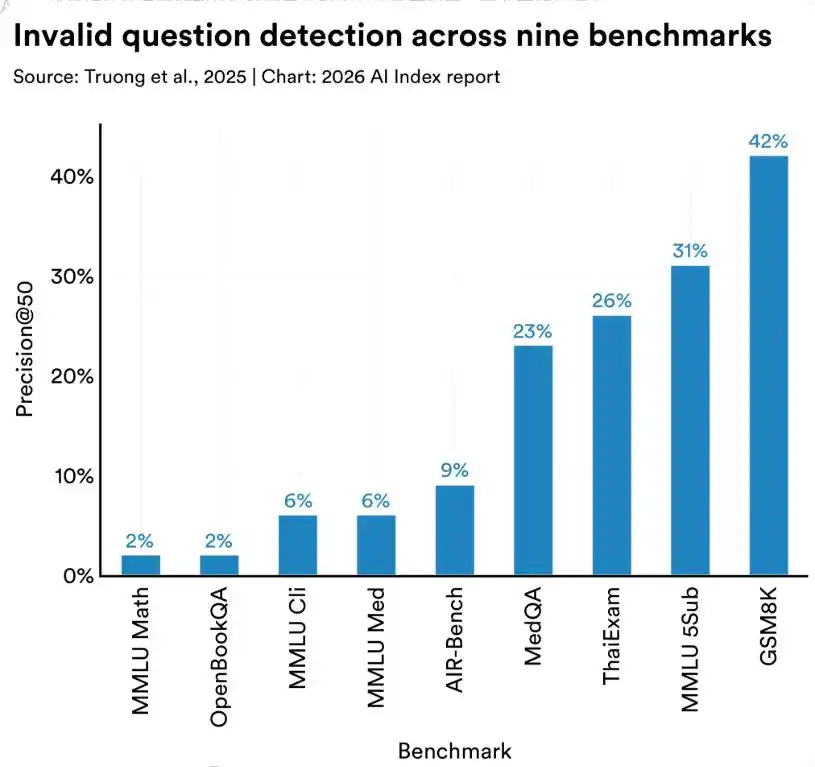
Headlines like "AI Surpasses Humans" are all based on the credibility of benchmarks. But the Stanford report found that nearly 42% of the questions in the widely used math benchmark GSM8K are invalid. Other tests are also suspected of being "gamed"; models can score high after being trained on the test data, but that doesn't mean they've gotten smarter. Many companies refuse to disclose relevant benchmark results. Gil, one of the report's authors, said: "The refusal to disclose results might itself say something."

2

The Substantial US-China Gap Disappeared, Only 2.7% Difference

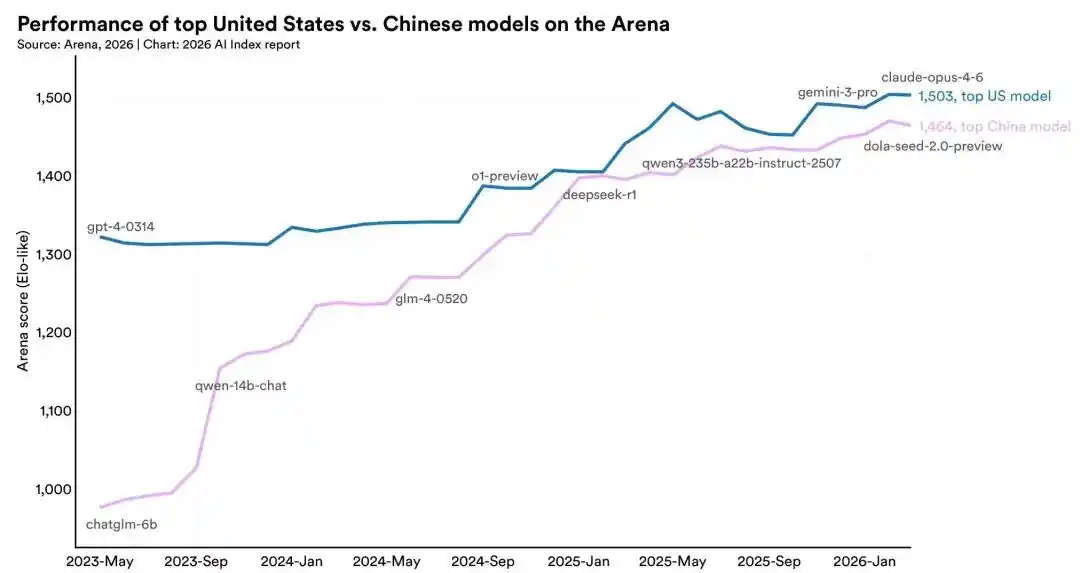
As of March 2026, the Elo rating of the US's strongest model, Claude Opus 4.6, is 1503, with China's strongest model close behind, a gap of only 2.7%. Over the past year, the models from the two countries have taken the lead multiple times. In February 2025, DeepSeek R1 once caught up to the US's strongest model.

However, the AI advantages of the two countries are completely different. The US has stronger models, more capital, and owns 5,427 data centers, more than 10 times that of any other country. China leads in AI research papers, patents, and robot deployment. Simply put, the US wins in computing power and money, China wins in research and manufacturing.

3

Frontier Models Converge, Intelligence Levels Comparable

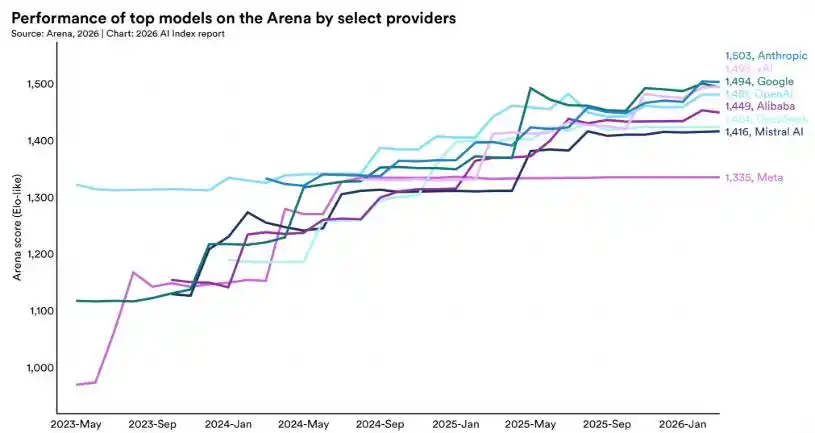
As of March 2026, Anthropic (1503), xAI (1495), Google (1494), and OpenAI (1481) are squeezed into an extremely narrow range. This means "whose model is stronger" is no longer the focus of competition. The focus of competition is shifting to cost, reliability, and optimization for specific domains—this also explains why Anthropic is working on Advisor Tools (to reduce costs), Google is buying Wiz (cloud security), and OpenAI is buying various application-layer companies (to expand scenarios). As the models' own performance converges in intelligence, differentiation must be created elsewhere.

4

Employment for 22-25 Year Old Developers Drops Nearly 20%

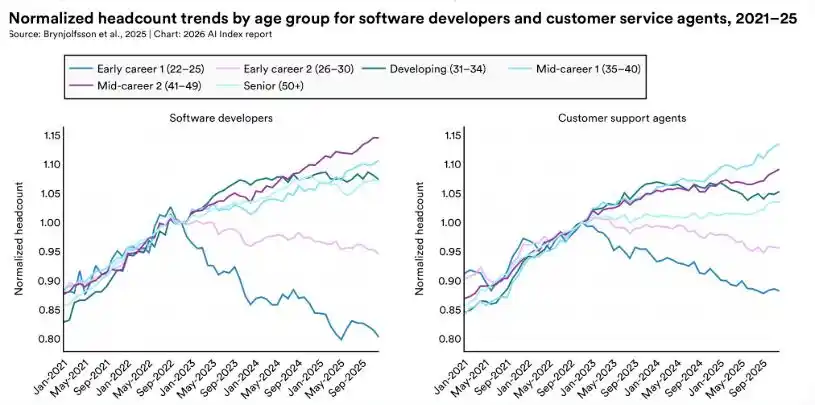
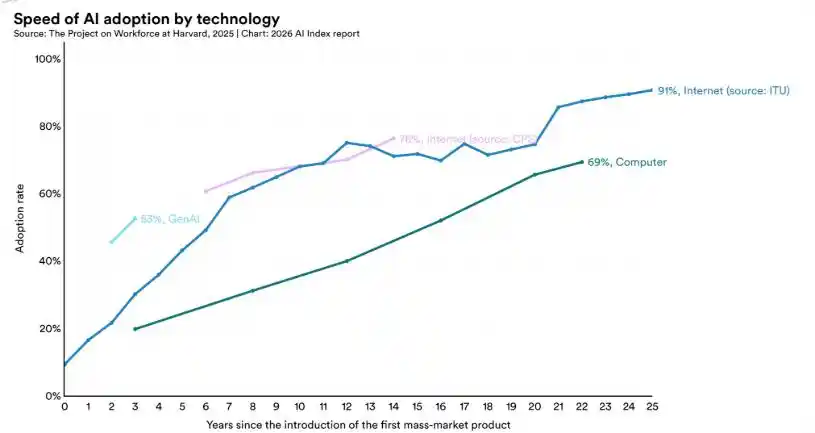
Generative AI achieved an adoption rate of over 53% at the population level within three years, and 88% of organizations are already using AI. But the employment impact is not even. A 2025 study by Stanford economists found that employment of software developers aged 22-25 has fallen by nearly 20% since 2022, while older demographics are still growing. A McKinsey 2025 survey showed that 1/3 of organizations expect to reduce staff due to AI in the next year, with cuts concentrated in service operations, supply chain, and software engineering.

Overall data does not yet show mass unemployment, but this is enough to show that the job market is like a frog in slowly heating water; the crisis is growing gradually.

5

Adoption Speed Surpasses PC and Internet, US Ranks Only 24th

Generative AI reached a 53% population-level adoption rate within three years, a speed that surpassed the personal computer and the internet. But the most counterintuitive data point is: The US leads the world in AI investment and model development, but its population adoption rate is only 28.3%, ranking 24th globally. UAE 64%, Singapore 60.9%. The country that spends the most, uses it the least.

6

Global AI Investment $581.7B, US is 23 Times China's, But...

Global corporate AI investment reached $581.7 billion in 2025, a year-on-year increase of 129.9%. US private AI investment was $285.9 billion, 23 times that of China and 48.5 times that of the UK. California alone accounts for over 75% of the US total. Large deals are also dense: OpenAI raised $40 billion, valuation $300 billion; Anthropic raised $13 billion, valuation $183 billion; Cursor raised $2.3 billion at a $29.3 billion valuation.

However, there is a hidden piece of information: Domestically (in China), state-owned funds injected approximately $184 billion into AI companies between 2000 and 2023; this money was not counted in the private investment statistics. Adding this part, the funding gap between the US and China might be much smaller than the numbers on paper suggest.

7

AI Agent: From Chatting to Doing, But Still Has 1/3 Failure Rate

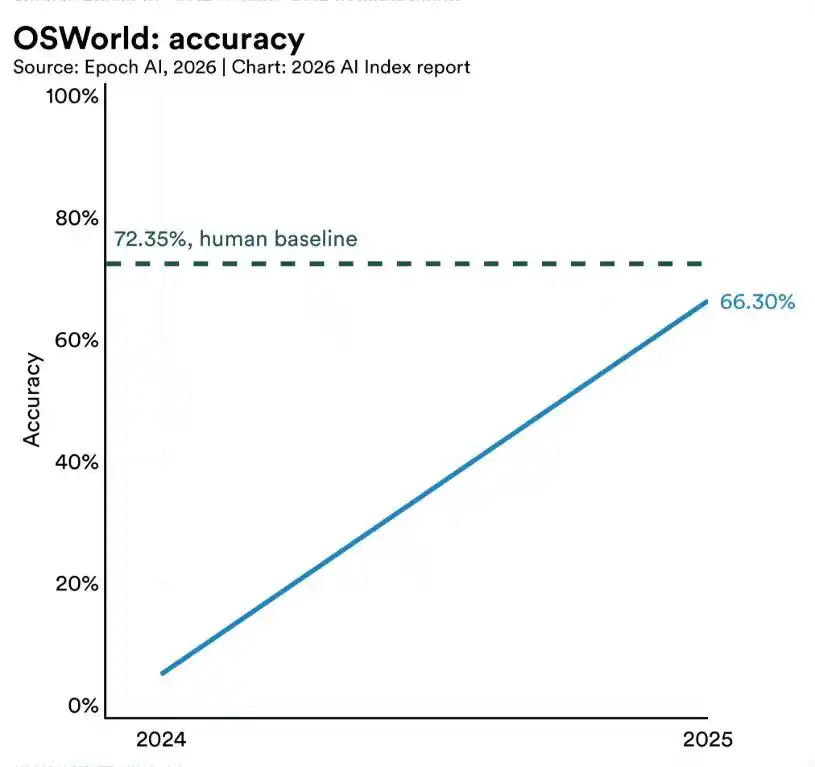
2025 was the year of the AI Agent. Accuracy on OSWorld (testing AI's ability to complete tasks on an operating system) soared from 12% to 66.3%, only 6 percentage points away from human performance. WebArena reached 74.3%, Cybench (cybersecurity tasks) surged from 15% to 93%.

But overall, Agents still have about a 1/3 failure rate. And actual enterprise deployment is still in the single digits—in most business scenarios, over 2/3 of respondents said they do not use AI Agents at all. There is still a big gap between progress on benchmarks and actual deployment.

8

89% of Robots Live in the Lab

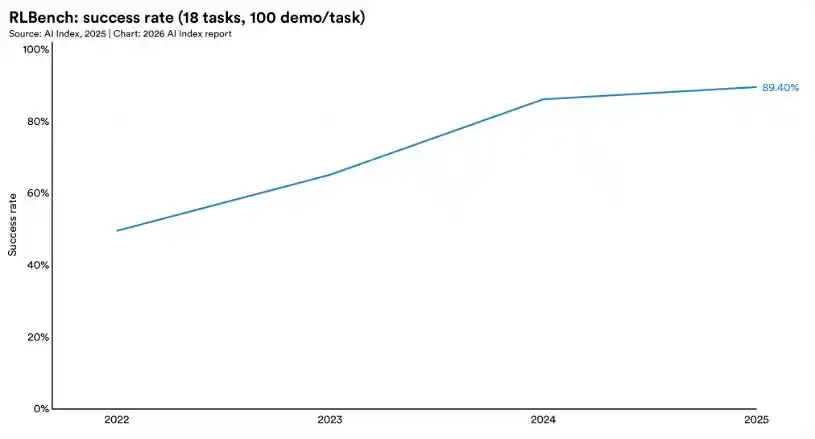
AI is already very strong in the virtual world, but still very weak in the physical world. The success rate for robot manipulation in software simulation environments is 89.4%, but the success rate for real-world household tasks is only 12.4%. One is a clean lab, the other is a messy home; in the latter kind of real environment, robot participation is still negligible.

However, autonomous driving is an exception: Waymo has about 450,000 trips per week, Apollo Go completed about 11 million fully driverless trips in 2025.

9

Experts vs Public: 73% vs 23% Cognitive Divide

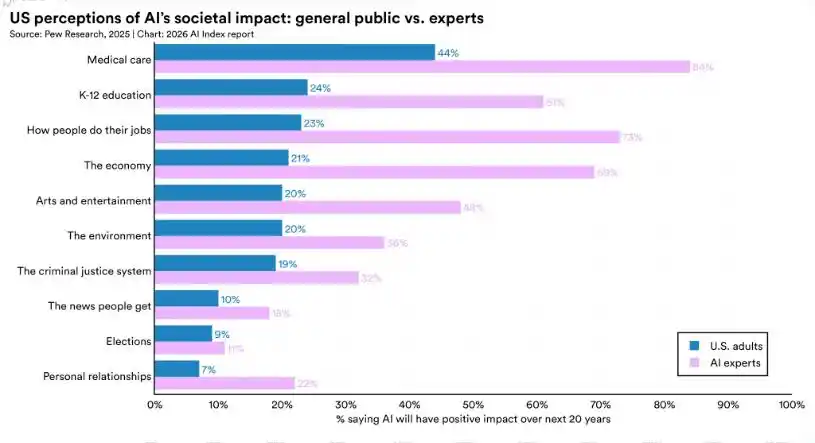
A Pew survey cited in the report reveals a startling divide: 73% of AI experts believe AI will have a positive impact on jobs, but only 23% of the American public thinks so—a complete polarization.

Another interesting data point: Among all countries surveyed, Americans have the lowest trust in government regulation of AI. Experts are also more optimistic about AI's prospects in education and healthcare, but both sides believe AI will harm elections and interpersonal relationships.

10

GPT-4o Uses Water for Over 12M People Annually, Electricity Could Power Entire New York State

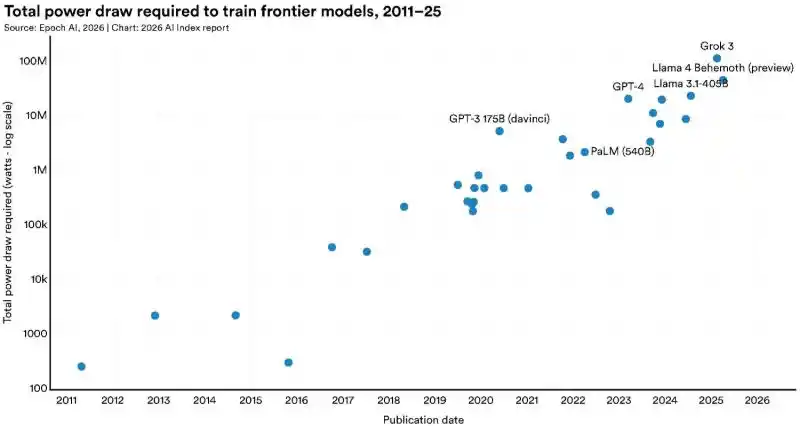
AI's progress comes at an environmental cost. Global AI data centers can now draw 29.6 GW of power, an amount sufficient to power the entire state of New York during peak usage. The annual water consumption of OpenAI's GPT-4o model alone could exceed the drinking water needs of over 12 million people.

These massive consumptions are injected into model training after model training, yet the chip supply chain behind the models is extremely fragile. The US owns most of the world's AI data centers, but almost every cutting-edge AI chip is manufactured by a single company, Taiwan's TSMC. All the computing power, all the investment, all the model progress, is built on this physical foundation.

The above is just the tip of the iceberg of the report, but it is enough to see that we are "embracing" a technology we don't fully understand at the fastest speed in history.

The full report covers more dimensions including AI safety, regulatory dynamics, research trends, and more. Highly recommended for interested friends to read the full original report. Link 👉🏻: https://hai.stanford.edu/ai-index

This article is from the WeChat public account "APPSO", author: APPSO Discovering Tomorrow's Products

Связанные с этим вопросы

QWhat is the core conclusion of the 2026 AI Index Report from Stanford HAI regarding the adoption of AI?

AThe core conclusion is that AI is being adopted globally at a speed surpassing that of the PC and the internet, but human institutions, job markets, and measurement tools are lagging behind.

QAccording to the report, what is the performance gap between the top AI models from the US and China as of March 2026?

AThe performance gap between the top US model (Claude Opus 4.6) and the top Chinese model is only 2.7% in Elo rating.

QWhat significant trend is reported regarding employment for young software developers aged 22-25?

AEmployment for software developers aged 22-25 has declined by nearly 20% since 2022, while employment for older age groups has continued to grow.

QHow does the generative AI adoption rate compare to the adoption rates of personal computers and the internet?

AGenerative AI achieved a population adoption rate of over 53% within three years, a speed that exceeds the adoption rates of both personal computers and the internet.

QWhat is the reported failure rate for AI Agents in 2025, and what does this indicate about their real-world deployment?

AAI Agents had an overall failure rate of about one-third. This high failure rate, along with the fact that most businesses reported no use of AI Agents, indicates a significant gap between benchmark progress and actual real-world deployment.

Похожее

The Age of Decoupling Has Arrived: Bitcoin is No Longer the Sole Compass of Crypto

The era of the cryptocurrency market moving in lockstep with Bitcoin is ending, as the industry splits into two distinct asset categories: endogenous and exogenous. Endogenous assets, like Bitcoin, derive value purely from the crypto market's cycles. Their narratives swing between being "interstellar money" in bull markets and "digital collectibles" in bear markets. Exogenous assets, however, are nominally crypto but operate with independent value drivers. Examples include: * **Venice:** An AI inference service using tokens for payments; its consumer-AI business model is decoupled from crypto price swings. * **Figure:** A fintech lender using blockchain to speed up loan approvals; its core value is in credit, not crypto. * **Stablecoin firms like BVNK:** Acquired by traditional finance giants (Mastercard, Stripe), their growth is tied to payment infrastructure, not market cycles. Hybrid projects like **Hyperliquid** (a decentralized exchange) show a shift, with a growing share of non-crypto trading (e.g., prediction markets). This divergence is fundamental. Endogenous assets remain highly correlated to Bitcoin, similar to gold miners to gold. Exogenous assets are evolving to have their own fundamentals, like the weak correlation between gold and the S&P 500. This changes investment analysis. Evaluating exogenous assets requires traditional fundamental research—assessing user bases, unit economics, and moats—more akin to fintech investing than charting Bitcoin. Promising exogenous sectors include: on-chain exchanges/brokers, AI-crypto fusion, privacy-focused digital banks, lending (institutional/private credit), stablecoins/real-world asset tokenization, payment rails, and non-financial crypto-consumer products. Currently, investing via equity is often safer than via tokens, as token value accrual mechanisms need further regulatory and industry development (e.g., the CLARITY Act). Nonetheless, the core trend is clear: crypto market drivers are diversifying from a single factor (Bitcoin) to multiple fundamentals, ending the era of uniform market moves.

marsbit46 мин. назад

The Age of Decoupling Has Arrived: Bitcoin is No Longer the Sole Compass of Crypto

marsbit46 мин. назад

Five Cryptos That Could Outperform Bitcoin Over the Next Cycle Due To Higher Growth Velocity

Bitcoin's growth often sets market trends, but analysts believe the next cycle's highest percentage gains may come from assets with greater growth velocity. While Bitcoin provides stability, several cryptocurrencies are positioned for stronger relative upside. This article highlights five such assets, with a particular focus on Ozak AI as the potential high-growth standout of the cycle. Ethereum (ETH) is noted for its ongoing evolution and institutional adoption. Solana (SOL) is recognized for its high throughput and history of sharp rallies. Chainlink (LINK) is highlighted as essential infrastructure for DeFi and AI applications. Avalanche (AVAX) is mentioned for its subnet architecture and enterprise potential. Ozak AI ($OZ) is presented as a distinct early-stage opportunity, currently in presale at $0.014 with a target listing price of $1.00. The project is building a full AI-native blockchain ecosystem, including prediction agents, a data stream network, and structured data vaults. Analysts suggest its early valuation stage and focus on AI infrastructure could allow for exponential growth velocity compared to more mature assets like Bitcoin, which requires massive capital inflows for significant price movement. The final takeaway positions Ozak AI as a high-asymmetry bet for investors seeking exponential upside alongside more stable assets.

TheNewsCrypto1 ч. назад

Five Cryptos That Could Outperform Bitcoin Over the Next Cycle Due To Higher Growth Velocity

TheNewsCrypto1 ч. назад

What's New in Jensen Huang's 'Agent Factory'?

In a keynote at COMPUTEX 2026, NVIDIA CEO Jensen Huang shifted the company's focus from hardware "full-stack" solutions to the era of AI Agents. The centerpiece is the Vera Rubin platform, now in production, which is designed specifically for Agent workloads and offers 10x the efficiency of its predecessor. The platform features the new Vera CPU, built for AI, and incorporates Spectrum-X Ethernet Photonics with CPO technology for improved networking and energy efficiency. NVIDIA introduced DSX, an integrated toolkit for designing, simulating, and operating AI data centers, aiming to streamline "AI factory" deployment and management. For end-user deployment, the company unveiled DGX Station for Windows, a desktop AI supercomputer for running Agents locally, and the RTX Spark SoC for AI PCs. On the software front, NVIDIA launched the 550B-parameter Nemotron 3 Ultra model for enterprise Agents and the Cosmos 3 foundation model for physical AI, unifying visual reasoning and action prediction. In robotics, a partnership with Unitree yielded the H2 Plus, a reference humanoid robot built on the Isaac GR00T platform to lower development barriers. Security was emphasized with enhanced confidential computing for Vera Rubin and new data path security features for the BlueField-4 STX storage platform. The presentation highlighted a strategic pivot: NVIDIA is reorganizing its entire technology stack—from chips and data centers to models, software, and robots—around the emerging ecosystem of autonomous, practical AI Agents.

marsbit1 ч. назад

What's New in Jensen Huang's 'Agent Factory'?

marsbit1 ч. назад

Торговля

Спот
Фьючерсы

Популярные статьи

Неделя обучения по популярным токенам (2): 2026 может стать годом приложений реального времени, сектор AI продолжает оставаться в тренде

2025 год — год институциональных инвесторов, в будущем он будет доминировать в приложениях реального времени.

1.8k просмотров всегоОпубликовано 2025.12.16Обновлено 2025.12.16

Неделя обучения по популярным токенам (2): 2026 может стать годом приложений реального времени, сектор AI продолжает оставаться в тренде

Обсуждения

Добро пожаловать в Сообщество HTX. Здесь вы сможете быть в курсе последних новостей о развитии платформы и получить доступ к профессиональной аналитической информации о рынке. Мнения пользователей о цене на AI (AI) представлены ниже.

活动图片