Shorting the Prediction Market

marsbitPublished on 2025-12-08Last updated on 2025-12-08

Abstract

The author critiques the growing influence of prediction markets, arguing they distort truth and social reality rather than reflect it. While proponents claim these markets, fueled by real-money bets, offer a more accurate alternative to traditional polls and expert opinions, the author contends they operate like a Keynesian “beauty contest,” where participants bet on what others will think rather than on objective truth. This dynamic, combined with a lack of natural hedgers, creates a system dominated by insiders and doomed to collapse once “dumb money” is exhausted. The piece highlights how large bets can manipulate outcomes by influencing media coverage and public perception, turning probability signals into self-fulfilling prophecies. This undermines social stability, as the markets incentivize disruption rather than security. The author posits that society is reaching a peak in “gambling culture” and predicts a eventual rejection of hyper-financialization in favor of real-world experiences and deeper human connections. Ultimately, to “short” prediction markets is to go long on human agency and life itself—choosing to step away from the virtual casino and back into the sunlight.

I am not a gambler, nor do I understand the thrill of watching candlestick charts with a racing heart. But when CNN and CNBC announced that they were integrating digital odds from prediction markets into their news broadcasts, I felt as if we were being played by a new kind of "truth."

Crypto bros are evangelizing: traditional polls will be replaced, experts are the high priests of the old era, and only the odds built with real money can reflect the wisdom of the crowd and the truth of reality. However, the trading logic fostered by prediction markets aligns with the "beauty contest" described by Keynes—you no longer care about who is the most beautiful, you only care about "who others think is the most beautiful." The very concept of beauty is "deconstructed," much like Duchamp's urinal placed in an art museum. Prediction markets will continue to accelerate, lose control, until more and more清醒的人 start to "short" this frenzy, to "short" the narrative of prediction markets itself.

Exchanges and casinos are two distinctly separate worlds. Farmers worry about falling grain prices, downstream food processing plants worry about rising prices, so they come to the derivatives market to find someone willing to take on the risk. Because their needs differ, trading can flow.

Yet, in the context of prediction markets, such natural hedgers do not exist. This results in a market where, aside from market makers, there are only smart money with insider information and gamblers destined to be harvested: if a counterparty with an information advantage is willing to trade at that price, the trade is likely a loss for you. Once the "dumb money" is exhausted, liquidity quickly dries up. Since insider trading is allowed to exist on a large scale, prediction markets, without a constant influx of gamblers, are an unsustainable new Ponzi scheme.

In natural systems, the reading on a thermometer does not change the temperature; no matter how we bet, Halley's Comet will still return on schedule. But in social systems, probability itself has the power to "distort the stance of reality"; the greed of the observer can alter the observed reality.

Ethereum can ensure the "economic security" of its blockchain network through slashing mechanisms in staking, but prediction markets completely fail to ensure "social security." On the contrary, they even reward destruction.

If a billionaire heavily bets on an extreme event, they are effectively funding that outcome and using the market's probability signal to create panic or consensus. Massive capital can form a tremendous potential energy, coercing media coverage in reverse to influence public confidence, forcibly collapsing an outcome full of uncertainty into the form the bettor desires.
Kaito, which aimed to be an information distribution center, ended up becoming a broadcast station outputting only noise. Prediction markets tout themselves as telescopes to glimpse the future, yet they cannot stop themselves from becoming billboards that manufacture the future.

Many believe that, with relaxed regulations and an influx of capital, prediction markets are inevitably the next big trend. But things always go too far.

People are gradually realizing that we are at the peak of the "gambling culture" cycle.

Total financialization only brings nihilism. People will eventually grow tired of this high-frequency dopamine stimulation and return to the experience of life. We begin to turn off the screens, go hiking, touch real soil, read physical books, and build deep relationships beyond the screen.

"Shorting" the prediction market is not just going long on "human agency," it is also going long on "life."

Since we cannot return to the past, perhaps the only way out is to stop wasting energy at the virtual betting table and turn to step into the sunlight.


Related Questions

QWhat is the core argument the author makes against prediction markets?

AThe author argues that prediction markets are fundamentally flawed because they lack natural hedgers, are dominated by insiders and gamblers, can be manipulated by wealthy actors to influence outcomes, and ultimately promote a gambling culture that erodes genuine human connection and reality.

QHow does the author compare prediction markets to Keynes' 'beauty contest' analogy?

AThe author states that the trading logic of prediction markets aligns with Keynes' 'beauty contest,' where participants are not betting on what they believe is true (or beautiful) but on what they think others will believe is true, thereby dissolving the concept of intrinsic value or truth.

QWhat problem does the author identify regarding 'smart money' and 'dumb money' in prediction markets?

AThe author identifies that without natural hedgers, the market consists only of insiders ('smart money') with an information advantage and gamblers ('dumb money') who are likely to be harvested. If the supply of 'dumb money' gamblers dries up, the market's liquidity will quickly collapse.

QAccording to the author, how can a wealthy individual manipulate a prediction market and reality?

AA wealthy individual can place a massive bet on an extreme event, which provides funding and creates a powerful momentum for that outcome. This action can use the market's probability signal to manufacture panic or consensus, influence media coverage, and sway public confidence, thereby forcing a uncertain result to collapse into the outcome the bettor desires.

QWhat does the author suggest is the ultimate alternative to participating in prediction markets?

AThe author suggests that the ultimate alternative is to 'short' the prediction market narrative itself by turning away from the virtual betting table, stepping into the sunlight, and re-engaging with real-life experiences like hiking, reading physical books, and building deep relationships offline.

Related Reads

Blocked Its Own Treasure, WeChat AI Steps Up

Tencent's stock surged over 10% on June 2nd amid reports that WeChat, with 1.43 billion monthly users, is finalizing tests for a native AI Agent. The reported feature, accessible by swiping right from the main interface, allows users to issue commands in natural language. The AI then decomposes tasks and automatically calls upon relevant Mini Programs within WeChat to complete actions like ordering food, booking tickets, or making payments, creating a closed-loop service execution system. This strategic shift follows the internal conflict and subsequent "blocking" of Tencent's standalone AI app, Yuanbao, by WeChat for violating sharing rules during a 2026 Spring Festival promotion. The incident highlighted a lack of internal consensus and exposed the weakness of competing in the standalone AI assistant arena against rivals like ByteDance's Doubao (345M MAU) and Alibaba's Qianwen. The new WeChat AI Agent aims to leverage WeChat's unique assets—its massive user base, standardized Mini Program APIs, WeChat Pay, and identity system—to move from simple content generation to actual task execution. Analysts note this changes the competitive landscape from model benchmarks to which AI can connect to more real-world services. However, success depends on key variables: the capability of Tencent's underlying Hunyuan model, managing massive inference costs, and redesigning incentives for Mini Program developers whose traffic might be bypassed. The move is seen as an attempt to keep user service intent within WeChat's ecosystem as AI begins to redefine how users access services.

marsbit13m ago

Blocked Its Own Treasure, WeChat AI Steps Up

marsbit13m ago

ByteDance Adopts Arm CPUs, Jensen Huang: So Sad I Didn't Buy Arm

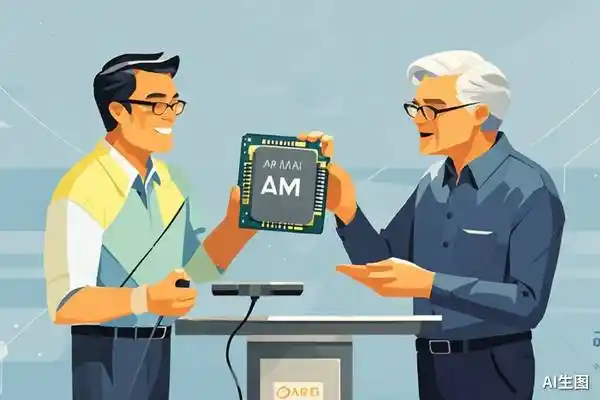
**Summary:** At Computex 2026, Arm CEO Rene Haas announced that ByteDance and Oracle have adopted Arm's self-designed Arm AGI data center CPU. The company expects significant revenue growth from this product, projecting $20 billion in demand for the 2027/2028 fiscal years. Haas noted that restricting AI-capable CPUs from the US to China is nearly impossible due to their widespread applications. Arm's stock has surged dramatically this year, notably rising 16% after NVIDIA's Arm-based Vera CPU and RTX Spark announcements. A highlight was the informal, humorous on-stage conversation between Haas and NVIDIA CEO Jensen Huang. Huang joked about NVIDIA's failed attempt to acquire Arm and playfully lamented selling his Arm shares. Both executives showed a clear sense of camaraderie and shared regret over the missed merger. Key technical topics were discussed: 1. **AI PC Design:** Huang explained NVIDIA's RTX Spark superchip (with a 20-core Arm CPU) is designed for future AI agents that will autonomously run and use tools on PCs, blending local and cloud processing. 2. **Agent vs. OS:** Huang emphasized the operating system remains crucial, as AI agents rely on its APIs and tools to function. 3. **Growth Constraints:** He identified the shift to "useful AI" that generates profitable tokens as a primary driver for immense, almost limitless, computational demand. Haas outlined Arm's strategy across PC and data centers. For PCs, Arm collaborates with partners like NVIDIA and MediaTek, offering its compute subsystem (CSS) for custom SoCs. In data centers, its Arm AGI CPU (built on TSMC's 3nm process) has gained major partners including OpenAI, Meta, and now ByteDance and Oracle. Arm presented a multi-year roadmap for its in-house CPU line. The article concludes that while GPUs dominated the AI training race, the explosion of AI agents is shifting significant focus to CPUs for inference, state management, and tool orchestration. The industry is trending towards vertical integration, with companies like cloud providers designing chips and chip/IP firms offering full solutions, all competing to deliver more efficient computing per watt.

marsbit34m ago

ByteDance Adopts Arm CPUs, Jensen Huang: So Sad I Didn't Buy Arm

marsbit34m ago

New Wall Street Play: Yen Shorts Still Adding, But Japan Stocks Don't Rely on Carry Trade Unwinding

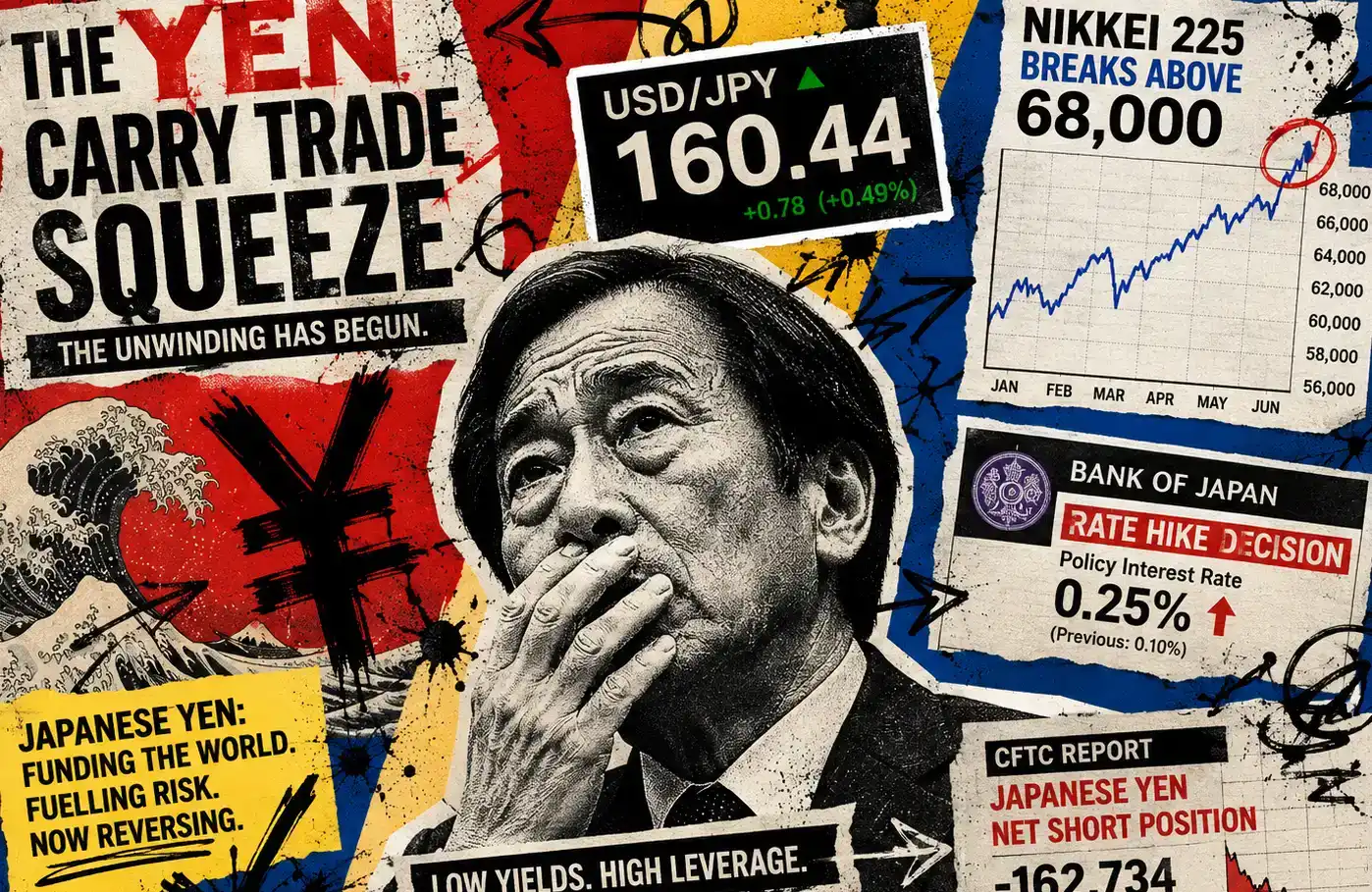
On June 3rd, USD/JPY hit 160.44, its highest level since July 2024, while the Nikkei 225 surged past 68,000 points. Contrary to popular narratives of an imminent "carry trade unwind" akin to August 2024, data reveals a more complex picture. Speculative net short positions in yen futures have actually increased, reaching -114,667 contracts by late May, suggesting traders are doubling down rather than retreating. Meanwhile, Japan's Finance Ministry conducted its largest-ever single-round FX intervention (11.73 trillion yen) in April-May but failed to hold the 160 yen line. The Nikkei's rally is not driven by carry trade dynamics. Foreign investors are aggressively buying Japanese stocks, with net purchases in 2026 running nearly 16 times higher than 2025 levels. This inflow is concentrated in AI and semiconductor-related stocks like SoftBank and Socionext, fueled by positive sector outlooks, rather than being a flight from unwinding yen shorts. Furthermore, the Nikkei has continued climbing despite the Bank of Japan's (BOJ) rate hikes to 0.75%. This disconnect exists because the current equity boom is fueled by AI-driven foreign investment, not reliant on cheap yen funding. However, this relationship remains fragile. Should the BOJ hike rates further (e.g., to 1.0%) while dollar weakness increases carry trade costs, the trajectories of the yen and Japanese stocks could reconverge, potentially triggering volatility.

marsbit38m ago

New Wall Street Play: Yen Shorts Still Adding, But Japan Stocks Don't Rely on Carry Trade Unwinding

marsbit38m ago

Broadcom's Q3 Guidance Misses Expectations by $12 Billion, After-Hours Trading Plummets Over 13%, AI Narrative "Cooling"?

On June 3, Broadcom released record Q2 FY26 results with revenue of $22.19B, up 48% YoY, and AI chip sales of $10.8B, up 143%. Adjusted EPS of $2.44 beat estimates. However, its Q3 AI semiconductor revenue guidance of $16B, while up over 200% YoY, fell roughly $1.2B (7%) short of analyst consensus expectations of $17.2B. This miss, coupled with slightly weaker-than-expected software revenue, triggered a severe market reaction. CEO Hock Tan maintained the FY26 AI revenue outlook of over $100B but did not raise it, disappointing investors who had priced in more robust growth. The stock plummeted over 13% in after-hours trading, erasing roughly $270B in market cap. The sell-off extended to peers like Marvell. A key concern for markets, particularly for Chinese optical module suppliers, was Tan's comment that the contribution of AI networking (e.g., Ethernet switches, optical interconnect chips) to AI revenue, currently near 40%, is expected to normalize to around 30% over time, signaling a potential peak in growth for that segment. Despite the guidance shortfall, Tan reiterated that AI demand remains "insatiable" and reaffirmed the long-term target of exceeding $100B in AI revenue by FY27. The reaction highlights the heightened sensitivity and premium valuation placed on AI-exposed stocks, where anything less than stellar guidance can prompt significant profit-taking. The broader question is whether this represents a cooling AI narrative or a correction in overstretched valuations.

marsbit38m ago

Broadcom's Q3 Guidance Misses Expectations by $12 Billion, After-Hours Trading Plummets Over 13%, AI Narrative "Cooling"?

marsbit38m ago

Trading

Spot
Futures

Hot Articles

HTX Learn: Learn Hot Tokens to Share 1000 USDT​

To enhance your understanding of this week's featured cryptos, we are rolling out various rewarding events. Join them now and bring home generous rewards through learning and trading.

20.4k Total ViewsPublished 2026.05.21Updated 2026.05.21

HTX Learn: Learn Hot Tokens to Share 1000 USDT​

How to Buy SFP

Welcome to HTX.com! We've made purchasing SafePal (SFP) simple and convenient. Follow our step-by-step guide to embark on your crypto journey.Step 1: Create Your HTX AccountUse your email or phone number to sign up for a free account on HTX. Experience a hassle-free registration journey and unlock all features.Get My AccountStep 2: Go to Buy Crypto and Choose Your Payment MethodCredit/Debit Card: Use your Visa or Mastercard to buy SafePal (SFP) instantly.Balance: Use funds from your HTX account balance to trade seamlessly.Third Parties: We've added popular payment methods such as Google Pay and Apple Pay to enhance convenience.P2P: Trade directly with other users on HTX.Over-the-Counter (OTC): We offer tailor-made services and competitive exchange rates for traders.Step 3: Store Your SafePal (SFP)After purchasing your SafePal (SFP), store it in your HTX account. Alternatively, you can send it elsewhere via blockchain transfer or use it to trade other cryptocurrencies.Step 4: Trade SafePal (SFP)Easily trade SafePal (SFP) on HTX's spot market. Simply access your account, select your trading pair, execute your trades, and monitor in real-time. We offer a user-friendly experience for both beginners and seasoned traders.

611 Total ViewsPublished 2026.05.22Updated 2026.06.02

How to Buy SFP

Discussions

Welcome to the HTX Community. Here, you can stay informed about the latest platform developments and gain access to professional market insights. Users' opinions on the price of A (A) are presented below.

活动图片