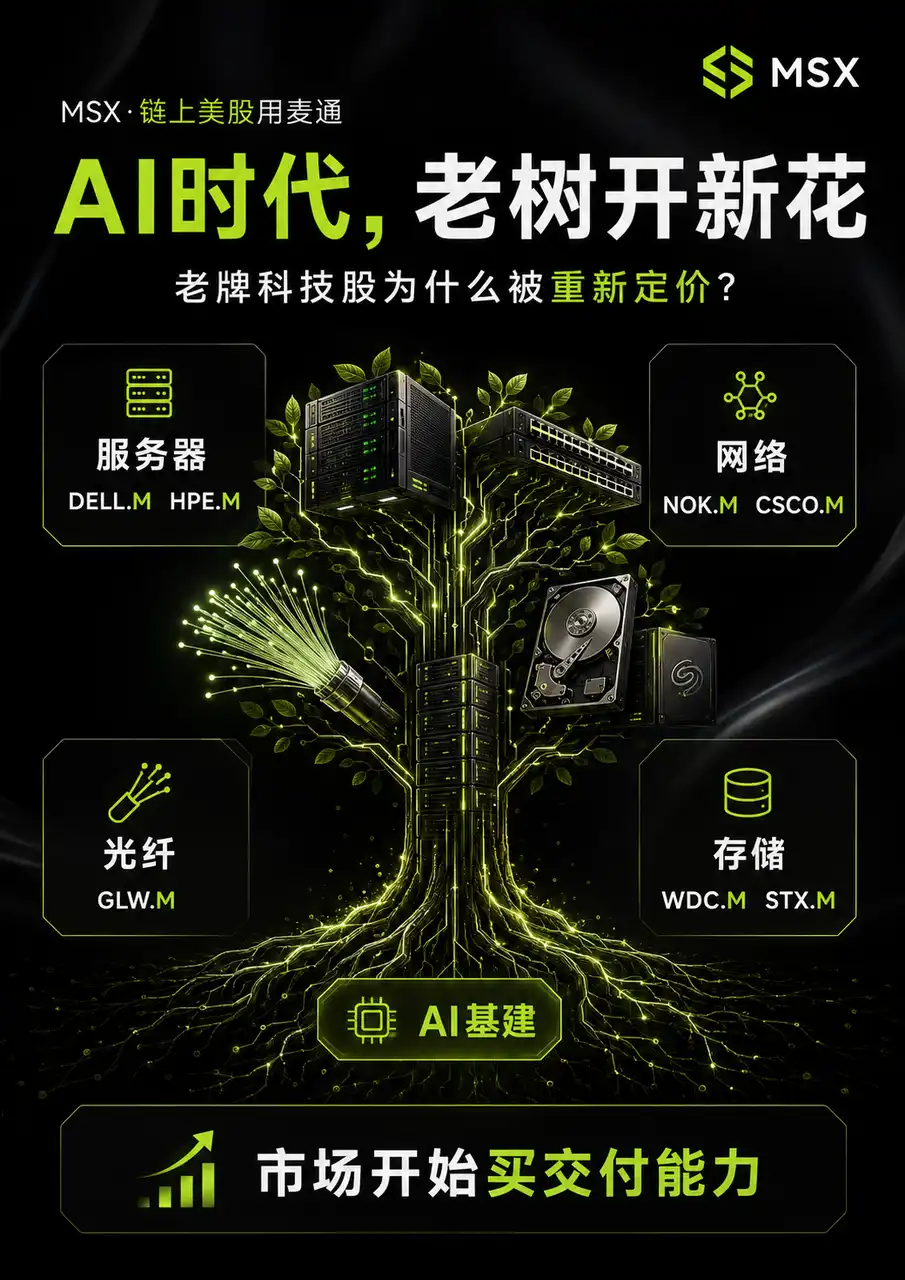
A year ago, if someone told you that Dell, Nokia, Cisco, Corning, Western Digital, etc., would once again become hot AI investment targets, you'd probably think they were a bit confused...
After all, for a long time, when the market talked about AI, the first reactions were usually NVIDIA, memory, optical modules, power, and data centers. They were either close enough to GPUs or directly in the hottest segments of computing expansion. In contrast, these old-school tech companies like Dell, HP, Nokia, Cisco, Corning, and Seagate were more often labeled with tags like "slow growth," "old story," and "valuation with no elasticity."
But just these old-tech stocks, which seemed not sexy enough in the past, have recently performed quite brilliantly, leading the market to start re-discussing them.
The market quickly and adaptively found a suitable explanatory angle: as AI moves from model parameters to real data centers, the market naturally starts re-looking for companies with delivery capabilities and infrastructure capabilities, which is why Dell, HP, Nokia, etc., are being seen again.
So, is this a genuine industrial revaluation or a new narrative temporarily attached to old-tech stocks by the market?
一、AI Market Rotation: Why Revalue Old Tech Stocks?
Over the past few years, the core investment narrative in AI has been very clear: first look at the models, then look at the computing power.
This is easy to understand. Whoever has the strongest model or can secure the most GPUs receives the most direct market premium. During this stage, investors were most willing to buy into the imagination of AI, the supply gap in computing power, and core beneficiaries like NVIDIA.
However, the problem is that AI cannot ultimately remain just in press conferences and model parameters. After all, models need to be trained, requiring data centers; inference needs large-scale deployment, requiring servers, networks, storage, and power; enterprises need to actually use AI, requiring complete IT architecture and delivery capabilities.
In other words, AI is not a problem that can be solved by a single GPU; it's a complex set of system engineering. This is also the starting point for the re-pricing of old-tech companies.
In the past, looking at Dell, the market might think of PCs and traditional servers; looking at HPE, enterprise hardware; looking at Nokia, old 5G equipment stories; looking at Cisco, traditional networking equipment; looking at Corning, glass and fiber optic materials; looking at Western Digital and Seagate, hard drive cyclical stocks.
These labels are not wrong, but their roles have changed in the AI infrastructure cycle—AI data centers need to be built, requiring rack servers, liquid cooling, storage, network switches, fiber optic connections, data management, power infrastructure, and enterprise-grade delivery capabilities. The larger the AI cluster, the higher the requirements for system integration, network transmission, storage capacity, and operational capabilities.
Therefore, the essence of this revaluation is not that the market has suddenly become nostalgic, nor is it that old companies are collectively riding the AI wave. It's that as AI enters the phases of orders, revenue, and delivery, the market begins to re-search for "who can actually build the AI infrastructure."
Such companies may not be the sexiest, but they share a common advantage: the customers, channels, supply chains, delivery experience, and infrastructure capabilities accumulated over the past decades have regained value in the phase of large-scale AI deployment.
In other words, AI is placing a batch of "old assets" into a "new demand" for re-pricing.
二、From Servers and Networks to Storage: Old Tech Stocks Are Being Placed into the AI Infrastructure Chain
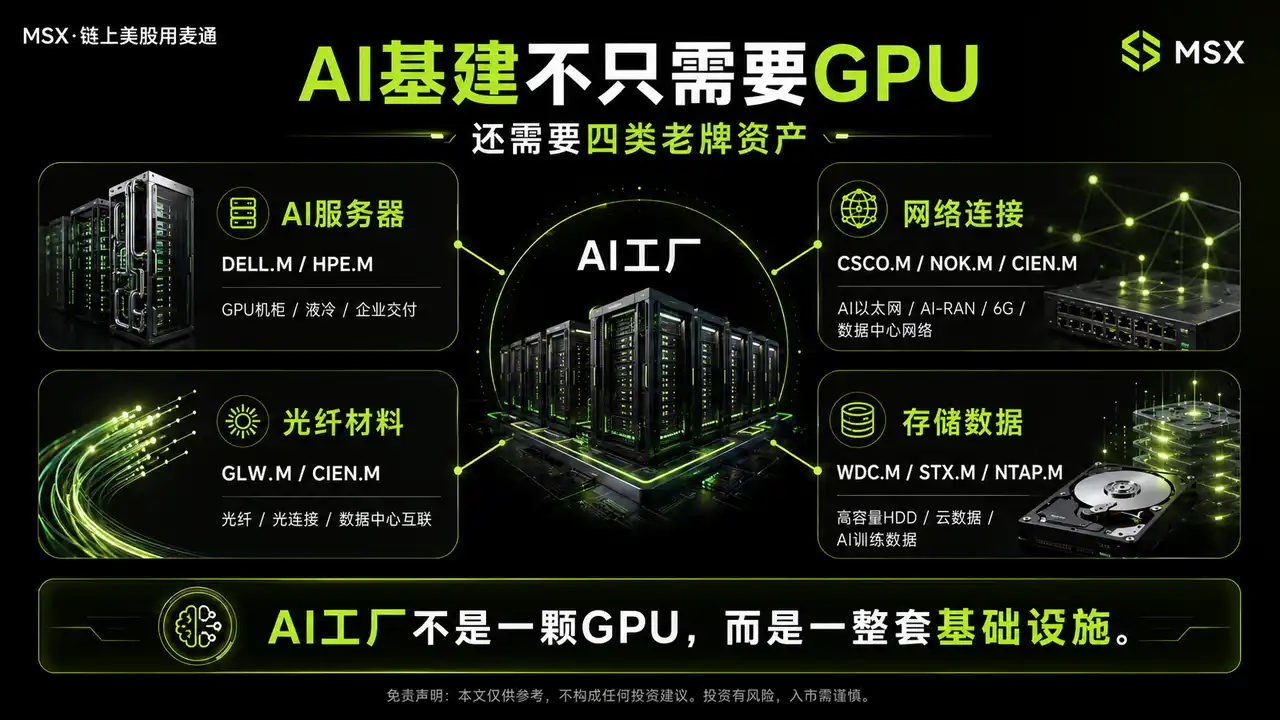
Overall, the old tech stocks being revalued by AI can roughly be divided into three lines: servers & system integration, networking & connectivity, storage & data management.
The first line is servers and system integration.
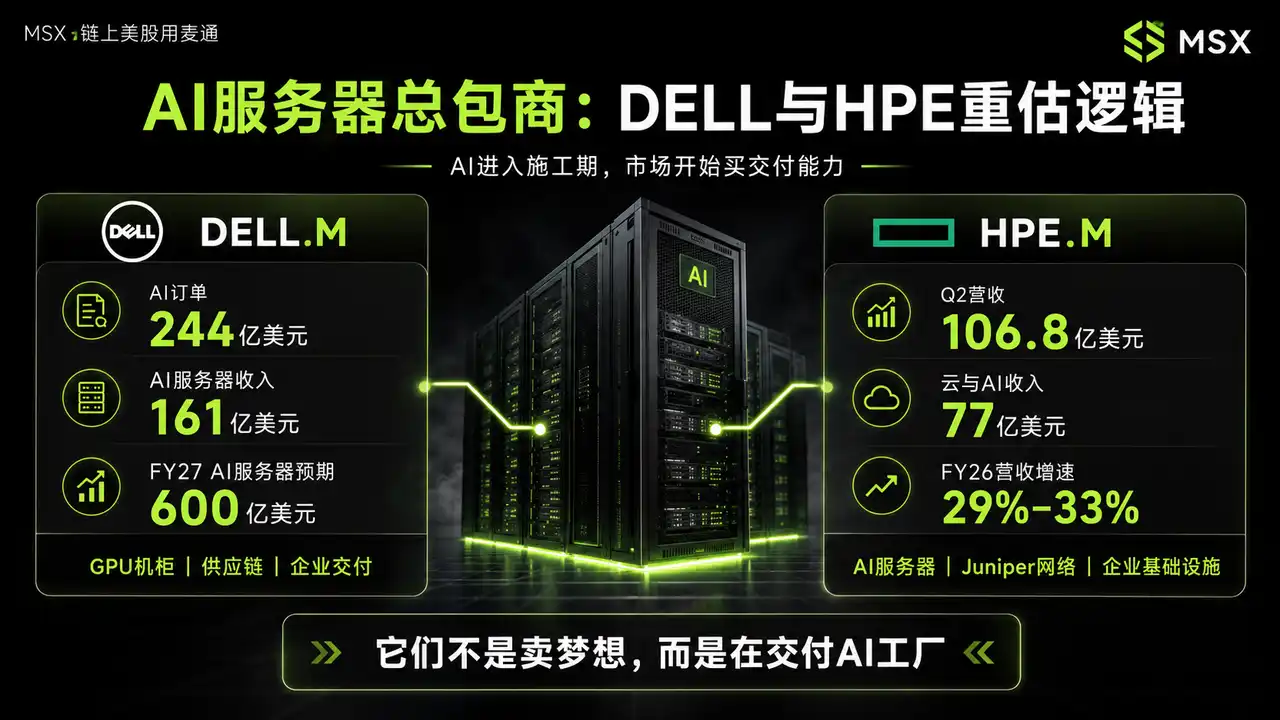
Dell is the most typical example. In its latest quarterly earnings report, Dell delivered very strong numbers: Q1 FY27 revenue reached $43.8 billion, AI orders reached $24.4 billion, and $16.1 billion in AI server revenue was confirmed. The company also raised its full-year FY27 AI server revenue expectation to $60 billion and raised its full-year revenue guidance midpoint to $167 billion.
These numbers are important because they change how the market views Dell. In the past, investors looked at Dell, focusing more on the PC cycle, traditional servers, and enterprise hardware demand. But now the market is looking at Dell, starting to see if it can become the general contractor in building AI factories.
Its advantage is not making GPUs itself, but its supply chain, delivery capabilities, enterprise customers, server system design, and compatibility with the NVIDIA ecosystem. An AI server sale doesn't end with selling a GPU; it needs to be installed into racks, connected to networks, power, and liquid cooling systems, and then delivered to cloud providers and enterprise customers.
Dell is capturing precisely this stage from chips to system deployment. HPE's logic is similar.
HPE's stock surged after its latest earnings report, also largely due to strong AI infrastructure demand. The company's Q2 revenue reached $10.68 billion, up 40% year-over-year; cloud & AI-related business revenue reached $7.71 billion, and it raised its FY2026 full-year growth expectations. More importantly, HPE also adds networking capabilities from Juniper, making it less like just a traditional server company and more like an "AI Networking + Enterprise Infrastructure" platform.
Therefore, the revaluation logic for Dell and HPE is not "they are turning into NVIDIA," but that they are becoming crucial system integrators in the construction crew for AI factories.
The second line is networking and connectivity.
One of the most easily overlooked aspects of AI infrastructure is connectivity. Computing power does not exist in isolation. Data centers require high-speed internal interconnects, data centers require fiber optic connections between them, and as AI applications move towards the edge and end-devices, stronger telecom networks and wireless infrastructure are needed. The larger the scale of AI training and inference, the less networking and connectivity remain supporting roles; they become key infrastructure determining computing efficiency.
This is also why Corning, Nokia, and Cisco are being discussed again by the market. Corning is a very typical example. It's not a traditional AI chip stock, but its fiber optics, optical connectivity, and optical communication materials are precisely the important supporting infrastructure for AI data center expansion.
The company's Q1 2026 core sales reached $4.35 billion, up 18% year-over-year; within that, optical communications sales reached $1.846 billion, up 36% year-over-year. The company also mentioned that Gen AI product demand and new long-term agreements with large hyperscale customers are key growth drivers. This indicates that AI data centers don't just need GPUs; they also need the fundamental materials to truly connect that computing power.
Nokia's story extends from traditional 5G equipment to AI-RAN, 6G, and AI-native wireless networks. NVIDIA previously announced a $10 billion investment in Nokia, with both sides collaborating to advance AI-RAN and the transition from 5G to 6G. This signal is important because AI traffic won't remain only within data centers; it will enter terminal scenarios like smartphones, cars, robots, and AR/VR. As long as AI applications continue to spread to the edge and mobile networks, telecom infrastructure companies will regain narrative space.
Cisco's logic leans more towards data center networking. The company's Q3 FY2026 revenue reached $15.8 billion, up 12% year-over-year; data center switching orders grew over 40% year-over-year. It's crucial to remember that in AI clusters, networking is not just simple cabling; it's a key factor affecting data transfer efficiency, computing utilization, and cluster stability.
The common logic for this category of companies is: the more AI moves towards scaled deployment, the more valuable networking and connectivity become.
The third line is storage.
This line has become widely familiar to the market over the past two months. Namely, AI not only lacks computing power but also lacks storage. While the market previously focused most on HBM, DRAM, and NAND, now high-capacity HDDs are also coming back into view, because AI model training, inference logs, video data, enterprise data, and cold data archiving all create demand for greater storage capacity.
Western Digital is one representative. The company's latest quarterly revenue grew 45% year-over-year to $3.34 billion, and it gave next-quarter revenue guidance above market expectations. More importantly, the market noted that its high-capacity HDD demand primarily comes from AI and cloud data centers. Seagate is similar, benefiting significantly from high-capacity nearline HDDs, with data center customers accounting for an increasing share.
Of course, the AI era does not mean all data needs to be stored in the most expensive high-speed storage. A large amount of cold data, training data, log data, video data, and archival data still require high-cost-performance, large-capacity hard drives. Therefore, the revaluation logic for WDC and STX is not "sudden hard drive revival" but that the AI data explosion has made storage a necessity again.
三、What Constitutes a Genuine Revaluation?
However, the revaluation of old tech stocks by AI does not equal that all old companies are worth blindly bullish sentiment.
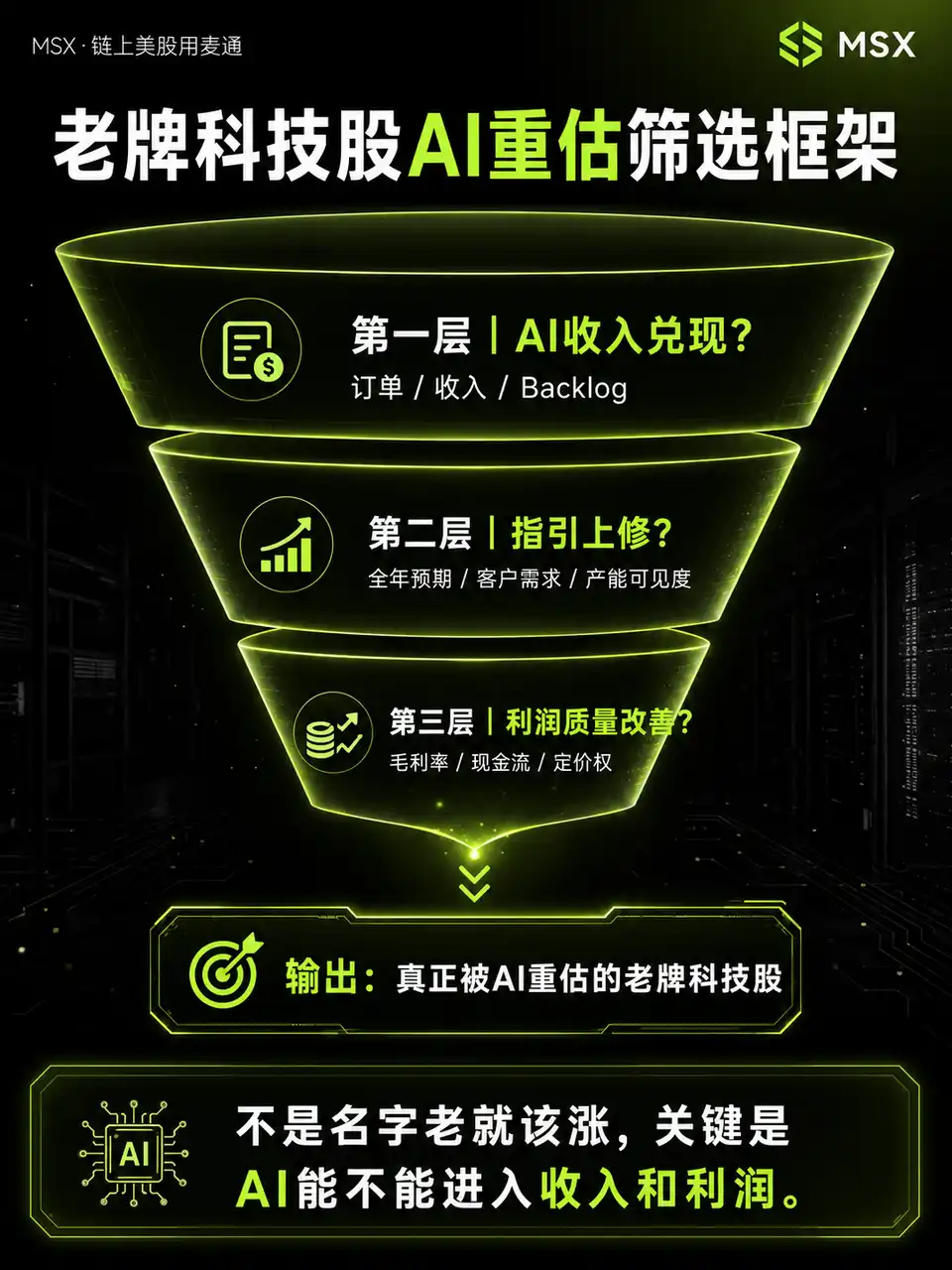
The most important distinction here is that some companies have genuinely entered the AI infrastructure chain. Therefore, to judge whether such companies are being truly revalued, at least three criteria should be examined:
- First, is there order and revenue realization: For example, Dell's AI orders and AI server revenue, HPE's cloud & AI-related business, Corning's optical communications revenue, Cisco's data center switching orders, WDC's high-capacity HDD demand—these are all more important than simply telling an AI story;
- Second, is guidance being revised upward: If AI remains only in press conferences and product introductions, stock prices can easily rise and fall back. But if management is willing to raise full-year revenue expectations, business growth expectations, or key product shipment expectations upward, it indicates AI demand is not just short-term sentiment but may be changing the company's growth trajectory. This is also why the market is re-pricing companies like Dell and HPE;
- Third, can profit quality keep up: The biggest problem for old-school hardware companies has always been gross margins and cyclicality. Fast growth in AI server revenue does not necessarily mean high profit elasticity; rising storage prices might also be just short-term supply-demand mismatch; increased networking equipment orders must also translate into sustained profits;
A genuinely good revaluation should involve simultaneous improvement in revenue growth, order visibility, and profit quality.
If only revenue goes up, but gross margins are squeezed thin, or if demand is just a short-cycle restocking phase, then the valuation revaluation will be limited. Ultimately, the market buys not "old companies telling new stories," but "can old assets combined with new demand turn into new profits."
This is the most noteworthy point of this "old trees blooming with new flowers." AI will not turn all traditional tech companies back into growth stocks; it will only filter out those truly positioned at key infrastructure junctions and capable of converting AI demand into orders, revenue, and profits.
In Conclusion
Objectively speaking, the AI investment theme has progressed to a point where it's no longer just about "whose model is stronger" or "who has more GPUs." The real change is that AI is entering a phase of real construction.
As more AI data centers are built, server companies will be re-priced. As computing clusters become more complex, networking companies will be re-priced. As data centers require more fiber optic connectivity, materials companies will be re-priced. As AI data continues to explode, storage companies will also be re-priced.
This is why old-tech stocks are being seen again by the market. They haven't suddenly become young; it's that the AI era once again needs the infrastructure they possess.
But this also means that this round of revaluation will not be distributed equally among all "old guys."
Only those that can genuinely enter the capital expenditure chain for data centers and enterprise deployments have the potential for old tech companies to move from "valuation repair" to "logic revaluation."