What Is The XLS-66 And What Does It Mean For XRP Holders?

bitcoinistPublished on 2026-04-19Last updated on 2026-04-19

Abstract

Cryptocurrency expert James explains that the XLS-66 amendment on the XRP Ledger introduces an institutional lending protocol, not a simple deposit-and-earn system. XRP holders deposit tokens into single-asset vaults and receive MPT tokens representing their share. The redemption value of these MPT tokens increases over time as borrowers (banks, fintechs, payment providers) repay loans with interest. This interest remains in the vault, growing the pool's value. Loans are uncollateralized, short-term (30-180 days), and managed by off-chain underwriters. Validators are preparing to vote on this amendment, which is seen as a modern DeFi approach that minimizes on-chain risks. XRP price is currently around $1.46.

Crypto pundit James has highlighted what the XLS-66 amendment is about and what it would mean for XRP holders in terms of earning yields. This comes as the XRP Ledger validators prepare to vote on the amendment, which will introduce the institutional lending protocol.

How XRP Holders Can Earn Yields Through XLS-66 Amendment

In an X post, James noted that, contrary to what XRP holders may think, the XLS-66 amendment is not just about depositing one’s tokens and collecting interest. Instead, it is a structured, institutional lending protocol in which investors’ yields accrue within the single-asset vault and are realized only when they choose to redeem their deposits.

As such, the XLS-66 amendment won’t give XRP holders automatic payments or dividends. Instead, they receive an MPT token, which represents the altcoin they deposited into the vault. These MPT shares grow in redemption value over time. James noted that the borrowers aren’t retail investors but banks, market makers, fintechs, and payment providers borrowing short-term working capital on neutral rails.

As such, holders are not lending their capital to strangers. Instead, they are participating alongside institutions in the same transparent on-chain pools. He added that the redeem-and-deploy cycle across multiple vaults is how they manage risk and realize periodic income without locking everything up indefinitely.

How The Vaults Operate

Pundit Bodhi had also broken down how the XLS-66 amendment works and how holders can enjoy yields from these single asset vaults. He noted that as borrowers repay their loans, they repay both the principal and the interest. The interest remains in the vault and increases the pool’s total XRP holdings. This causes the redemption value of each MPT to rise over time.

As to how the loans work, he explained that an associated LoanBroker pools the XRP in the vault and makes it available for lending. The LoanBroker originates fixed-term loans lasting between 30 and 180 days. The loans are uncollateralized, meaning borrowers do not post any collateral on-chain. Traditional underwriters are responsible for handling the credit decisions off-chain.
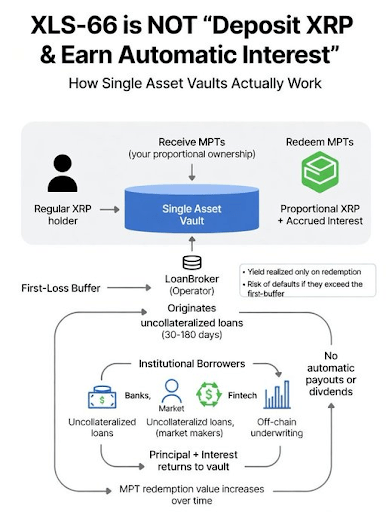
Source: Chart from Bodhi on X

Fig, the co-founder of Squid’s UNL validator, said they will vote yes on the XLS-66 amendment. He noted that a strong characteristic of the lending protocol is that it leaves the difficult aspects, such as credit assessment, off-chain. The XRPL validator added that this is a contemporary approach to DeFi protocol design that is gaining traction.

Fig also mentioned that DeFi protocols have, in the past, tried to create autonomous systems that compute interest rates and handle credit details through smart contracts. However, this process can often be manipulated and is more vulnerable to attacks.

At the time of writing, the XRP price is trading at around $1.46, up over 2% in the last 24 hours, according to data from CoinMarketCap.

XRP trading at $1.46 on the 1D chart | Source: XRPUSDT on Tradingview.com

Related Questions

QWhat is the XLS-66 amendment and what does it introduce to the XRP Ledger?

AThe XLS-66 amendment is a proposal that introduces an institutional lending protocol to the XRP Ledger, allowing for structured lending through single-asset vaults.

QHow do XRP holders earn yields through the XLS-66 amendment?

AXRP holders deposit their tokens into a vault and receive MPT tokens in return. The redemption value of these MPT tokens increases over time as borrowers repay their loans with interest, which remains in the vault and increases the pool's total XRP holdings.

QWho are the primary borrowers in this lending protocol, according to the article?

AThe primary borrowers are not retail investors but institutions such as banks, market makers, fintech companies, and payment providers, who borrow short-term working capital.

QHow are credit decisions and risk assessment handled in the XLS-66 protocol?

ACredit decisions are handled off-chain by traditional underwriters. The loans are uncollateralized, meaning borrowers do not post any collateral on-chain, and the difficult aspects like credit assessment are managed off-chain.

QWhat is one key advantage of the XLS-66's design compared to some past DeFi protocols, as mentioned by Fig?

AA key advantage is that it leaves complex aspects like credit assessment off-chain, which is a contemporary approach that reduces vulnerability to manipulation and attacks compared to autonomous systems that try to handle everything through smart contracts.

Related Reads

Vitalik's Full Speech at the 2026 Hong Kong Web3 Carnival

In his keynote speech at the 2026 Hong Kong Web3 Carnival, Ethereum co-founder Vitalik Buterin outlined the platform’s vision as a "world computer" and detailed its technical roadmap for the next five years. Buterin emphasized Ethereum’s two core functions: serving as a public bulletin board where applications can publish verifiable data, and enabling shared computational objects like tokens, NFTs, and DAOs. He stressed the importance of Ethereum lies in its ability to provide self-sovereignty, verifiability, and permissionless participation without relying on trusted third parties. He discussed the evolution of Layer 2 solutions, arguing that meaningful L2s should complement Ethereum by integrating necessary off-chain components—such as oracles or privacy protocols—rather than simply scaling through centralization. Key short-term goals include scaling data availability and computational capacity through initiatives like increasing the gas limit and deploying zkEVM for more complex, verifiable computations. Buterin also highlighted ongoing efforts to improve quantum resistance, privacy, and efficiency through proposals like EIP-8141 for account abstraction and quantum-safe signatures. Long-term, Ethereum aims to maximize security and decentralization through formal verification, AI-assisted proof generation, and a hybrid consensus model combining Bitcoin’s longest-chain rule with BFT-style finality. The goal is a robust, easily verifiable platform that supports a wide range of applications—from finance and identity to decentralized social networks—while ensuring long-term resilience and trustlessness.

marsbit49m ago

Vitalik's Full Speech at the 2026 Hong Kong Web3 Carnival

marsbit49m ago

Trading

Spot
Futures

Hot Articles

How to Buy XRP

Welcome to HTX.com! We've made purchasing XRP (XRP) simple and convenient. Follow our step-by-step guide to embark on your crypto journey.Step 1: Create Your HTX AccountUse your email or phone number to sign up for a free account on HTX. Experience a hassle-free registration journey and unlock all features.Get My AccountStep 2: Go to Buy Crypto and Choose Your Payment MethodCredit/Debit Card: Use your Visa or Mastercard to buy XRP (XRP) instantly.Balance: Use funds from your HTX account balance to trade seamlessly.Third Parties: We've added popular payment methods such as Google Pay and Apple Pay to enhance convenience.P2P: Trade directly with other users on HTX.Over-the-Counter (OTC): We offer tailor-made services and competitive exchange rates for traders.Step 3: Store Your XRP (XRP)After purchasing your XRP (XRP), store it in your HTX account. Alternatively, you can send it elsewhere via blockchain transfer or use it to trade other cryptocurrencies.Step 4: Trade XRP (XRP)Easily trade XRP (XRP) on HTX's spot market. Simply access your account, select your trading pair, execute your trades, and monitor in real-time. We offer a user-friendly experience for both beginners and seasoned traders.

15.7k Total ViewsPublished 2024.03.29Updated 2025.03.21

How to Buy XRP

What is XRP 2.0

XRP 2.0: A New Frontier in the Cryptocurrency Landscape Introduction to XRP 2.0 In the ever-evolving realm of cryptocurrency, new projects continuously emerge, vying for attention and adoption. One such promising initiative is XRP 2.0, a novel cryptocurrency project designed to leverage advanced blockchain technology and robust encryption methodologies. While the name draws parallels with Ripple’s XRP, it’s crucial to note that XRP 2.0 operates independently, focusing on enhancing transaction security, privacy, and scalability. As the digital financial landscape increasingly embraces decentralized solutions, XRP 2.0 aims to contribute meaningfully to web3 and the overall expansion of crypto projects. What is XRP 2.0? At its core, XRP 2.0 is a cryptocurrency project that aims to create a secure and decentralized digital currency ecosystem. Its foundational technology integrates sophisticated blockchain principles with cutting-edge encryption techniques. The overarching goal of XRP 2.0 is to establish itself as a reliable and efficient platform enabling swift transaction execution while prioritizing enhanced privacy protections for its users. The project is promoted as a solution to many limitations faced by existing cryptocurrencies, proposing a system that can handle a higher volume of transactions with improved speed and privacy. This versatility positions XRP 2.0 as a significant contender in a marketplace riddled with various digital currencies. Who is the Creator of XRP 2.0? The identity of the creator behind XRP 2.0 has been flagged as ‘Wilbur.’ However, comprehensive details regarding Wilbur or their associated entity remain elusive. The anonymity of many cryptocurrency creators is not an uncommon phenomenon in the industry, often designed to maintain a degree of privacy and security. Who are the Investors of XRP 2.0? As of now, specific information related to the investment foundations or organizations supporting XRP 2.0 is not publicly available. In the cryptocurrency sector, the backing by reputed investors can significantly influence a project's credibility and success, yet the transparency regarding the financial supporters of XRP 2.0 has not been established. How Does XRP 2.0 Work? XRP 2.0 stands out by employing a combination of blockchain technology and advanced encryption algorithms that ensures secure and decentralized transactions. Its innovative structure includes unique features designed to foster user engagement and broaden functionalities beyond conventional cryptocurrency transactions. Among these features, XRP 2.0 incorporates AI-powered capabilities, such as text-to-image and text-to-speech functionalities. These additions are designed to enhance the interactive experience for users, promoting broader applicability across various sectors. By bridging technological advancements with user-centered design, XRP 2.0 aims to capture the attention of a diverse range of individuals and enterprises looking to integrate cryptocurrency solutions into their operational frameworks. Timeline of XRP 2.0 Understanding XRP 2.0 requires examining the milestones that have defined its journey thus far: July 23, 2023: XRP 2.0 is introduced as a novel cryptocurrency project, aiming to revolutionize secure and decentralized transaction capabilities in the blockchain domain. September 8, 2023: The launching of another project, XRP20, occurs, marking the emergence of an ERC-20 token on the Ethereum blockchain that remains unrelated to XRP 2.0. November 13, 2023: The XRP Ledger undergoes a significant update with the release of rippled server software version 2.0.0. It is essential to note that this development is disconnected from the XRP 2.0 cryptocurrency project. Key Points About XRP 2.0 To distill the essence of XRP 2.0, several critical factors emerge: Unique Features: The inclusion of features like AI-powered text-to-image and text-to-speech further diversifies the potential applications of XRP 2.0. Blockchain Technology: The framework utilizes advanced blockchain mechanisms and encryption protocols, ensuring a secure and decentralized environment for transactions. Scalability and Privacy: XRP 2.0 prioritizes enhanced privacy protections in transaction processes and the scalability necessary to accommodate a growing user base. No Affiliation with Ripple: Importantly, despite its name, XRP 2.0 does not have any allegiance or collaboration with Ripple’s XRP, distinguishing its operational framework and objectives within the cryptocurrency ecosystem. Conclusion XRP 2.0 represents an ambitious venture into the cryptocurrency sphere, aiming to offer a combination of security, privacy, and efficiency in digital transactions. By integrating sophisticated technologies and user-friendly features, the project sets out to broaden the horizons of what cryptocurrency can achieve in today's digital economy. While the anonymity of its creator and lack of disclosed investors might raise questions for some, XRP 2.0's focus on advanced functionalities and decentralisation enhances its appeal amidst an increasingly crowded crypto market. As the cryptocurrency landscape continues to evolve, XRP 2.0 may yet emerge as a pivotal player in the expansion of secure and scalable blockchain solutions.

941 Total ViewsPublished 2024.04.01Updated 2024.12.03

What is XRP 2.0

Discussions

Welcome to the HTX Community. Here, you can stay informed about the latest platform developments and gain access to professional market insights. Users' opinions on the price of XRP (XRP) are presented below.

活动图片