US Moves Bitcoin During Iran Strikes — Market Watches Closely

bitcoinistPublished on 2026-03-05Last updated on 2026-03-05

Abstract

The US government moved a small amount of seized Bitcoin (1.23 BTC, ~$22,550) during a period of significant market volatility triggered by military strikes on Iran. The timing of the transfer, though modest, drew attention as it coincided with a sharp crypto sell-off. Bitcoin initially fell to near $63,000 amid the geopolitical tension but later recovered to $71,000. The market whipsawed further on news of Iranian Supreme Leader Khamenei's death. Meanwhile, Iranian citizens rushed to move money via crypto, with outflows from the country's largest exchange surging 700%. The US holding $23 billion in seized cryptocurrency, traders are closely monitoring both further government wallet movements and geopolitical developments.

The US government shifted seized Bitcoin on Monday just as military strikes on Iran sent crypto markets into a sharp sell-off.

On-chain analytics platform Arkham Intelligence tracked three transfers totaling roughly 1.23 Bitcoin — about $22,550 — from a wallet labeled “Miguel Villanueva Seized Funds” to three separate wallets, receiving $2,500, $16,250, and $3,800 respectively.

Small Transfers, Big Timing

The amounts were modest. But small government crypto transfers like these often precede larger moves, and the timing drew immediate attention from traders already watching the markets closely.
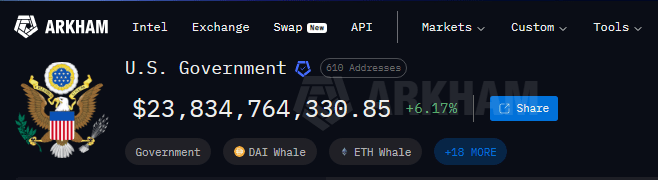
Source: Arkham Intelligence

The US government currently holds around $23 billion in seized cryptocurrency, according to Arkham data. No official explanation was issued for the transfers.

Bitcoin had already taken a hit when the transfers were recorded. American and Israeli forces launched strikes on Iran over the weekend, sending the price tumbling roughly 3% within hours to near $63,000 — though it has since recovered sharply, climbing to $71,000 as of press time.
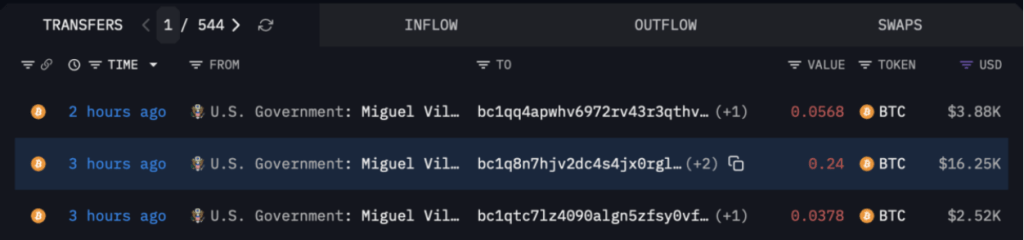
The BTC transfers. Source: Arkham Intelligence

Gold and oil climbed. US equity futures pointed lower. Bitcoin behaved the way it usually does when fear takes over — it sold off alongside other risk assets.

Markets Whipsaw On Khamenei News

Then the situation shifted again. Iranian officials confirmed the death of Supreme Leader Ayatollah Ali Khamenei, and Bitcoin briefly spiked to $68,196 before reversing course and settling near $65,300 — still down about 2%.

BTCUSD now trading at $71,062. Chart: TradingView

Iran fired back at the strikes, launching missiles toward Israel and hitting US military bases in Kuwait, the United Arab Emirates, and Bahrain.

Through all of it, Bitcoin held up better than US stock futures. Funding rates in Bitcoin’s futures markets turned sharply negative during the worst of the selling, a sign traders rushed to open short positions expecting further losses. If the conflict widens and oil prices surge, analysts say a deeper risk-off wave could follow.

Iranian Citizens Rushed To Move Money

On the ground in Iran, ordinary people responded immediately. Nobitex, the country’s largest crypto exchange, saw outflows jump 700% right after the strikes began. Crypto offered one of the few available channels to move money quickly across borders under sanctions.

The convergence of events — a live military conflict, a government Bitcoin transfer, and a dramatic surge in Iranian crypto activity — landed on markets all at once.

Whether the US transfers were routine or something larger is still unclear. Traders are watching the next wallet move just as closely as the next headline from the region.

Featured image from Unsplash, chart from TradingView

Related Questions

QWhat was the significance of the US government's Bitcoin transfer during the military strikes on Iran?

AThe US government transferred a small amount of seized Bitcoin (1.23 BTC) at the same time military strikes on Iran caused a sharp crypto market sell-off. While the transfer itself was modest, the timing drew immediate scrutiny from traders, as such small government moves often precede larger transactions.

QHow did the Bitcoin price react to the initial military strikes and the subsequent news from Iran?

ABitcoin initially tumbled roughly 3% to near $63,000 following the military strikes. It then experienced volatility, briefly spiking to $68,196 after news confirmed the death of Iran's Supreme Leader, before reversing and settling near $65,300. It later recovered sharply to $71,000.

QWhat was the reaction of Iranian citizens on the crypto exchange Nobitex to the military conflict?

AIranian citizens rushed to move money, causing outflows on the country's largest crypto exchange, Nobitex, to jump by 700% immediately after the strikes began. Crypto provided a crucial channel to move money across borders under sanctions.

QWhat does the sharp turn to negative funding rates in Bitcoin futures markets indicate?

AThe sharp turn to negative funding rates during the worst of the selling indicates that traders rushed to open short positions, expecting further price declines in Bitcoin.

QHow much seized cryptocurrency does the US government currently hold, according to Arkham Intelligence?

AAccording to Arkham Intelligence, the US government currently holds around $23 billion in seized cryptocurrency.

Related Reads

Google and Amazon Simultaneously Invest Heavily in a Competitor: The Most Absurd Business Logic of the AI Era Is Becoming Reality

In a span of four days, Amazon announced an additional $25 billion investment, and Google pledged up to $40 billion—both direct competitors pouring over $65 billion into the same AI startup, Anthropic. Rather than a typical venture capital move, this signals the latest escalation in the cloud wars. The core of the deal is not equity but compute pre-orders: Anthropic must spend the majority of these funds on AWS and Google Cloud services and chips, effectively locking in massive future compute consumption. This reflects a shift in cloud market dynamics—enterprises now choose cloud providers based on which hosts the best AI models, not just price or stability. With OpenAI deeply tied to Microsoft, Anthropic’s Claude has become the only viable strategic asset for Google and Amazon to remain competitive. Anthropic’s annualized revenue has surged to $30 billion, and it is expanding into verticals like biotech, positioning itself as a cross-industry AI infrastructure layer. However, this funding comes with constraints: Anthropic’s independence is challenged as it balances two rival investors, its safety-first narrative faces pressure from regulatory scrutiny, and its path to IPO introduces new financial pressures. Globally, this accelerates a "tri-polar" closed-loop structure in AI infrastructure, with Microsoft-OpenAI, Google-Anthropic, and Amazon-Anthropic forming exclusive model-cloud alliances. In contrast, China’s landscape differs—investments like Alibaba and Tencent backing open-source model firm DeepSeek reflect a more decoupled approach, though closed-source models from major cloud providers still dominate. The $65 billion bet is ultimately about securing a seat at the table in an AI-defined future—where missing the model layer means losing the cloud war.

marsbit3h ago

Google and Amazon Simultaneously Invest Heavily in a Competitor: The Most Absurd Business Logic of the AI Era Is Becoming Reality

marsbit3h ago

Computing Power Constrained, Why Did DeepSeek-V4 Open Source?

DeepSeek-V4 has been released as a preview open-source model, featuring 1 million tokens of context length as a baseline capability—previously a premium feature locked behind enterprise paywalls by major overseas AI firms. The official announcement, however, openly acknowledges computational constraints, particularly limited service throughput for the high-end DeepSeek-V4-Pro version due to restricted high-end computing power. Rather than competing on pure scale, DeepSeek adopts a pragmatic approach that balances algorithmic innovation with hardware realities in China’s AI ecosystem. The V4-Pro model uses a highly sparse architecture with 1.6T total parameters but only activates 49B during inference. It performs strongly in agentic coding, knowledge-intensive tasks, and STEM reasoning, competing closely with top-tier closed models like Gemini Pro 3.1 and Claude Opus 4.6 in certain scenarios. A key strategic product is the Flash edition, with 284B total parameters but only 13B activated—making it cost-effective and accessible for mid- and low-tier hardware, including domestic AI chips from Huawei (Ascend), Cambricon, and Hygon. This design supports broader adoption across developers and SMEs while stimulating China's domestic semiconductor ecosystem. Despite facing talent outflow and intense competition in user traffic—with rivals like Doubao and Qianwen leading in monthly active users—DeepSeek has maintained technical momentum. The release also comes amid reports of a new funding round targeting a valuation exceeding $10 billion, potentially setting a new record in China’s LLM sector. Ultimately, DeepSeek-V4 represents a shift toward open yet realistic infrastructure development in the constrained compute landscape of Chinese AI, emphasizing engineering efficiency and domestic hardware compatibility over pure model scale.

marsbit4h ago

Computing Power Constrained, Why Did DeepSeek-V4 Open Source?

marsbit4h ago

Trading

Spot
Futures

Hot Articles

What is $BITCOIN

DIGITAL GOLD ($BITCOIN): A Comprehensive Analysis Introduction to DIGITAL GOLD ($BITCOIN) DIGITAL GOLD ($BITCOIN) is a blockchain-based project operating on the Solana network, which aims to combine the characteristics of traditional precious metals with the innovation of decentralized technologies. While it shares a name with Bitcoin, often referred to as “digital gold” due to its perception as a store of value, DIGITAL GOLD is a separate token designed to create a unique ecosystem within the Web3 landscape. Its goal is to position itself as a viable alternative digital asset, although specifics regarding its applications and functionalities are still developing. What is DIGITAL GOLD ($BITCOIN)? DIGITAL GOLD ($BITCOIN) is a cryptocurrency token explicitly designed for use on the Solana blockchain. In contrast to Bitcoin, which provides a widely recognized value storage role, this token appears to focus on broader applications and characteristics. Notable aspects include: Blockchain Infrastructure: The token is built on the Solana blockchain, known for its capacity to handle high-speed and low-cost transactions. Supply Dynamics: DIGITAL GOLD has a maximum supply capped at 100 quadrillion tokens (100P $BITCOIN), although details regarding its circulating supply are currently undisclosed. Utility: While precise functionalities are not explicitly outlined, there are indications that the token could be utilized for various applications, potentially involving decentralized applications (dApps) or asset tokenization strategies. Who is the Creator of DIGITAL GOLD ($BITCOIN)? At present, the identity of the creators and development team behind DIGITAL GOLD ($BITCOIN) remains unknown. This situation is typical among many innovative projects within the blockchain space, particularly those aligning with decentralized finance and meme coin phenomena. While such anonymity may foster a community-driven culture, it intensifies concerns about governance and accountability. Who are the Investors of DIGITAL GOLD ($BITCOIN)? The available information indicates that DIGITAL GOLD ($BITCOIN) does not have any known institutional backers or prominent venture capital investments. The project seems to operate on a peer-to-peer model focused on community support and adoption rather than traditional funding routes. Its activity and liquidity are primarily situated on decentralized exchanges (DEXs), such as PumpSwap, rather than established centralized trading platforms, further highlighting its grassroots approach. How DIGITAL GOLD ($BITCOIN) Works The operational mechanics of DIGITAL GOLD ($BITCOIN) can be elaborated on based on its blockchain design and network attributes: Consensus Mechanism: By leveraging Solana’s unique proof-of-history (PoH) combined with a proof-of-stake (PoS) model, the project ensures efficient transaction validation contributing to the network's high performance. Tokenomics: While specific deflationary mechanisms have not been extensively detailed, the vast maximum token supply implies that it may cater to microtransactions or niche use cases that are still to be defined. Interoperability: There exists the potential for integration with Solana’s broader ecosystem, including various decentralized finance (DeFi) platforms. However, the details regarding specific integrations remain unspecified. Timeline of Key Events Here is a timeline that highlights significant milestones concerning DIGITAL GOLD ($BITCOIN): 2023: The initial deployment of the token occurs on the Solana blockchain, marked by its contract address. 2024: DIGITAL GOLD gains visibility as it becomes available for trading on decentralized exchanges like PumpSwap, allowing users to trade it against SOL. 2025: The project witnesses sporadic trading activity and potential interest in community-led engagements, although no noteworthy partnerships or technical advancements have been documented as of yet. Critical Analysis Strengths Scalability: The underlying Solana infrastructure supports high transaction volumes, which could enhance the utility of $BITCOIN in various transaction scenarios. Accessibility: The potential low trading price per token could attract retail investors, facilitating wider participation due to fractional ownership opportunities. Risks Lack of Transparency: The absence of publicly known backers, developers, or an audit process may yield skepticism regarding the project's sustainability and trustworthiness. Market Volatility: The trading activity is heavily reliant on speculative behavior, which can result in significant price volatility and uncertainty for investors. Conclusion DIGITAL GOLD ($BITCOIN) emerges as an intriguing yet ambiguous project within the rapidly evolving Solana ecosystem. While it attempts to leverage the “digital gold” narrative, its departure from Bitcoin's established role as a store of value underscores the need for a clearer differentiation of its intended utility and governance structure. Future acceptance and adoption will likely depend on addressing the current opacity and defining its operational and economic strategies more explicitly. Note: This report encompasses synthesised information available as of October 2023, and developments may have transpired beyond the research period.

363 Total ViewsPublished 2025.05.13Updated 2025.05.13

What is $BITCOIN

Discussions

Welcome to the HTX Community. Here, you can stay informed about the latest platform developments and gain access to professional market insights. Users' opinions on the price of BTC (BTC) are presented below.

活动图片