Eight Global Central Banks Enter the Fray, Aiming to Claim a Piece of the Stablecoin Pie?

marsbitPublished on 2026-06-02Last updated on 2026-06-02

Abstract

The article discusses the Agorá project, a global cross-border payment system initiative led by the Bank for International Settlements (BIS) with participation from eight major central banks (including the Federal Reserve Bank of New York, Bank of England, and Bank of Japan) and over 40 private financial institutions like JPMorgan and SWIFT. Agorá aims to create a unified platform for the instant settlement of cross-border transactions using tokenized commercial bank deposits. A key feature is its strict "permissioned" design, where funds are pre-labeled by country and smart contracts enforce AML and sanctions checks. This contrasts with the "permissionless" ideal suggested by its ancient Greek namesake. The system employs a two-tier architecture: central banks retain full control over sovereign reserves on separate ledgers, while private entities manage a shared ledger for multi-currency clearing. The project, which completed a prototype in May 2026, seeks to streamline the slow, multi-step process of traditional cross-border payments. It is positioned as a centralized, regulatory-compliant alternative to decentralized stablecoins like Tether, targeting large-scale institutional transfers. The analysis highlights a potential future market split: projects like Agorá could dominate wholesale institutional payments, while public blockchain-based stablecoins retain their role in retail, remittance, and emerging market use cases. This represents an effort by traditional financ...

Author: Thejaswini M A

Compilation: Chopper, Foresight News

Thousands of years ago, the ancient Greek Agorá was the public marketplace in Athens, a place where anyone could come and trade freely, with no entry barriers, not bound by any local jurisdiction. The concept of "permissionlessness" lies at the very heart of this word.

The Bank for International Settlements (BIS) named its project Agorá, a choice laden with meaning. However, the actual design of the Agorá project, spearheaded by the BIS and implemented jointly by seven central banks and over forty private institutions, stands in stark contrast to the word's original association with a "free market."

In this system, funds are tagged with their country of origin before they are transferred; smart contracts perform anti-money laundering screening and sanctions list verification at the token layer; each central bank retains full control over its own reserves, and cross-border fund flows must pass through a compliance validation layer embedded within the token.

In short, this is a programmable fiat currency system where permission must be granted beforehand for everything.

The seven central banks participating in the Agorá project are: the Federal Reserve Bank of New York, the Bank of England, the Bank of Japan, the Bank of Korea, the Bank of Mexico, the Swiss National Bank, and the Banque de France representing the Eurozone; the Bank of Canada joined the ranks just four days ago. Financial giants such as JPMorgan Chase, HSBC, Deutsche Bank, UBS, Mastercard, Visa, and the Society for Worldwide Interbank Financial Telecommunication (SWIFT), along with more than forty other institutions, are jointly involved in the development.

A project mobilizing such a massive institutional force prompted me to delve deeper into dissecting this system.

The project employs a two-tier separated architecture: one tier is fully controlled by the respective central banks, managing the underlying base currency reserves; the other tier is operated by commercial banks, handling daily transactions for end-users. Tokenized commercial bank deposits are consolidated onto a shared platform, processed collaboratively by multiple private institutions for multi-currency clearing; meanwhile, each central bank's reserves are stored independently on its own sovereign ledger, with sovereignty firmly retained by each respective central bank.
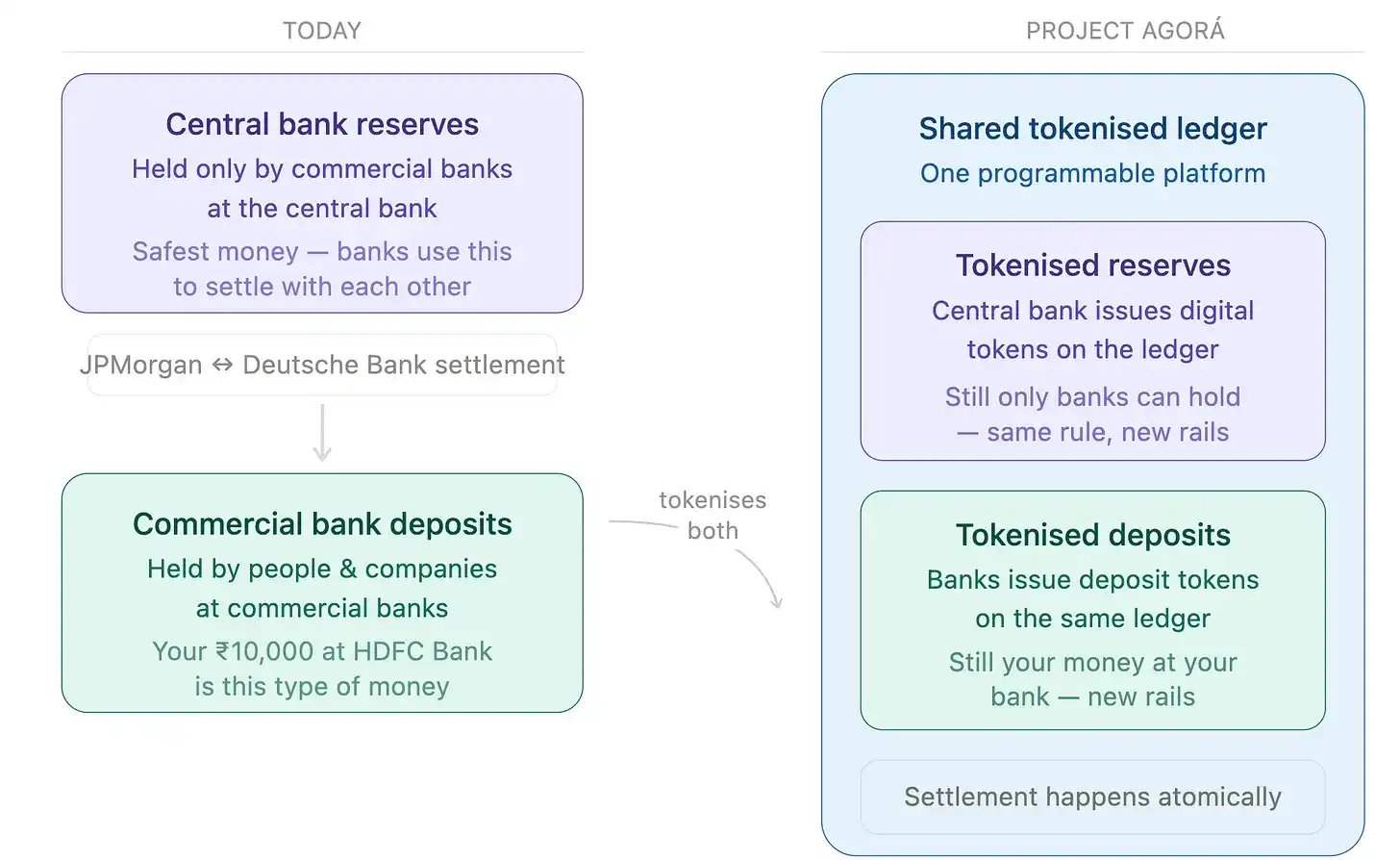
The BIS aims to build a state-controlled, closed-loop payment system by integrating commercial bank ledgers and anchoring sovereign reserves. Institutions are accelerating the implementation of a compliant framework, intending to establish it before decentralized stablecoins like Tether completely sever global commerce from the traditional banking system.

Current cross-border payments are akin to a relay race: message transmission, manual compliance checks, and ledger clearing belong to different institutional systems, often taking days. The Agorá project compresses this lengthy multi-step collaboration into a single on-chain, real-time operation. This prototype concluded on May 27, 2026, with the Bank of Canada promptly announcing its participation.

Organizers emphasize that the current phase remains infrastructure testing, with no formal timeline for commercial deployment, but the next stage will involve pilot tests with real funds.

Unlike previous central bank initiatives that only released research papers, seven major currency authorities spent two years developing and testing this real-time cross-border clearing system. The underlying code is functional. The existing challenge is no longer technical but rather how multiple governments will implement regulation and delineate responsibilities for the shared network, facing immense administrative coordination hurdles.
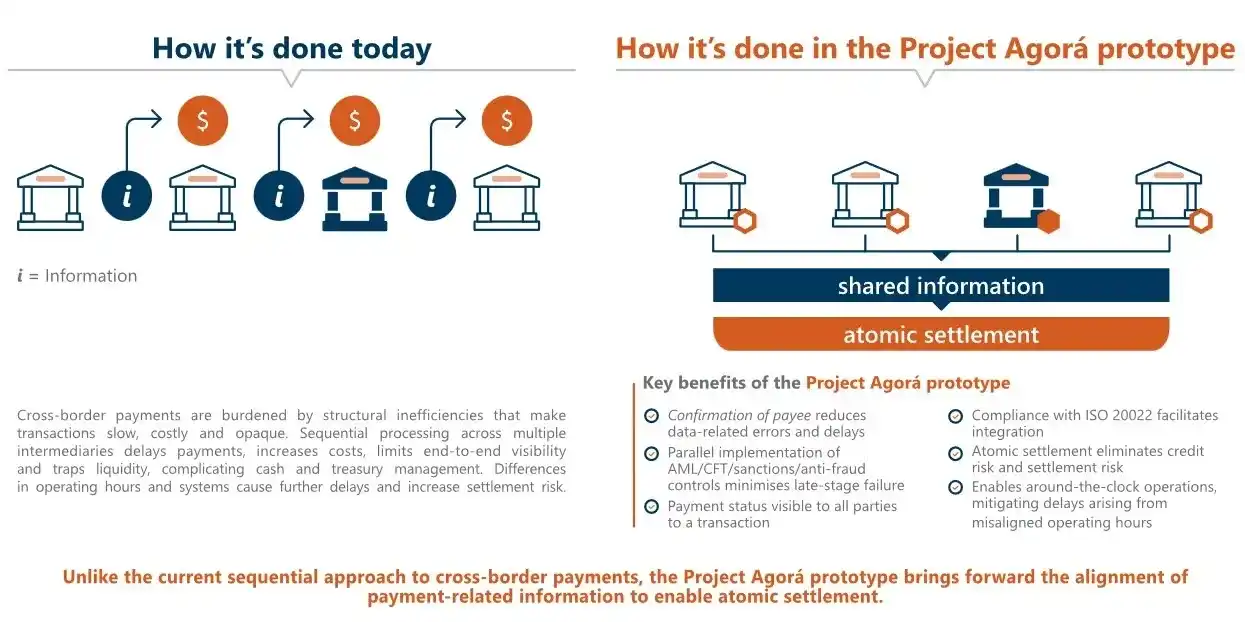
Meanwhile, the established cross-border messaging giant SWIFT is concurrently advancing its own underlying transformation, positioning its layout precisely within the commercial banking layer. On March 30, 2026, SWIFT finalized the design for its blockchain-based shared ledger, entering Minimum Viable Product (MVP) development, with plans to launch real-time transactions within the year. The ledger is built on Hyperledger Besu, which is compatible with the Ethereum Virtual Machine (EVM), with final fund clearing still performed off-chain using traditional Real-Time Gross Settlement systems.

However, SWIFT and Agorá are not in competition: the SWIFT ledger focuses on reconciling tokenized deposits between commercial banks, while Agorá handles the final large-value clearing of central bank reserves. The BIS ensured interoperability standards between the two systems from the outset, methodically transforming the traditional cross-border clearing system into a programmable digital network in two steps.

A closer look at the participant list reveals significant overlap: Deutsche Bank, a core Agorá member, also formed an alliance with Goldman Sachs, Bank of America, Barclays, Santander, and nine other banks to explore issuing 1:1 reserve-backed tokens on public blockchains; UBS and Citigroup are similarly involved in both; JPMorgan Chase participates in Agorá, operates its own JPM Coin, and recently piloted cross-border clearing on the Ripple ledger.

Such parallel investments are highly unusual in finance: the standard practice for institutions is to concentrate technical resources on one technological path. Top teams simultaneously developing two potentially competing frameworks on separate tracks reflects internal division within bank management. Giants holding vast data and enormous capital cannot predict which framework will ultimately prevail. The technological paths are clear, but policy directions remain uncertain.

Ripple, after a decade of effort, has consistently argued that "atomic settlement" (where a transaction either completes in full or fails entirely) is the optimal solution for cross-border payments. Now, the BIS's Agorá project has implemented this settlement logic, albeit replacing XRP as the bridging asset with central bank reserve tokens, directly undermining XRP's necessity as a cross-border bridge asset.

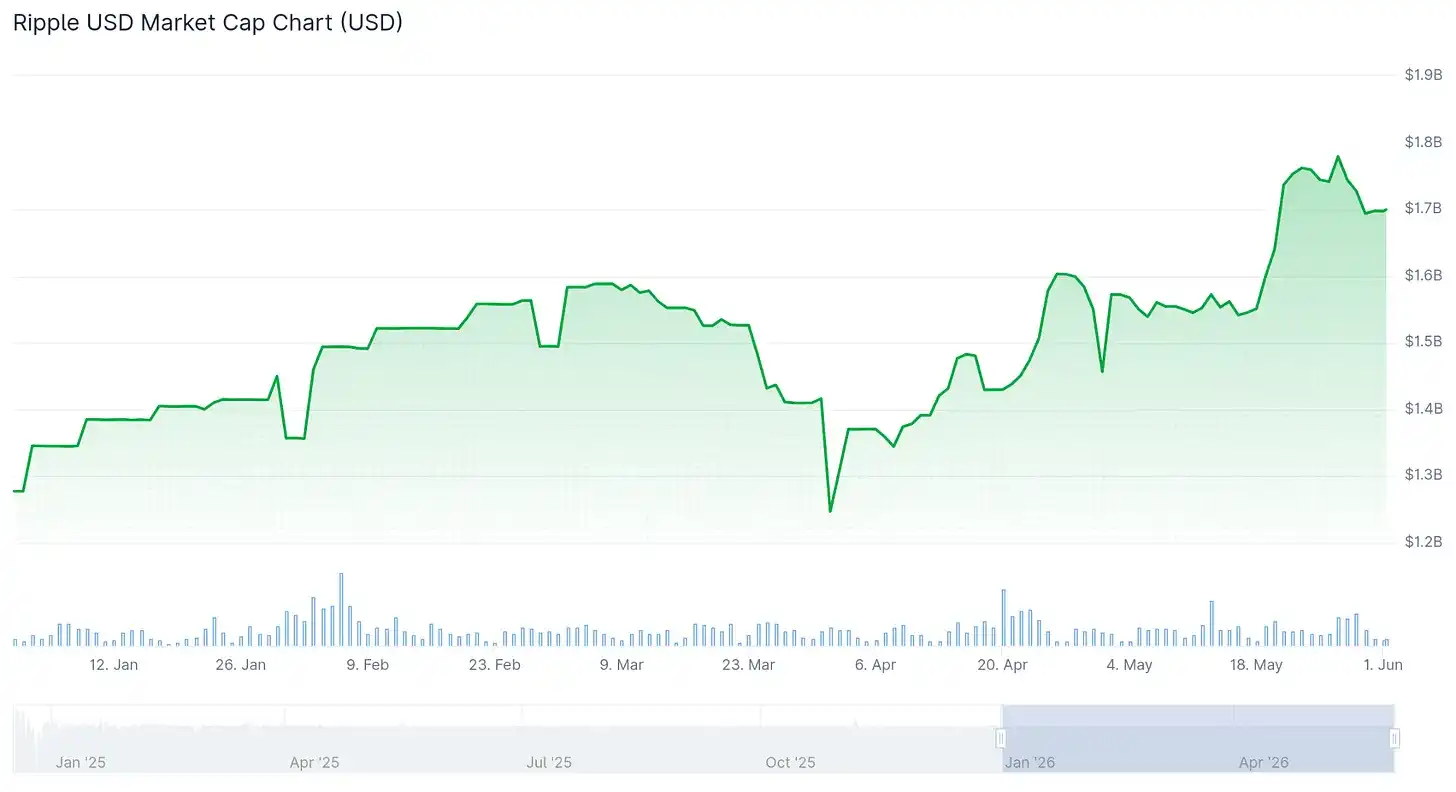
Nevertheless, the Ripple ledger continues to permeate traditional finance. On May 6, JPMorgan's Kinetyx, Mastercard, Ripple, and Ondo Finance completed the first cross-border redemption of tokenized U.S. Treasury bonds on Ripple, with the entire clearing process taking less than five seconds. The Ripple USD stablecoin RLUSD's market capitalization surpassed $1.4 billion; in January 2026, the total value of tokenized assets on Ripple exceeded $2 billion; Société Générale issued a Euro stablecoin on Ripple in February; and in December 2025, Ripple obtained a limited-purpose trust bank charter from the U.S. Office of the Comptroller of the Currency (OCC).
While Ripple's architectural logic is validated, the assertion that "XRP is indispensable" has not materialized. Even so, Ripple's ongoing integration into institutional clearing systems holds far greater significance for long-term value than debates over whether Ripple or central bank reserve tokens are superior.

Setting aside commercial rhetoric, on the Ripple network, transaction fees are extremely low and permanently waived, not flowing to node operators. Increased institutional transaction volume does not generate revenue for validators or token holders like Ethereum's Gas fees; it only results in a slight burn of the existing XRP supply. When institutions like JPMorgan transfer tokenized assets on-chain, they utilize their own liquidity pools and do not rely on XRP circulating in the market for liquidity support; the network merely provides high-speed transfer and cryptographic security.

The core value of this model lies in ecosystem lock-in. Once financial institutions trust the network to custody fiat and stablecoin assets, the technology becomes embedded in global financial infrastructure, compelling the deployment of bank-grade node facilities, and the ledger becomes a permanent component of the global financial system. In the long run, deep technological integration with global banking is far more important than the price fluctuations of a single token.

All these variables ultimately converge on the stablecoin arena. Tether's daily trading volume consistently ranges between $40-50 billion, with the total stablecoin market exceeding $320 billion. While Agorá is still in the pilot stage with deployment seemingly distant, SpaceX already uses stablecoins to manage cross-border corporate funds, and Western Union has launched remittance services on the Solana public blockchain; market competition has already taken the lead.

Agorá targets large-scale, wholesale cross-border clearing for institutions. If successfully deployed, it could divert corporate cross-border funding needs currently served by stablecoins. However, this is just one segment of stablecoin applications: Brazil's Central Bank issued Resolution 561, prohibiting local financial institutions from using stablecoins for cross-border payments, yet it cannot stop Brazilian citizens from holding dollar stablecoins as a store of value; Turkish retail investors buy USDT to hedge against lira inflation—these fragmented needs fall outside Agorá's intended scope.

In the short term, stablecoins and Agorá are more complementary than competitive, with almost non-overlapping use cases: Agorá is a closed institutional network, accessible only to central banks or licensed banks authorized by them; ordinary people hoarding dollars for safety or small payment companies using public blockchains for remittances cannot access this system. The official closed-loop system cannot achieve the inclusive access speed of public blockchains, nor can public chain stablecoins achieve the final settlement authority required by central banks.

The medium-term landscape is more complex. Currently, corporate treasury teams choose USDC or USDT for cross-border settlements primarily due to the lengthy cycles and high fees of traditional correspondent banking. If Agorá is successfully deployed in the future with sufficient liquidity, some corporate funds may shift. Given comparable clearing efficiency, corporate treasurers would likely prioritize official channels that are sovereign-regulated and free from third-party counterparty risk.

However, unifying governance rules among seven sovereign central banks is a monumental global challenge, and many past cross-border projects have failed at this hurdle. Simultaneously, major corporations have already integrated USDC systems and established mature risk control processes; they will not overhaul existing operations simply because of a theoretically superior new system.

The market will likely evolve towards stratification: Agorá monopolizes large-value institutional cross-border channels, while public chain stablecoins retain the retail and fragmented business segments. This appears to be a market split, but in reality, the sovereign system completes the boundary-setting for public chains, confining decentralized networks to areas that cannot challenge the foundations of traditional intermediaries—remittances, individual savings, and small-value payments in emerging markets. These markets are sizable but not the core concentration points of global financial leverage.

This market stratification theory is about to face real-world testing: the EU's Pontes framework is set to connect various distributed ledgers with Europe's core clearing system, TARGET, by September 2026—just three months away. Once successfully integrated, European institutional tokenized payments will gain direct access to central banks, marking the formal beginning of direct competition between the official system and open public blockchains.

The ancient Athenian Agorá marketplace ultimately perished because people stopped going there to trade. That, ultimately, is the final metric by which all financial networks are judged.


Related Questions

QWhat is the BIS Agorá project, and how does it differ from the concept of an 'open market'?

AThe BIS Agorá project is a real-time cross-border payment system developed by the Bank for International Settlements (BIS) in collaboration with eight major central banks (like the New York Fed, Bank of England, Bank of Japan) and over 40 private financial institutions. Despite being named after the ancient Greek 'Agorá' (a free, open market), the system is designed to be a 'permissioned' or controlled framework. It uses tokenized bank deposits and national central bank reserves on a shared platform but mandates regulatory checks (like anti-money laundering screening) at the token layer and maintains strict control of reserves with each sovereign central bank, contrasting with a fully open and permissionless system.

QWhat is the two-tier design of the Agorá project?

AThe Agorá project features a two-tier, separate design. The first tier is controlled by national central banks, which are solely responsible for managing the underlying base currency reserves. The second tier is operated by commercial banks, which handle the daily transactions of end-users. Tokenized commercial bank deposits are consolidated on a shared platform for multi-currency clearing by private institutions, while the national central bank reserves are kept independently on each country's own ledger, ensuring sovereign control is maintained.

QHow does the Agorá project aim to improve the current cross-border payment process?

AThe current cross-border payment process is often slow, involving multiple steps like message transmission, manual compliance checks, and ledger clearing across different systems, which can take days. The Agorá project compresses this lengthy multi-step collaboration into a single, instantaneous on-chain operation. It aims to create a real-time cross-border settlement system by using tokenized bank deposits and linking them to national central bank reserves on a shared ledger, significantly reducing transaction time.

QWhat potential impact could the Agorá project have on existing stablecoins like USDT and USDC in the medium term?

AIn the medium term, if the Agorá project is successfully implemented with sufficient liquidity, it could divert some large-scale corporate cross-border payment flows away from stablecoins like USDC and USDT. Businesses might prefer the sovereign-backed, regulated, and potentially lower-risk official channel offered by Agorá for wholesale settlements. However, it is unlikely to replace stablecoins entirely, as they serve different retail and decentralized finance (DeFi) use cases that Agorá does not target. The market is expected to become segmented, with Agorá handling large institutional transactions and stablecoins dominating retail, remittance, and emerging market payments.

QAccording to the article, what is the relationship between the Agorá project and Ripple's technology?

AThe article suggests that the BIS Agorá project has effectively implemented the 'atomic settlement' logic that Ripple has long advocated for as the optimal solution for cross-border payments. However, Agorá uses central bank reserve tokens instead of XRP as the settlement asset, which potentially undermines the necessity of XRP as a bridge currency. Despite this, Ripple's ledger continues to see adoption in traditional finance (e.g., for tokenized treasury settlements), and its long-term value lies in the deep integration of its technology into the global financial infrastructure, creating a network effect that binds institutions, rather than just the price performance of XRP itself.

Related Reads

How Difficult is Chip Making? A Division Error Costs 475 Million Dollars

How Hard Is It to Make a Chip? A Division Error Cost $475 Million Chip expert Shi Kan, a researcher at the Chinese Academy of Sciences and a popular tech creator, explains the immense challenges of chip development. Chips are foundational to modern technology, but their creation is extraordinarily difficult. The journey from sand to a functional chip involves complex design and manufacturing, but a critical bottleneck is verification—ensuring the design works flawlessly before costly production. A single, undetected bug can have catastrophic consequences, as illustrated by the infamous 1994 Intel Pentium FDIV bug. A flaw in the floating-point division unit forced a recall costing $475 million. Unlike software, chips cannot be easily patched after manufacture, making "first-time success" paramount. However, industry surveys show only 24% of chip projects achieve this; over three-quarters require at least one costly re-spin due to design flaws. Verification has thus become the dominant phase, consuming up to 70% of the design cycle. The core challenge is a "verification impossible triangle" between high performance, good debuggability, and low cost. Exhaustively verifying a modern CPU core could take 15,000 years with software simulation, or 30 years with advanced hardware emulation—timeframes utterly impractical for development. Despite being essential, verification is often seen as unglamorous "dirty work," receiving less academic attention than fields like AI. Shi and his team are tackling this by developing an agile verification research framework called ENCORE, based on FPGA technology, to improve verification efficiency and debug capability. Beyond research, Shi engages in public science communication through long-form video content, aiming to demystify chip technology, AI, and computer science. He argues for the value of pursuing "hard and long-term" endeavors, whether in the meticulous world of chip verification or in creating substantive educational content, believing such sustained effort is likely the right path forward.

marsbit8m ago

How Difficult is Chip Making? A Division Error Costs 475 Million Dollars

marsbit8m ago

Blockchain Has Finally Started to Sail into the Mainstream After 18 Years

Blockchain Finds Its True Path After 18 Years: Becoming the Financial Backbone for AI Agents and Autonomy This analysis explores a pivotal shift in the blockchain and crypto investment landscape, driven by the dominance of AI. Major venture capital firms, including Variant, Paradigm, Haun Ventures, and YZi Labs, are moving beyond pure "crypto" investment theses. They are expanding their focus to AI, robotics, and frontier tech, signaling that blockchain is no longer seen as a standalone sector but as an underlying infrastructure layer. The core argument is that blockchain's killer application may not be user-facing apps, but rather providing the economic rails for the coming wave of AI agents, autonomous robots, and automated systems. Key capabilities like self-custody wallets, programmable stablecoins for micropayments, on-chain identity, and verifiable smart contracts are positioned as essential for a future where machines conduct economic activity. The recent $1.4 billion investment by Tether (via its venture arm) in German robotics company NEURA Robotics exemplifies this, aiming to embed Tether's wallet tools directly into robots for autonomous transactions. While many "AI + Crypto" projects remain superficial, the article concludes that true value lies where crypto is a necessary component—enabling machine-to-machine payments, agent autonomy, verifiable data provenance, and open financial settlement for the AI era. For crypto venture capital, this convergence with AI represents both an adaptation to shifting capital flows and a potential path to unlocking the large-scale, non-speculative utility the industry has long sought.

marsbit29m ago

Blockchain Has Finally Started to Sail into the Mainstream After 18 Years

marsbit29m ago

Blockchain has finally begun sailing toward the main channel after 18 years

After 18 years of development, blockchain technology is beginning to move from a specialized niche into mainstream adoption, according to a recent industry analysis. The shift is reflected in the changing strategies of major crypto venture capital firms, which are expanding their focus beyond pure "digital ownership" towards broader themes like "autonomy." The report highlights that leading VC firms like Variant, Paradigm, Haun Ventures, and YZi Labs are broadening their investment mandates to include not only crypto but also artificial intelligence (AI), robotics, biotech, and other frontier technologies. This reflects a recognition that the isolated "crypto investment" narrative is losing appeal to limited partners (LPs) as capital and attention increasingly flow toward AI and other high-growth tech sectors. A key emerging thesis is that blockchain's most significant future application may not be as a consumer-facing product, but as the underlying economic and settlement infrastructure for the AI era. As AI agents and autonomous systems become more prevalent, they will require programmable, global, and low-cost payment networks (like stablecoins), verifiable digital identities, and secure wallets to manage transactions and assets on behalf of users. The investment by stablecoin issuer Tether into robotics company NEURA, with plans to integrate its wallet technology, is cited as a prime example of this convergence. However, the article cautions that simply labeling projects as "AI + Crypto" is insufficient. True value lies in integrations where blockchain technology is essential—such as enabling machine-to-machine micropayments, verifiable data provenance for AI, or transparent governance for autonomous organizations—rather than being a superficial marketing add-on. In conclusion, while AI currently dominates the tech narrative and capital flows, it may ultimately create the real-world, high-frequency demand that the crypto industry has long sought. For crypto VCs and projects, the path forward is to position blockchain not as a competing sector, but as a critical foundational layer powering autonomy and economic activity in an AI-driven future.

链捕手35m ago

Blockchain has finally begun sailing toward the main channel after 18 years

链捕手35m ago

Y Combinator Co-founder: How to Make a Billion Dollars?

The Y Combinator co-founder argues that becoming a billionaire by founding a successful startup is not only possible but demonstrably achievable without unfair or unethical practices. He disputes a politician's claim to the contrary, using the example of a founder whose company grew at 93% monthly solely through creating a product users loved and recommended. The core mechanism is exponential growth. A conservative 15% monthly growth rate compounds to a 4384x increase over five years, which can easily lead to billion-dollar valuations and founder wealth. The process depends on two key variables: the growth rate and the duration it can be sustained. A high growth rate stems from a great product that users naturally promote, while a long duration requires a large enough market. For aspiring founders, especially young ones, the simplest path is to build something they and their friends genuinely need. Young people's current needs often predict future mass-market trends. He advises against actively "searching" for ideas, as this tends to filter out unconventional but promising ones. Instead, inspiration should come from working on interesting projects with friends, as many iconic companies (e.g., Apple, Facebook) started this way. Ultimately, building a massively valuable startup is not about exploitation but empathy: deeply understanding a user group and building a product that significantly improves their lives. This, powered by exponential growth in a large market, is the legitimate path to immense wealth creation.

Foresight News38m ago

Y Combinator Co-founder: How to Make a Billion Dollars?

Foresight News38m ago

Trading

Spot
Futures
活动图片