ZOOZ's Bitcoin treasury play faces Nasdaq delisting clock

cointelegraphPublished on 2025-12-23Last updated on 2025-12-23

Abstract

ZOOZ Strategy has received a Nasdaq delisting warning for failing to maintain a minimum $1 share price, giving it 180 days to regain compliance, potentially through a reverse stock split. The Israel-based firm, which holds 1,036 Bitcoin as a core treasury asset, has seen its stock decline despite this strategy. It now has until June 2026 to meet the requirement. The notice follows similar warnings to other crypto-focused firms like KindlyMD and DCX, though not all Bitcoin treasury companies are struggling, with examples like Metaplanet and Strategy continuing to advance their Bitcoin acquisition strategies.

ZOOZ Strategy has received a notice from Nasdaq that its shares no longer meet the $1 minimum bid‐price requirement, giving the Israel‐based company 180 days to get back on track or risk delisting.

The dual‐listed firm, which trades on Nasdaq and the Tel Aviv Stock Exchange, said in a Monday statement that it plans to monitor the situation, and it may consider a reverse share split if needed.

A reverse share split is when a company reduces the number of its outstanding shares and raises the price per share proportionally, typically to lift the stock price without changing the firm’s overall market value.

The top 100 Bitcoin treasury companies collectively hold over 1 million BTC, and the number of public companies holding Bitcoin rose 38% between July and September amid deepening institutional adoption. Back then, market watchers claimed that the rising accumulation by treasury companies place upward pressure on the price of Bitcoin.

Related: Monster week for crypto treasury firms with $8B buying blitz

ZOOZ’s Bitcoin bet under pressure

​ZOOZ is built around a long‐term Bitcoin treasury strategy, and has accumulated 1,036 BTC (BTC) as a strategic asset, which gives its shareholders indirect exposure to Bitcoin. That pitch helped the stock grab attention when it launched earlier this year, but it has not prevented the share price from sliding under the $1 threshold.

​The notice does not mean an immediate delisting. Under Nasdaq rules, ZOOZ has until June 15, 2026, to post a closing bid of at least $1 for 10 straight trading days, and could be eligible for a second grace period if it meets other criteria.
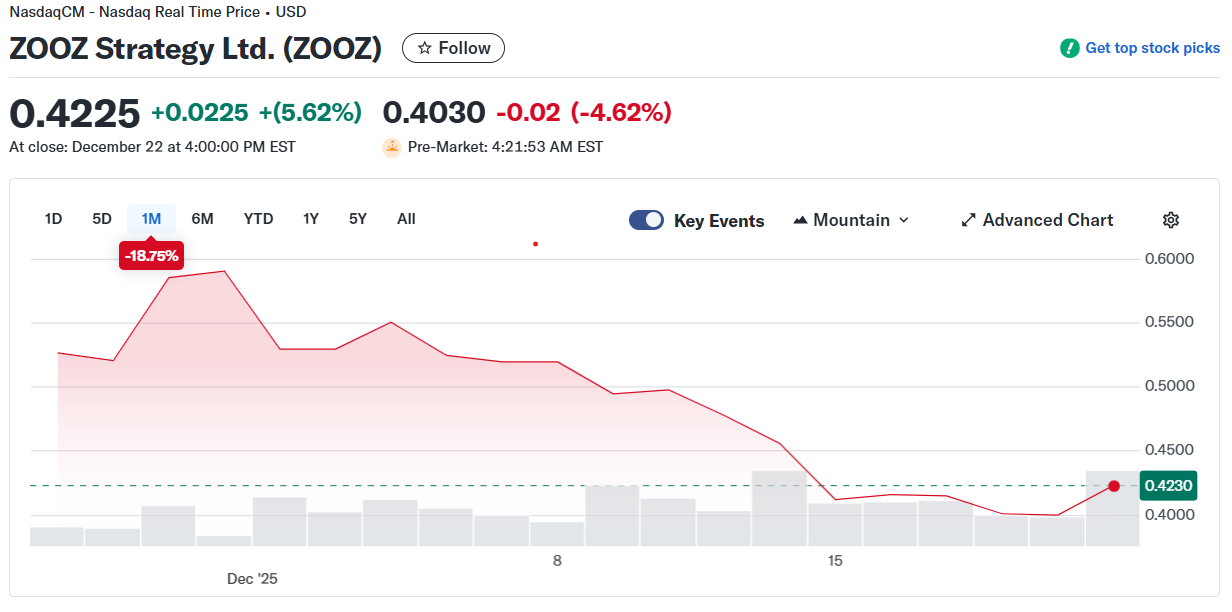
Zooz share price tanks below $1. Source: Yahoo Finance

For now, the company says its operations are unaffected, but acknowledges that it may need to use “available options.”

Related: ETHZilla liquidates $74.5M in Ether to redeem convertible debt

Winners and losers of the Bitcoin strategy

ZOOZ’s warning lands less than a week after KindlyMD, another Bitcoin treasury player created via a merger with David Bailey’s Bitcoin‐native holding company Nakamoto, disclosed its own price‐deficiency notice from Nasdaq after its shares slipped below the $1 mark.

Listing pressure is not limited to pure Bitcoin treasuries. Digital Currency X Technology (DCX), a digital‐asset firm that reports more than $1.4 billion in token holdings following its EdgeAI token acquisition, announced on Dec. 18 that it had received a separate Nasdaq non‐compliance notice tied to minimum market‐value requirements.

This doesn’t mean that all Bitcoin treasuries are on thin ice. Tokyo‐listed Metaplanet, which also leans on Bitcoin as a treasury asset, has continued to find ways to tap capital markets, most recently clearing the issuance of new shares and Bitcoin‐linked dividend instruments aimed at institutional investors.

Strategy, the best‐known corporate Bitcoin holder, has also kept pressing its strategy into December, adding roughly $980 million in BTC in mid‐month and lifting its total stash to over 671,000 coins.


Related Questions

QWhy did ZOOZ Strategy receive a notice from Nasdaq?

AZOOZ Strategy received a notice from Nasdaq because its share price fell below the $1 bid-price requirement, which violates the exchange's listing rules.

QWhat is a reverse share split and why might ZOOZ consider it?

AA reverse share split is when a company reduces the number of its outstanding shares to proportionally increase the price per share, typically to meet minimum price requirements for stock exchange listings without changing the company's overall market value. ZOOZ may consider this to regain compliance with Nasdaq's $1 minimum bid-price rule.

QHow much Bitcoin does ZOOZ hold as part of its treasury strategy?

AZOOZ holds 1,036 BTC as a strategic asset, which provides its shareholders with indirect exposure to Bitcoin.

QWhat is the deadline for ZOOZ to regain compliance with Nasdaq's listing rules?

AZOOZ has until June 15, 2026, to achieve a closing bid price of at least $1 for 10 consecutive trading days to avoid delisting from Nasdaq.

QAre other companies with Bitcoin treasury strategies facing similar delisting pressures?

AYes, other companies like KindlyMD and Digital Currency X Technology (DCX) have also received non-compliance notices from Nasdaq due to falling share prices or failing to meet minimum market-value requirements, indicating that listing pressures are not unique to ZOOZ.

Related Reads

From Madison Square Garden to Kalshi: Prediction Markets Break into the NBA Finals

From Madison Square Garden to Kalshi: Prediction Markets Break into the NBA Finals Prediction markets are playing a significant role in the 2026 NBA Finals, particularly around the New York Knicks' unexpected 2-0 series lead. Platforms like Kalshi and Polymarket have seen massive trading volumes, exceeding hundreds of millions of dollars on championship and related markets. Their influence extends beyond online trading. Kalshi's official partnership with Madison Square Garden has given it prominent physical branding at the arena. Furthermore, local businesses like The Jeffrey bar are using prediction market contracts to hedge the risk of game-result-based promotions, turning potential losses into manageable costs—a concept similar to the famous "Mattress Mack" strategy from traditional sports betting. These markets differentiate themselves by offering a wider, more entertainment-focused range of "event contracts" beyond typical game outcomes, such as predicting celebrity attendance. They also have broader accessibility across the U.S. compared to age- and location-restricted traditional sportsbooks. However, their rapid integration into sports raises regulatory and ethical questions. The NBA is cautiously engaging, discussing integrity frameworks with regulators like the CFTC. While the league permits minor investments like Giannis Antetokounmpo's stake in Kalshi, it advocates for strict rules to prevent insider trading. Many fans express concern on platforms like Reddit, fearing that the close ties between prediction markets, the league, and players could compromise the game's integrity. The NBA Finals has thus become a high-stakes testing ground, showcasing prediction markets' commercial potential while challenging traditional boundaries between financial trading, entertainment, and gambling.

marsbit2h ago

From Madison Square Garden to Kalshi: Prediction Markets Break into the NBA Finals

marsbit2h ago

Recursive Self-Improvement AI Gains Traction, Google Pours Cold Water, While DeepSeek and Others Approach the Fringes

The term "recursive self-improvement" (RSI), where AI improves itself autonomously, is gaining momentum in the AI industry. Startups like Recursive Superintelligence and projects such as Andrej Karpathy's Auto-Research aim to create systems where AI designs, implements, and validates its own research, moving toward superintelligence. While Google CEO Sundar Pichai cautions that such exponential acceleration is not yet a reality, progress is evident. For instance, Anthropic reported its Claude Code writes nearly 100% of the team's code, though it still lacks true self-direction. Analysts frame RSI development in stages: "adequacy" (systems functioning without humans), "parity" (matching human research quality), and "supremacy" (exceeding human-AI collaboration). Reaching parity could trigger rapid, unpredictable advancement due to AI's continuous operation. In China, companies like DeepSeek and Baidu incorporate self-optimization techniques without explicitly branding them as RSI, focusing on algorithmic efficiency and reinforcement learning. However, challenges remain, including "model collapse" from training on AI-generated data and the immense computational and open-collaboration requirements. Ultimately, RSI represents a trend of increasing automation in AI development, potentially reducing human oversight in the creation process itself.

marsbit2h ago

Recursive Self-Improvement AI Gains Traction, Google Pours Cold Water, While DeepSeek and Others Approach the Fringes

marsbit2h ago

Trading

Spot
Futures

Hot Articles

Discussions

Welcome to the HTX Community. Here, you can stay informed about the latest platform developments and gain access to professional market insights. Users' opinions on the price of S (S) are presented below.

活动图片














