From August 23 to 25, the price of $ZEC fluctuated between $820 and $871, with the estimated Zcash network hashrate around 25 GSol/s. Recently, several monitoring services recorded figures ranging from 27 to 29 GSol/s, indicating the network's activity is at one of its highest levels ever observed.
Economic logic perfectly explains what's happening. When coin revenue exceeds electricity and hosting costs, idle machines suddenly become productive assets again. Operators power up dormant equipment, place additional units in existing halls, or seek new machines until the rising mining difficulty begins to erode the extra margin.
Regarding the proof-of-work algorithm and consensus, the Zcash network uses Equihash – a mining algorithm built on computational operations requiring intensive memory use. Miners work through possible mathematical solutions, and the machine that first finds a solution meeting the network's difficulty requirements gets to add the next block of transactions.
Zcash's 75-Second Blocks Push ASIC Miners to Full Throttle
Unlike Bitcoin, which targets a block approximately every ten minutes, Zcash aims to create a block every 75 seconds. This translates to roughly 1,152 blocks per day. Currently, the protocol subsidy is 1.5625 $ZEC per block, but miners receive 80%, or 1.25 $ZEC, plus transaction fees.
The remainder is split between Zcash community grants and the protocol fund. The next halving in Zcash is expected around the end of 2028, when the total block reward is set to decrease to 0.78125 $ZEC. About 16.9 million out of the maximum 21 million $ZEC are already in circulation.
Zcash also measures mining computational power differently than Bitcoin. Bitcoin counts hashes per second, as ASIC miners repeatedly compute hashes. Equihash hardware generates possible solutions, so the number of solutions per second is a more accurate metric. One GSol/s corresponds to 1 billion solutions per second.
Why Zcash Hashrate Tracking Services Disagree on Data
This distinction helps explain why individual $ZEC mining dashboards regularly display different figures simultaneously. For example, on August 25, Coinwarz showed the Zcash hashrate at about 24.2 GSol/s, while the figures from the mining pool 2miners reached approximately 27.87 GSol/s. Neither of these numbers reflects the precise count of all mining devices connected to the Zcash network.
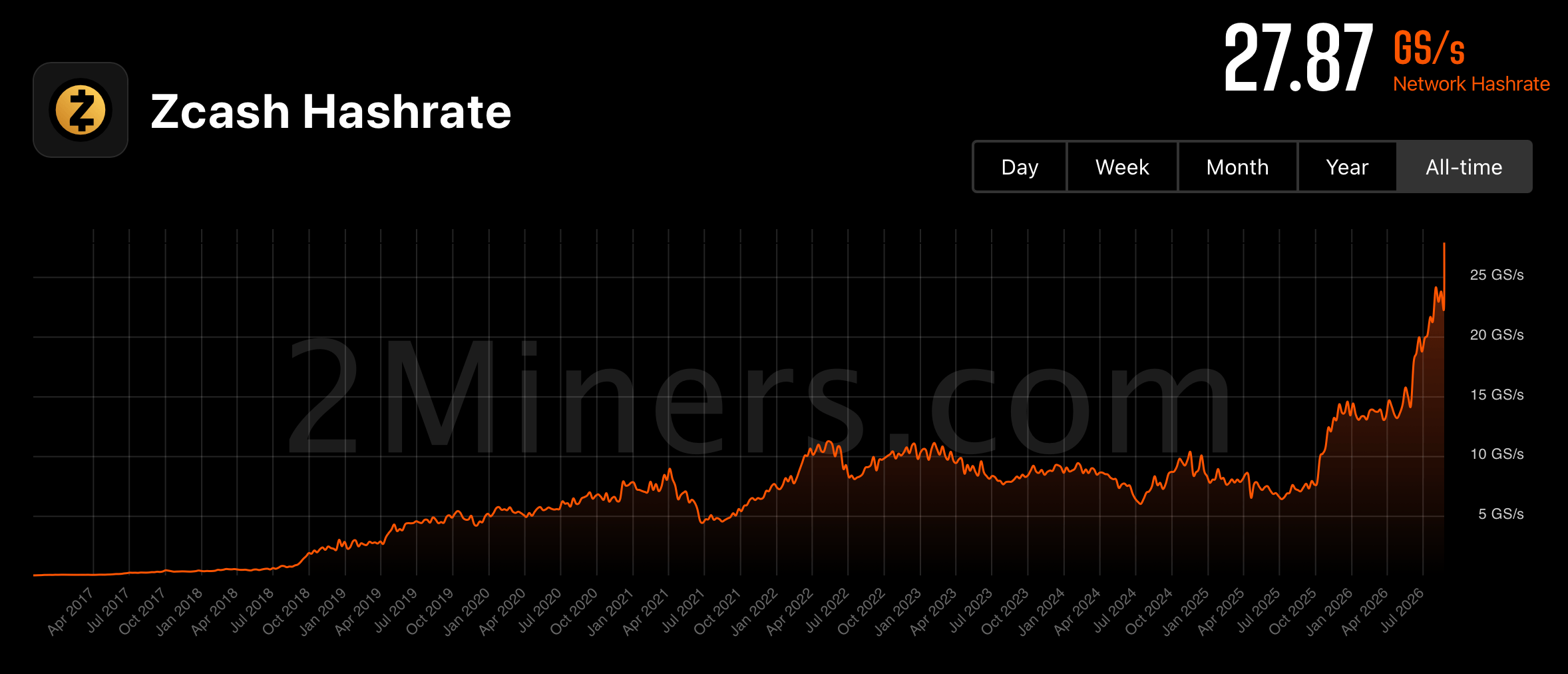
Instead, dashboards calculate the hashrate based on network difficulty and block formation time. One standard calculation method involves multiplying the Zcash difficulty by 8,192 and dividing the result by the target block interval of 75 seconds. With a difficulty of 227.36 million, this gives an approximate network hashrate estimate of about 24.8 GSol/s.
A tracker using the actual time between recent blocks might yield different results. If blocks appear closer to 70 seconds apart instead of 75, calculations point to higher mining power. Thus, different averaging windows, block heights, and update intervals can lead to discrepancies of several GSol/s, with no single dashboard necessarily being incorrect.
In Zcash's case, this effect is particularly noticeable because difficulty adjusts after each block using a 17-block averaging window. This mechanism aims to align mining with the 75-second target as miners join or leave. Therefore, a series of fast or slow blocks can sharply push the difficulty in one direction before it returns to its original level.
Bitmain's Z15 Pro Leads the Zcash Mining Race
The hardware behind this growth is highly specialized. Bitmain's Antminer Z15 Pro produces about 840 kiloSolutions per second (kSol/s) with a power consumption of approximately 2,780 watts, making it the standard machine in major Zcash mining farms. The older Antminer Z15 model generates about 420 kSol/s with a power draw of roughly 1,510 watts.
At a network rate of 25 GSol/s, a single Z15 Pro contributes a mere 0.00336% of the estimated Zcash mining power. Approximately 298 machines are required for a 1% share. On August 18, Cypherpunk Technologies reported launching Z15 Pro capacity of 4.2 GSol/s, equivalent to about 5,000 units at the standard output of 840 kSol/s.
These calculations show how quickly Zcash mining has become industrial-scale. A network of about 25 GSol/s represents roughly 30,000 Z15 Pro-equivalent machines, excluding obsolete equipment. Against the backdrop of high $ZEC prices, operators have every incentive to deploy hardware, but each additional ASIC increases mining difficulty and splits rewards among more competitors.
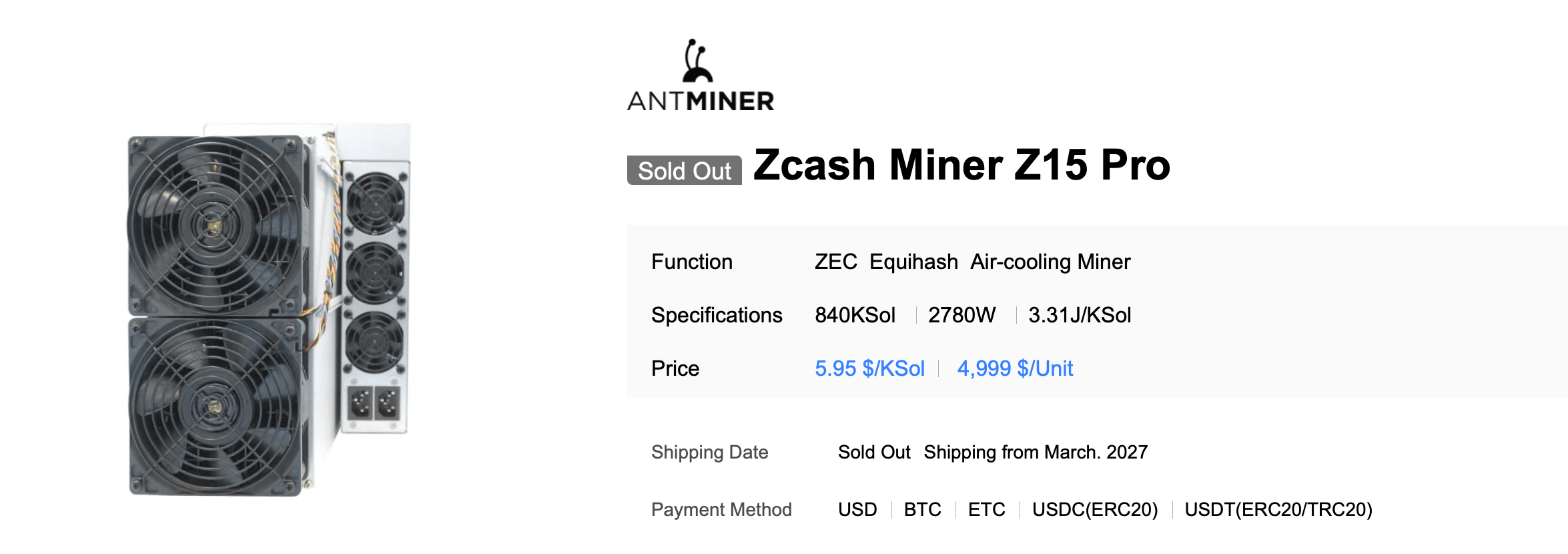
The problem is that it may be difficult for ordinary buyers to purchase a Z15 miner, as Bitmain's Antminer Z15 Pro ASIC miners priced at $4,999 are officially sold out. This forces buyers to turn to the second-hand market and independent shops. According to current data, factoring in today's $ZEC rate, the estimated daily revenue for an older Antminer Z15 mining $ZEC is approximately $17.06, while the Z15 Pro brings in about $34.69 per day.
At the moment, Zcash miners top the ASIC miner profitability rankings. However, the real test will be whether $ZEC can sustain prices that keep these machines profitable once the difficulty catches up with their output. Miners are also watching potential NU7 changes in Zcash and the halving at the end of 2028, while hashrate dashboards will likely show volatile readings as new Equihash-powered capacity comes online and unprofitable machines are switched off.
end-content