XRP Ledger Adds Military-Grade Security Via Payments Engine Standard

bitcoinistPublished on 2025-12-18Last updated on 2025-12-18

Abstract

Ripple has published the first formal specification for the XRP Ledger’s Payment Engine, developed with formal methods firm Common Prefix. This document aims to provide a canonical reference for payment behavior and cross-asset transfers on the ledger, moving beyond empirical success to mathematical certainty. The initiative addresses the limitations of relying solely on the C++ codebase as the source of truth, which makes it difficult to distinguish intentional design from historical behavior. As the ledger prepares for more complex features—like lending, batch transactions, and decentralized exchange upgrades—this specification ensures clarity and safety. The specification focuses on the Payment Engine and plans to extend to the Consensus Protocol, described as non-negotiable for network safety. Ripple aims to create both human-readable reference and machine-verifiable models to enable formal verification by 2026. The goal is to shift from "code-as-truth" to "mathematics-as-truth," enhancing security and enabling advanced features. The XRP community has welcomed the announcement as a major step toward military-grade security and protocol reliability.

Ripple has published the first formal specification of the XRP Ledger’s Payment Engine, positioning it as a foundational upgrade for protocol safety as XRPL moves into a more feature-dense era. The document was released in partnership with formal methods firm Common Prefix and is intended to become a canonical reference for how payments and cross-asset value transfer behave on-ledger.

The motivation is straightforward, and Ripple does not sugarcoat it. XRPL has operated for more than a decade without downtime, but the team argues that a long track record is still not the same as provable correctness. In the DEV Community post published Dec. 17 under the RippleX Developers banner, the authors write that “to prepare the ledger for the next generation of complex features, we must move beyond empirical success to mathematical certainty.”

A Turning Point For XRP Ledger Security

That is the tone throughout: less victory lap, more engineering debt disclosure. For much of XRPL’s life, the C++ implementation (xrpld) has effectively acted as the only definitive source of truth for core behavior. Ripple’s post calls out a practical problem with that model: “The code tells us, in very precise C++ terms, what it does. It does not always tell us why.” In other words, when code is the spec, it becomes difficult to separate intentional design choices from historical behavior that simply persisted because nothing broke.

That gap starts to matter more as new amendments arrive. Ripple points directly to a pipeline of complex features — including lending, DEX-related work tied to Multi-Purpose Tokens (MPTs), batch transactions, and permissioned DEX concepts — and warns that the number of possible system states expands quickly as new modules “weave into the decades-old logic of the ledger.”

The published specification is hosted on GitHub and labeled as work in progress, but it is already framed as a serious technical artifact: “a technical specification document intended for developers implementing or verifying XRPL payment system behavior.” It also spells out the heart of the system in plain language: the Payment Engine is what “figures out how value should travel and then carries out those moves,” enabling payments to draw across “trust lines, MPTs, order books, AMMs, and direct XRP.”

The deeper point, though, is what this enables next. Ripple’s post lays out a two-part target. First, a human-readable specification that reduces ambiguity and becomes the canonical reference for builders and researchers. Second, a machine-verifiable model — a mathematical representation of the spec — that can support mechanical proofs about system properties and whether proposed changes violate core safety guarantees.

It is also explicit about scope discipline. Ripple argues that specifying the entire ledger in one shot is not realistic: “It would be prohibitively expensive and time-consuming to specify the entire system at once.” So the work focuses on what it describes as the two most critical and complex components: the Payment Engine and the Consensus Protocol.

Consensus, in particular, is framed as non-negotiable infrastructure. Ripple describes it as “the heart of the ledger,” adding: “Its correctness is non-negotiable and underpins the safety and liveness of the entire network.”

The stated objective is to formally model the mechanism to prove properties such as liveness, safety, and finality. On timing, Ripple is clear that this is the starting line, not the finish. After publishing the Payment Engine specification, the team says it intends to begin formal verification work on the Payment Engine and the Consensus Protocol in 2026.

The closing line captures the direction of travel: “The shift from code-as-truth to mathematics-as-truth is underway.”

In the XRP community, the announcement landed with predictable euphoria. “Absolute freaking game changer! ... Aerospace & military grade security incoming,” wrote XRPL validator and community member Vet, adding: “The XRP Ledger is receiving its first formal specification for the payments engine. By mathematically specifying key protocol components [...] Basically, this is the enabler for the endboss of audits AND for other things like complex features or client diversity.”

At press time, XRP traded at $1.83.
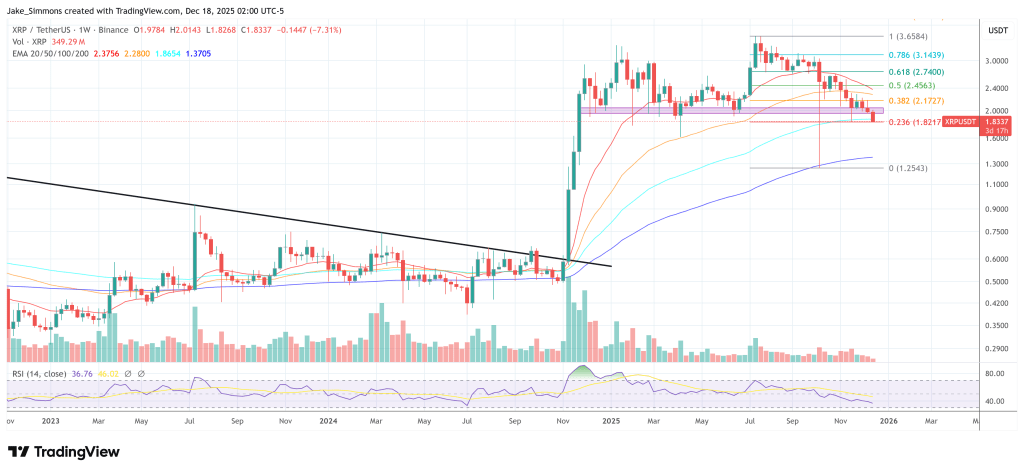
XRP falls below support zone, 1-week chart | Source: XRPUSDT on TradingView.com

Related Questions

QWhat is the main purpose of Ripple publishing the first formal specification of the XRP Ledger's Payment Engine?

AThe main purpose is to provide a foundational upgrade for protocol safety, moving beyond empirical success to mathematical certainty, and to serve as a canonical reference for how payments and cross-asset value transfer behave on-ledger as the XRPL introduces more complex features.

QWhich two critical components does Ripple's specification work focus on, and why?

AThe work focuses on the Payment Engine and the Consensus Protocol because specifying the entire ledger at once would be prohibitively expensive and time-consuming. These are described as the two most critical and complex components, with consensus being non-negotiable infrastructure that underpins the entire network's safety and liveness.

QWhat practical problem does Ripple identify with having the C++ code (xrpld) as the only definitive source of truth?

AThe code precisely tells what it does in C++ terms but does not always explain why, making it difficult to separate intentional design choices from historical behavior that simply because nothing broke, which becomes a greater issue as new amendments and complex features are added.

QWhat are the two parts of Ripple's target for the XRP Ledger specification?

AFirst, a human-readable specification that reduces ambiguity and becomes the canonical reference for builders and researchers. Second, a machine-verifiable model—a mathematical representation—that can support mechanical proofs about system properties and whether proposed changes violate core safety guarantees.

QWhen does Ripple intend to begin formal verification work on the Payment Engine and Consensus Protocol?

ARipple intends to begin the formal verification work on the Payment Engine and the Consensus Protocol in 2026.

Related Reads

DeepSeek Funding: Liang Wenfeng's 'Realist' Pivot

DeepSeek, a leading Chinese AI company, has initiated its first external funding round, aiming to raise at least $300 million at a valuation of no less than $10 billion. This move marks a significant shift from its founder Liang Wenfeng’s previous idealistic stance of rejecting external capital to maintain independence. Despite strong financial backing from its parent company, quantitative trading firm幻方量化 (Huanfang Quant), which provided an estimated $700 million in revenue in 2025 alone, DeepSeek faces mounting challenges. Key issues include a 15-month gap in major model updates, delays in its flagship V4 release, and the loss of several core researchers to competitors offering significantly higher compensation. The company is also undergoing a strategic pivot by migrating its infrastructure from NVIDIA’s CUDA to Huawei’s Ascend platform, a move aligned with China’s push for technological self-reliance amid U.S. export controls. However, DeepSeek lags behind rivals like智谱AI and MiniMax—both now publicly listed—in areas such as product ecosystem, multimodal capabilities, and commercialization. The funding round, though relatively small in scale, is seen as a way to establish a market-validated valuation anchor, making employee stock options more competitive and facilitating talent retention. It also signals DeepSeek’s transition from a pure research-oriented organization to a commercially-driven player in the global AI ecosystem.

marsbit27m ago

DeepSeek Funding: Liang Wenfeng's 'Realist' Pivot

marsbit27m ago

Solana Q1 Report: Revenue Plunges 68% Year-on-Year, Developers Decrease by 30%

Solana Q1 2026 Report: Key Metrics Show Significant Decline Amid Market Reset Solana experienced a substantial downturn in Q1 2026, with key performance indicators reflecting a broader market cooling. Total network revenue (REV) fell to $89.9 million, down 68% year-over-year (YoY) and 1.4% quarter-over-quarter (QoQ). This decline was driven by reduced speculative activity, which had previously fueled the network during the 2024/2025 bull market. Key revenue components saw mixed results: base fees dropped 8.7% QoQ, Jito tips (MEV) fell 19.7%, priority fees rose 23%, and vote fees declined 44.5%. The annualized real yield for stakers was just 0.17%, down 67% YoY. Network GDP, generated by top applications, fell 7% QoQ to $451 million. Pump Fun emerged as a standout, generating $103 million (up 3% QoQ), surpassing Solana's L1 revenue. However, daily active addresses averaged 2.4 million, down 4.8% YoY. Stablecoin supply on Solana reached $15.9 billion, down 2.7% QoQ but up 18% YoY. USDC and USDT remained dominant. DEX volumes averaged $3.2 billion daily, with private DEXs now accounting for 60% of all volume. The network's net dilution rate was 4.38%, while the cost to produce $1 of REV was $8.10, up 93% YoY. The number of new tokens created on launchpads grew 42% QoQ to 3 million, with Pump Fun dominating 85% of this market. Despite the downturn, Solana's core strengths remain: its position as a hub for retail trading apps, potential in perpetual markets, and growing use in stablecoin-based fintech applications, particularly in Latin America. However, developer activity declined 32% YoY, slightly worse than Ethereum's 29% drop. The network must now focus on attracting traditional finance, competing in perpetual markets, and sustaining developer ecosystem growth to drive the next expansion cycle.

marsbit1h ago

Solana Q1 Report: Revenue Plunges 68% Year-on-Year, Developers Decrease by 30%

marsbit1h ago

Trading

Spot
Futures

Hot Articles

How to Buy XRP

Welcome to HTX.com! We've made purchasing XRP (XRP) simple and convenient. Follow our step-by-step guide to embark on your crypto journey.Step 1: Create Your HTX AccountUse your email or phone number to sign up for a free account on HTX. Experience a hassle-free registration journey and unlock all features.Get My AccountStep 2: Go to Buy Crypto and Choose Your Payment MethodCredit/Debit Card: Use your Visa or Mastercard to buy XRP (XRP) instantly.Balance: Use funds from your HTX account balance to trade seamlessly.Third Parties: We've added popular payment methods such as Google Pay and Apple Pay to enhance convenience.P2P: Trade directly with other users on HTX.Over-the-Counter (OTC): We offer tailor-made services and competitive exchange rates for traders.Step 3: Store Your XRP (XRP)After purchasing your XRP (XRP), store it in your HTX account. Alternatively, you can send it elsewhere via blockchain transfer or use it to trade other cryptocurrencies.Step 4: Trade XRP (XRP)Easily trade XRP (XRP) on HTX's spot market. Simply access your account, select your trading pair, execute your trades, and monitor in real-time. We offer a user-friendly experience for both beginners and seasoned traders.

15.7k Total ViewsPublished 2024.03.29Updated 2025.03.21

How to Buy XRP

What is XRP 2.0

XRP 2.0: A New Frontier in the Cryptocurrency Landscape Introduction to XRP 2.0 In the ever-evolving realm of cryptocurrency, new projects continuously emerge, vying for attention and adoption. One such promising initiative is XRP 2.0, a novel cryptocurrency project designed to leverage advanced blockchain technology and robust encryption methodologies. While the name draws parallels with Ripple’s XRP, it’s crucial to note that XRP 2.0 operates independently, focusing on enhancing transaction security, privacy, and scalability. As the digital financial landscape increasingly embraces decentralized solutions, XRP 2.0 aims to contribute meaningfully to web3 and the overall expansion of crypto projects. What is XRP 2.0? At its core, XRP 2.0 is a cryptocurrency project that aims to create a secure and decentralized digital currency ecosystem. Its foundational technology integrates sophisticated blockchain principles with cutting-edge encryption techniques. The overarching goal of XRP 2.0 is to establish itself as a reliable and efficient platform enabling swift transaction execution while prioritizing enhanced privacy protections for its users. The project is promoted as a solution to many limitations faced by existing cryptocurrencies, proposing a system that can handle a higher volume of transactions with improved speed and privacy. This versatility positions XRP 2.0 as a significant contender in a marketplace riddled with various digital currencies. Who is the Creator of XRP 2.0? The identity of the creator behind XRP 2.0 has been flagged as ‘Wilbur.’ However, comprehensive details regarding Wilbur or their associated entity remain elusive. The anonymity of many cryptocurrency creators is not an uncommon phenomenon in the industry, often designed to maintain a degree of privacy and security. Who are the Investors of XRP 2.0? As of now, specific information related to the investment foundations or organizations supporting XRP 2.0 is not publicly available. In the cryptocurrency sector, the backing by reputed investors can significantly influence a project's credibility and success, yet the transparency regarding the financial supporters of XRP 2.0 has not been established. How Does XRP 2.0 Work? XRP 2.0 stands out by employing a combination of blockchain technology and advanced encryption algorithms that ensures secure and decentralized transactions. Its innovative structure includes unique features designed to foster user engagement and broaden functionalities beyond conventional cryptocurrency transactions. Among these features, XRP 2.0 incorporates AI-powered capabilities, such as text-to-image and text-to-speech functionalities. These additions are designed to enhance the interactive experience for users, promoting broader applicability across various sectors. By bridging technological advancements with user-centered design, XRP 2.0 aims to capture the attention of a diverse range of individuals and enterprises looking to integrate cryptocurrency solutions into their operational frameworks. Timeline of XRP 2.0 Understanding XRP 2.0 requires examining the milestones that have defined its journey thus far: July 23, 2023: XRP 2.0 is introduced as a novel cryptocurrency project, aiming to revolutionize secure and decentralized transaction capabilities in the blockchain domain. September 8, 2023: The launching of another project, XRP20, occurs, marking the emergence of an ERC-20 token on the Ethereum blockchain that remains unrelated to XRP 2.0. November 13, 2023: The XRP Ledger undergoes a significant update with the release of rippled server software version 2.0.0. It is essential to note that this development is disconnected from the XRP 2.0 cryptocurrency project. Key Points About XRP 2.0 To distill the essence of XRP 2.0, several critical factors emerge: Unique Features: The inclusion of features like AI-powered text-to-image and text-to-speech further diversifies the potential applications of XRP 2.0. Blockchain Technology: The framework utilizes advanced blockchain mechanisms and encryption protocols, ensuring a secure and decentralized environment for transactions. Scalability and Privacy: XRP 2.0 prioritizes enhanced privacy protections in transaction processes and the scalability necessary to accommodate a growing user base. No Affiliation with Ripple: Importantly, despite its name, XRP 2.0 does not have any allegiance or collaboration with Ripple’s XRP, distinguishing its operational framework and objectives within the cryptocurrency ecosystem. Conclusion XRP 2.0 represents an ambitious venture into the cryptocurrency sphere, aiming to offer a combination of security, privacy, and efficiency in digital transactions. By integrating sophisticated technologies and user-friendly features, the project sets out to broaden the horizons of what cryptocurrency can achieve in today's digital economy. While the anonymity of its creator and lack of disclosed investors might raise questions for some, XRP 2.0's focus on advanced functionalities and decentralisation enhances its appeal amidst an increasingly crowded crypto market. As the cryptocurrency landscape continues to evolve, XRP 2.0 may yet emerge as a pivotal player in the expansion of secure and scalable blockchain solutions.

941 Total ViewsPublished 2024.04.01Updated 2024.12.03

What is XRP 2.0

Discussions

Welcome to the HTX Community. Here, you can stay informed about the latest platform developments and gain access to professional market insights. Users' opinions on the price of XRP (XRP) are presented below.

活动图片