XRP Daily Fees Down 89% Since February: Network Activity Drying Up?

bitcoinistPublished on 2025-12-12Last updated on 2025-12-12

Abstract

XRP network transaction fees have plummeted by approximately 89% since their peak in February 2025, falling from 5,900 tokens per day to just 650 tokens per day—the lowest level since December 2020. This significant drop in daily fees, which are permanently destroyed in the XRP Ledger's unique consensus mechanism, suggests a substantial decline in overall network activity. Concurrently, the price of XRP has retreated to the $2.00 level after a recent downturn.

Data shows the XRP transfer fee has witnessed a significant decrease over the last several months, a sign network activity has been declining.

XRP Transaction Fee Has Dropped To 650 Tokens Per Day

In a new post on X, on-chain analytics firm Glassnode has discussed the latest trend in the Total Transaction Fees indicator for XRP. This metric measures, as its name suggests, the amount of fees that senders on the XRP network attach to their transactions every day.

On blockchains like Bitcoin and Ethereum, the transaction fee goes to the network validator who added the associated move to the next block. In the case of BTC, the network runs on a consensus mechanism called the proof-of-work (PoW), with validators called miners competing against each other using computational resources to get the chance to add the next block to the chain.

While for ETH, validators known as stakers handle consensus by locking in an ETH amount known as the “stake.” This mechanism is known as the proof-of-stake (PoS).

XRP takes an approach that differs from both digital asset giants. In the XRP Ledger Consensus Protocol, network validators maintain a list of other validators that they trust. Validators propose and vote on transactions, with consensus being reached when more than 80% of trusted nodes agree on the validity of the transactions.

The key difference is that in this system, there are no block/staking rewards, and validators aren’t compensated with transaction fees, either. Instead, the fee that users pay is destroyed. This means that every time a transaction occurs, a tiny part of the asset’s supply exits from circulation.

While the destination of the transaction fees is different for XRP when compared to Bitcoin and Ethereum, the network dynamics can still be similar. In other words, high traffic can push the Total Transaction Fees metric up, while low activity periods can lead to a drop in it.

Now, here is the chart shared by Glassnode that shows the trend in the 90-day simple moving average (SMA) of the XRP Total Transaction Fees over the last few years:
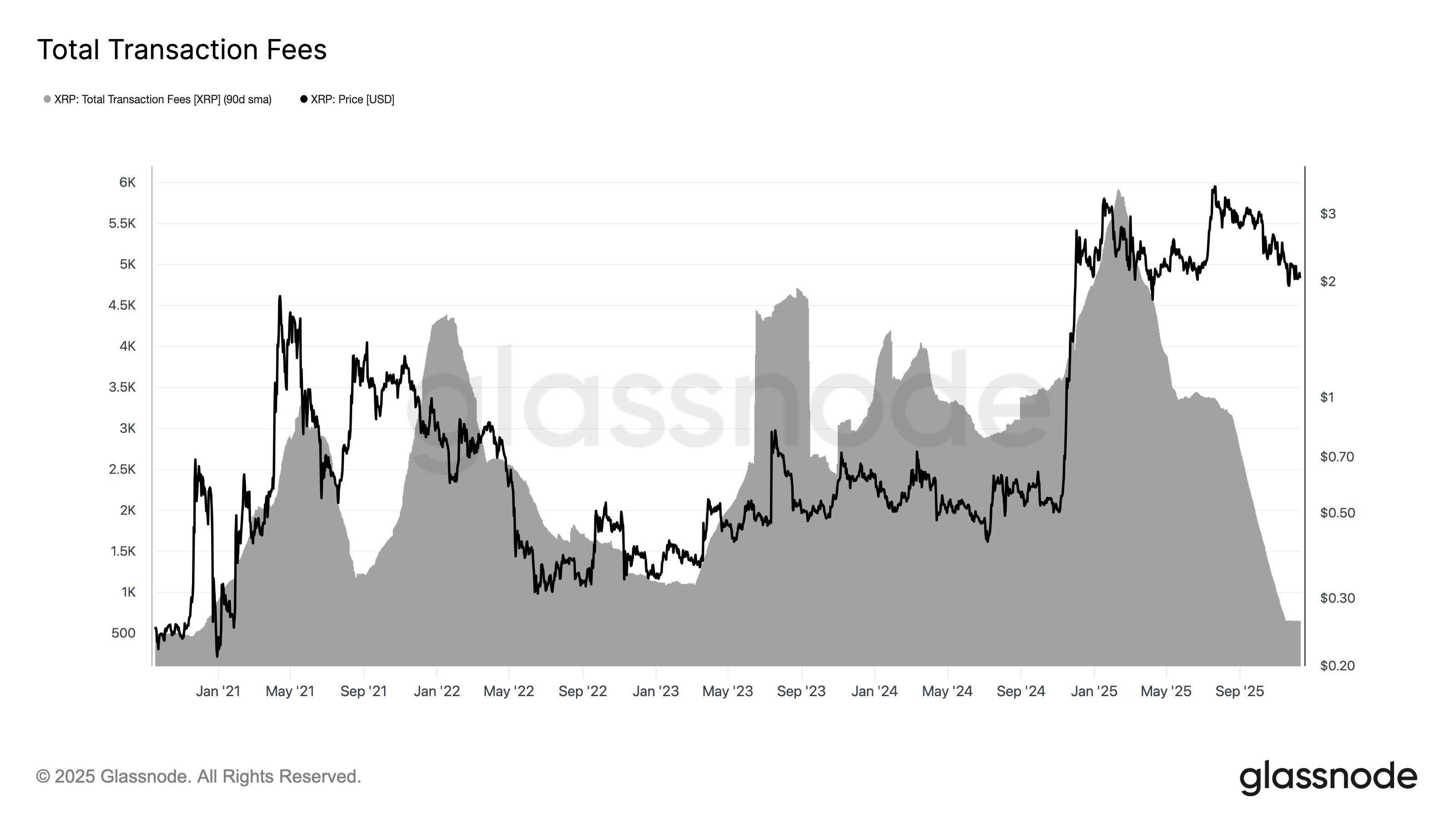
Looks like the value of the metric has been going down in recent months | Source: Glassnode on X

As displayed in the above graph, the XRP Total Transaction Fees witnessed a surge to an extreme level in early 2025. Users were paying 5,900 tokens per day as transfer fees at the peak of this explosion in February.

Since then, however, the blockchain has witnessed a rapid decline in the indicator. Today, the network is witnessing just 650 tokens per day in fees, reflecting a decrease of about 89% from the February high. The 90-day SMA Total Transaction Fees haven’t been this low for the asset since December 2020.

XRP Price

XRP has gone downhill during the last couple of days as its price has returned to the $2.00 level.

The trend in the price of the coin over the last five days | Source: XRPUSDT on TradingView

Trending Cryptos

Related Reads

Chipsea Turns from A-share to H-share: Riding the Price Surge Trend, or Gambling on the Cycle?

Xintianxia Technology, a Chinese flash memory chipmaker, is making its second attempt to list on the Hong Kong Stock Exchange after withdrawing its application for a mainland China IPO in late 2023. This move coincides with an upcycle in the memory chip sector. Ranked fifth among global fabless code-type flash memory suppliers in 2025, Xintianxia specializes in NOR Flash and SLC NAND chips. However, it holds a small 1.3% global market share in this niche segment. The company is highly dependent on a concentrated group of suppliers, with its top five accounting for over 80% of procurement in Q1 2026. After posting losses in 2023 and 2024, the company's fortunes reversed sharply in Q1 2026. Revenue grew 77.4% year-over-year to RMB 224 million, with net profit reaching RMB 75.89 million. This dramatic turnaround was primarily driven by strategic inventory stockpiling and significant price increases for its core products, leading to a gross margin surge to 55.63%. However, this aggressive strategy carries major risks. Inventory days have risen significantly, and the company's operating cash flow turned negative in Q1 2026 due to high stockpiling costs. The memory industry's cyclical nature means the current price boom may not last. If a downturn arrives, Xintianxia's high-cost inventory could become a financial burden, a scenario that previously derailed its A-share listing ambitions. Further complicating its IPO journey are corporate governance concerns. The company paid substantial dividends during loss-making years, and several major shareholders, including state-backed funds and the founder, cashed out significant stakes shortly before the Hong Kong listing application. Chinese regulators have requested details on past equity transfers, questioning pricing fairness. In essence, Xintianxia's Hong Kong listing bid is a high-stakes gamble on the sustainability of the current chip price cycle. Its future hinges not just on favorable market conditions but on its ability to withstand the inevitable downturn and prove its long-term operational resilience.

marsbit8m ago

Chipsea Turns from A-share to H-share: Riding the Price Surge Trend, or Gambling on the Cycle?

marsbit8m ago

BlackRock Launches Stablecoin Reserve Fund BRSRV: Bringing Short-Term US Treasuries to Solana, Ethereum, and Tempo

BlackRock Launches Tokenized Stablecoin Reserve Fund BRSRV, Expands to Solana and Tempo Global asset management giant BlackRock has introduced BRSRV (BlackRock Daily Reinvestment Stablecoin Reserve Vehicle), a tokenized money market fund specifically designed for stablecoin reserves. Concurrently, the firm is issuing tokenized, on-chain shares of its existing BSTBL (BlackRock Select Treasury-Based Liquidity Fund). A key development is the expansion of supported blockchains beyond Ethereum to include Solana and Stripe-affiliated chain Tempo for recording share ownership. The transfer agent Securitize will manage the process through approved, whitelisted wallets requiring verified identity, with a minimum initial investment of $3 million. The fund will invest solely in cash, short-term U.S. Treasuries, and overnight repurchase agreements backed by U.S. government securities, explicitly avoiding any crypto assets. BlackRock states the structure aims to qualify as a compliant reserve asset under the U.S. GENIUS Act for payment stablecoins. This launch builds upon BlackRock's broader tokenization strategy, notably following its BUIDL fund introduced in March 2024, which now holds over $26 billion in assets. The move places BlackRock alongside other major institutions like Morgan Stanley and Fidelity in offering products tailored for the stablecoin reserve market, signaling a deepening institutional push into tokenized real-world assets (RWA) and on-chain finance infrastructure.

marsbit9m ago

BlackRock Launches Stablecoin Reserve Fund BRSRV: Bringing Short-Term US Treasuries to Solana, Ethereum, and Tempo

marsbit9m ago

Wall Street Morning Report: AI + Cloud Computing Takes Over the Market Again, Amazon Knocks on the Door of $3 Trillion

Wall Street's August began with a strong rally, driven by easing Middle East tensions as President Trump signaled progress on U.S.-Iran talks, prompting a sharp drop in oil prices. Major indices hit record or near-record highs, with the Dow Jones Industrial Average up 1.32%, the Nasdaq Composite surging 2.13%, and the S&P 500 rising 1.48%. The energy sector was the sole decliner. The AI and cloud computing narrative dominated the tech rally. The "Magnificent Seven" index jumped 3.6%. Amazon's market cap surpassed $3 trillion for the first time following robust AWS results, while Nvidia regained a $5 trillion valuation. Meta, Google, and Microsoft also posted significant gains. Other AI-related stocks like Palantir, CoreWeave, and various semiconductor and infrastructure companies saw strong advances. In other markets, gold held above $4,000, supported by central bank buying. Treasury yields fell as oil prices dropped. The U.S. dollar remained stable despite strong manufacturing data. Japan's substantial currency intervention raised concerns, but U.S. officials reassured markets about the mechanism used. Key events ahead include major industry conferences (Ai4 2026, FMS Summit) and earnings reports from companies like SpaceX, AMD, and Pfizer. The White House is also set to host a meeting with leading AI firms to discuss regulatory frameworks.

marsbit1h ago

Wall Street Morning Report: AI + Cloud Computing Takes Over the Market Again, Amazon Knocks on the Door of $3 Trillion

marsbit1h ago

The July Tech Stock Pullback: Which Funds Are Paying the Price for Buying High?

In July, China's technology stocks experienced a sharp correction, causing significant pain for actively managed mutual funds that aggressively increased their holdings in the sector during the second quarter. The sell-off saw major indices like the ChiNext and STAR 50 fall over 25% and 28% for the month, respectively. Funds that piled into tech at its June peak faced steep losses. Notably, several veteran "value investor" fund managers, known for long-term holdings in consumer staples, made dramatic shifts. Star managers like Zhang Kun (E Fund Blue Chip Selected) and Liu Yanchun (Invesco Great Wall Dingyi) drastically reduced positions in liquor stocks like Kweichow Moutai, switching instead to semiconductor and AI hardware companies like SMIC and Ingenic International. Data shows active equity funds' allocation to the electronics sector reached a historical high of 42.64% by end-Q2. Around 67 funds saw their TMT (Technology, Media, Telecom) weighting surge from an average of 6.75% to 54.99%. The consequences were severe in July: these high-TMT funds fell an average of over 20%, with 12 plunging more than 40%. Examples include Jinhua High-Quality Growth and Guoshou Anbao Wenhui, which fell 26.34% and nearly 40% respectively after raising TMT weights above 70%. The article also highlights issues of "style drift," where funds with names like "high-dividend" held high-P/E tech stocks instead, confusing investors. Newly launched funds suffered even more. For instance, Guotai Haitong New Energy RuiXuan Hybrid, launched in mid-June, saw its net asset value plummet to 0.5509 yuan by July 30, a loss of nearly 45%. Analysts note the extreme sector concentration mirrored past bubbles (e.g., 2021 new energy). The intense, crowded trade itself became a major risk. While tech stocks rebounded sharply on July 31, the funds that chased the high face a longer-term market test.

marsbit1h ago

The July Tech Stock Pullback: Which Funds Are Paying the Price for Buying High?

marsbit1h ago

Trading

Spot

Hot Articles

What is XRP 2.0

XRP 2.0: A New Frontier in the Cryptocurrency Landscape Introduction to XRP 2.0 In the ever-evolving realm of cryptocurrency, new projects continuously emerge, vying for attention and adoption. One such promising initiative is XRP 2.0, a novel cryptocurrency project designed to leverage advanced blockchain technology and robust encryption methodologies. While the name draws parallels with Ripple’s XRP, it’s crucial to note that XRP 2.0 operates independently, focusing on enhancing transaction security, privacy, and scalability. As the digital financial landscape increasingly embraces decentralized solutions, XRP 2.0 aims to contribute meaningfully to web3 and the overall expansion of crypto projects. What is XRP 2.0? At its core, XRP 2.0 is a cryptocurrency project that aims to create a secure and decentralized digital currency ecosystem. Its foundational technology integrates sophisticated blockchain principles with cutting-edge encryption techniques. The overarching goal of XRP 2.0 is to establish itself as a reliable and efficient platform enabling swift transaction execution while prioritizing enhanced privacy protections for its users. The project is promoted as a solution to many limitations faced by existing cryptocurrencies, proposing a system that can handle a higher volume of transactions with improved speed and privacy. This versatility positions XRP 2.0 as a significant contender in a marketplace riddled with various digital currencies. Who is the Creator of XRP 2.0? The identity of the creator behind XRP 2.0 has been flagged as ‘Wilbur.’ However, comprehensive details regarding Wilbur or their associated entity remain elusive. The anonymity of many cryptocurrency creators is not an uncommon phenomenon in the industry, often designed to maintain a degree of privacy and security. Who are the Investors of XRP 2.0? As of now, specific information related to the investment foundations or organizations supporting XRP 2.0 is not publicly available. In the cryptocurrency sector, the backing by reputed investors can significantly influence a project's credibility and success, yet the transparency regarding the financial supporters of XRP 2.0 has not been established. How Does XRP 2.0 Work? XRP 2.0 stands out by employing a combination of blockchain technology and advanced encryption algorithms that ensures secure and decentralized transactions. Its innovative structure includes unique features designed to foster user engagement and broaden functionalities beyond conventional cryptocurrency transactions. Among these features, XRP 2.0 incorporates AI-powered capabilities, such as text-to-image and text-to-speech functionalities. These additions are designed to enhance the interactive experience for users, promoting broader applicability across various sectors. By bridging technological advancements with user-centered design, XRP 2.0 aims to capture the attention of a diverse range of individuals and enterprises looking to integrate cryptocurrency solutions into their operational frameworks. Timeline of XRP 2.0 Understanding XRP 2.0 requires examining the milestones that have defined its journey thus far: July 23, 2023: XRP 2.0 is introduced as a novel cryptocurrency project, aiming to revolutionize secure and decentralized transaction capabilities in the blockchain domain. September 8, 2023: The launching of another project, XRP20, occurs, marking the emergence of an ERC-20 token on the Ethereum blockchain that remains unrelated to XRP 2.0. November 13, 2023: The XRP Ledger undergoes a significant update with the release of rippled server software version 2.0.0. It is essential to note that this development is disconnected from the XRP 2.0 cryptocurrency project. Key Points About XRP 2.0 To distill the essence of XRP 2.0, several critical factors emerge: Unique Features: The inclusion of features like AI-powered text-to-image and text-to-speech further diversifies the potential applications of XRP 2.0. Blockchain Technology: The framework utilizes advanced blockchain mechanisms and encryption protocols, ensuring a secure and decentralized environment for transactions. Scalability and Privacy: XRP 2.0 prioritizes enhanced privacy protections in transaction processes and the scalability necessary to accommodate a growing user base. No Affiliation with Ripple: Importantly, despite its name, XRP 2.0 does not have any allegiance or collaboration with Ripple’s XRP, distinguishing its operational framework and objectives within the cryptocurrency ecosystem. Conclusion XRP 2.0 represents an ambitious venture into the cryptocurrency sphere, aiming to offer a combination of security, privacy, and efficiency in digital transactions. By integrating sophisticated technologies and user-friendly features, the project sets out to broaden the horizons of what cryptocurrency can achieve in today's digital economy. While the anonymity of its creator and lack of disclosed investors might raise questions for some, XRP 2.0's focus on advanced functionalities and decentralisation enhances its appeal amidst an increasingly crowded crypto market. As the cryptocurrency landscape continues to evolve, XRP 2.0 may yet emerge as a pivotal player in the expansion of secure and scalable blockchain solutions.

1.4k Total ViewsPublished 2024.04.01Updated 2024.12.03

What is XRP 2.0

Discussions

Welcome to the HTX Community. Here, you can stay informed about the latest platform developments and gain access to professional market insights. Users' opinions on the price of XRP (XRP) are presented below.

活动图片