X Makes A Big Crypto Move With Cashtags And In-App Trading Plans

bitcoinistPublished on 2026-04-15Last updated on 2026-04-15

Abstract

X is expanding its crypto and financial market integration with the launch of Cashtags, a feature that enables users to discover tokens, view real-time price charts, and access trading functionality directly within the app. Initially available on iPhone in the US and Canada, the rollout will soon extend to web, Android, and global markets. Cashtags and contract addresses now trigger asset suggestions, allowing users to select specific stocks or cryptocurrencies. Tapping a Cashtag displays relevant posts feed and a price chart without leaving the platform. X also announced a pilot integration with Canadian brokerage Wealthsimple, enabling seamless in-app trading. This move aims to bridge market conversation with execution, positioning X as a platform where discovery, pricing, and trading converge. A broader global launch is expected soon.

X is pushing deeper into crypto and market infrastructure with a new Cashtags rollout that brings token discovery, price charts, and early trading functionality directly into the app. The feature is live on iPhone in the US and Canada, with web, Android, and a broader global launch slated to follow soon.

X Launches New Crypto Cashtags

The pitch from X is straightforward: keep traders inside the timeline. In a post announcing the launch, X’s head of product Nikita Bier said, “X has always been the best source of financial news for traders and investors. Billions of dollars are allocated every day based on what people read on Timeline. Today we’re launching our new Cashtags feature in the US and Canada on iPhone, bringing real-time financial data to X.”

Cashtags and contract addresses now trigger asset suggestions, allowing users to select the specific stock or crypto token they mean. Once selected, a tap on the Cashtag opens a feed of relevant posts alongside a price chart, all without forcing users off-platform.

Bier described that flow in product terms, but the market implication is clear. “When you search for or post a cashtag (or contract address), X will automatically suggest matching stocks or crypto tokens, so you can select the exact asset you had in mind. Anyone who taps a Cashtag will see posts mentioning it along with its price chart—without ever leaving X. This ensures that you’re always matched to the chatter for the right stock or token.”

For crypto users, that reduces one of the platform’s longstanding friction points: the gap between seeing a ticker trend and finding the corresponding asset context.

X also signaled that Cashtags are meant to evolve beyond a media feature into a transaction layer. Bier said, “Our vision is more than just charts. The content on X is valuable & actionable, so trading should be frictionless. Today we’re also announcing a pilot integration with Wealthsimple, Canada’s leading brokerage. Users in Canada will see a button on Cashtags so they can trade seamlessly from X. This is just a small preview of what’s to come.”

That last point is the more consequential one. If Cashtags become the bridge between market conversation and execution, X moves from being a venue where crypto narratives form to one where they can also be expressed in trades. For now, the trading button is limited to a Canadian pilot via Wealthsimple, and the rollout remains narrow by geography and device. But the direction is unmistakable.

Bier also said web and Android support, along with a global launch, are coming “very soon.” For crypto that suggests X is trying to formalize a role the platform has informally held for years: not just the place where the market talks, but a place where discovery, pricing, and eventually execution converge in the same interface.

At press time, the total crypto market cap stood at $2.48 trillion.
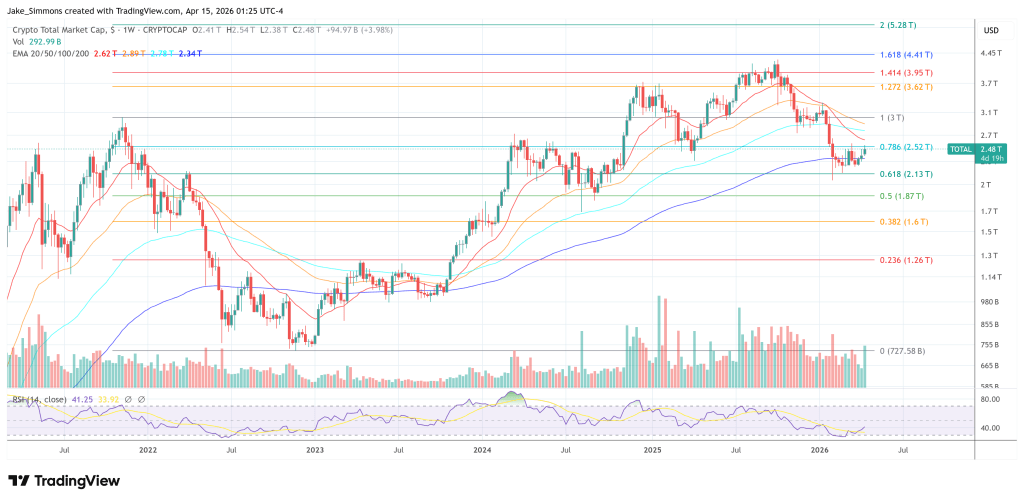
Total crypto market cap needs to break the 0.786 Fib. 1-week chart | Source: TOTAL on TradingView.com

Related Questions

QWhat new feature is X launching to deepen its crypto and market infrastructure integration?

AX is launching a new Cashtags feature that provides token discovery, price charts, and early trading functionality directly within the app.

QWhich regions and devices currently have access to the Cashtags feature, and what expansions are planned?

AThe Cashtags feature is currently live on iPhone in the US and Canada, with web, Android, and a broader global launch planned to follow soon.

QHow does the Cashtags feature improve the user experience for crypto traders on X?

AIt reduces friction by automatically suggesting matching stocks or crypto tokens when users search or post a cashtag, and displays relevant posts alongside a price chart without leaving the X platform.

QWhat partnership did X announce to enable in-app trading, and where is it available?

AX announced a pilot integration with Wealthsimple, Canada's leading brokerage, which allows users to see a trading button on Cashtags for seamless transactions. This is currently available only in Canada.

QWhat is the broader vision for Cashtags beyond just displaying price charts and information?

AX's vision is for Cashtags to evolve into a transaction layer, making trading frictionless and converging market discovery, pricing, and execution within the same interface on the platform.

Related Reads

WeChat Agent Issues a 'Heroic Summons,' Half of the Internet Responds

WeChat AI Agent is on the horizon. The WeChat Open Platform has issued a guide for developers, offering them ways to integrate into the WeChat AI ecosystem. This will enable mini-programs to be discovered and invoked by the AI. Meituan has already announced its integration, allowing users to access services like food delivery through WeChat AI. Other platforms like Ctrip and Tongcheng have followed suit. Furthermore, WeChat is collaborating with major smartphone manufacturers to enable their native AI assistants to perform actions within WeChat, such as initiating calls or sending messages, through a controlled protocol called Agent-to-Agent (A2A). Reports indicate the WeChat AI Agent will be accessible by swiping right on the main interface. It aims to understand user intent within the rich context of chats, groups, and past interactions, then automatically call upon relevant mini-programs to complete tasks like ordering coffee or booking restaurants. This positions it as a potential "super app" with direct access to WeChat's vast ecosystem of services, social connections, and payment systems. Technically, this is a complex endeavor. It requires advanced natural language understanding, a "world model" to predict interactions within mini-programs (UI-Oceanus), multi-model orchestration for cost efficiency, and careful coordination with millions of third-party service providers. Tencent's development follows a "Co-Design" approach, where product teams and the Hunyuan model team collaborate closely, allowing capabilities honed in other AI products (like Yuanbao for chat, ima for search, WorkBuddy for office tasks) to be transferred to the WeChat Agent. Tencent is strategically opting for the A2A protocol over GUI-based automation (which it has blocked in the past), maintaining control over its ecosystem. To manage the immense scale and cost of serving 1.4 billion monthly active users, Tencent is deepening its ties with DeepSeek, known for its cost-effective training, to secure a low-cost inference backbone. The ultimate goal is to solve practical, everyday problems for users within the WeChat ecosystem, moving beyond technical benchmarks to deliver real utility, which Tencent sees as the key to winning in the long-term AI game.

marsbit4m ago

WeChat Agent Issues a 'Heroic Summons,' Half of the Internet Responds

marsbit4m ago

Humanity Loses $31 Million in Attack, Token Price Plummets 90% Due to a Single Private Key

On June 9th, the digital identity project Humanity Protocol suffered a major security breach resulting in over $31 million in losses. According to on-chain analyst Specter, hundreds of wallets holding the project's H token were drained. The attack was confirmed by founder Terence Kwok to be caused by the compromise of a foundation member's private key. As a precaution, users are advised to avoid interacting with Humanity's cross-chain bridge or liquidity pools. The incident caused the H token price to crash over 90%, from around $0.70 to a low of $0.052, wiping its market cap from $2 billion to approximately $35.7 million. The attacker allegedly minted 100 million new H tokens and is selling them for BNB. This breach adds to existing controversies surrounding Humanity Protocol. Founded in 2024, it aimed to verify human users via palm-print biometrics and zero-knowledge proofs. However, a leaked conversation in 2025 revealed that only about 1 million of its 9 million claimed Human IDs had completed biometric verification, suggesting 88% might be bots. Furthermore, the project has faced allegations of being a repackaged product from a Chinese access control vendor, raising privacy and authenticity concerns. Founder Terence Kwok's previous venture, Tink Labs, a hotel smartphone startup that raised $170 million, failed and entered bankruptcy in 2020 after burning through its funding. The current attack highlights the persistent critical issue of private key management in crypto. Unlike smart contract exploits, a private key compromise bypasses all on-chain security mechanisms. With no user compensation plan announced yet, this $31 million breach may be a final blow to the project's credibility, already weakened by previous controversies and a heavily depreciated token.

marsbit39m ago

Humanity Loses $31 Million in Attack, Token Price Plummets 90% Due to a Single Private Key

marsbit39m ago

MicroStrategy Will Not Die in This Downturn: Reflexivity, STRC Anchoring Back to Par, and the Self-Rescue Logic of "Sell Stock, Not Bitcoin"

This article analyzes the recent sharp decline in Bitcoin and MicroStrategy (MSTR), framing it as a targeted "reflexivity" attack. The trigger was MSTR using its cash reserves to buy back convertible notes, raising market concerns about a liquidity crisis. The playbook follows George Soros's principle: market expectations can shape reality. Fears that MSTR might be forced to sell BTC caused panic selling, lowering BTC's price and worsening MSTR's financial ratios, thus reinforcing the negative narrative. The author argues that MSTR's Structured Convertible (STRC), while falling in price, is a floating-rate security that will eventually return to par value (100). The price drop reflects the market demanding a higher yield due to perceived risk, but as a floating-rate instrument, its coupon can adjust, naturally pulling the price back to par over time. This is crucial for MSTR's continued ability to raise funds. The core thesis is that MSTR's best move to counter the attack is to **issue new equity (sell shares)**, not sell its Bitcoin holdings. While selling BTC would solve the immediate cash crunch, it would destroy the company's core investment thesis and premium. It would dilute the BTC per share, likely erase the market premium over its net asset value (mNAV > 1), and worsen its debt-to-asset ratio. Issuing shares while mNAV is high (e.g., 1.25x) allows MSTR to raise cash for reserves without harming shareholder value or the "perpetual accumulation" narrative. It improves the debt ratio and reassures STRC holders, breaking the negative reflexivity cycle. In conclusion, while MSTR could survive this episode even by selling BTC, doing so would fundamentally alter its investment proposition and weaken it for future cycles. The optimal, value-preserving strategy is to sell equity to rebuild reserves and maintain the long-term growth flywheel.

marsbit39m ago

MicroStrategy Will Not Die in This Downturn: Reflexivity, STRC Anchoring Back to Par, and the Self-Rescue Logic of "Sell Stock, Not Bitcoin"

marsbit39m ago

Humanity Loses $31 Million, a Private Key Causes Token Price to Plunge 90%

On June 9th, the digital identity project Humanity Protocol suffered a major security breach resulting in over $31 million stolen from hundreds of wallets holding its H token. The attack was caused by the compromise of a private key belonging to a foundation member, leading the team to advise users against interacting with its bridge or liquidity pools. Following the incident, the price of the H token plummeted by over 90%, from around $0.70 to a low of $0.052, wiping out a significant portion of its market capitalization. The attacker allegedly minted 100 million new H tokens and began selling them for BNB. Humanity Protocol, founded in 2024, aimed to verify human users through palm-print biometrics and zero-knowledge proofs on Polygon CDK. Despite raising $50 million across two funding rounds and achieving a unicorn valuation, the project faced prior controversies. Shortly after its June 2025 token launch, reports emerged that only about 1 million of its 9 million registered IDs had completed biometric verification, suggesting 88% might be bots. Furthermore, allegations surfaced that the project might be a rebranded "shell" of a Chinese access control company, raising concerns about data privacy and authenticity. The project's founder, Terence Kwok, has a controversial business history. His previous venture, Tink Labs, burned through $170 million in funding before collapsing in 2020. The breach highlights the persistent critical risk of private key management in crypto. With no user compensation plan detailed in the initial response, the incident deals a severe blow to trust in a project already struggling with credibility issues.

Foresight News1h ago

Humanity Loses $31 Million, a Private Key Causes Token Price to Plunge 90%

Foresight News1h ago

Trading

Spot
Futures

Hot Articles

How to Buy MOVE

Welcome to HTX.com! We've made purchasing Movement (MOVE) simple and convenient. Follow our step-by-step guide to embark on your crypto journey.Step 1: Create Your HTX AccountUse your email or phone number to sign up for a free account on HTX. Experience a hassle-free registration journey and unlock all features.Get My AccountStep 2: Go to Buy Crypto and Choose Your Payment MethodCredit/Debit Card: Use your Visa or Mastercard to buy Movement (MOVE) instantly.Balance: Use funds from your HTX account balance to trade seamlessly.Third Parties: We've added popular payment methods such as Google Pay and Apple Pay to enhance convenience.P2P: Trade directly with other users on HTX.Over-the-Counter (OTC): We offer tailor-made services and competitive exchange rates for traders.Step 3: Store Your Movement (MOVE)After purchasing your Movement (MOVE), store it in your HTX account. Alternatively, you can send it elsewhere via blockchain transfer or use it to trade other cryptocurrencies.Step 4: Trade Movement (MOVE)Easily trade Movement (MOVE) on HTX's spot market. Simply access your account, select your trading pair, execute your trades, and monitor in real-time. We offer a user-friendly experience for both beginners and seasoned traders.

4.4k Total ViewsPublished 2024.12.10Updated 2026.06.02

How to Buy MOVE

Discussions

Welcome to the HTX Community. Here, you can stay informed about the latest platform developments and gain access to professional market insights. Users' opinions on the price of MOVE (MOVE) are presented below.

活动图片