Author: Golem
Original Title: On the Eve of the Storm: Powell Holds Rates, Trump Announces New Fed Chair?
At 3:00 AM Beijing time on January 29 (this Thursday), the Federal Reserve is set to announce its first interest rate decision of 2026; half an hour later, current Fed Chair Jerome Powell will hold a monetary policy press conference. However, there is little suspense around this Fed rate decision, as the market widely expects the Fed to keep rates unchanged. Polymarket data shows the probability of holding rates steady is close to 100%.
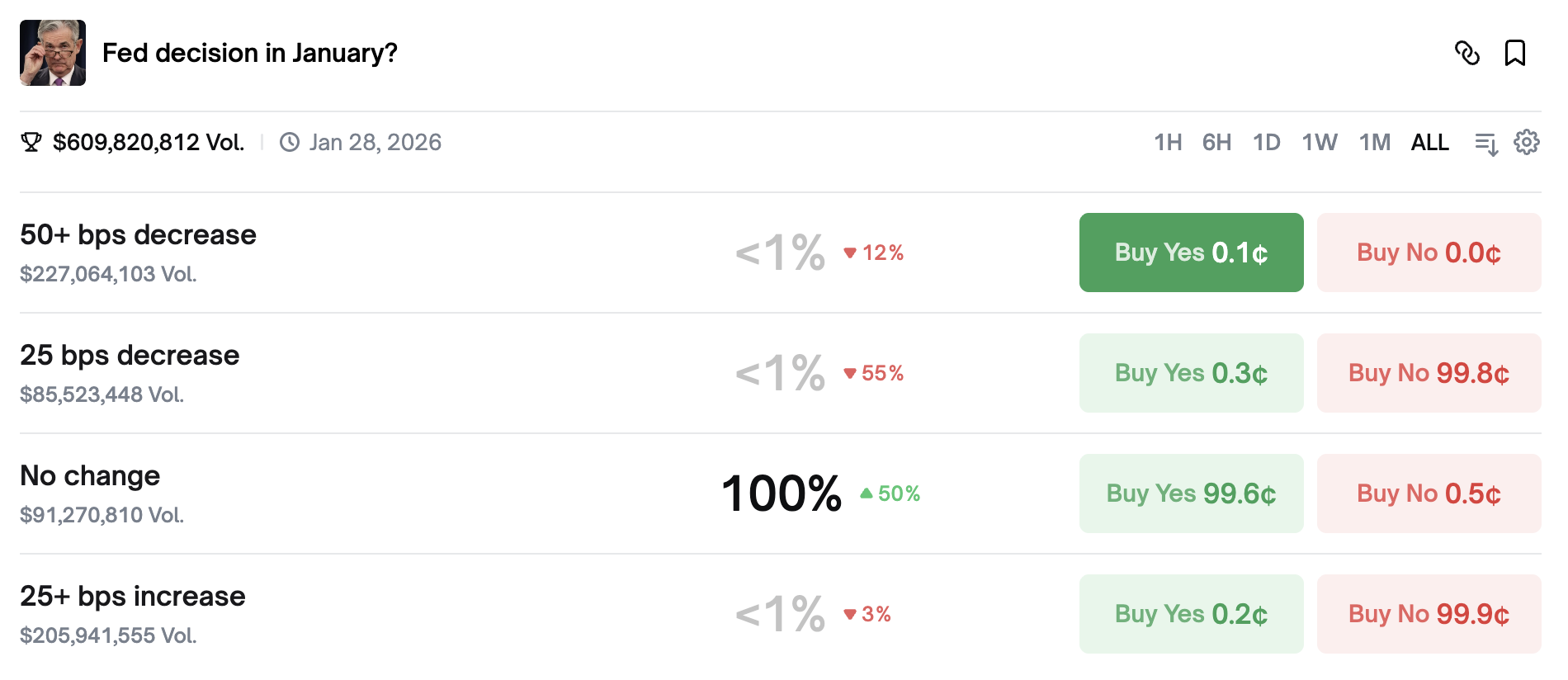
Such a high probability has allowed the market to提前消化 (price in) the negative impact of the Fed's "no rate cut" announcement this time. OKX data shows that BTC has fallen only 0.39% in the past 7 days, basically hovering sideways, but this period of market "silence" might be broken tonight.
On one hand, although the market almost unanimously believes the Fed will hold rates this week, there is significant divergence regarding the fiscal path for the remainder of 2026, making this still an important meeting to watch. The Fed's future key policy tendencies—whether it will continue cutting rates in 2026, the frequency of cuts, etc.—will affect the market. If Powell makes hawkish remarks during his speech, such as "need to continue observing," the market might "fall in response."
On the other hand, the announcement of the successor to the Fed Chair will also have a long-term impact on the market. The shortlist has been narrowed down to four people. Trump previously stated he has a preferred candidate but is waiting for the right time to announce, and this suitable time could very well be tonight.
2026 Rate Cut Direction Still Uncertain
Since last September, the Fed initiated a new rate-cutting cycle, conducting three consecutive rate cuts. If rates are held unchanged this week, it would be the first pause since the cycle began. At this point, the market is concerned not with the reason for holding rates, but whether this is a brief pause to observe or the start of a prolonged pause in rate cuts, or even the beginning of a rate hike cycle?
Previously, the prevailing market view was that 2026 would be a year of further quantitative easing by the Fed.
Reason one, from a data perspective, the US labor market indeed shows signs of weakness. Non-farm payrolls increased by only 50,000 in December 2025, with an unemployment rate of 4.4%. While there hasn't been "massive layoffs," it remains in a state of "low hiring, cooling demand." Reason two, the Fed might still believe Trump's tariff policies won't have a long-term impact on inflation (Odaily: Powell cited this factor for a rate cut in September 2025). Reason three, Trump has publicly stated he will choose a "dovish" figure as the next Fed Chair.
However, some in the market believe there is uncertainty about the Fed continuing rate cuts in 2026. Some analysts think that unless the job market deteriorates significantly, it will be difficult to see rate cuts before mid-year, as the pace of inflation decline is not sufficient to convince hawkish members.
The Fed's mandate, simply put, is to curb inflation and promote employment. However, in 2025, the US experienced a phenomenon of a weak labor market coexisting with high inflation. The Fed ultimately chose to prioritize the employment issue, hence initiating the rate-cutting cycle. Yet, the reality is that the US inflation rate remains stuck at 2.8%, far above the Fed's 2% target, forcing the Fed to reconsider the impact of tariffs on inflation. Holding rates this week would also indicate the Fed is starting to "observe."
Furthermore, although the next Fed Chair chosen by Trump is destined to be "dovish," the new rotating chairs of the Fed's interest rate-setting committee are predominantly "hawkish." At the beginning of each year, four of the 12 regional Fed presidents rotate onto the interest rate-setting committee and gain voting rights for the next eight policy meetings. This year's rotating list includes Dallas Fed President Lorie Logan, Cleveland Fed President Loretta Mester (referred to as Hamack in the text, likely a transliteration for Mester), Philadelphia Fed President Patrick Harker (referred to as Paulson in the text, likely a transliteration for Harker), and Minneapolis Fed President Neel Kashkari.
Among them, Logan and Mester are seen as "hawkish" figures, both having previously publicly stated the Fed should focus on inflation. Harker is seen as "dovish," having expressed "cautious optimism" about inflation. Kashkari's stance is relatively neutral. The addition of new "hawkish" members might disrupt the previous balance of policy倾向 within the Fed. Even if Trump chooses a "dovish" Chair, they cannot single-handedly sway the entire interest rate-setting committee.
Moreover, the Fed Chair might not completely follow Trump's wishes in主导降息 (leading rate cuts). Years ago, Trump personally appointed Powell as Fed Chair, but last year, even though Trump promoted Powell, Powell did not "repay" Trump with sustained, significant rate cuts. Under US law, the Fed is independent and can make interest rate decisions based on the economic situation, not government wishes. Therefore, even if the new Fed Chair verbally promises Trump to cut rates, they might "go their own way" after taking office.
This kind of meaningless "political promise" is also a concern for Trump. Last week, Trump said in a speech at the World Economic Forum in Davos, Switzerland, "It's amazing how people change once they get that job," meaning candidates "say nice things during the interview" but emphasize their independence once confirmed.
Considering these factors, Powell's speech after tonight's FOMC meeting will also be closely watched by investors for hints on how long the Fed might pause rate cuts.
This Week's FOMC Meeting Could Be One of the Best Times for Trump to Announce the Fed Chair Successor
Besides this week's FOMC meeting, the Fed Chair successor is another macro event that can influence the market. The candidates have been narrowed down to Kevin Hassett, Kevin Warsh, Rick Rieder, and Christopher Waller. According to Polymarket data, Rick Rieder currently has the highest probability of being nominated by Trump at 47%; Kevin Hassett has the lowest probability at 6%.
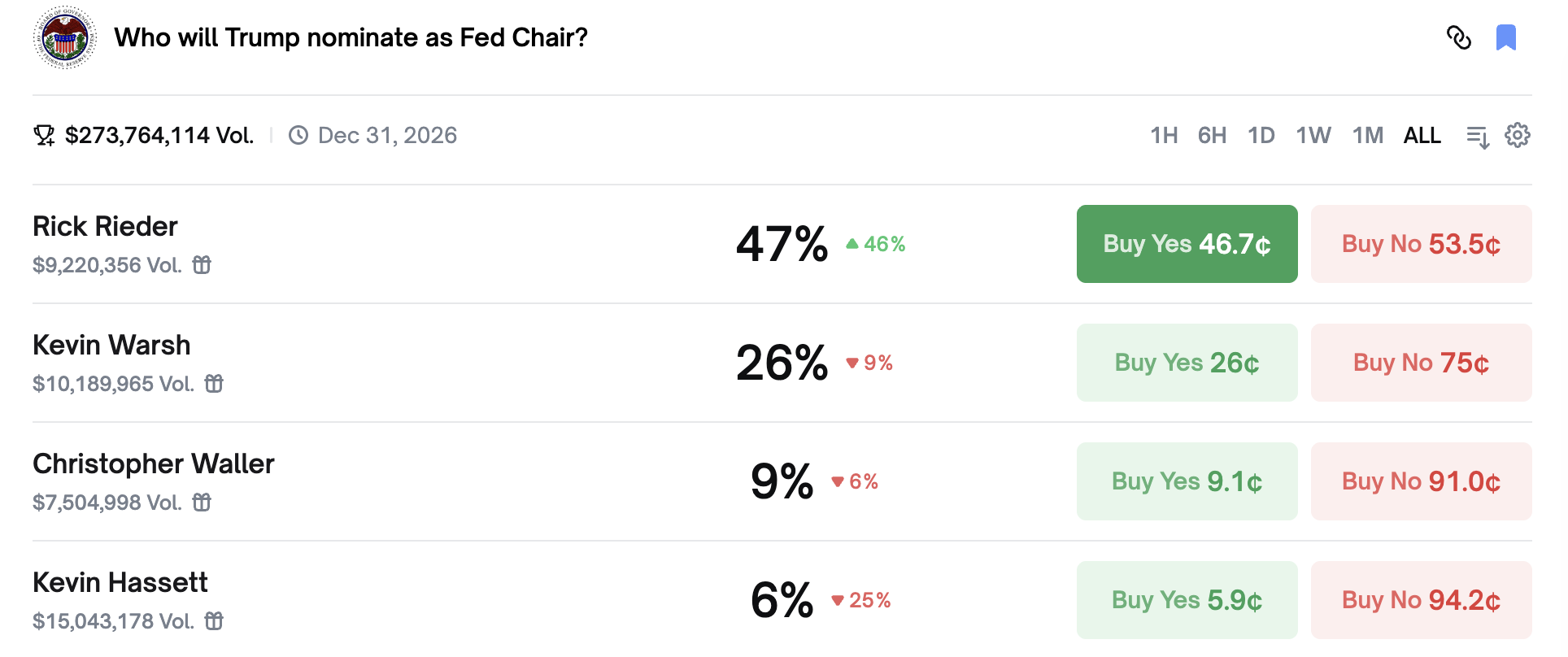
Rick Rieder is BlackRock's Chief Investment Officer of Global Fixed Income. Although he doesn't have much government experience, he has consistently advocated for supporting low interest rates based on his understanding of the market rather than politics. This resume might attract Trump, who is worried about the new Fed Chair becoming "disobedient" upon taking office. Economists at Evercore ISI, including Krishna Guha, even believe "if Rick Rieder becomes the new Fed Chair, he might advocate for three rate cuts this year." (Odaily Note: For more information on Rick Rieder, read 《The Last Seat on the Fed Chair Candidate List, What is Rick Rieder's Attitude Towards Crypto?》)
Hassett was once considered the most likely candidate for the new Fed Chair, with probability一度 (once) exceeding 80%. But Hassett is Trump's economic advisor. Previously,外界质疑 (outside doubts emerged) that if Trump nominated Hassett, it would damage the Fed's independence. Additionally, Trump publicly stated he didn't want to lose Hassett within his administration. Therefore, Hassett's probability of selection declined, though some still believe his nomination probability is higher than 6%.
Trump has repeatedly publicly stated he would announce his nominee in January. In late December 2025, Trump told reporters in Florida he would announce the next Fed Chair人选 (candidate) sometime in January; On January 14, 2026, Trump said in an interview with Reuters he would announce the candidate within the next few weeks; Two weeks later, on January 27, Trump said in Iowa he would announce the new Fed Chair candidate soon, but has not done so yet.
Although Trump's answers are vague each time, it's certain that the probability of an announcement in January is very high. It's even highly possible that the best time to announce is during this week's FOMC meeting.
As mentioned earlier, Powell's speech tonight will be a key focus for investors. If Powell does not make dovish-leaning remarks, financial markets might suffer a blow, a scenario Trump显然不愿见到 (obviously does not want to see). Therefore, if Trump wants to shift market attention away from the uncertain Powell, he might announce his nominee for the next Fed Chair during tonight's FOMC meeting. This would release the positive news of a "dovish chair" to the market, reducing attention on Powell's speech or mitigating potential negative market impacts.
Tonight, let's wait and see!
Twitter:https://twitter.com/BitpushNewsCN
BitPush TG Discussion Group:https://t.me/BitPushCommunity
BitPush TG Subscription: https://t.me/bitpush