Will Ethereum reclaim its highs? 3 reasons why whale execution is bullish

AmbcryptoPublished on 2026-01-23Last updated on 2026-07-31

Abstract

3 reasons why whale execution is bullish.

Despite a broad crypto pullback, aggressive Ethereum accumulation has continued as large buyers step in during weakness rather than retreating.

On-chain data from Lookonchain showed Tom Lee’s Bitmine absorbing nearly 45,000 ETH in rapid succession, sourcing liquidity directly from Kraken and BitGo.

At the same time, an OTC-linked whale added another 10,000 ETH even as broader sentiment weakened.

This behavior signals intent. Instead of waiting for confirmation, large players appear willing to absorb downside volatility.

However, accumulation alone does not guarantee immediate upside. Therefore, the structure of spot demand, order behavior, and leverage positioning now matters more than price reactions.

Large buyers absorb sell pressure

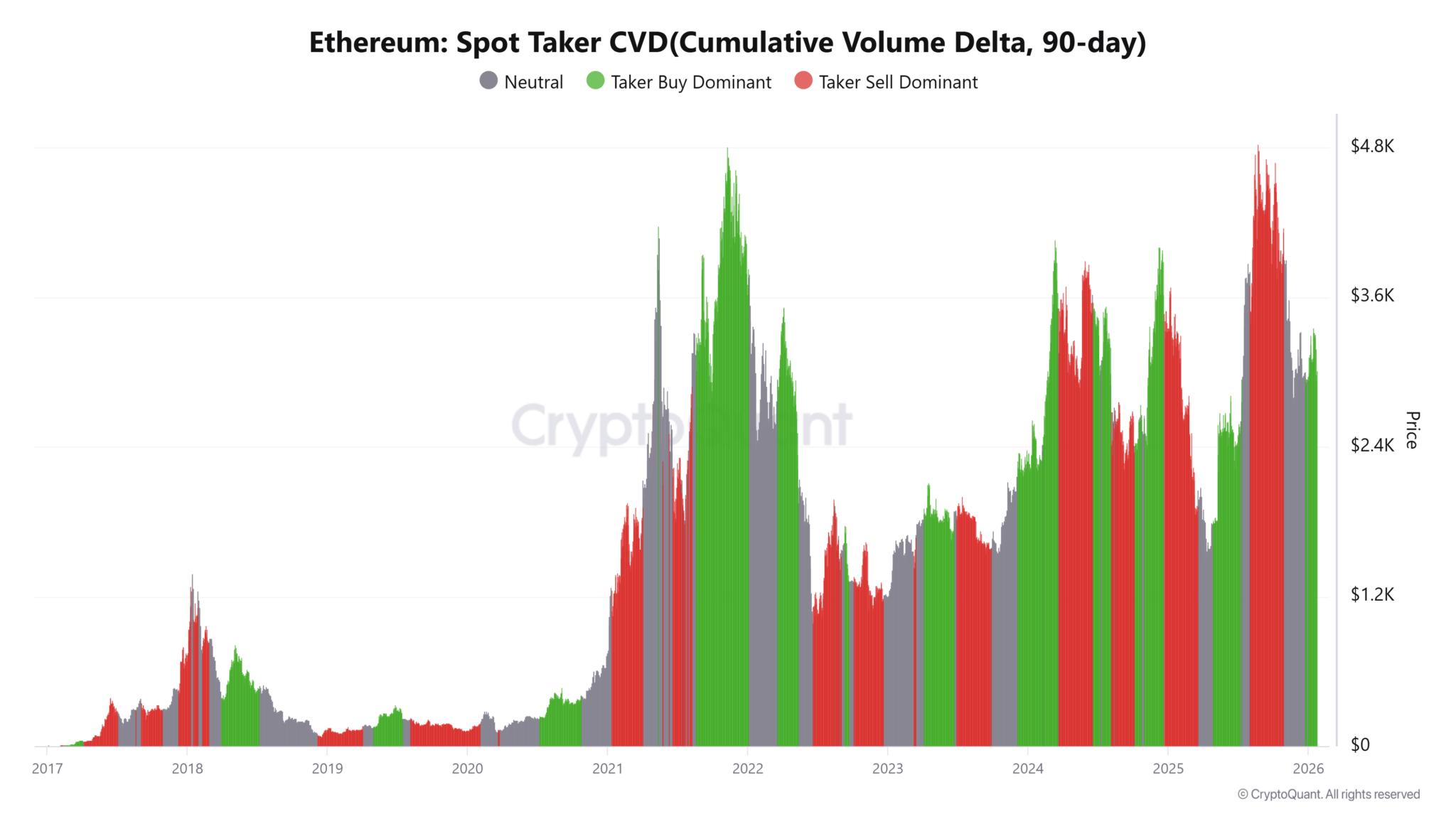
Spot taker CVD continued to print buyer dominance, reinforcing the idea that aggressive participants control execution at market prices.

Buyers do not wait on bids; instead, they cross the spread and absorb available supply. This pattern suggested urgency rather than caution.

Furthermore, buyer-dominant CVD during a market drawdown often reflects conviction rather than speculative chasing. However, this demand does not come from scattered retail flows. Large executions dominate activity.

As a result, the Spot market showed clear absorption rather than distribution. Still, sustained buyer aggression must persist to offset broader risk-off conditions.

Otherwise, sellers could regain short-term control. Therefore, spot taker behavior now acts as the primary stabilizing force for Ethereum’s [ETH] price structure.
Ethereum order sizes reveal whale execution

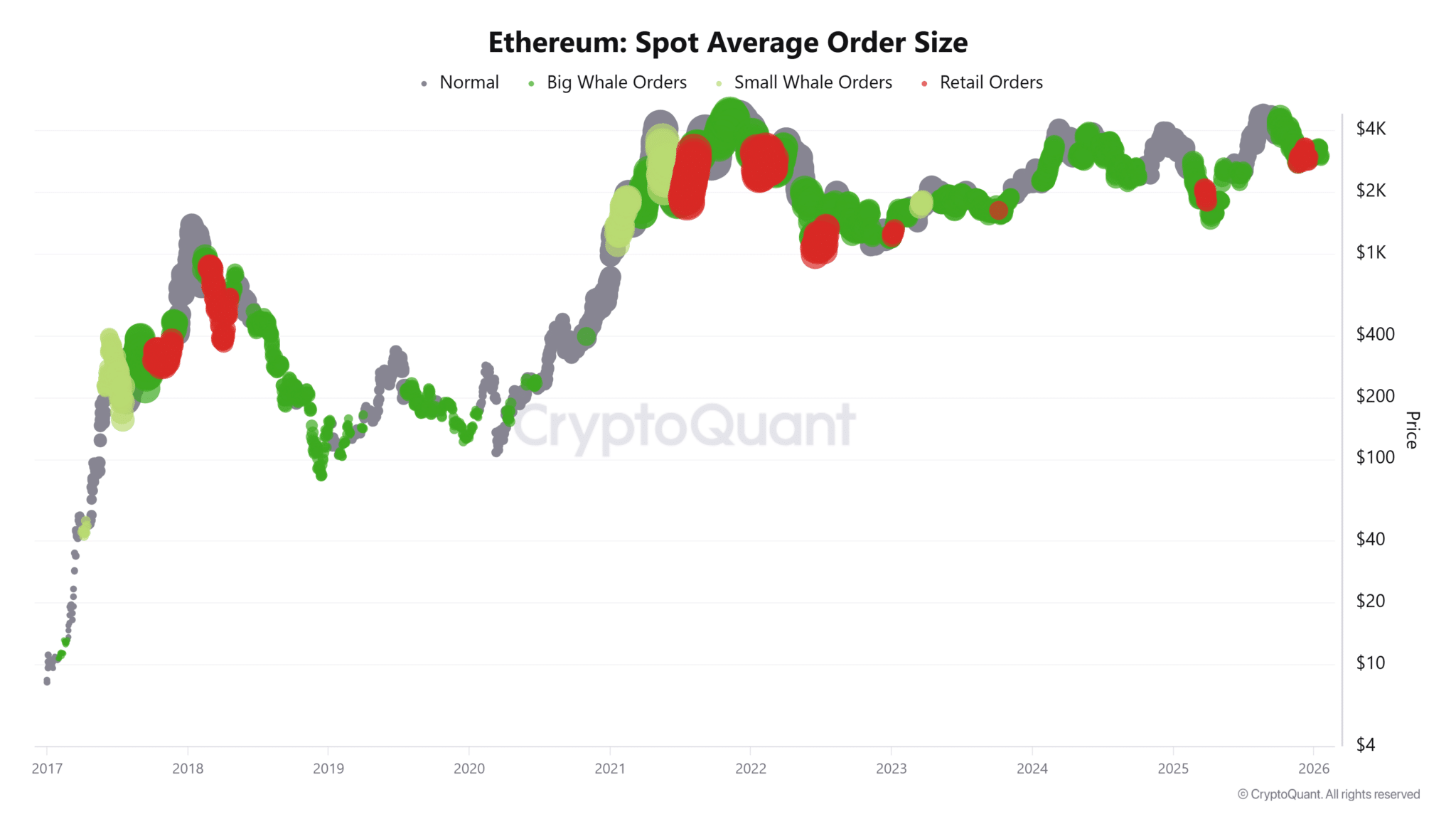
Spot Average Order Size has expanded sharply, pointing directly toward whale-driven participation rather than fragmented retail activity.

Larger order sizes usually reflect institutional desks or OTC-linked execution strategies. In this case, order growth aligns closely with the accumulation flows identified on-chain.

The alignment matters. It shows consistency between wallet-level behavior and exchange-level execution.

However, whales do not chase price blindly. They typically scale into positions while liquidity remains available. Therefore, rising order size during weakness suggests deliberate accumulation rather than panic buying.

At the same time, sustained large orders can compress the available supply. The compression would increase sensitivity to future demand spikes.

Hence, order size now reinforces the broader accumulation narrative already visible on-chain.
Leverage builds as confidence grows

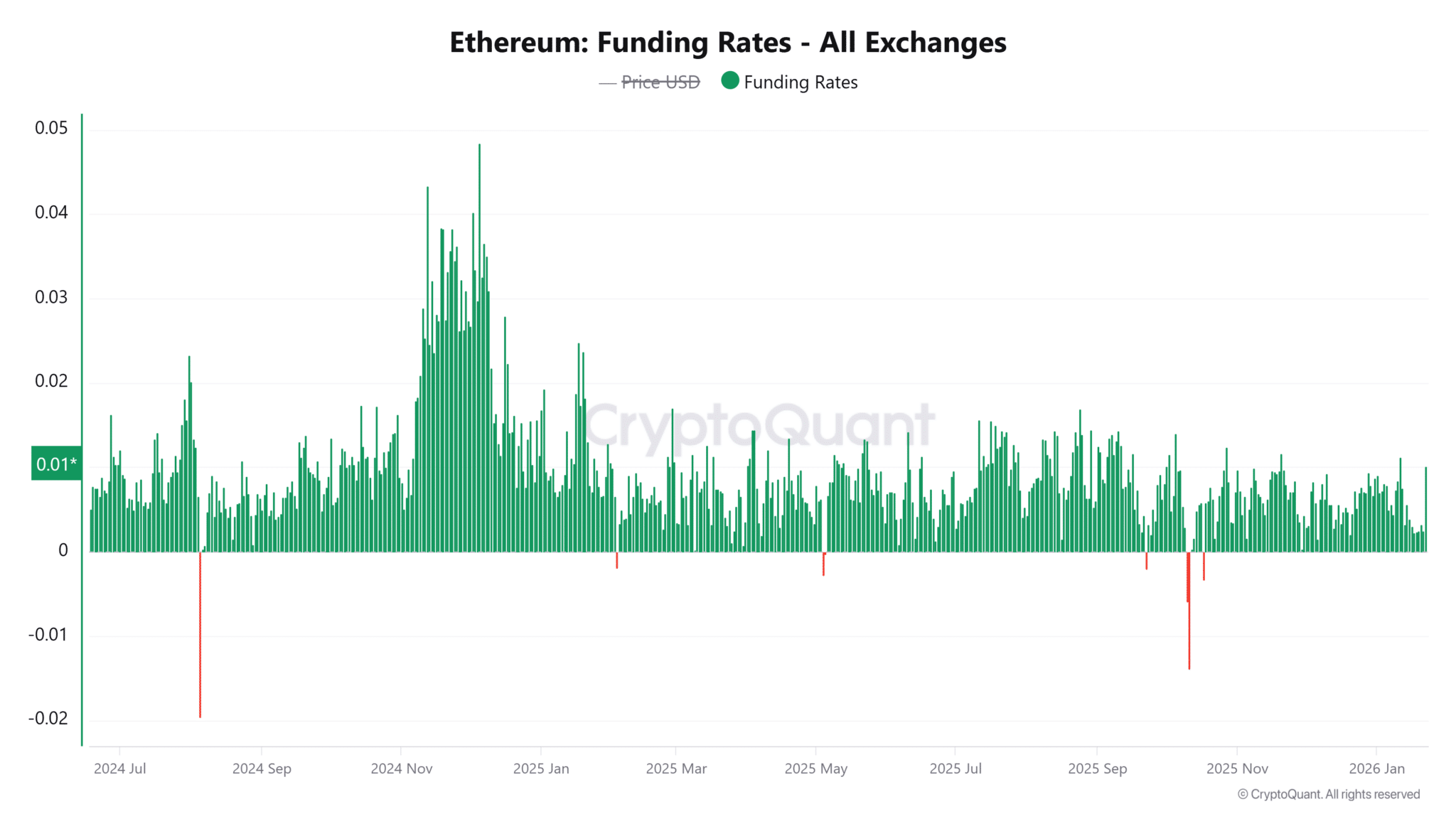
Funding Rates have risen sharply, signaling that traders increasingly favor long exposure. The metric sat around 0.01017, marking a 145.56% increase over the recent baseline.

Traders now pay a clear premium to maintain long positions. This shift reflects growing confidence rather than hesitation.

However, leverage behaves differently from spot demand. While spot buyers absorb supply outright, leveraged traders rely on price continuation.

Therefore, elevated funding strengthens upside pressure only if the price holds steady. If momentum stalls, funding costs could force faster unwinds.

Furthermore, rapid funding expansion often increases short-term volatility. As a result, leverage now adds fuel to Ethereum’s structure but also raises sensitivity to abrupt pullbacks.
Can accumulation stabilize Ethereum?

Ethereum’s structure favored stabilization rather than breakdown. Large buyers continue absorbing supply, Spot demand remains aggressive, and whale-sized executions dominate flows.

However, rising leverage introduces conditional risk. If spot accumulation persists, it would likely anchor the price and limit downside volatility. If Spot demand fades, leverage could magnify weakness.

Therefore, Ethereum’s near-term direction hinges less on sentiment and more on whether aggressive buyers continue absorbing supply under pressure.

Final Thoughts

  • Large players appear comfortable absorbing volatility rather than waiting for confirmation.
  • Leverage adds upside potential but could amplify moves if spot demand weakens.

Trending Cryptos

Related Questions

QWhat on-chain data indicates that large buyers are aggressively accumulating Ethereum during the recent pullback?

AOn-chain data from Lookonchain showed Tom Lee’s Bitmine absorbing nearly 45,000 ETH in rapid succession, and an OTC-linked whale added another 10,000 ETH, signaling aggressive accumulation during market weakness.

QAccording to the article, what does a buyer-dominant Spot Cumulative Volume Delta (CVD) during a market drawdown typically reflect?

AA buyer-dominant Spot CVD during a market drawdown often reflects conviction from aggressive participants who are crossing the spread to absorb supply, rather than speculative chasing or caution.

QWhat does the sharp expansion in Spot Average Order Size suggest about the nature of the current market activity?

AThe sharp expansion in Spot Average Order Size points directly toward whale-driven or institutional participation, rather than fragmented retail activity, indicating deliberate accumulation strategies.

QHow have Funding Rates changed, and what does this signal about trader sentiment?

AFunding Rates have risen sharply to around 0.01017, a 145.56% increase, signaling that traders are increasingly confident and willing to pay a premium to maintain long positions.

QWhat is the primary risk that rising leverage introduces to Ethereum market structure, according to the article?

AThe primary risk is that elevated leverage relies on price continuation; if spot demand weakens and momentum stalls, funding costs could force faster unwinds, amplifying downside volatility and magnifying weakness.

Related Reads

Has Bitcoin Bottomed, or Is a 'Shakeout' Approaching? What's the Situation with XRP?

Cryptocurrency analytics platform Santiment shared key insights on Bitcoin and altcoin markets, highlighting significant signals from on-chain data. Analysis shows Bitcoin's 365-day MVRV ratio has fallen to -26%, indicating substantial losses for long-term holders, a level historically associated with market bottom formations and long-term buying opportunities. While short-term MVRV is near breakeven, suggesting no clear directional signal, the annual perspective points to a bottom before bullish cycles. On-chain data reveals divergent behavior: large wallets (10-10,000 BTC) have been accumulating, adding ~18,500 BTC in 10 days, while smaller retail investors continue buying dips. Analysts caution that high retail demand can sometimes create a risk of a final market shakeout or correction. The altcoin market shows a mixed picture. Ethereum's 365-day MVRV is around -33%, but recent monthly gains combined with overly optimistic social sentiment pose a short-term correction risk. XRP is in oversold territory with 30-day and 365-day MVRVs at -57.5% and -45.5% respectively, signaling potential for a strong mid-to-long term rebound. Social activity and optimism are rising for Solana, while investor sentiment remains calmer towards Cardano. Future direction for Bitcoin and altcoins depends not only on on-chain metrics but also on macroeconomic and regulatory developments. The Federal Reserve's interest rate decision and upcoming policy rulings are increasing market volatility expectations, while uncertainty around the U.S. Congressional clarity process continues to pressure pricing. *This is not investment advice.

cryptonews.ru1h ago

Has Bitcoin Bottomed, or Is a 'Shakeout' Approaching? What's the Situation with XRP?

cryptonews.ru1h ago

Bank of Korea Reveals Results of Tokenized Deposit Testing

The Bank of Korea has announced the results of its pilot test for tokenized deposits. Involving 28 central banks and international financial organizations, the project saw participation from major South Korean banks including KB Kookmin Bank, NH NongHyup Bank, Shinhan Bank, Woori Bank, and Hana Bank. Transactions, from payment orders to final settlement, were completed in real time, averaging just 80 seconds. The test involved 30 transactions across 17 different scenarios—such as corporate and interbank transfers—and was conducted in six currencies, including the Korean won, US dollar, and euro, with a total transaction value reaching approximately $995,000. The central bank reported that the platform operated stably throughout, despite being only partially connected to the existing banking infrastructure. Settlements using tokenized deposits were executed seamlessly, quickly, and transparently. An internal transfer of 20 million won (about $13,890) between NH NongHyup Bank and Shinhan Bank was also successfully processed via the Project Agora platform, which involved connecting to the Bank of Korea's CBDC test platform, Project Hangang. Additionally, KB Kookmin Bank and Japan's MUFG Bank tested cross-border payments using these deposit tokens—digital certificates issued by commercial banks within the pilot, not directly by the central bank. The Bank of Korea plans to continue testing payments with tokenized deposits. This follows last year's pledge by South Korean authorities to tighten regulations for won-based stablecoins, which will require approval from both the central bank and the Financial Services Commission.

cryptonews.ru3h ago

Bank of Korea Reveals Results of Tokenized Deposit Testing

cryptonews.ru3h ago

Trading

Spot

Hot Articles

Discussions

Welcome to the HTX Community. Here, you can stay informed about the latest platform developments and gain access to professional market insights. Users' opinions on the price of ETH (ETH) are presented below.

活动图片