Why is Siren’s price down today? Long liquidations, funding rates & more…

ambcryptoPublished on 2026-06-30Last updated on 2026-06-30

Abstract

Despite a 14% price drop and $172k in long liquidations, Siren (SIREN) shows signs of a potential short-term rebound. Momentum indicators turned bullish with a MACD crossover on June 27th and the Money Flow Index (MFI) recovering from oversold levels. Although Open Interest fell 15%, positive Funding Rates indicate persistent bullish conviction among remaining traders. Liquidation heatmaps reveal liquidity clusters above the current price, which could attract upward movement. Overall, improving capital flows and technical signals suggest a recovery is possible if buying demand strengthens, though price confirmation is still needed.

Siren [SIREN] may be approaching a rebound despite heavy capital outflows. The token fell 14% over the past day, leaving momentum firmly bearish in the short term.

Liquidation data highlighted that weakness. Long traders lost $172,000, compared to just $22,000 in short liquidations. Even so, buyers continued adding long exposure despite the losses.

What do SIREN momentum indicators suggest?

Momentum indicators pointed to improving bullish sentiment.

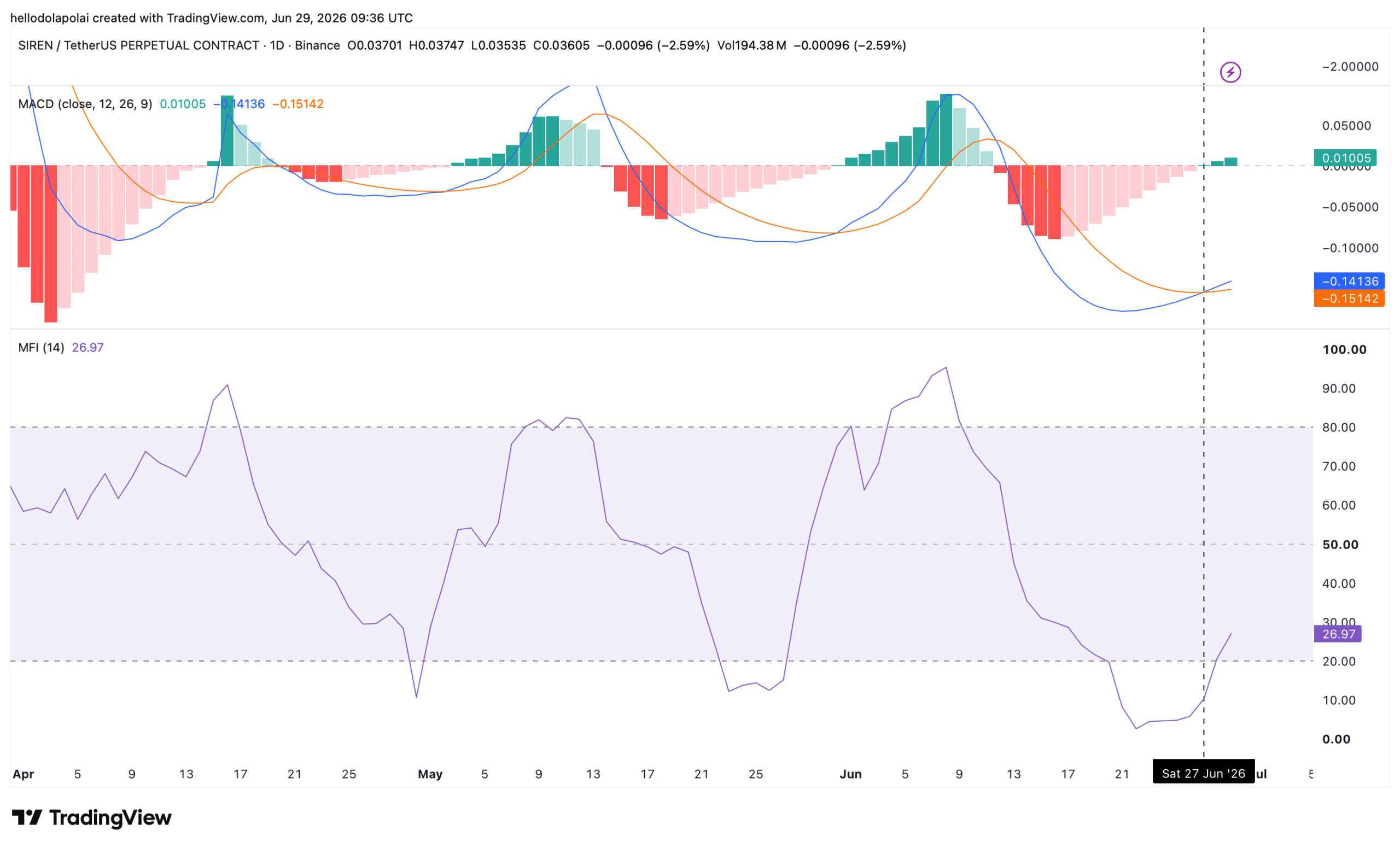
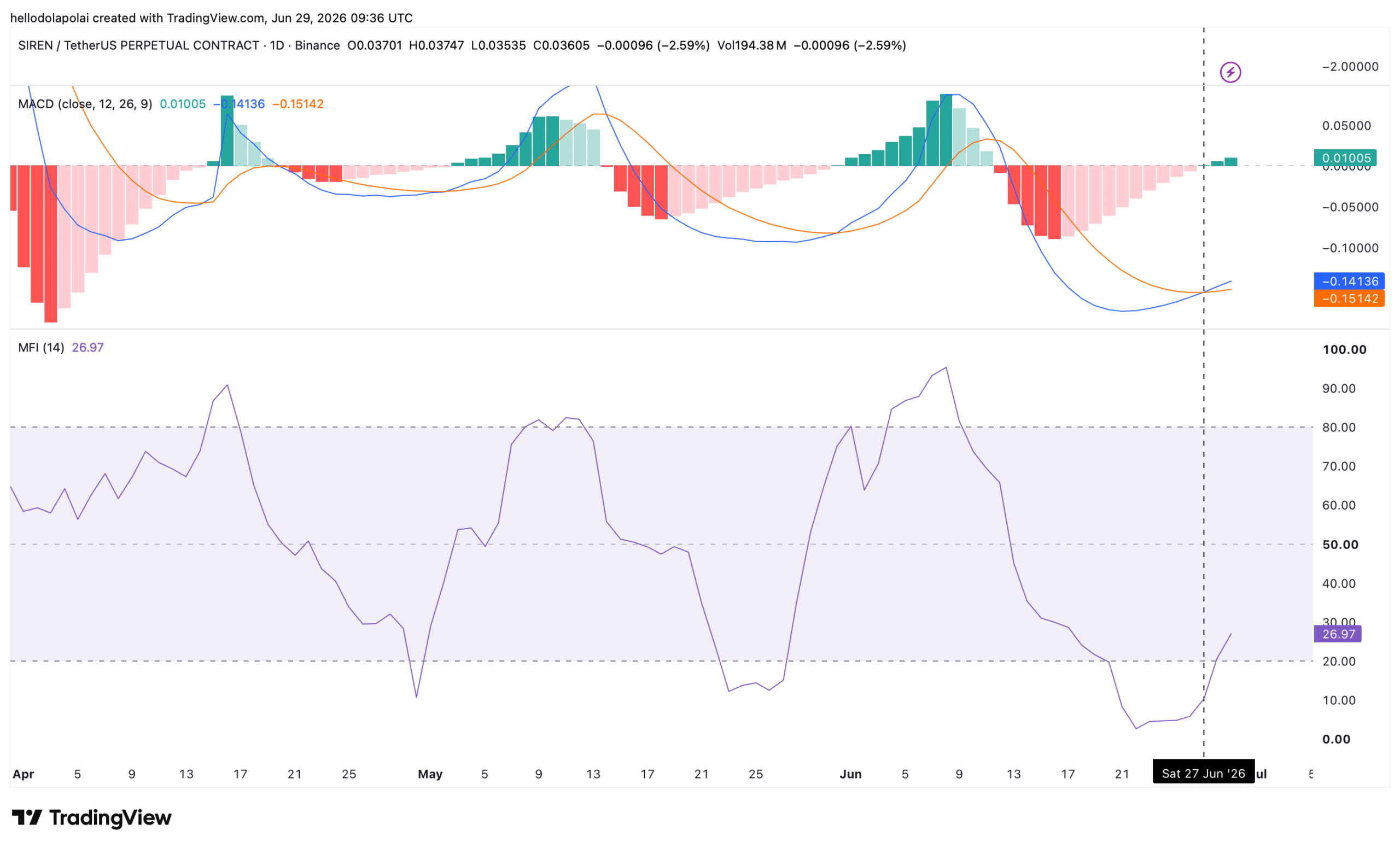
The Moving Average Convergence Divergence (MACD), which measures trend momentum, flashed an early bullish crossover on the 27th of June. The MACD line crossed above the signal line, suggesting buyers were beginning to regain strength.

That move aligned with improving capital flows.

The Money Flow Index (MFI), which tracks buying and selling pressure, rebounded after falling below the oversold threshold of 20.

The indicator has since climbed to around 38 and continued moving higher, suggesting fresh capital was returning to SIREN.
Source: TradingView

Are traders still betting on higher prices?

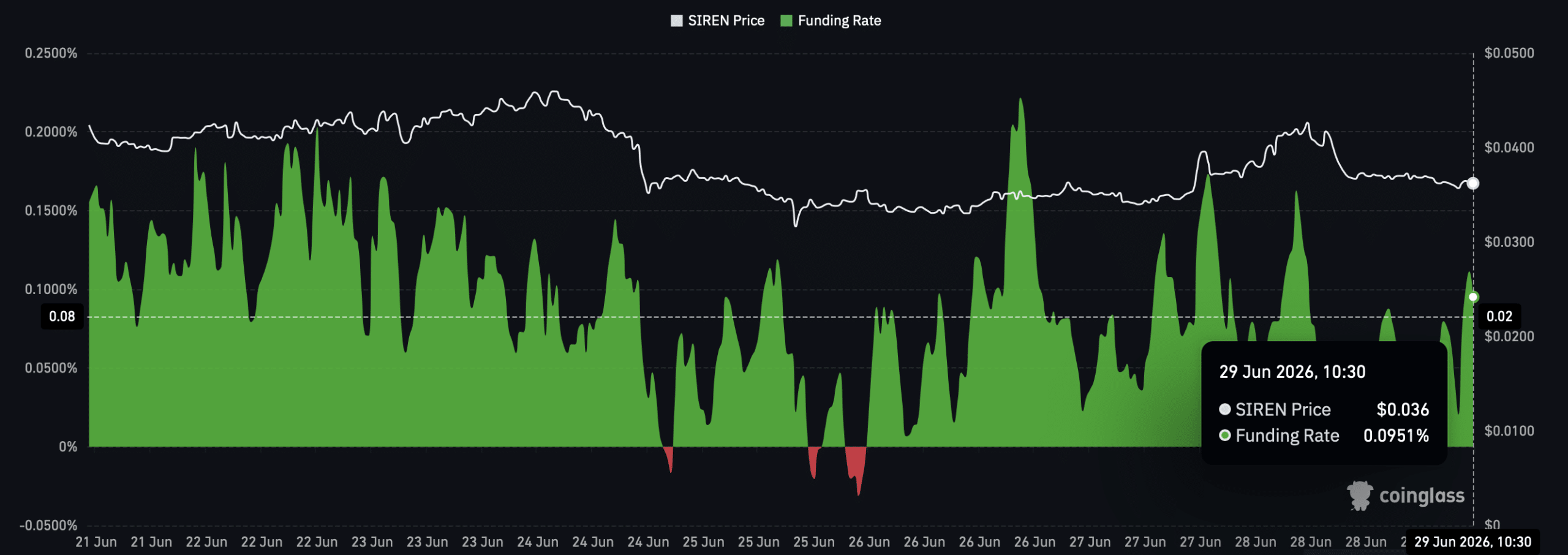
Despite heavy losses among long traders, market positioning remained tilted toward the bullish side.

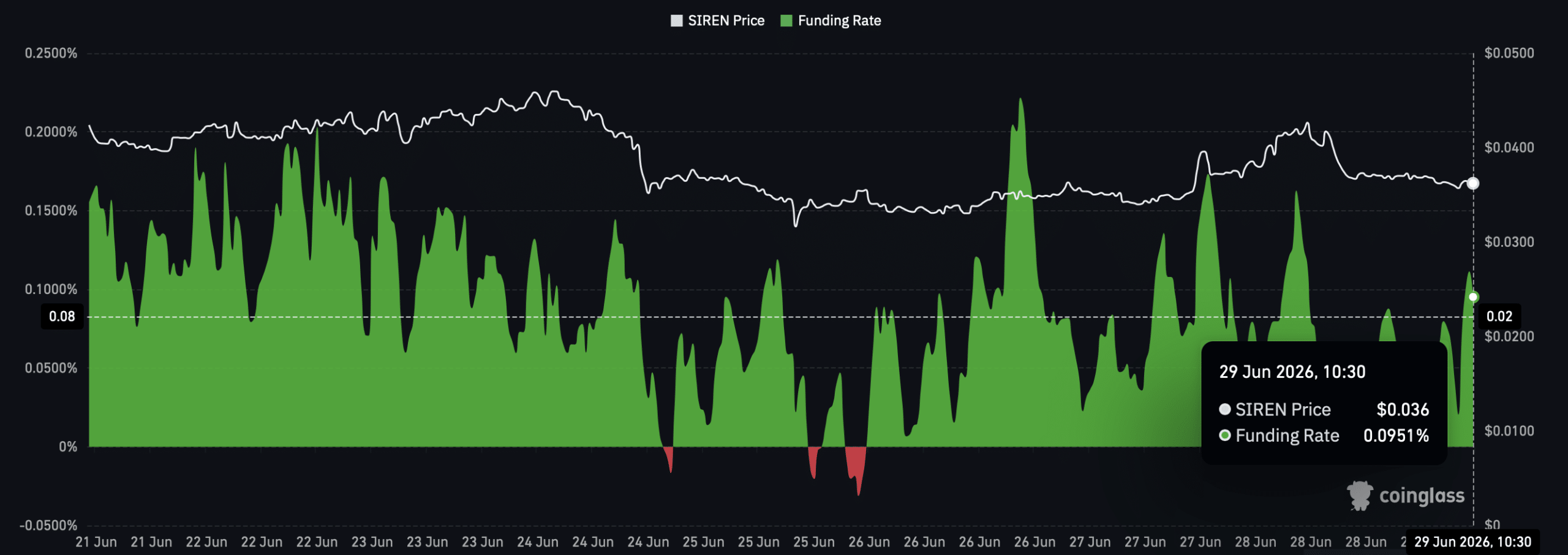
Funding Rates stayed positive at 0.0951% at press time, indicating traders continued paying a premium to maintain long positions.
Source: CoinGlass

The positive Funding Rates suggested bullish conviction persisted despite the recent decline.

However, Open Interest dropped 15% to $35.97 million, reflecting reduced participation after the sell-off. Even so, the remaining positions remained largely long-biased, which could support a recovery if buying demand strengthens.

Where could SIREN move next?

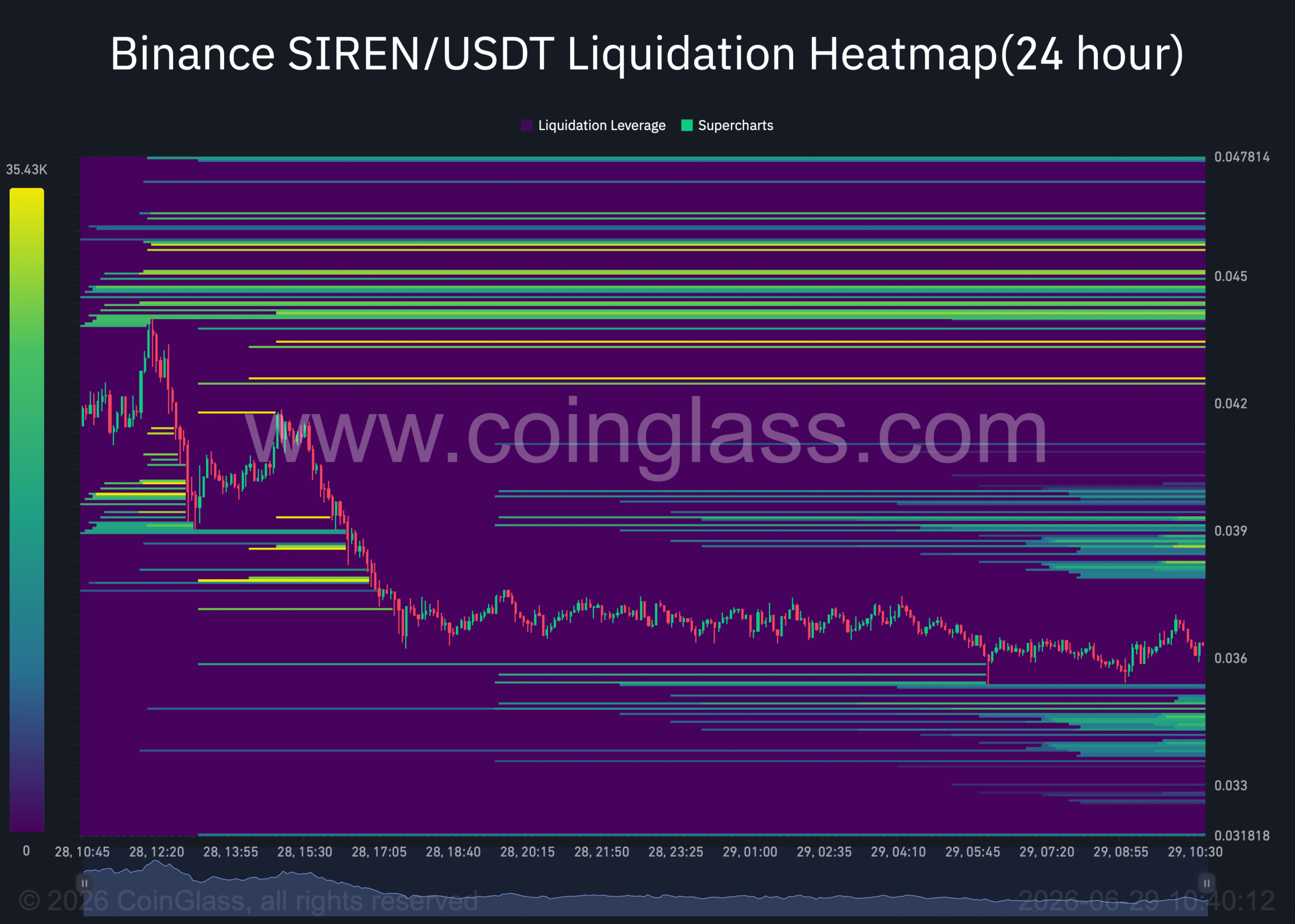
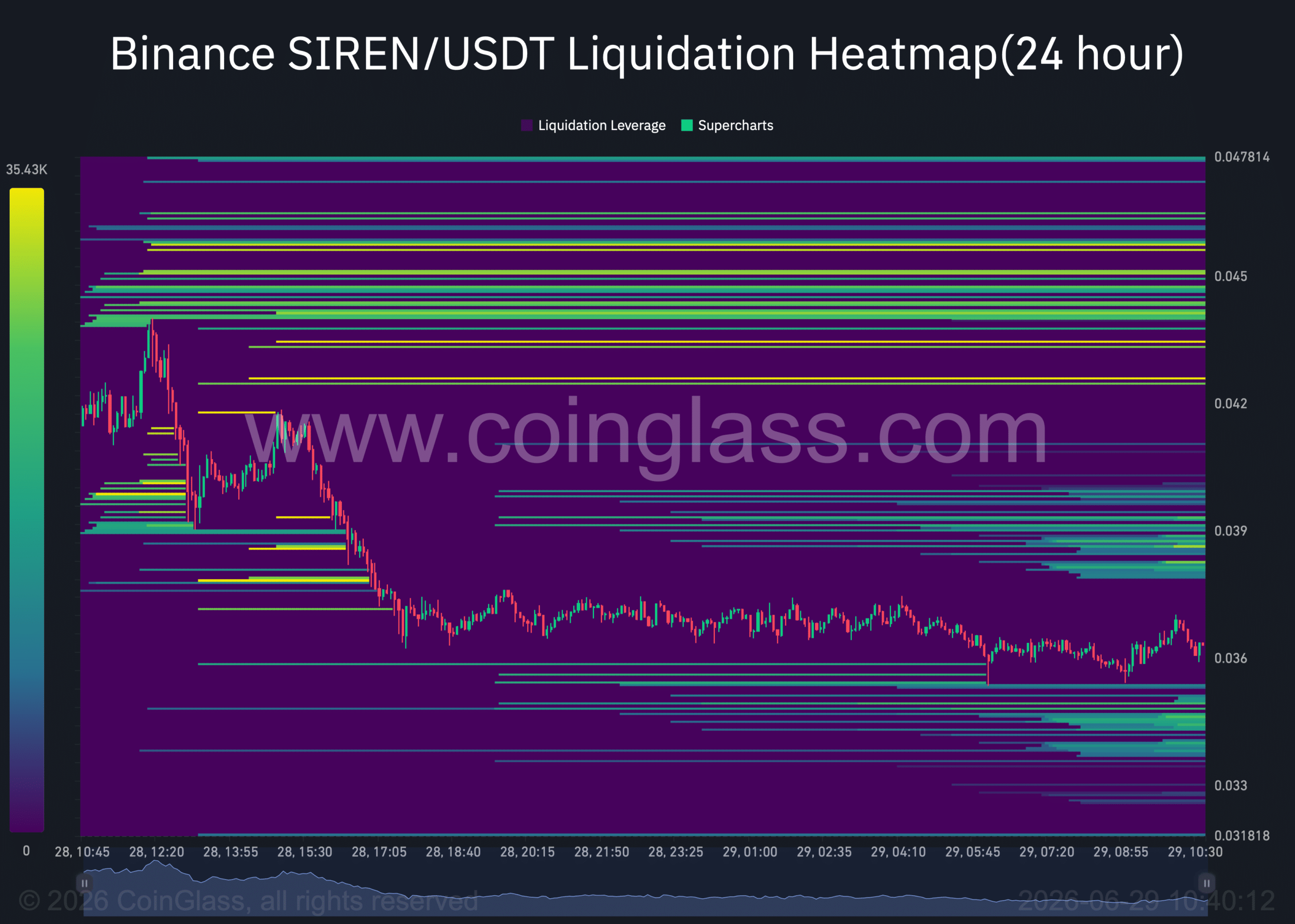
The Liquidation Heatmap highlighted several liquidity clusters above the current price.

Those clusters often attract price movement as markets seek liquidity. That left room for SIREN to attempt a move higher if buyers maintained momentum.

On top of that, improving capital flows and bullish momentum indicators supported the possibility of a short-term recovery.

Even so, price confirmation remained necessary before a sustained reversal could be established.
Source: CoinGlass

Final Summary

  • SIREN fell 14%, with long traders absorbing most liquidation losses during the sell-off.
  • Even so, MACD, MFI, positive Funding Rates, and overhead liquidity clusters suggested a rebound could still develop if buyers regained control.


Trending Cryptos

Related Questions

QWhy did the price of Siren (SIREN) fall recently according to the article?

AThe price of SIREN fell 14% over the past day due to heavy capital outflows and a significant number of long liquidations, where long traders lost $172,000 compared to just $22,000 in short liquidations.

QWhat do the momentum indicators MACD and MFI suggest about SIREN's price action?

AThe MACD flashed an early bullish crossover on June 27th, suggesting buyers were beginning to regain strength. The Money Flow Index (MFI) rebounded from below the oversold level of 20 to around 38 and continued rising, indicating fresh capital was returning to SIREN.

QDespite the price drop, how do Funding Rates indicate trader sentiment towards SIREN?

AFunding Rates remained positive at 0.0951%, indicating that traders continued to pay a premium to maintain long positions. This suggests that bullish conviction persisted despite the recent price decline.

QWhat is the significance of the Liquidation Heatmap mentioned for SIREN's potential price movement?

AThe Liquidation Heatmap highlighted several liquidity clusters above the current price. These clusters often attract price movement as markets seek liquidity, leaving room for SIREN to attempt a move higher if buying momentum is maintained.

QWhat key factors does the article suggest could support a short-term recovery for SIREN?

AThe article suggests that improving capital flows, bullish momentum indicators (MACD and MFI), positive Funding Rates, and the presence of overhead liquidity clusters could support a short-term recovery, provided buyers regain control and price confirmation is established.

Related Reads

US CFTC Launches Broad Investigation into Polymarket, Is the Prediction Market Party Coming to an End?

The U.S. Commodity Futures Trading Commission (CFTC) is conducting a broad investigation into the prediction market platform Polymarket, focusing on its business practices including social media promotions. This follows a bipartisan letter from U.S. senators urging the CFTC to probe alleged fraudulent marketing tactics used to promote gambling-like products. The action coincides with a period of explosive growth for the prediction market sector, driven by events like the World Cup, with platforms like Kalshi and Robinhood reporting record trading volumes and revenue. The investigation signals a potential end to the sector's unregulated expansion and may lead to clearer federal oversight, particularly regarding investor protection and distinguishing prediction markets from traditional sports betting. The CFTC's move has also intensified a jurisdictional conflict with multiple U.S. states (including Kentucky and New York), which have sued platforms like Polymarket and Kalshi, accusing them of operating illegal sports betting and threatening state gambling tax revenues. Furthermore, the CME Group has sued the CFTC, challenging its approval of certain prediction market products. The report also highlights the political and capital interests intertwined with the industry. Donald Trump Jr. holds advisory and investment roles in both Kalshi and Polymarket, and the Trump administration has previously emphasized federal regulatory authority over these markets. The CFTC's investigation into Polymarket is framed as a step towards formalizing the industry's regulatory landscape, moving it from a phase of "wild growth" towards a more structured future.

marsbit9m ago

US CFTC Launches Broad Investigation into Polymarket, Is the Prediction Market Party Coming to an End?

marsbit9m ago

U.S. CFTC Launches Extensive Investigation into Polymarket, Is the Prediction Market Frenzy Season Cooling Down?

The U.S. Commodity Futures Trading Commission (CFTC) has launched a broad investigation into the prediction market platform Polymarket, focusing on its business practices including social media activities. This follows a bipartisan letter from U.S. senators urging the CFTC to probe allegations of paid influencer false marketing and fraudulent promotion of gambling-like products to American users. The investigation comes as the prediction market sector experiences explosive growth, largely driven by the World Cup. Weekly trading volumes have hit record highs, exceeding $14.4 billion, with platforms like Kalshi and Robinhood's new venture seeing significant activity. Major firms like Meta are also showing interest in the space. This regulatory scrutiny signals a potential end to the sector's "wild growth" phase. The CFTC's move also highlights an escalating jurisdictional conflict between federal regulators and state authorities. Over a dozen states, including Kentucky and New York, have sued platforms like Polymarket and Kalshi, accusing them of operating illegal sports betting, which threatens state gambling tax revenues. The CFTC is countersuing to assert its exclusive federal jurisdiction over these "event contracts" as derivatives. Furthermore, the CFTC's approval of Kalshi's Bitcoin perpetual futures contract has sparked a lawsuit from traditional exchange CME, alleging regulatory overreach. The political and capital landscape is intricate, with Donald Trump Jr. holding advisory roles and investments in both Kalshi and Polymarket. This connects capital, political influence, and regulatory bodies, suggesting the current investigation may be a step toward formalizing the industry's rules rather than halting its progress.

Odaily星球日报12m ago

U.S. CFTC Launches Extensive Investigation into Polymarket, Is the Prediction Market Frenzy Season Cooling Down?

Odaily星球日报12m ago

Opinion: AI Bubble Bursts, Bitcoin and Other Risky Assets Are the First to Be Impacted

BIS Warns AI Investment Boom Could Trigger Market Stress, Impacting Bitcoin First The Bank for International Settlements (BIS) warns that a potential bursting of the "AI bubble" could tighten liquidity and severely impact risk assets like Bitcoin in the near term. Major tech firms are projected to spend over $1 trillion on AI infrastructure in 2025-2026. The BIS cautions that if returns fail to meet expectations, a sudden withdrawal of financing could turn this investment boom into a prolonged bust, creating ripple effects across financial markets. While AI holds long-term economic promise, the current scale and speed of investment, coupled with intense competition and physical bottlenecks (e.g., semiconductors, power grids), mirror historical bubbles. The report highlights that the AI funding web—spanning corporate debt, private credit, and complex vendor agreements—makes systemic risks harder to see. A disappointment in AI adoption could transmit stress through this chain, widening credit spreads and pressuring weaker borrowers. For Bitcoin, the initial reaction to such a market shock would likely be defensive. As liquidity tightens, investors typically sell liquid assets first, and Bitcoin often trades in line with other risk assets during portfolio de-risking. Recent correlations, like Bitcoin's drop following a sharp decline in South Korea's stock market, support this view. However, the longer-term outcome for Bitcoin depends on the policy response. If an AI-driven credit crunch forces central banks to inject liquidity and ease policy eventually, it could reignite Bitcoin's narrative as a hedge against monetary debasement. Yet, traders betting on this outcome may first have to endure significant market volatility and potential price declines.

marsbit1h ago

Opinion: AI Bubble Bursts, Bitcoin and Other Risky Assets Are the First to Be Impacted

marsbit1h ago

Trading

Spot

Hot Articles

Discussions

Welcome to the HTX Community. Here, you can stay informed about the latest platform developments and gain access to professional market insights. Users' opinions on the price of S (S) are presented below.

活动图片