Why Did NVIDIA's Bond Issue Go Unnoticed While SpaceX's Caused a Plunge?

marsbitPublished on 2026-06-23Last updated on 2026-06-23

Abstract

The article analyzes the contrasting market reactions to recent bond issuances by SpaceX and NVIDIA. While NVIDIA's $25 billion bond offering was met with strong demand and seen as securing long-term capital for its already profitable AI business, SpaceX's move to raise at least $20 billion in bonds (primarily to refinance bridge loans) triggered a sell-off in its stock (SPCX). The key difference lies in the stage of cash flow validation for their respective core narratives. For NVIDIA, the AI boom is generating substantial, visible revenue and profits, making debt a tool to amplify a proven growth curve. For SpaceX, despite a strong cash position post-IPO and a revenue-generating business in Starlink, its valuation is heavily tied to future, capital-intensive projects like Starship, global satellite networks, and potential AI infrastructure. The bond issuance acted as a trigger, shifting market focus from SpaceX's long-term vision to the pressing question of whether Starlink's profits can fund these ambitious, unproven ventures before they generate their own returns. Thus, the market penalizes not the act of borrowing itself, but the perceived gap between high capital expenditure and the speed of cash flow realization. SpaceX's valuation recovery hinges on demonstrating that Starlink's profitability can outpace the burn rate of its futuristic projects or that those projects (like Starship achieving reliable, low-cost reusability) can soon transition from costly visions to ...

TL;DR

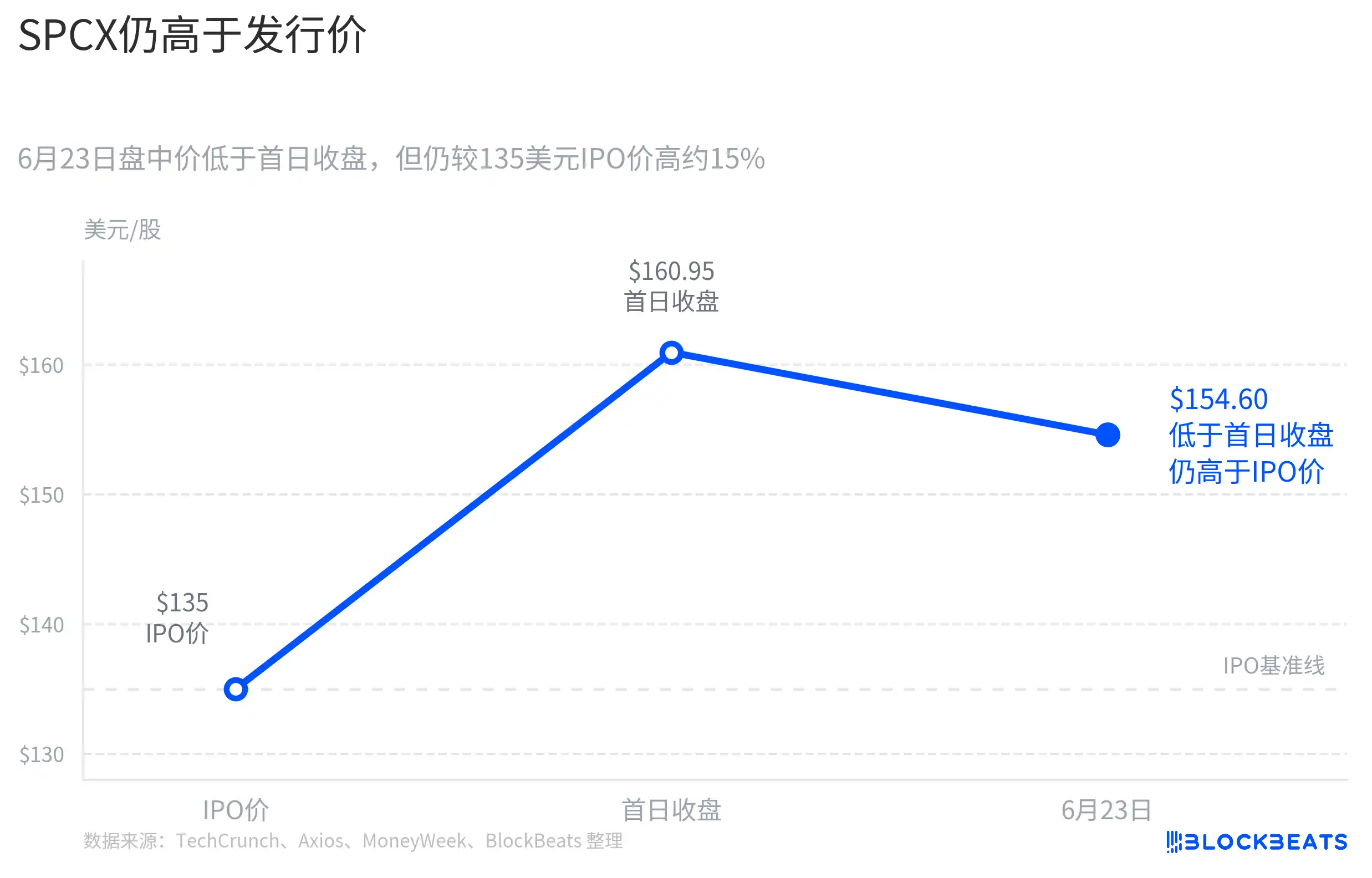
Around June 22, SpaceX pursued at least a $20 billion bond financing following its IPO, primarily to repay previous bridge loans. Subsequently, the SpaceX-linked security SPCX faced selling pressure in the secondary market. On June 23, it traded around $154.60 intraday, below its first-day closing price but still above the $135 IPO price.
This price movement should not be simplistically attributed to the bond event alone, but the financing news indeed acted as a trigger. It swiftly shifted the nascent space narrative in the public markets back to cash flow concerns: the market began recalculating how much funding SpaceX's long-term projects would require and which business segment would cover them.

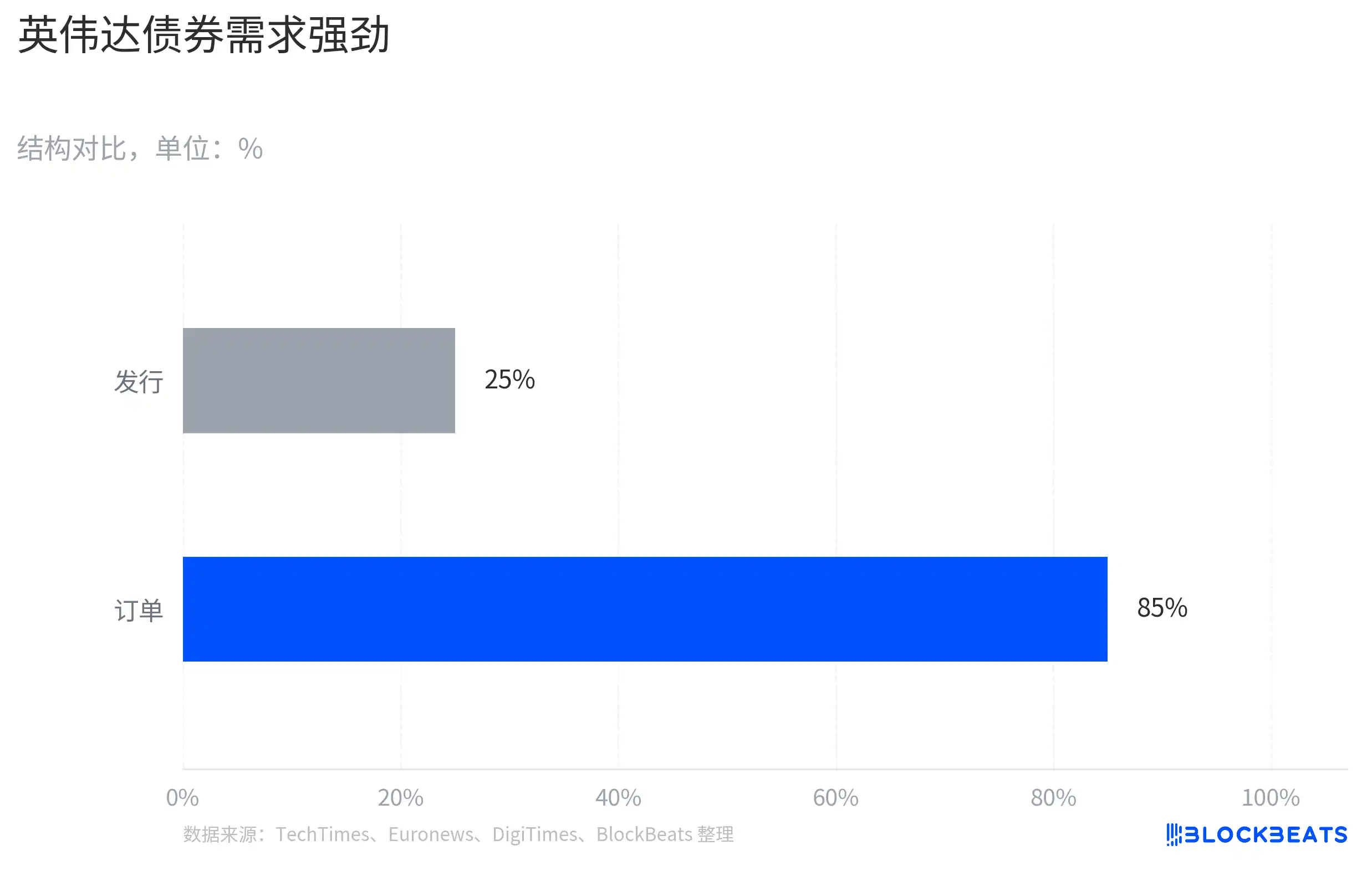
NVIDIA serves as the most crucial reference point. On June 15, NVIDIA issued $25 billion in high-grade bonds, with order demand reportedly reaching approximately $85 billion. The issuance size was also increased from an initial plan of about $20 billion. Both companies raised funds under grand narratives, but market reactions were entirely different: NVIDIA's bond issue was more readily perceived as locking in long-term capital, whereas SpaceX's immediately subjected the company to a capital expenditure stress test.

The difference lies not in the act of issuing bonds itself, but in the market's level of trust regarding cash flows. NVIDIA's AI demand has already been validated by revenue and profits, making its debt more akin to amplifying a growth curve that is already realized. SpaceX, however, needs to answer another question: can the money earned by Starlink sustain Starship, the satellite network, AI infrastructure, and even more distant space visions?

SpaceX's Financing Forces the Market to Recalculate Capex

The bond issue itself isn't the problem. For high-credit companies, replacing short-term bridge loans with long-term debt is often just capital structure management. SpaceX's reported at least $20 billion bond financing was also primarily framed as repaying previous bridge loans, and should not be simply interpreted as negative news.

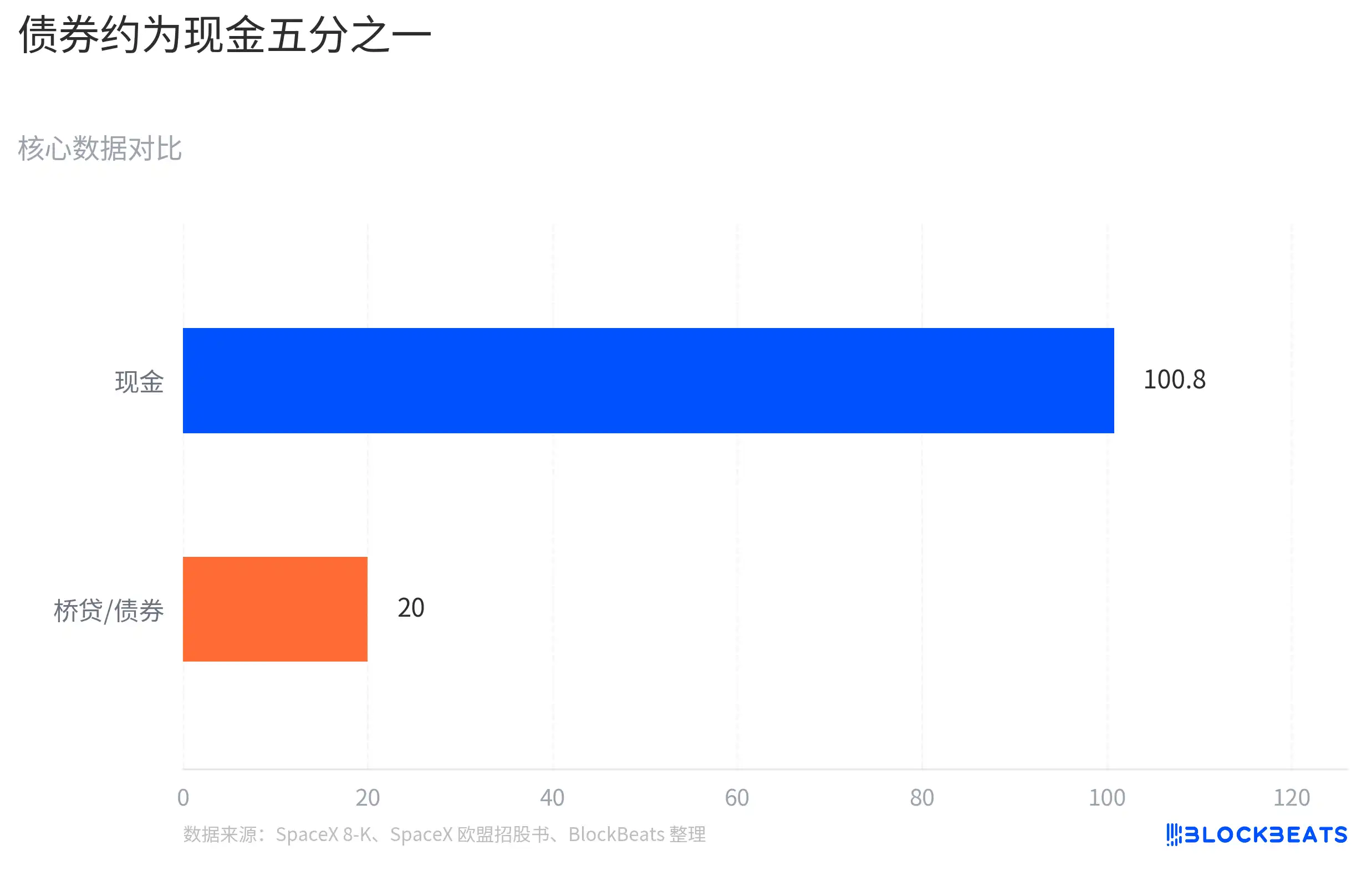
SpaceX isn't reliant on the bond market for survival either. Filings indicated that as of June 19, the company's cash and cash equivalents were approximately $100.8 billion. Having cash on hand at the hundred-billion-dollar level post-IPO suggests the company's financial structure is, at the very least, not poor.

However, abundant cash doesn't mean the market won't recalculate future spending velocity. More critical is the structure of the bridge loan: SpaceX already had a $20 billion unsecured bridge loan in March, maturing on September 2, 2027, with an extension option. The subsequent at least $20 billion bond financing is primarily described as refinancing or repaying this bridge loan.

The bonds will alter how the market views SpaceX. Equity investors can prepay for the long-term upside of Starship, Mars transportation, and space infrastructure. Debt investors are more concerned with cash flow, capital expenditures, and debt repayment schedules. When SpaceX pursues a large bond financing shortly after going public, the market naturally shifts the question from "How far can Musk's space story go?" to "How much more will these projects cost before they materialize?"

SpaceX already has profitable businesses; the market is questioning whether these businesses can cover the costs of all the long-term, capital-intensive projects the company is simultaneously advancing. Starlink is the most tangible cash flow engine currently, with growing satellite internet subscribers and revenues setting it apart from many purely conceptual space companies.

But SpaceX's valuation isn't built solely on Starlink. It's also built on Starship's high-frequency reusability, global satellite network expansion, Mars transportation, and potentially new narratives tied to AI infrastructure. These narratives are grand, and they are also expensive. Starship requires ongoing testing, iteration, and launch capacity development. The satellite network requires replenishment and upgrades. If AI infrastructure becomes further integrated into SpaceX's capital story, investors will also need to assess when this segment will generate revenue.

Therefore, the bonds aren't the sole reason for SpaceX's dip, but they were a clear trigger. They reminded the market that once the space narrative enters the public markets, it's not enough to prove the vision is grand; one must also demonstrate sufficient self-sustaining capability.
AI Narrative and Space Narrative Are at Different Realization Stages

NVIDIA's concurrent bond issue provides a clear reference point. On June 15, NVIDIA issued $25 billion in high-grade bonds, with order demand reportedly reaching approximately $85 billion. The market did not primarily interpret this debt as a pressure point but rather viewed it more as a strong company locking in long-term capital.
The difference stems from the stage of cash flow underlying the bonds. NVIDIA's AI demand has already materialized in its financials through data center revenue, customer orders, and profit margins. Investors are debating how long this growth curve can last. For NVIDIA, issuing debt is more like adding financial flexibility to an already realized growth trajectory.

SpaceX's situation is different. It also has the Starlink cash flow engine and ample cash post-IPO, but its valuation incorporates more long-term, heavy capital projects that are not yet fully commercialized. When the market sees SpaceX issuing bonds, the question isn't "Can it borrow?" but rather "Will future project cash burn outpace cash flow realization?"

This doesn't mean space commercialization has lost value, nor does it mean the market has dismissed SpaceX. A more accurate description is that the AI narrative has become visible revenue for NVIDIA, while the space narrative still requires more stage-by-stage proof for SpaceX. Starship's value hinges on demonstrating higher frequency, lower cost, and more reliable reusability. Mars transportation and space infrastructure are even further out. If AI infrastructure becomes a new growth driver, it will also need real customers, real revenue, and an explainable capital return.

This highlights the most easily overlooked distinction in deep-tech investing. A company can possess strong technology, a strong brand, and a strong founder, but as long as cash flow validation lags behind capital investment, debt will be viewed by the market as a source of pressure.

The phrase "Mars burns cash" is catchy but incomplete. SpaceX has a path to commercialization; it's just that multiple future projects require continued capital infusion. NVIDIA's opposite reaction makes this contrast even clearer: what the market rewards is not the visionary label, but the speed at which the story translates into revenue, profit, and free cash flow.

The Pace of Cash Flow Coverage Determines the Recovery Potential

SpaceX's potential for recovery hinges on whether the market can see Starlink's profit expansion covering the heavier capital expenditure curve. As long as Starship remains in a high-investment phase, the satellite network still requires continuous updates, and AI infrastructure still lacks a clear path to monetization, investors will repeatedly calculate cash burn.

Bond pricing will provide an initial signal. If the final spread, coupon, and order demand show the credit market is willing to provide long-term funds at a relatively low cost, it indicates investors still accept SpaceX's longer timeframe for realizing its space infrastructure story. If financing costs are high or the market demands a higher risk premium, equity valuation will continue to face pressure.

More crucial is progress on the business front. If Starship delivers stronger validation regarding high-frequency reusability and launch cost reduction, the business models for Starlink, deep space transportation, and even space infrastructure will be revalued. Conversely, if subsequent disclosures show Starlink's growth cannot cover the expansion of other projects, debt will continue to remind the market that SpaceX remains in a capital-intensive visionary phase.
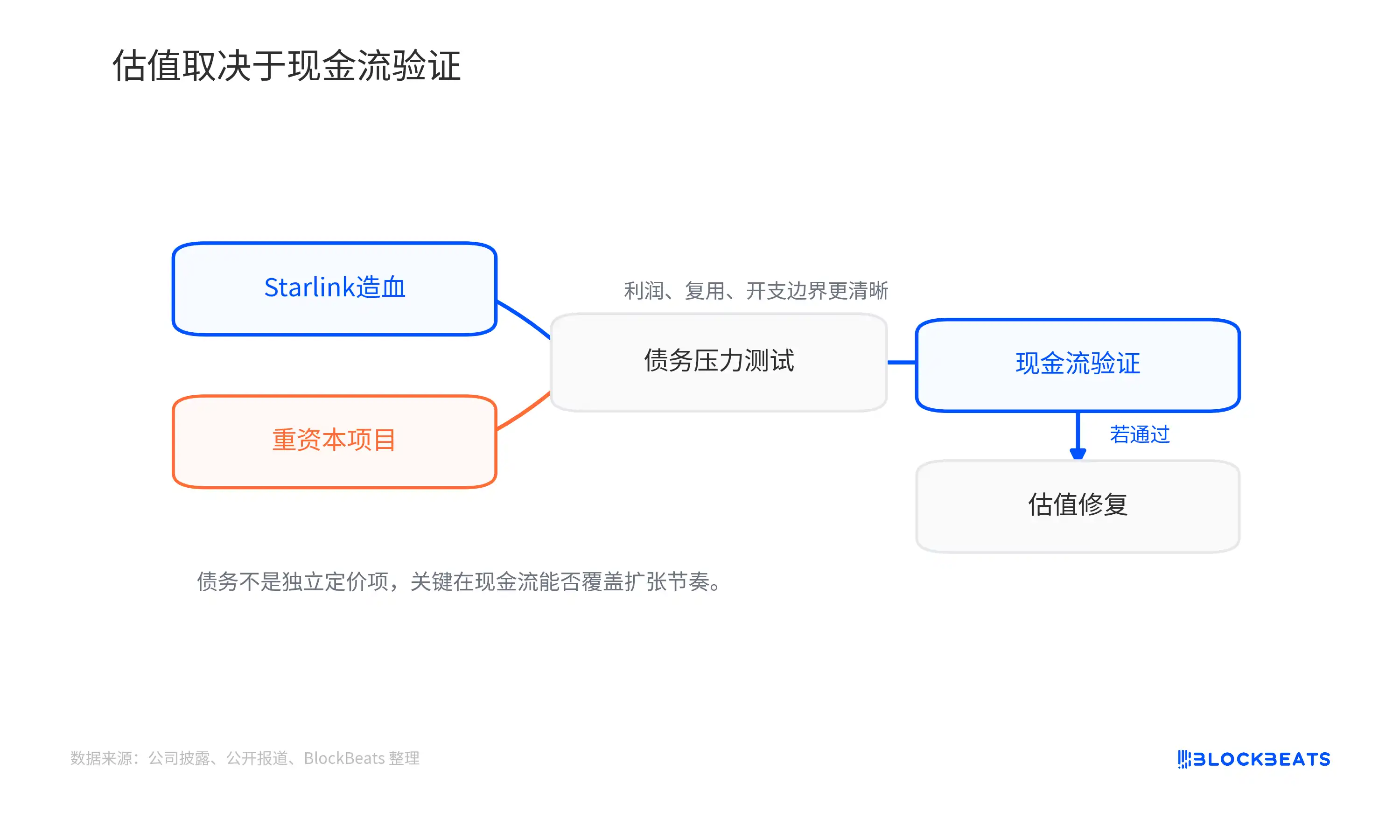
This is also the core tension in SpaceX's current valuation. It has hundred-billion-dollar-level cash on its balance sheet and a cash flow engine like Starlink, but the public market won't price the company based on cash reserves alone. Only when Starlink's profits, Starship's reusability progress, and the boundaries of capital expenditures all become clearer will debt potentially be re-evaluated from a pressure point back to a growth tool.


Trending Cryptos

Related Questions

QWhat was the market's reaction to SpaceX's bond issuance announcement, and how did it compare to NVIDIA's?

AFollowing SpaceX's announcement of a bond issuance of at least $20 billion, its related SPCX experienced selling pressure in the secondary market. This reaction was a key trigger for market concerns. In contrast, when NVIDIA issued $25 billion in bonds, the order book reached approximately $85 billion, and the offering was upsized. The market viewed NVIDIA's bond issuance as a way to secure long-term capital for a growing, already-proven business.

QWhat core question does SpaceX's bond issuance raise for investors regarding its business model?

ASpaceX's bond issuance forces investors to shift focus from the company's long-term vision to a more immediate financial question: Can the cash flow from the currently profitable Starlink business cover the immense capital expenditures required for other long-term, high-cost projects like Starship, global satellite network expansion, and potential AI infrastructure initiatives?

QAccording to the article, what is the fundamental difference between the market's perception of NVIDIA's and SpaceX's bond issuances?

AThe fundamental difference lies in the stage of cash flow validation for their respective narratives. NVIDIA's AI narrative has already been validated through substantial revenue, orders, and profits, so its debt is seen as amplifying a proven growth curve. SpaceX's space narrative, however, still requires significant proof of commercialization and faces major capital outlays before its most ambitious projects can generate returns.

QWhat determines whether SpaceX's bond issuance will eventually be seen as a growth tool rather than a pressure point?

AThe key determining factor is the speed at which Starlink's profit growth can cover the capital expenditure curve of SpaceX's other projects. If Starship demonstrates significant progress in reusability and cost reduction, and Starlink's expansion proves financially robust, debt can be re-evaluated as a strategic tool. Conversely, if capital spending outpaces cash flow generation, debt will remain a source of investor concern.

QWhat does the article suggest is the 'core contradiction' in SpaceX's current valuation?

AThe core contradiction is that while SpaceX has a massive cash reserve of approximately $100 billion and a cash-generating engine like Starlink, the public market does not value the company based on cash alone. Valuation hinges on the clarity and progress of integrating Starlink's profits with the financial demands and commercial prospects of Starship and other capital-intensive, long-term projects.

Related Reads

Deep Insight: Decentralized Inference is Not Hype, but a Key Track for AI to Break Through Centralized Monopoly

Decentralized Reasoning: Beyond the Hype, a Key to Breaking AI's Centralized Monopoly A future scenario where a powerful AI model is banned by a major government illustrates the core value proposition of decentralized AI: resistance to censorship. The core bet of decentralized inference networks is mitigating this risk, with other benefits like cost being secondary. The path is extremely difficult, involving four key challenges: 1. **Running Massive Models:** Distributing a single model across a decentralized GPU swarm requires sophisticated techniques like pipeline and speculative decoding to overcome crippling network latency, aiming for usable speeds (e.g., 30-40 tokens/second). 2. **Proving Model Integrity:** Verifying that a node runs the correct model is critical. Solutions range from cryptographically secure but slow ZKML to faster, economically-secure methods like statistical fingerprints, deterministic re-execution, or live-weight proofs, each involving trade-offs between integrity, latency, and cost. 3. **Ensuring Prompt Privacy:** Simply sharding a model does not protect user inputs from nodes. Robust solutions currently require trusted hardware (TEEs) or advanced cryptography (FHE), which are not yet widely deployed in consumer swarms. 4. **Building a Real Market:** Identifying the ideal customer is tough. Beyond speculative AI agents, the viable market currently consists of startups embedding AI and projects needing batch processing (e.g., synthetic data generation), where decentralized aggregation can be an advantage over low-latency needs. The article analyzes several projects tackling these problems, such as Dolphin Network (live-weight proofs), Inference.net (statistical verification), Morpheus (TEE-based), and Darkbloom (Apple Secure Enclave). It provides a framework: decentralization is a "tax" for latency-sensitive applications (e.g., chat) but a potential supply-side advantage for throughput-oriented tasks (e.g., batch processing). The long-term vision is a closed data loop where decentralized inference generates valuable data (traces, preferences) to feed decentralized training networks, which in turn produce better open-weight models for the inference networks. A due diligence checklist advises focusing on projects that: are truly decentralized at specific layers; have a credible integrity method; offer real cost benefits; ensure genuine privacy; handle node reliability; have paying users; and are built by teams with deep AI expertise. The ultimate goal should be products that appeal beyond the crypto-native audience, using crypto mechanisms invisibly to deliver better cost, performance, or privacy.

Foresight News9m ago

Deep Insight: Decentralized Inference is Not Hype, but a Key Track for AI to Break Through Centralized Monopoly

Foresight News9m ago

The Final Piece of Franklin Templeton's Crypto Ambition

Franklin Templeton Completes Crypto Ambition with Acquisition of 250 Digital On June 22, Franklin Templeton announced the acquisition of 250 Digital and established Franklin Crypto, a new division focused on actively managed cryptocurrency strategies for institutional investors. The unit is led by Christopher Perkins and Seth Ginns. This acquisition marks a key piece in Franklin Templeton's multi-year crypto strategy, which began in 2018 with a digital assets team. The firm's crypto product suite now spans three layers: tokenized funds like the blockchain-based money market fund BENJI (~$831M AUM); a series of passive ETFs including Bitcoin (EZBC, ~$368M), Ethereum (EZET), XRP (XRPZ, ~$252M), Solana (SOEZ), and a multi-crypto index fund (EZPZ); and the newly added active management strategies from Franklin Crypto. The company has also expanded its crypto ecosystem through investments in projects like Ethena and Crossmint, and collaborations with blockchains such as Aptos and Sui. With approximately $18B in digital asset AUM and a total firm AUM of ~$1.78T, Franklin Templeton is positioning itself as a comprehensive crypto asset manager for pensions and sovereign wealth funds. In contrast, competitor Fidelity Investments has taken a different path, focusing early on building its own custody and trading infrastructure. Fidelity's Bitcoin ETF (FBTC) holds over $11B, significantly larger than Franklin Templeton's equivalent offering. Both giants' moves underscore the deepening trend of traditional finance entering the crypto space.

Foresight News33m ago

The Final Piece of Franklin Templeton's Crypto Ambition

Foresight News33m ago

Trading

Spot
Futures

Hot Articles

Discussions

Welcome to the HTX Community. Here, you can stay informed about the latest platform developments and gain access to professional market insights. Users' opinions on the price of S (S) are presented below.

活动图片