Why Are Bitcoin Miners Collectively Turning to AI? The Reasons Behind Are Astonishing

marsbitPublished on 2025-12-17Last updated on 2025-12-17

Abstract

Bitcoin miners are shifting from cryptocurrency mining to leasing data center space to major tech companies for AI workloads, driven by fundamental vulnerabilities in their core business model. Mining revenues are highly volatile and entirely dependent on Bitcoin's unpredictable price, while structural expenses—including rising electricity costs, increasing mining difficulty, and hardware depreciation—continue to climb. With the current cost to mine one Bitcoin estimated at around $130,000, far above its market price, miners face sustained operational losses. This financial pressure has accelerated a strategic pivot. Miners possess key infrastructure valuable to AI firms: high-performance GPU clusters, massive power capacity, and advanced cooling systems. Companies like Core Scientific are repurposing their facilities into AI data centers, generating stable rental income. This transition provides more reliable cash flow, reduces reliance on Bitcoin's price volatility, and strengthens the overall industry by weeding out weaker players and fostering a more resilient, diversified business model.

This article is written by Tiger Research, discussing how the plummeting price of Bitcoin is forcing miners to transform their business models.

Key Takeaways

  • Unstable revenue and the rising costs of Bitcoin mining are making the core business of crypto mining companies unstable.

  • As a result, crypto mining companies are pivoting, leveraging their existing mining facilities to lease data center space to large tech companies.

  • This move reduces intense competition and makes the industry more robust.

1. The Business Risks Faced by Crypto Mining Companies

We previously analyzed the financial risks that falling Bitcoin prices pose to companies with Digital Asset Treasury (DAT) reserves. However, it's not just DAT companies under pressure. Bitcoin mining companies that directly operate mining businesses also face significant risks.

The vulnerability of mining companies stems from their structurally simple business model. Revenue is almost entirely dependent on the price of Bitcoin, which is inherently unpredictable. In contrast, costs tend to rise over time.

  • Unpredictable Revenue: Company revenue depends entirely on the market price of Bitcoin.

  • Structurally Rising Costs: Mining difficulty continues to increase, electricity prices are rising, and hardware requires regular replacement.

This structure is particularly problematic during periods of falling Bitcoin prices. Revenue drops immediately, while costs continue to rise. Mining companies are caught in a double bind.

Regulatory risk adds another layer of uncertainty. The state of New York, USA, has proposed a bill to increase the consumption tax on mining companies. Currently, most large crypto mining companies are located in more lenient regulatory regions like Texas, so the immediate impact is limited. Nonetheless, the risk from broader regulatory pressure cannot be ignored.

Against this backdrop, mining companies face a fundamental question: Is this business model viable in the long term?

2. The Structural Fragility of Crypto Mining Companies
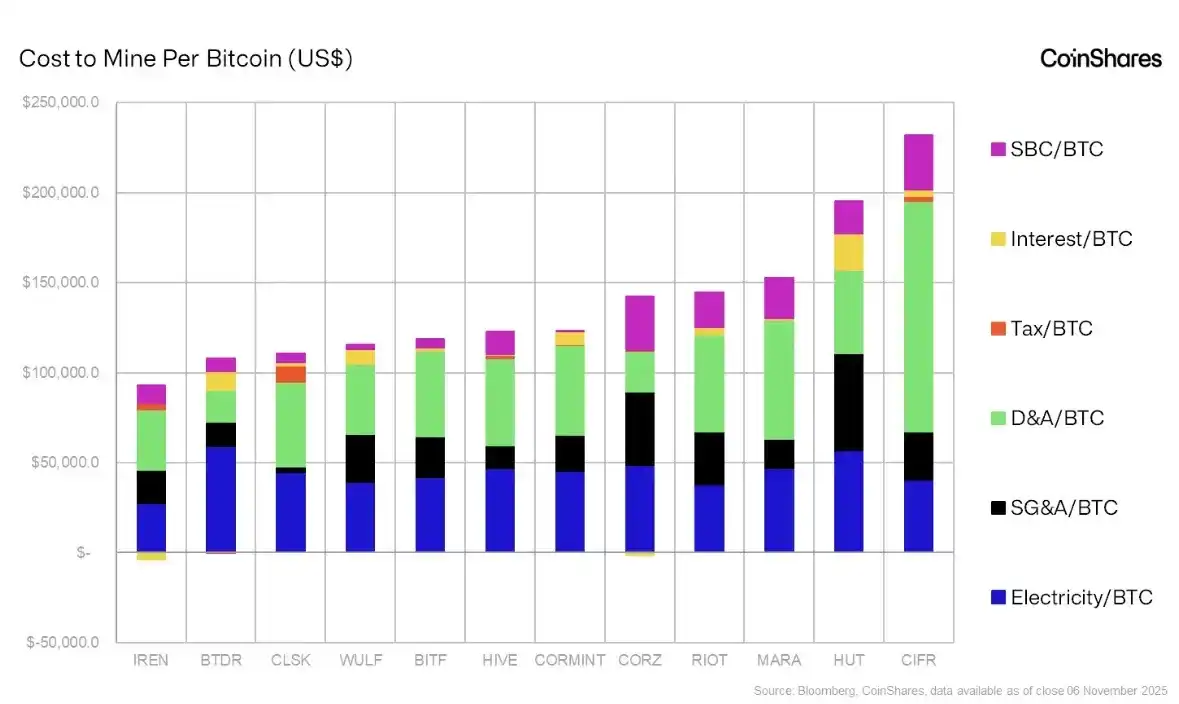
As of today, the average cost to mine one Bitcoin is approximately $74,600, nearly 30% higher than a year ago. When factors like depreciation and equity incentives are considered, the total production cost per Bitcoin rises to about $130,000.

With Bitcoin currently trading around $90,000, this means mining companies are suffering a paper loss of about $46,000 for every Bitcoin mined. This gap highlights the growing disconnect between operational costs and market prices.

The situation has become more fragile over time. Compared to 2022, mining difficulty in 2025 has increased significantly, alongside tightening energy regulations in multiple regions. These factors reduce cost predictability and undermine the structural stability of mining operations.

3. The Pivot to AI Data Center Leasing

As competition in the artificial intelligence sector intensifies, the demand for data centers from large tech companies has surged dramatically. However, building new data centers takes years. In the AI race, measured in months or quarters, waiting is not an option.

Mining companies have spotted the opportunity presented by this market gap. Their currently operational facilities are equipped with high-performance computing hardware, massive power supplies, and advanced cooling systems. While these facilities cannot be fully repurposed overnight, their specifications are highly compatible with the needs of large tech companies. This allows them to transition into AI data centers relatively quickly.

  • High-Performance GPUs: Crypto mining companies operate vast clusters of GPUs, which can be repurposed for AI computation. NVIDIA GPUs are a common example. By adapting their facilities, these assets can support new revenue streams beyond mining.

  • Power Infrastructure: Mining companies have secured grid access on a scale of hundreds of megawatts. In tightly regulated power markets, access of this scale is scarce and difficult to replicate, even with capital.

  • Cooling Systems: The experience gained from operating ASIC miners translates well to managing high-heat AI servers like the H100 and H200. In fact, many mining farms can be converted into AI data centers within six to twelve months.

Core Scientific is a prime example. The company faced bankruptcy risk in 2022 but successfully pivoted into AI data center operations. It currently operates approximately 200 megawatts of data center capacity, with plans to gradually expand to 500 megawatts. This transformation from a struggling miner to a data center lessor clearly illustrates how leveraging alternative infrastructure can stabilize a business.

Other mining companies are following a similar model. IREN and TeraWulf are also expanding beyond their core mining businesses. While they haven't fully transitioned into pure data center leasing companies, they are developing complementary business models beyond Bitcoin mining.

These moves reflect a broader trend. As mining profitability declines, crypto mining companies are seeking business models better suited for the AI era. This shift is driven more by necessity than by growth ambition.

4. The Diversification Strategy of Crypto Mining Companies

The shift of crypto mining companies from unprofitable mining to AI data center business is not a temporary trend, but rather a rational survival strategy aimed at reallocating capital to more efficient uses.

This transition should not be viewed negatively. On the contrary, it helps mining companies establish more stable cash flow. With more stable income, companies can continue to hold Bitcoin without being forced to sell at low prices.

The alternative is far less appealing. Companies with persistently negative cash flow face bankruptcy risk and are often forced to sell Bitcoin at unfavorable prices. In contrast, data center revenue gives mining companies the flexibility to hold or sell Bitcoin strategically, enabling tactical trading. This is more beneficial for both the companies and the overall market.

Not all companies are focused solely on pure data center leasing. Some, such as Bitmine and Cathedra Bitcoin, are expanding into DAT-style business models beyond mining.

In summary, these changes indicate that the cryptocurrency mining industry is maturing. Weaker participants are exiting the market or transforming, thereby alleviating mining pressure. Meanwhile, leading companies are evolving from simple mining operations into diversified DAT businesses.

In effect, the weaker links are being weeded out, and the overall market structure is becoming more resilient.

Original Link

Related Questions

QWhy are Bitcoin miners collectively shifting to AI data center operations?

ADue to unstable Bitcoin mining revenues and rising operational costs, miners are repurposing their existing infrastructure—high-performance GPUs, power capacity, and cooling systems—to lease data center space to large tech companies for AI workloads, creating a more stable revenue stream.

QWhat are the main business risks faced by Bitcoin mining companies?

ABitcoin mining companies face unpredictable revenue dependent on Bitcoin's volatile price, structurally rising costs from increasing mining difficulty and energy prices, and regulatory uncertainties, making their core business model financially unstable.

QHow does the cost of mining a Bitcoin compare to its current market price?

AAs of the article, the average cost to mine one Bitcoin is about $74,600, with total production costs including depreciation and incentives reaching $130,000, while Bitcoin trades at around $90,000, resulting in significant per-Bitcoin losses for miners.

QWhat infrastructure advantages do Bitcoin miners have for transitioning to data centers?

AMiners possess high-performance GPU clusters, large-scale power grid access (often hundreds of megawatts), and advanced cooling systems designed for high-heat equipment, which are directly applicable and adaptable for AI data center operations within 6-12 months.

QHow does diversifying into AI data centers benefit Bitcoin mining companies?

ADiversification provides stable cash flow from leasing, reducing reliance on volatile Bitcoin revenues, enabling companies to hold Bitcoin strategically without forced sales, lowering bankruptcy risk, and contributing to a more resilient market structure.

Related Reads

Bankless Co-founder: Why I Sold All My ETH

Author David Hoffman, founder of Bankless, explains his decision to sell all his ETH, despite being a prominent figure in the Ethereum ecosystem. He clarifies that his move is not a bearish take on Ethereum itself, which he remains highly optimistic about as a network. His core argument is that the "ETH is money" thesis, which he helped popularize, has largely played out. Hoffman argues that ETH has achieved the market valuation it deserves based on Ethereum's current success and competitive position. He details several reasons for this view. First, the path for ETH to become global money required nearly flawless execution and sustained dominance across Ethereum's entire technical and social stack—a coordination challenge he now believes had a narrower window for success than anticipated. Second, market data shows a strong correlation between L1 chain activity/fees and the price of its native asset; Ethereum's fee dominance has been challenged by competitors like Solana. Third, the "strong version" of crypto (decentralized, native crypto economies) that ETH's monetary thesis relied upon has struggled to maintain a positive mainstream narrative and stable adoption beyond a brief period. Finally, Ethereum's architecture as a "giver"—providing secure block space and tokenization capabilities at cost to L2s and applications—means it doesn't capture premium value directly. Its rollup-centric roadmap further directs most profits to L2s and applications ("fat app theory"). In conclusion, Hoffman believes the opportunity for ETH to be revalued significantly upward as money has diminished. He sold not because ETH will fail, but because its monetary thesis has matured, and he seeks to allocate capital to other opportunities he finds more compelling.

链捕手1h ago

Bankless Co-founder: Why I Sold All My ETH

链捕手1h ago

From Issuer to Infrastructure Owner: Circle's Arc Strategy and the Fatal Gap in the GENIUS Act

Circle raised $222 million for its proprietary Layer-1 blockchain, Arc, positioning itself not just as a stablecoin issuer but as the owner of the settlement infrastructure USDC relies on. This move, backed by investors like BlackRock and Apollo, highlights a significant structural conflict unaddressed by the GENIUS Act of 2025. While the act focuses on stablecoin reserves and issuer oversight, it remains silent on the market structure implications of an issuer controlling the underlying network—a scenario akin to a currency issuer also owning the payment rails. Traditionally, financial regulations separate issuers from settlement infrastructure to ensure neutrality. With Arc, Circle gains control over transaction ordering, fees, and network rules, potentially favoring USDC over competitors. The article argues that this creates a permanent structural temptation, even if no abuse occurs. The solution lies in applying established market infrastructure principles: mandating neutral transaction ordering, transparent fee schedules, and governance separated from Circle’s commercial interests. The current pre-mainnet phase offers a critical window for regulators to establish these rules before Arc becomes entrenched. Once operational, enforcing changes would be costly and disruptive. The core question remains: should a regulated stablecoin issuer be allowed to own the settlement network its competitors must use? The GENIUS Act doesn’t answer this, but Circle’s Arc strategy makes it urgent.

marsbit1h ago

From Issuer to Infrastructure Owner: Circle's Arc Strategy and the Fatal Gap in the GENIUS Act

marsbit1h ago

What Are the Key Variables Determining the AI Bull Market?

Title: What Determines the AI Bull Market? Key Variables Revealed Despite rising oil prices above $100/barrel, persistent inflation, and fragile Fed rate cut expectations—a traditionally hostile environment for high-valuation tech stocks—the AI sector continues to drive the market to new highs. According to analysts, the current AI boom is in a phase of "rational fervor": while bubbles exist, they are not yet out of control. The crucial shift is the emergence of Agentic AI, which is evolving from an assisting tool (Copilot) to an autonomous execution tool (Autopilot), creating a clearer commercial path from investment to revenue. This shift accelerates Token consumption and inference computing demand while boosting revenue forecasts for leading firms. The market is now rewarding capital expenditure as it transforms from a burden into a competitive moat, supporting hardware chains like GPUs, optical modules, and storage. However, valuations have already priced in growth expectations for 2027-2028. The forward P/E ratio for the "Magnificent Seven" tech giants is about 35x, compared to 25x for the rest of the S&P 500. This premium implies AI adoption must occur 5 to 8 times faster than past technological revolutions—a scenario with little room for error. The sustainability of the AI bull market hinges on three key variables: 1. **Short-term liquidity shocks**: Risks include sustained high oil prices, resurgent inflation, rising interest rates, and potential unwinding of the yen carry trade. The critical question is whether the upward revision speed of Annual Recurring Revenue (ARR) can outpace the rise in interest rates. 2. **Mid-term industry realization**: Can the actual pace of AI adoption and commercialization match the current lofty valuations? Historically, general-purpose technology revolutions follow a non-linear path with periods of acceleration and deceleration. 3. **Long-term structural constraints**: These include energy and power grid limitations, employment displacement and consumer purchasing power, social acceptance and potential backlash, and potential hardware technology breakthroughs that could disrupt current supply chains. While the long-term prospects for AI remain optimistic with potential for significant productivity gains, the stock market's pricing depends not just on the vision but on the actual speed of realization amid these growing constraints. The direction is clear, but the pace of execution will determine whether the bubble remains controlled or spirals out of control.

marsbit1h ago

What Are the Key Variables Determining the AI Bull Market?

marsbit1h ago

Trading

Spot
Futures

Hot Articles

What is $BITCOIN

DIGITAL GOLD ($BITCOIN): A Comprehensive Analysis Introduction to DIGITAL GOLD ($BITCOIN) DIGITAL GOLD ($BITCOIN) is a blockchain-based project operating on the Solana network, which aims to combine the characteristics of traditional precious metals with the innovation of decentralized technologies. While it shares a name with Bitcoin, often referred to as “digital gold” due to its perception as a store of value, DIGITAL GOLD is a separate token designed to create a unique ecosystem within the Web3 landscape. Its goal is to position itself as a viable alternative digital asset, although specifics regarding its applications and functionalities are still developing. What is DIGITAL GOLD ($BITCOIN)? DIGITAL GOLD ($BITCOIN) is a cryptocurrency token explicitly designed for use on the Solana blockchain. In contrast to Bitcoin, which provides a widely recognized value storage role, this token appears to focus on broader applications and characteristics. Notable aspects include: Blockchain Infrastructure: The token is built on the Solana blockchain, known for its capacity to handle high-speed and low-cost transactions. Supply Dynamics: DIGITAL GOLD has a maximum supply capped at 100 quadrillion tokens (100P $BITCOIN), although details regarding its circulating supply are currently undisclosed. Utility: While precise functionalities are not explicitly outlined, there are indications that the token could be utilized for various applications, potentially involving decentralized applications (dApps) or asset tokenization strategies. Who is the Creator of DIGITAL GOLD ($BITCOIN)? At present, the identity of the creators and development team behind DIGITAL GOLD ($BITCOIN) remains unknown. This situation is typical among many innovative projects within the blockchain space, particularly those aligning with decentralized finance and meme coin phenomena. While such anonymity may foster a community-driven culture, it intensifies concerns about governance and accountability. Who are the Investors of DIGITAL GOLD ($BITCOIN)? The available information indicates that DIGITAL GOLD ($BITCOIN) does not have any known institutional backers or prominent venture capital investments. The project seems to operate on a peer-to-peer model focused on community support and adoption rather than traditional funding routes. Its activity and liquidity are primarily situated on decentralized exchanges (DEXs), such as PumpSwap, rather than established centralized trading platforms, further highlighting its grassroots approach. How DIGITAL GOLD ($BITCOIN) Works The operational mechanics of DIGITAL GOLD ($BITCOIN) can be elaborated on based on its blockchain design and network attributes: Consensus Mechanism: By leveraging Solana’s unique proof-of-history (PoH) combined with a proof-of-stake (PoS) model, the project ensures efficient transaction validation contributing to the network's high performance. Tokenomics: While specific deflationary mechanisms have not been extensively detailed, the vast maximum token supply implies that it may cater to microtransactions or niche use cases that are still to be defined. Interoperability: There exists the potential for integration with Solana’s broader ecosystem, including various decentralized finance (DeFi) platforms. However, the details regarding specific integrations remain unspecified. Timeline of Key Events Here is a timeline that highlights significant milestones concerning DIGITAL GOLD ($BITCOIN): 2023: The initial deployment of the token occurs on the Solana blockchain, marked by its contract address. 2024: DIGITAL GOLD gains visibility as it becomes available for trading on decentralized exchanges like PumpSwap, allowing users to trade it against SOL. 2025: The project witnesses sporadic trading activity and potential interest in community-led engagements, although no noteworthy partnerships or technical advancements have been documented as of yet. Critical Analysis Strengths Scalability: The underlying Solana infrastructure supports high transaction volumes, which could enhance the utility of $BITCOIN in various transaction scenarios. Accessibility: The potential low trading price per token could attract retail investors, facilitating wider participation due to fractional ownership opportunities. Risks Lack of Transparency: The absence of publicly known backers, developers, or an audit process may yield skepticism regarding the project's sustainability and trustworthiness. Market Volatility: The trading activity is heavily reliant on speculative behavior, which can result in significant price volatility and uncertainty for investors. Conclusion DIGITAL GOLD ($BITCOIN) emerges as an intriguing yet ambiguous project within the rapidly evolving Solana ecosystem. While it attempts to leverage the “digital gold” narrative, its departure from Bitcoin's established role as a store of value underscores the need for a clearer differentiation of its intended utility and governance structure. Future acceptance and adoption will likely depend on addressing the current opacity and defining its operational and economic strategies more explicitly. Note: This report encompasses synthesised information available as of October 2023, and developments may have transpired beyond the research period.

363 Total ViewsPublished 2025.05.13Updated 2025.05.13

What is $BITCOIN

Discussions

Welcome to the HTX Community. Here, you can stay informed about the latest platform developments and gain access to professional market insights. Users' opinions on the price of BTC (BTC) are presented below.

活动图片