How Did Other Hedge Funds Perform in July Aside from the 'Stock God' Fund's Big Loss?

marsbitPublished on 2026-08-07Last updated on 2026-08-07

Abstract

In July, amidst significant AI stock volatility, hedge fund performance varied widely. Situational Awareness, an AI-focused fund, sold a majority of its public equity holdings to Citadel, reporting a 67% portfolio value decline for the month. In contrast, Citadel's equity-focused fund rose 14.2%. The narrative of uniform 'quant' success was challenged; while some systematic funds, like Renaissance's RIEF (+9.2%), posted gains, others like Qube's Torus declined. Business Insider's sample showed mostly negative returns for multi-strategy funds, yet BarclaysHedge's broader multi-strategy index estimated a 0.60% gain, highlighting sample and methodology differences. Tech-focused hedge funds fell 3.99%, while convertible arbitrose strategies rose 1.46%. Monthly gains don't always reflect year-to-date performance; RIEF's strong July brought its YTD return to only 4.5%, while Graham Capital's Tactical Trend strategy held a 23.7% YTD gain. The transfer of assets from Situational Awareness to Citadel was a pressured deleveraging event, not a direct arbitrage, as reported metrics cover different fund scopes and valuations. The data underscores that within the 'quant' label, performance diverges based on specific strategies, models, and market exposures.

In the last week of July, the AI-themed fund Situational Awareness sold most of its public equities to the large hedge fund Citadel. According to an investor letter seen by Reuters on July 31st, the fund's portfolio value fell 67% that month.

Five days later, based on investor information cited by Reuters on August 5th, Citadel's equity-focused fund rose 14.2% in July. In the same AI stock pullback, one fund deleveraged under financing pressure, while another took over part of the public positions.

This statement is only half correct. The July returns sheet includes systematic products with positive returns and samples that adjusted positions after tech holdings declined. Cramming them all into the two words "quantitative" would lose the most important distinctions.

Does This Rally Represent the Quant Industry?

According to a Business Insider report, the products mentioned came from 5 managers. The 7 systematic products it listed constitute only a limited return list, not a census of the quantitative industry.

On this small list, Renaissance Technologies' Renaissance Institutional Equities (RIEF) fund rose 9.2% in July. Among the products listed in the same report, Qube's Torus strategy was the only one that closed down. The blue bars on the chart look neat but cannot draw conclusions for the entire industry.
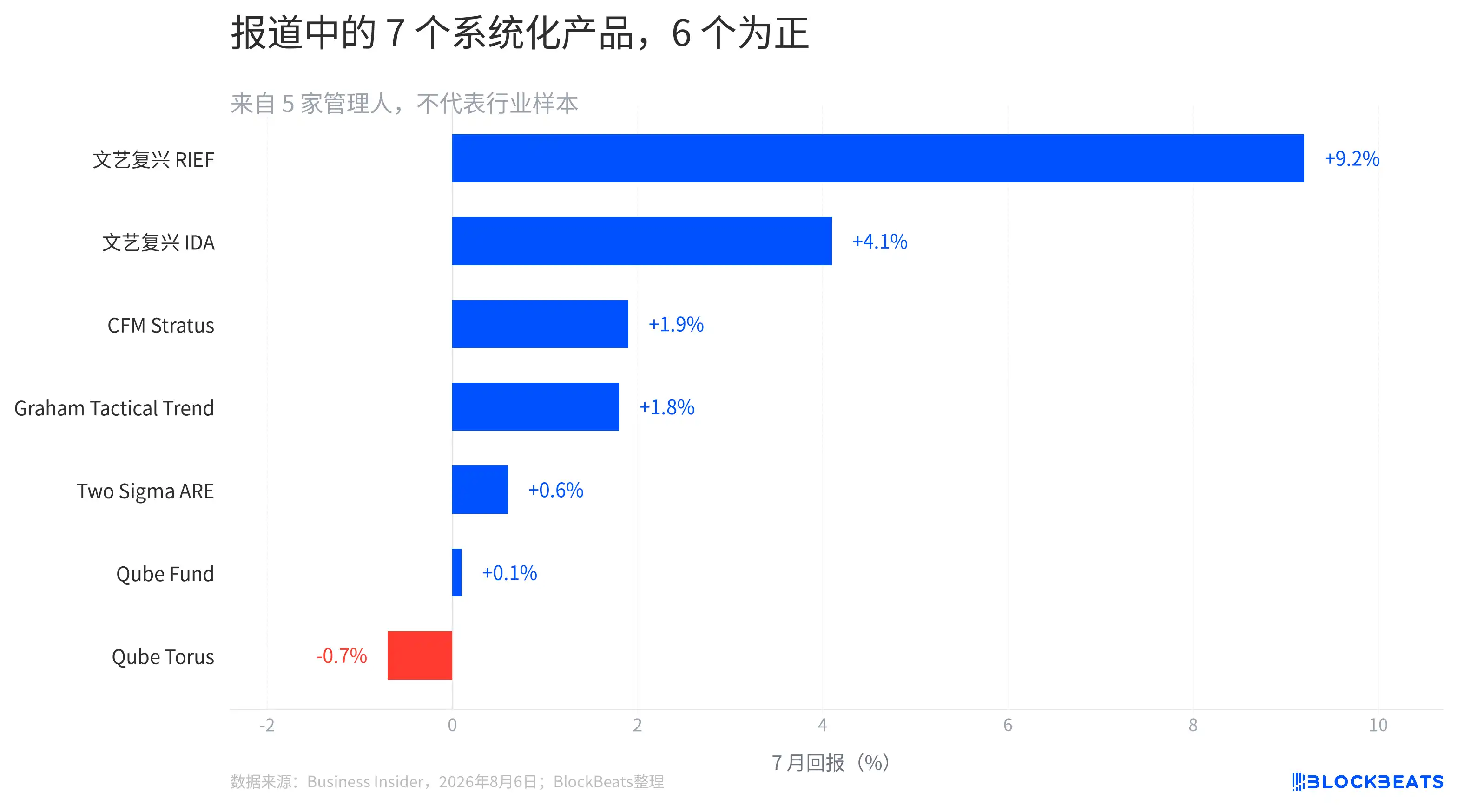
The truly useful part of this set of numbers is pulling "quantitative" back from an abstract label to specific products. For RIEF, Renaissance's Institutional Diversified Alpha, Two Sigma's Absolute Return Enhanced, the mentioned media report did not disclose their models, asset scope, or risk budgets. What outsiders can see are the monthly returns cited by the media.

Monthly positive returns cannot be automatically translated as "machines understand the market better." They merely indicate that these systems recorded positive returns in that particular month.

In the Same Month, Category Indices Are Also Diverging

On Business Insider's multi-strategy fund scorecard, most products closed down in July. However, the concurrent estimate from hedge fund data platform BarclaysHedge showed its multi-strategy category index rose 0.60%. The two readings do not contradict each other; they sample different sets and have different statistical methodologies.

The numbers on BarclaysHedge's page only cover data reported at that time and will adjust as funds continue to submit numbers later. It is more suitable for answering "which type of strategy came under pressure," not for labeling a specific private fund.
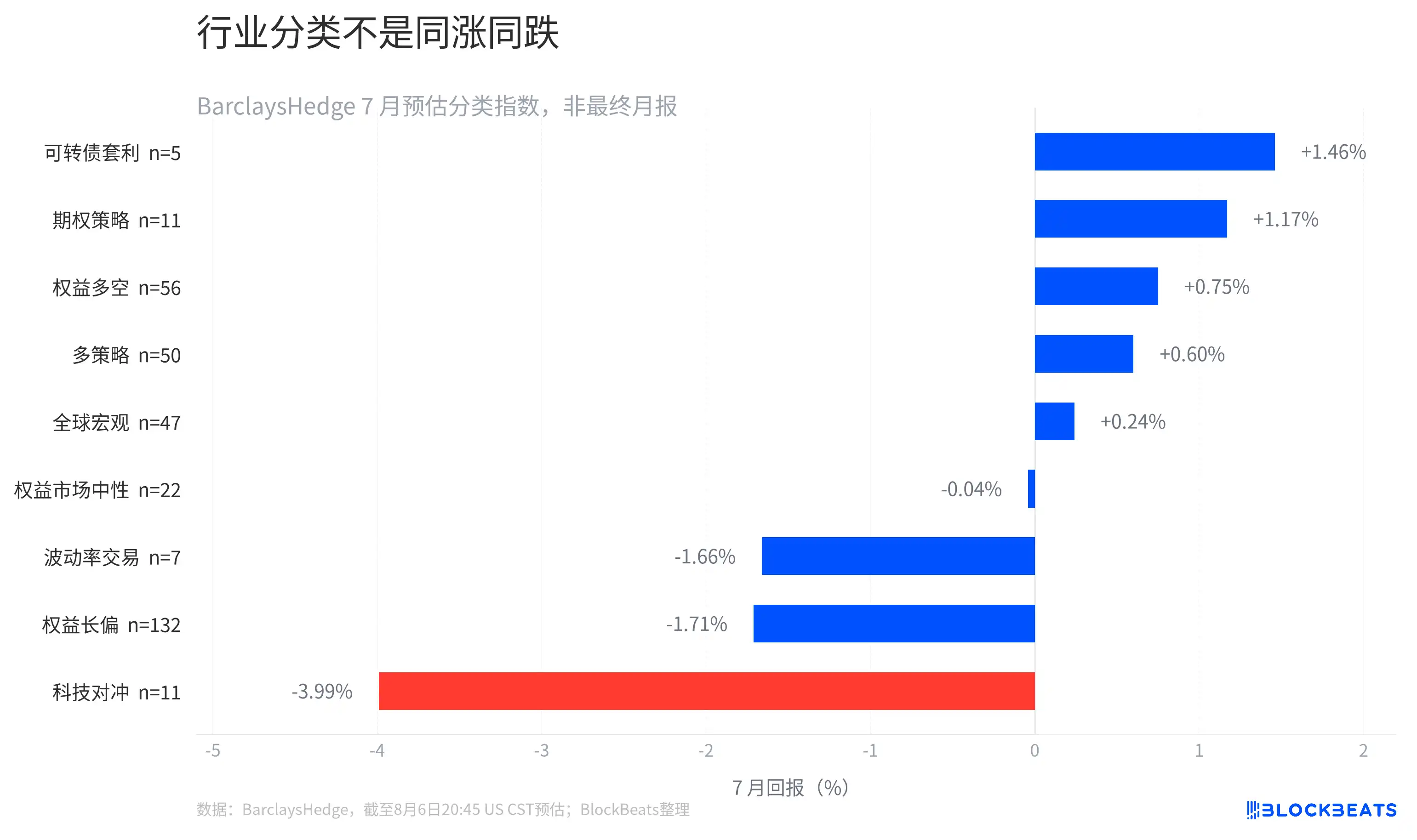
According to BarclaysHedge's estimate, the Technology Hedge category index fell 3.99% in July, while Convertible Arbitrage rose 1.46%. In the same month, the monthly performance of categories like Equity Long Bias and Convertible Arbitrage showed significant differences. This category table reminds readers to read each return within its specific strategy label.

This also explains why "multi-strategy funds broadly losing momentum" cannot be stated too definitively. Business Insider's sample has its news value, BarclaysHedge's indices have their coverage scope. Both should be read within their respective boundaries.

Is a One-Month Surge the Same as the Year-to-Date Score?

Not necessarily. According to the Business Insider report, RIEF's July performance was the most eye-catching, but its year-to-date return as of the end of July was only 4.5%. The report described this rally as making up for losses in the previous six months.

The same report also showed that hedge fund manager Graham Capital's Tactical Trend strategy had a year-to-date return of 23.7%, yet its monthly gain was not as glaring as RIEF's. London-based quant firm Qube's Torus strategy closed down for the month but still had a year-to-date return of about 18%. When the single-month ranking and year-to-date ranking are placed on the same chart, positions change quickly.
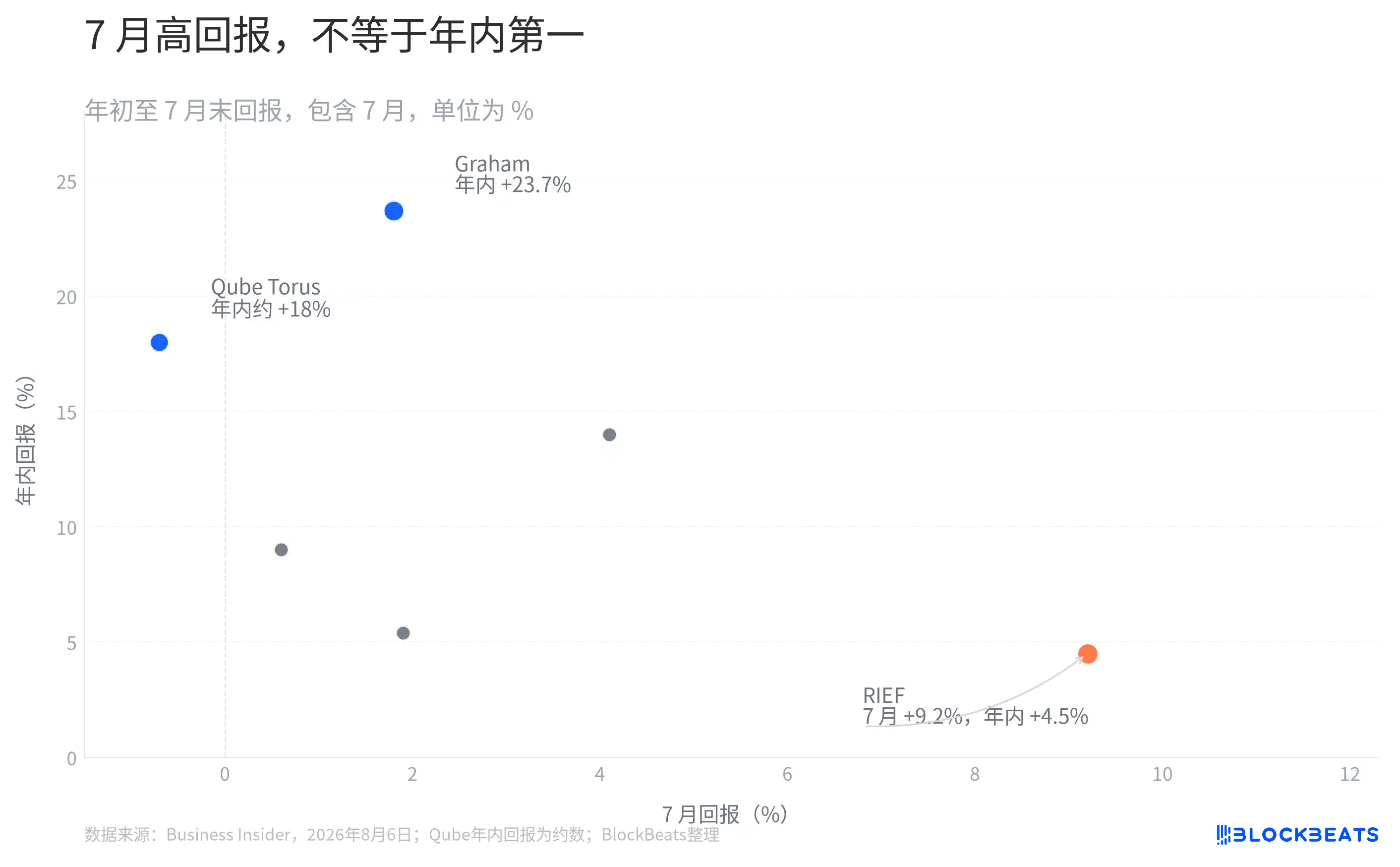
This chart is not proving the two sets of numbers are independent. The return from the beginning of the year to the end of July already includes July. It merely reminds readers that monthly rankings are like a snapshot; once the lens is pulled back, both the trend and the order shift.

Beyond Rankings, There Was an Asset Sale

A Reuters report on July 31st stated that Situational Awareness sold most of its public equities and said it had removed portfolio leverage after the AI stock pullback and liquidity deterioration. The report did not state definitively whether it received a formal margin call, so a safer description is that this was a deleveraging disposal under financing pressure.

According to a Reuters report on August 5th, Citadel took over some of these public positions, with discounts on some positions exceeding 10%. In the same month this sale occurred, based on investor information cited by Reuters, Citadel's equity-focused fund rose 14.2% in July.
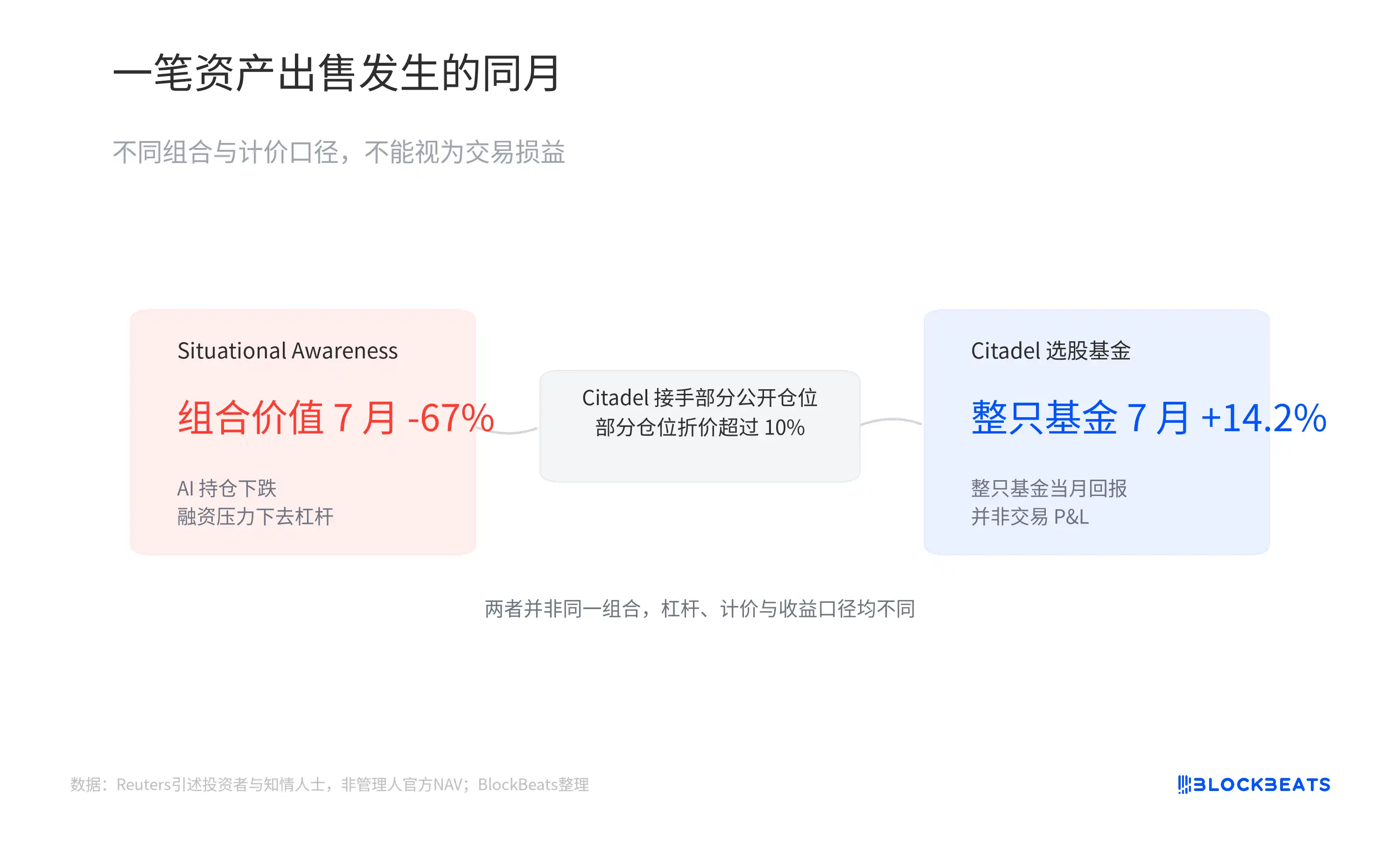
These two numbers cannot be subtracted to calculate the profit from a single trade. Situational Awareness disclosed its portfolio value change, while the media-reported Citadel number is the monthly performance of an entire fund, with differences in positions, leverage, and valuation methods. Putting this footnote in the chart is closer to the event itself than writing this asset disposal as a miraculous arbitrage.

Disassembling this return sheet, differences in systematic trading, positioning direction, and financing methods may manifest as different returns during the same market volatility.


Trending Cryptos

Related Questions

QAccording to the article, what was the performance of the equity-focused fund of Citadel in July?

AAccording to the article, citing investor information, Citadel's equity-focused fund rose 14.2% in July.

QWhat was the July performance of Renaissance Technologies' RIEF fund as mentioned in the article?

AThe article states that Renaissance Technologies' Renaissance Institutional Equities (RIEF) fund was up 9.2% in July.

QAccording to BarclaysHedge estimates, which two strategy categories showed notably divergent performance in July?

AAccording to BarclaysHedge estimates mentioned in the article, the Technology hedge category fell 3.99% while Convertible Arbitrage rose 1.46% in July.

QWhat major action did the fund Situational Awareness take in the last week of July, as reported by Reuters?

AAs reported by Reuters, the AI-themed fund Situational Awareness sold most of its public equities to large hedge fund Citadel in the last week of July, a move described as deleveraging under funding pressure.

QWhy does the article caution against using monthly performance to judge an entire strategy or industry?

AThe article cautions that a single month's positive return does not automatically mean a strategy or model is superior; it only indicates positive performance for that specific period. Annual rankings can differ significantly from monthly snapshots, as shown by funds having strong yearly returns despite modest or negative July performance.

Related Reads

1.65 Billion Yuan: Sichuan Power Semiconductor Company Sells Itself

Sichuan-based power semiconductor company Jingyi Semiconductor is being acquired by its customer, Jiangsu-listed power semiconductor firm Suzhou Kaiweite Semiconductor Co., Ltd. ("Kaiweite"), for 1.65 billion yuan. Following the transaction, Jingyi Semiconductor will become a wholly-owned subsidiary of Kaiweite. Kaiweite will pay for the acquisition partly with new shares (approximately 901 million yuan worth) and partly in cash (approximately 749 million yuan). The deal is considered a major asset restructuring as Jingyi Semiconductor's assets and revenue in 2025 were 176.34% and 137.38% of Kaiweite's, respectively. Financially, Kaiweite has reported losses for 2024 and 2025. In contrast, Jingyi Semiconductor has remained profitable. The acquisition is expected to significantly improve Kaiweite's profitability. Jingyi Semiconductor's controlling shareholder and chairman, Yi Kun, along with employee持股 platforms, will hold a 13.28% stake in Kaiweite post-transaction. Founded in 2015 and listed on Shanghai's STAR Market in 2023, Kaiweite is a national-level "Little Giant" specializing in intelligent power semiconductor devices and power integrated chips. Established in 2019, Jingyi Semiconductor is a fabless power semiconductor company and a national-level专精特新重点"Little Giant." Its products, including Intelligent Power Modules (IPM), are supplied to major domestic appliance makers like Midea, Xiaomi, Gree, TCL, and Hisense-Hitachi. The company holds a leading 53.5% market share in China's IPM半桥 module segment for white goods. The strategic acquisition aims to repair Kaiweite's profitability and expand its power semiconductor product portfolio through integration in technology, products, and customer channels.

marsbit1h ago

1.65 Billion Yuan: Sichuan Power Semiconductor Company Sells Itself

marsbit1h ago

Launch Event Turned into a Make-up Ceremony? Why Hasn't Pools.trade Produced a High-Market-Cap Meme Coin Yet?

The article discusses the launch of Pools.trade, Uniswap's new token launch platform on Robinhood Chain, designed as a Meme coin launchpad. Despite generating high initial trading volumes (over $1.5 billion before the official frontend launch), the platform has yet to produce a high-market-cap Meme coin. The piece highlights two primary reasons for this. First, it outlines Pools.trade's features: it offers Instant and Crowd Launch modes, locks liquidity permanently in Uniswap v4 pools, and charges a low 0.25% transaction fee (compared to 1% on competitors like Pons and Flap), with most fees reinvested into liquidity. Second, it identifies a key problem: a lack of perceived fairness. The two most notable coins on the platform, FRONG (a "frog mascot" coin) and POOLS (a platform namesake), were both minted days before Uniswap's official countdown began. This "pre-minting" or "insider" controversy has dampened community FOMO (Fear Of Missing Out) and trust, causing their market caps to fall from peaks of $18 million and $4 million, respectively. The article argues that fairness is foundational for Meme coin success, and its absence has hindered viral growth. In conclusion, while Pools.trade benefits from Uniswap's existing user base and Robinhood Chain's popularity, its current lack of a fair-launch, high-engagement narrative has prevented a breakout hit. However, the author suggests that with its inherent traffic, such a success might not be far off.

Odaily星球日报2h ago

Launch Event Turned into a Make-up Ceremony? Why Hasn't Pools.trade Produced a High-Market-Cap Meme Coin Yet?

Odaily星球日报2h ago

Trading

Spot

Hot Articles

Discussions

Welcome to the HTX Community. Here, you can stay informed about the latest platform developments and gain access to professional market insights. Users' opinions on the price of AI (AI) are presented below.

活动图片