When Transfers Become Truly Frictionless: How Sui Uses 'Zero Gas' to Become the Underlying Infrastructure for Stablecoin Payments

marsbitPublished on 2026-06-22Last updated on 2026-06-22

Abstract

Title: Sui Launches Zero-Gas Stablecoin Transfers to Become the Foundation for Stablecoin Payments Sui has introduced a zero-gas fee feature for peer-to-peer stablecoin transfers, eliminating the need for users or businesses to hold separate SUI tokens to pay transaction costs. This innovation, built on a new underlying account architecture called Address Balances, significantly reduces validator processing costs for eligible transactions. Currently, the feature applies to a whitelist of stablecoins for transfers meeting a minimum amount, effectively preventing spam. This development aims to unlock mainstream payment use cases for stablecoins—such as everyday purchases, remittances, and subscriptions—by removing cost and complexity barriers. It is also positioned to benefit high-frequency micro-payments for AI agents and institutional B2B payments, reducing operational friction. Major custody provider Fireblocks has already announced support. The move follows Sui processing over $1 trillion in stablecoin transfer volume since August 2025. Looking ahead, Sui plans to enhance this infrastructure with protocol-level confidential transactions later in 2026, aiming to provide scalable, free, and privacy-preserving payments. Together, these advancements strengthen Sui's goal of becoming the default settlement layer for stablecoin payments.

Author: Deep Tide TechFlow

If you go to an ATM to transfer money, and the ATM tells you that you must first buy "ATM usage coupons," you would probably think the ATM has gone crazy.

But this has been the operating rule for blockchain for over a decade: to make a transfer, first prepare the Gas.

As stablecoins play an increasingly critical role in the payment field, the cost of this threshold becomes clearer: new users are blocked outside, and payment scenarios are difficult to implement.

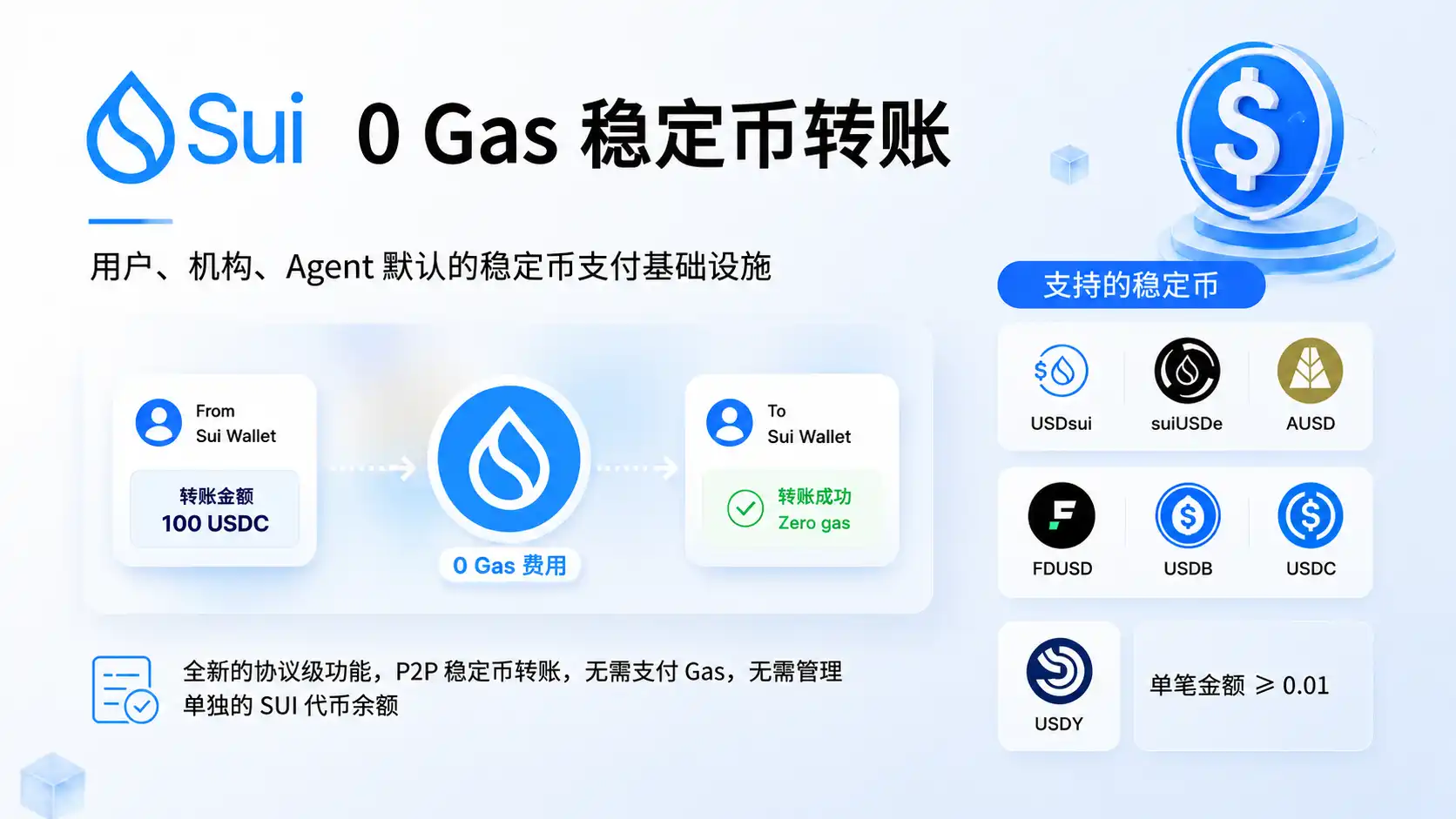
As a key initiative in building the "underlying infrastructure for stablecoin payments," on May 20, 2026, Sui announced the launch of a zero Gas stablecoin transfer feature, allowing users and enterprises to send stablecoins peer-to-peer without paying Gas fees, and without needing to manage a separate SUI token balance.

Although currently, this feature only supports P2P transfers of whitelisted stablecoins, stablecoins now have a real chance to transform from "crypto assets" into "payment infrastructure." The entity achieving this also further strengthens its position as a strong contender for the role of the "default foundation for stablecoin payments."
A New Kind of "Zero Gas": No One Is Paying for You in the Background

When mentioning zero Gas, most users' first reaction might be: Who paid the Gas for me?

This habitual thinking stems from past incomplete attempts at "zero Gas": either through subsidies or relays. The Gas never disappeared; someone was just quietly settling the bill in the background, a superficial solution that doesn't address the root cause.

Sui's "Zero Gas Stablecoin Transfer" targets the fundamental root.

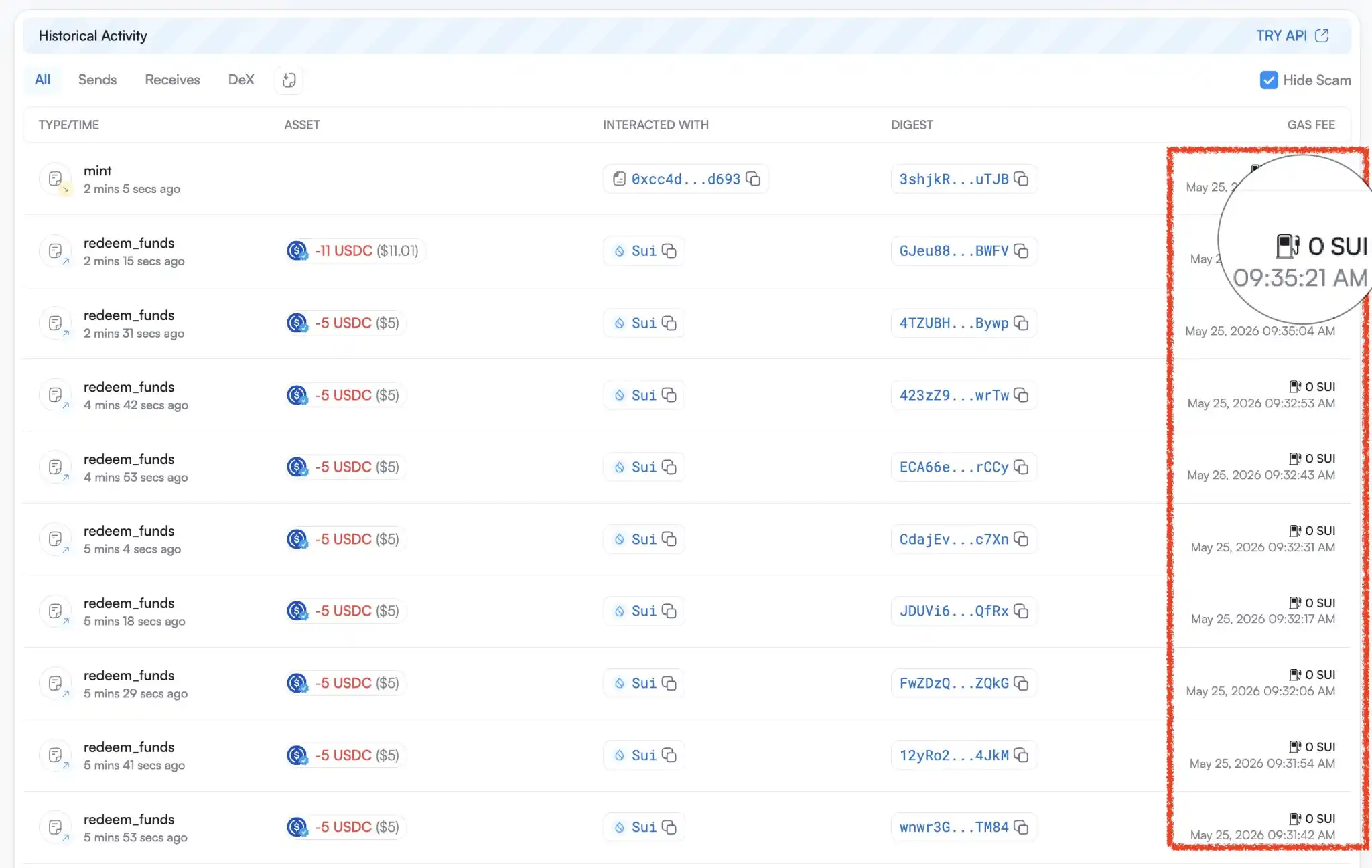
It is built upon a new underlying account architecture called Address Balances. When tokens are sent using specific Move functions, they are automatically consolidated into the single balance of the recipient's address, eliminating the need to create or manage Coin objects. This saves the overhead of object creation, splitting, merging, and version tracking. The processing cost for validators is extremely low, low enough that they can refrain from charging users fees.

Costs are reduced, and boundaries must also be clearly defined: Under the highly restricted PTB mechanism, only P2P transfers of whitelisted stablecoins, with amounts no less than 0.01, are judged as zero Gas. This supports payment scenarios while isolating malicious transactions.
What Can This Infrastructure Run?

Firstly, it opens the door to daily payments. When the experience is frictionless and the cost is zero, those payment scenarios we once pinned high hopes on for stablecoins—including consumption, tipping, subscriptions, cross-border remittances, etc.—gain the potential for rapid penetration. Stablecoin payments, for the first time, possess the basic conditions to compete head-on with traditional payment tools, potentially even faster and better.

Of course, for high-frequency micro-payment scenarios, many will think of the Agent economy. In the past, actions like AI autonomous transactions and arbitrage required additional Gas management. The zero Gas stablecoin transfer will become the lowest-cost, least-resistance choice for Agents. Combined with Sui's high-performance advantages, it will further support the large-scale deployment of autonomous payment flows.

Another keyword is: Institutions. This is a group Sui officials specifically emphasize. Whether it's cross-border B2B payments, supplier settlements, or platform profit sharing, institutions often face higher payment friction. The protocol-level zero Gas mechanism transforms stablecoins into a payment tool that institutions can directly utilize.

Worth mentioning is that when the zero Gas feature was launched, Fireblocks had already announced support for address balances, and soon after, it supported Gas-free stablecoin transfers, further enhancing the accessibility of Sui's payment infrastructure for institutions. At the same time, several institutional-grade custody platforms and wallets have announced they will support zero Gas transactions.

Zero Gas: The First Half; Privacy: The Second Half

Since August 2025, stablecoin transfer volume on the Sui network has exceeded $1 trillion. This figure is sufficient to show that the underlying logic for stablecoin payments in the Sui ecosystem is already working. The launch of zero Gas stablecoin transfers will undoubtedly accelerate the construction of Sui's role as the "default foundation for stablecoin payments."

But this is only the first half of Sui's 2026 payment narrative.

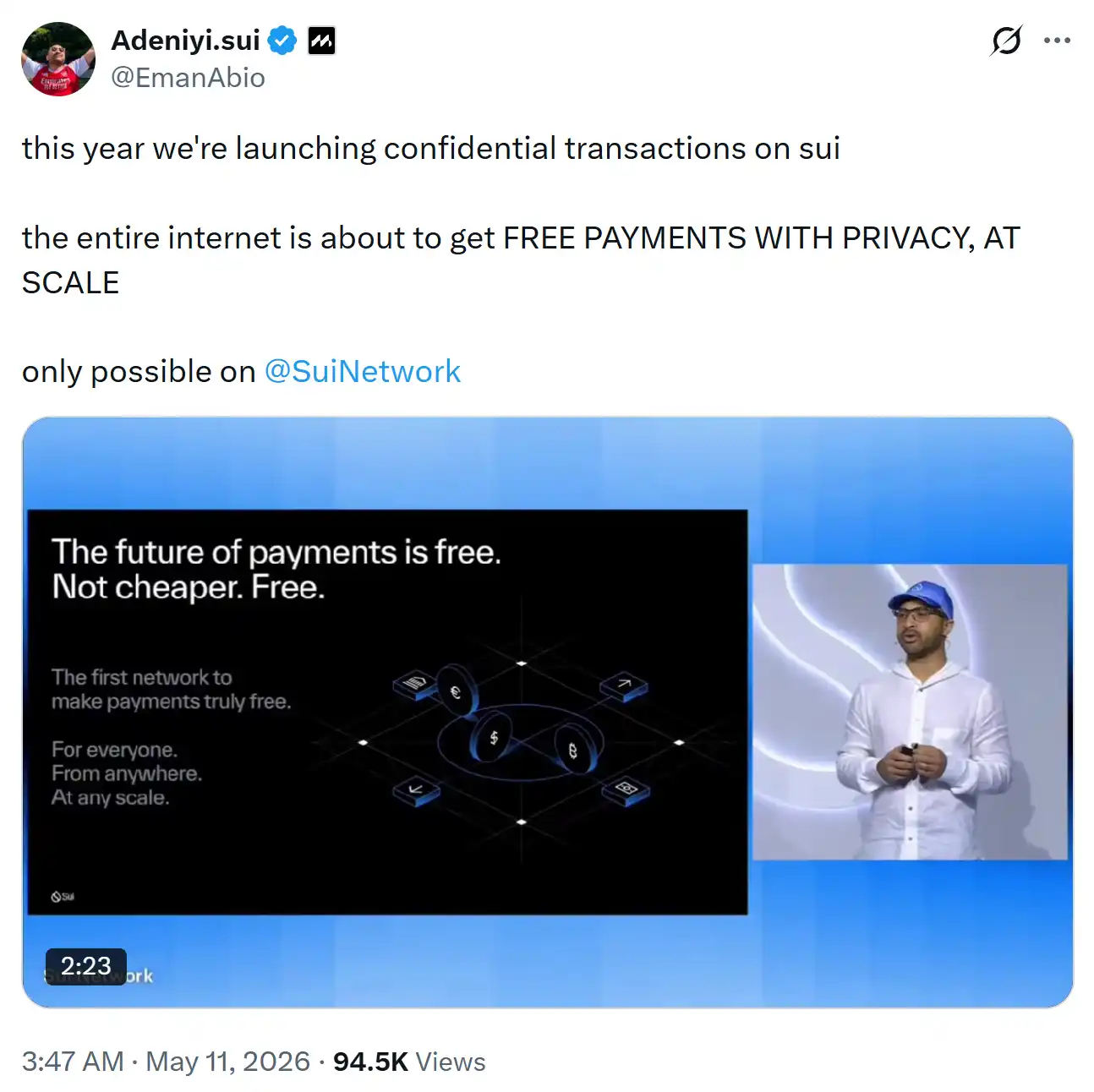
Regarding the second half, the Mysten Labs product team has hinted multiple times: Protocol-level confidential transaction functionality will be launched within 2026, aiming to achieve large-scale, free payments with privacy protection.

Transfers will not only be cost-free but will also be able to hide transaction amounts and certain details, while retaining necessary audit and compliance capabilities.

This combination is crucial for adoption, especially for institutions. The higher the compliance requirements, the greater the value of confidential transactions.
Let Money Flow Like Information.

This can be considered a phrase that runs through all of Sui's technological and ecosystem initiatives.

And now, from payments to Agents to institutions, the fuse that will decide large-scale adoption might just be lit by zero Gas stablecoin transfers.

Trending Cryptos

Related Questions

QWhat is the main announcement made by Sui regarding stablecoin transfers, and when was it announced?

ASui announced a zero Gas stablecoin transfer function on May 20, 2026. This feature allows users and businesses to send stablecoins peer-to-peer without paying Gas fees and without needing to manage a separate SUI token balance.

QHow does Sui's 'zero Gas' mechanism for stablecoin transfers fundamentally differ from previous attempts at eliminating Gas fees?

AUnlike previous methods that relied on subsidies or relayers where someone else ultimately pays the Gas, Sui's approach targets the underlying architecture. It is built on the new Address Balances system, where tokens are sent using specific Move functions and automatically merged into the recipient's single balance. This eliminates the overhead of creating, splitting, merging, and tracking Coin objects, reducing validator processing costs so low that fees can be waived for the user.

QAccording to the article, what are some of the key use cases or scenarios enabled by zero Gas stablecoin transfers on Sui?

AThe key use cases include: 1) Everyday payments like consumption, tipping, subscriptions, and cross-border remittances. 2) High-frequency micropayments for the Agent/AI economy, enabling autonomous transactions with minimal cost. 3) Institutional payments such as cross-border B2B payments, supplier settlements, and platform revenue sharing, where reducing friction is crucial.

QWhat is the 'second half' or next major development in Sui's 2026 payment narrative mentioned in the article?

AThe 'second half' of Sui's 2026 payment narrative is the planned launch of a protocol-level confidential transaction feature within the year. The goal is to enable large-scale, free (zero Gas), and privacy-preserving payments that can hide transaction amounts and certain details while retaining necessary audit and compliance capabilities.

QWhat underlying technical principle allows Sui to offer zero Gas fees for eligible stablecoin transfers?

AIt is enabled by the new Address Balances account architecture. When tokens are sent using specific Move functions, they are automatically merged into the recipient's address balance without creating individual Coin objects. This drastically reduces the computational overhead (like object creation, splitting, merging, and version tracking) for validators, making the cost so low that fees are not charged to users for qualifying transactions.

Related Reads

Home Furnishing Listed Companies Are Trying to Turn Around with AI and Semiconductors

Chinese home furnishing listed companies are increasingly turning to AI and semiconductor cross-border ventures to revive their fortunes amid declining core businesses. A prominent example is PVC flooring giant **Elegant Home Furnishing**, whose stock price skyrocketed with 10 consecutive trading limits after announcing a plan to acquire a majority stake in **Ou Kang Nuo**, a semiconductor storage testing equipment and services company. Despite Elegant Home's own financial struggles—including recent losses and tight cash flow—the acquisition, funded through asset sales and loans, has dramatically boosted its market value. The deal involves a cross-shareholding structure with Ou Kang Nuo's controlling shareholder. This trend is widespread. Over the past year, numerous home furnishing firms with stagnant main operations have seen their stock prices surge after announcing moves into hot sectors like AI, semiconductors, or computing power. Key cases include: * **Markor Home Furnishings** ("high-end home furnishing first share"), after years of heavy losses, acquired an AI server high-speed copper cable company and later introduced AI computing power investors. * **Zhenai Meijia** ("blanket king") became the first A-listed manufacturer controlled by an AI large model company following a takeover. * **Fasilon** (integrated ceiling) saw its stock soar after establishing an AI subsidiary. * **Jinlong Decoration** experienced multiple trading limits after being linked to "commercial aerospace" and "AI computing," despite clarifying these segments contribute less than 1% of its business. Statistics show over 20 A-share companies announced semiconductor crossovers in 2025, with home furnishing and building materials firms being the most active. This shift is largely driven by pressures from the real estate downturn, shrinking overseas demand, and trade tariffs, pushing companies to seek growth through trendy concepts rather than core business improvement. However, the article warns that such speculative frenzies often end when the hype fades, leaving stock prices to eventually reflect the companies' weak fundamentals, as seen in Jinlong Decoration's subsequent sharp price correction. The repeated attempts to "ride the trend" highlight a desperate struggle for survival in a challenging traditional industry.

marsbit23m ago

Home Furnishing Listed Companies Are Trying to Turn Around with AI and Semiconductors

marsbit23m ago

"Sell America" Trade Resurfaces: Global Funds Reprice Washington Policy Risks, Dollar and Treasuries Bear the Brunt

"Sale of America" Trade Resurges as Global Funds Reprice Washington Policy Risks, Hitting Dollar and Treasuries First Recent policy signals from Washington are prompting global bond and foreign exchange investors to reignite the "Sale of America" debate. Uncertainty stems from Fed Chair Wash's shift towards less policy communication, Treasury Secretary Bessant's approval of joint intervention with Japan to support the Yen (the first such coordinated move in nearly 30 years), expanding fiscal deficits, and trade war fears. These factors are undermining confidence in U.S. assets. The 30-year Treasury yield recently broke above 5%, hitting a high not seen since 2007, while the Bloomberg Dollar Spot Index has fallen about 2% from its June peak. This dollar weakness is unusual given still-high U.S. interest rates. Investors cite policy uncertainty as a key driver, with one manager calling the Fed Chair and Treasury Secretary a "double whammy" creating a "Trump administration premium." While the S&P 500 continues hitting record highs and foreign holdings of U.S. Treasuries remain high, parts of the bond and FX markets are adjusting. A core concern is whether the Fed under Wash can effectively anchor inflation expectations; analysts warn that if the Fed lags the hiking cycle, long-end yields could face further upward pressure. The 30-year term premium has risen sharply. The U.S.-backed Yen intervention has also sparked debate on the dollar's structural outlook. While framed by Bessant as a "reallocation of reserves," market participants caution that if Japan—America's largest foreign creditor—must sell Treasuries to fund interventions, ripple effects could hit the bond market. Strategists predict moderate dollar depreciation ahead. Most experts are not predicting an end to dollar hegemony or the safe-haven status of Treasuries. However, a key underlying risk is highlighted: the pace of foreign buying of U.S. debt may not keep up with the speed of American borrowing, gradually eroding the structural advantages that have long supported "American exceptionalism."

marsbit24m ago

"Sell America" Trade Resurfaces: Global Funds Reprice Washington Policy Risks, Dollar and Treasuries Bear the Brunt

marsbit24m ago

Trading

Spot

Hot Articles

How to Buy GAS

Welcome to HTX.com! We've made purchasing GAS (GAS) simple and convenient. Follow our step-by-step guide to embark on your crypto journey.Step 1: Create Your HTX AccountUse your email or phone number to sign up for a free account on HTX. Experience a hassle-free registration journey and unlock all features.Get My AccountStep 2: Go to Buy Crypto and Choose Your Payment MethodCredit/Debit Card: Use your Visa or Mastercard to buy GAS (GAS) instantly.Balance: Use funds from your HTX account balance to trade seamlessly.Third Parties: We've added popular payment methods such as Google Pay and Apple Pay to enhance convenience.P2P: Trade directly with other users on HTX.Over-the-Counter (OTC): We offer tailor-made services and competitive exchange rates for traders.Step 3: Store Your GAS (GAS)After purchasing your GAS (GAS), store it in your HTX account. Alternatively, you can send it elsewhere via blockchain transfer or use it to trade other cryptocurrencies.Step 4: Trade GAS (GAS)Easily trade GAS (GAS) on HTX's spot market. Simply access your account, select your trading pair, execute your trades, and monitor in real-time. We offer a user-friendly experience for both beginners and seasoned traders.

3.5k Total ViewsPublished 2024.03.29Updated 2026.06.02

How to Buy GAS

Discussions

Welcome to the HTX Community. Here, you can stay informed about the latest platform developments and gain access to professional market insights. Users' opinions on the price of GAS (GAS) are presented below.

活动图片