When the 'Bitcoin Bible' Prophecy Meets Soaring Silver: Is the Old Theory Still Valid?

比推Published on 2026-01-28Last updated on 2026-01-28

Abstract

A book published in 2018, "The Bitcoin Standard," argued that Bitcoin is a harder form of money than gold and that silver cannot serve as a reliable store of value due to its high supply elasticity—meaning production can quickly ramp up when prices rise, causing bubbles to burst, as seen in the Hunt brothers' case in the 1980s. However, eight years later, silver has surged to a record $117 per ounce, driven by structural shifts. Unlike past speculative bubbles, today’s rally is fueled by industrial demand: over 60% of silver use now comes from sectors like solar panels, electric vehicles, and AI hardware. Supply has not kept pace; mining output has declined since 2016, and inventories are shrinking. New factors, such as China’s export restrictions on refined silver, have further tightened markets. Bitcoin maximalists cite the book to defend their stance, arguing silver’s rise is temporary and that Bitcoin’s fixed supply makes it superior long-term. But current silver dynamics challenge earlier assumptions, highlighting a clash between old theories and new realities. As silver continues its rally, Bitcoin proponents await a narrative reversal.

Author: David, Shenchao TechFlow

Original Title: An 8-Year-Old Book About Bitcoin Is 'Predicting' a Silver Crash?


In 2020, MicroStrategy founder Michael Saylor read a book and decided to buy $425 million worth of Bitcoin.

This book is called "The Bitcoin Standard," published in 2018, translated into 39 languages, sold over a million copies, and is revered by Bitcoin enthusiasts as the "Bible."
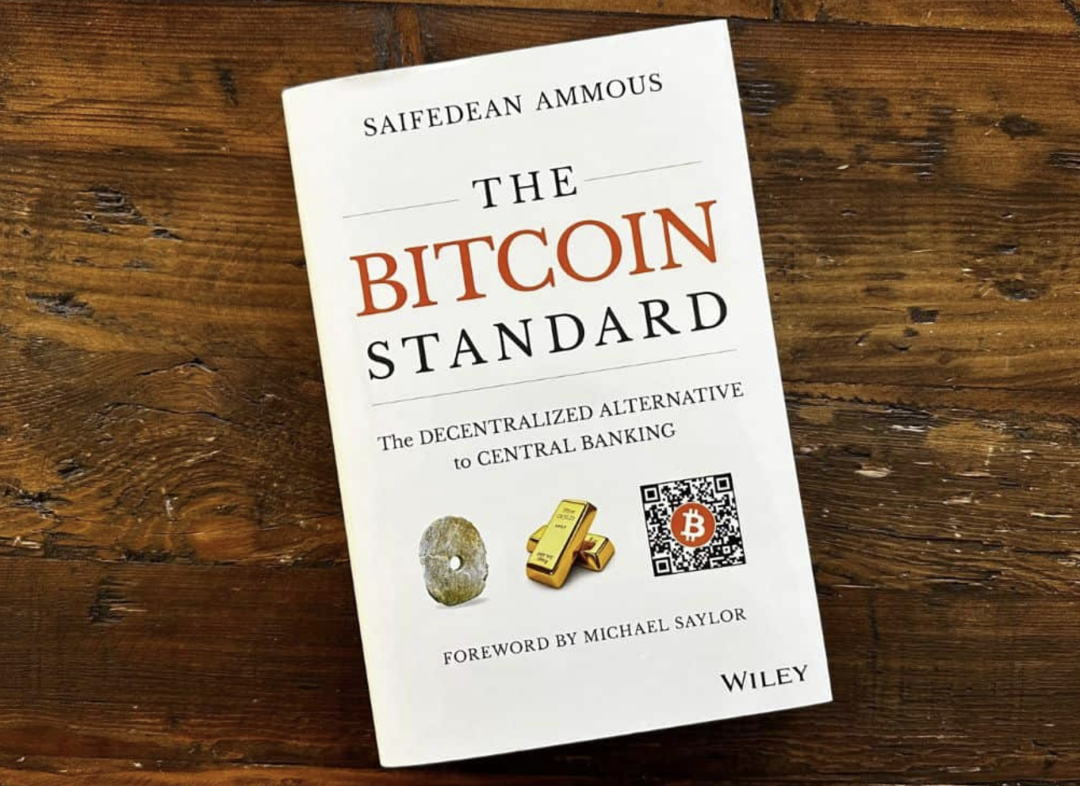
Author Saifedean Ammous, a Columbia University economics PhD, has one core argument:

Bitcoin is a "harder" form of hard currency than gold.

Meanwhile, on the book's promotional page, Michael Saylor's endorsement reads:

"This book is a work of genius. After reading it, I decided to buy $425 million worth of Bitcoin. It has had the greatest impact on MicroStrategy's way of thinking, leading us to shift our balance sheet to a Bitcoin standard."

But there is one chapter in this book that isn't about Bitcoin. It's about why silver cannot become a hard currency.

Eight years later, silver has just surged to a historic high of $117 per ounce, the investment frenzy in precious metals continues, and even Hyperliquid and a number of CEXs have begun listing precious metal contracts in various forms.

Often at times like these, there are always those who act as whistleblowers or defectors to warn of risks, especially in an environment where everything is rising except Bitcoin.

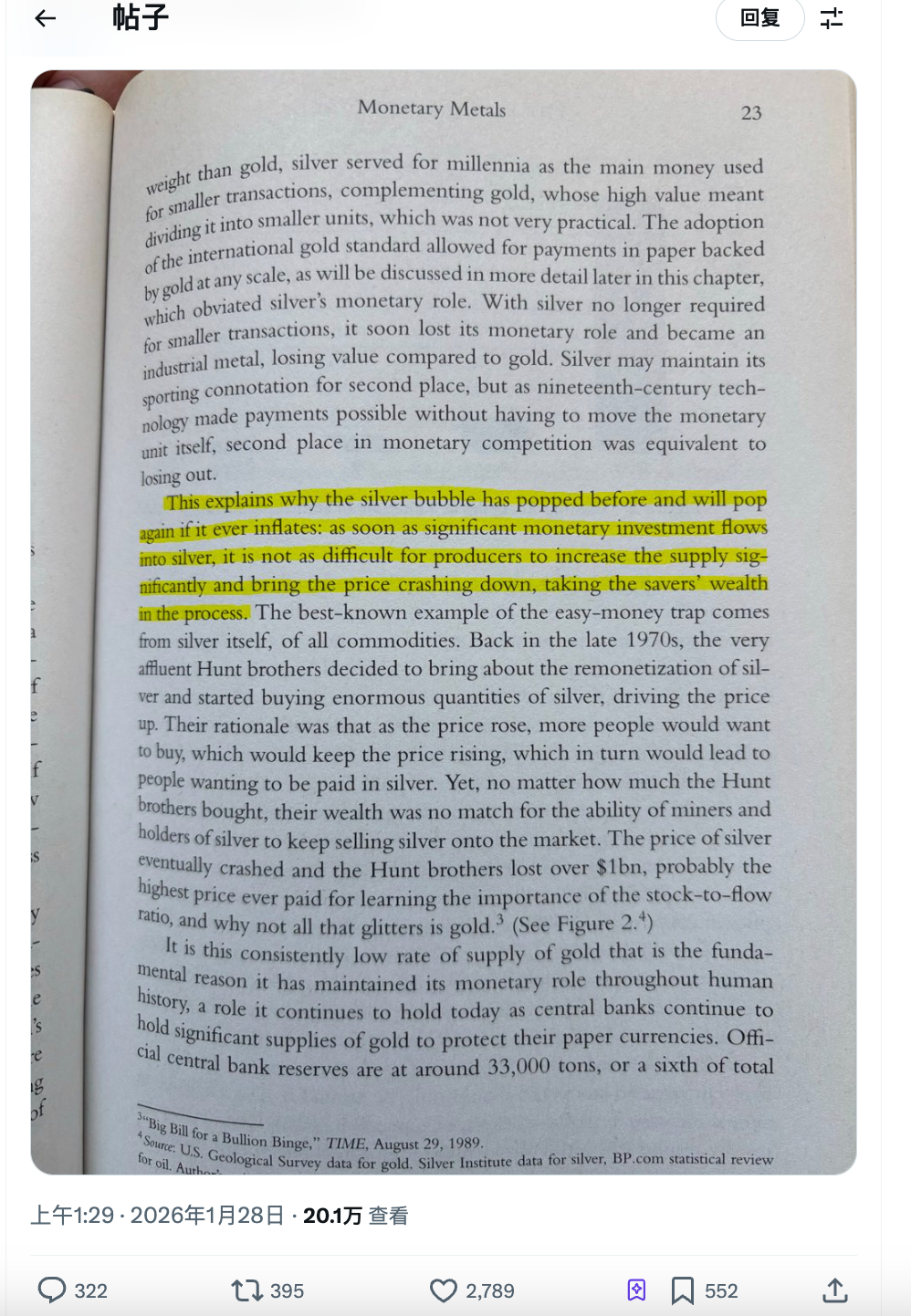
For example, a widely circulated post on Crypto Twitter today is someone quoting from this book, sharing a screenshot of page 23 with a highlighted paragraph that reads:

Every silver bubble has burst, and the next one will be no exception.
The History of Silver Speculation

Before you rush to criticize, let's look at what this core argument actually is.

The core argument in this book is called stock-to-flow. OG BTC enthusiasts have probably heard of this theory.

Translated into plain language: For something to become a "hard currency," the key is how difficult it is to increase its production.

Gold is hard to mine. Global above-ground gold stocks are about 200,000 tons, with annual new production of less than 3,500 tons. Even if the gold price doubles, miners can't suddenly dig out twice as much gold. This is called "supply rigidity."

Bitcoin is even more extreme. The total supply is capped at 21 million coins, halving every four years, and no one can change the code. This is scarcity created by algorithm.

What about silver?

The gist of that highlighted passage is: Silver bubbles have burst before and will burst again. Because once large amounts of money flow into silver, miners can easily increase supply, driving the price down, and evaporating the wealth of savers.

The author also gives an example: the Hunt brothers.

In the late 1970s, Texas oil tycoons the Hunt brothers decided to hoard silver, attempting to corner the market. They bought billions of dollars worth of silver and futures contracts, driving the price from $6 to $50, setting a then-historic high for silver.

And then? Miners疯狂出货白银 (frantically sold silver), exchanges raised margin requirements, and the silver price crashed. The Hunt brothers lost over $1 billion and eventually went bankrupt.

Therefore, the author's conclusion is:

Silver's supply elasticity is too high,注定不可能成为价值储存工具 (doomed to be unable to become a store of value). Every time someone tries to hoard it as "hard currency," the market will teach them a lesson with increased production.

When this logic was written in 2018, silver was $15 an ounce. Nobody cared.

Is This Silver Rally Different?

For the above logic about silver to hold true, there is a premise: if the silver price rises, supply can keep up.

However, data from the last 25 years tells a different story.

Global silver mine production peaked in 2016 at approximately 900 million ounces. By 2025, this number had dropped to 835 million ounces. The price increased 7-fold, but production反而缩了 7% (instead shrank by 7%).

Why doesn't the "price rise leads to production increase" logic work?

One structural reason is that about 75% of silver is produced as a by-product of copper, zinc, and lead mining. Miners' production decisions depend on the prices of these base metals, not on silver. Even if the silver price doubles, if the copper price doesn't rise, mines won't open more.

Another reason might be time. The cycle from exploration to production for a new mine project is 8 to 12 years. Even if work starts immediately, no new supply will be seen before 2030.

The result is five consecutive years of supply deficit. According to Silver Institute data, from 2021 to 2025, the global cumulative silver deficit is close to 820 million ounces, almost equivalent to a full year's global mine production.
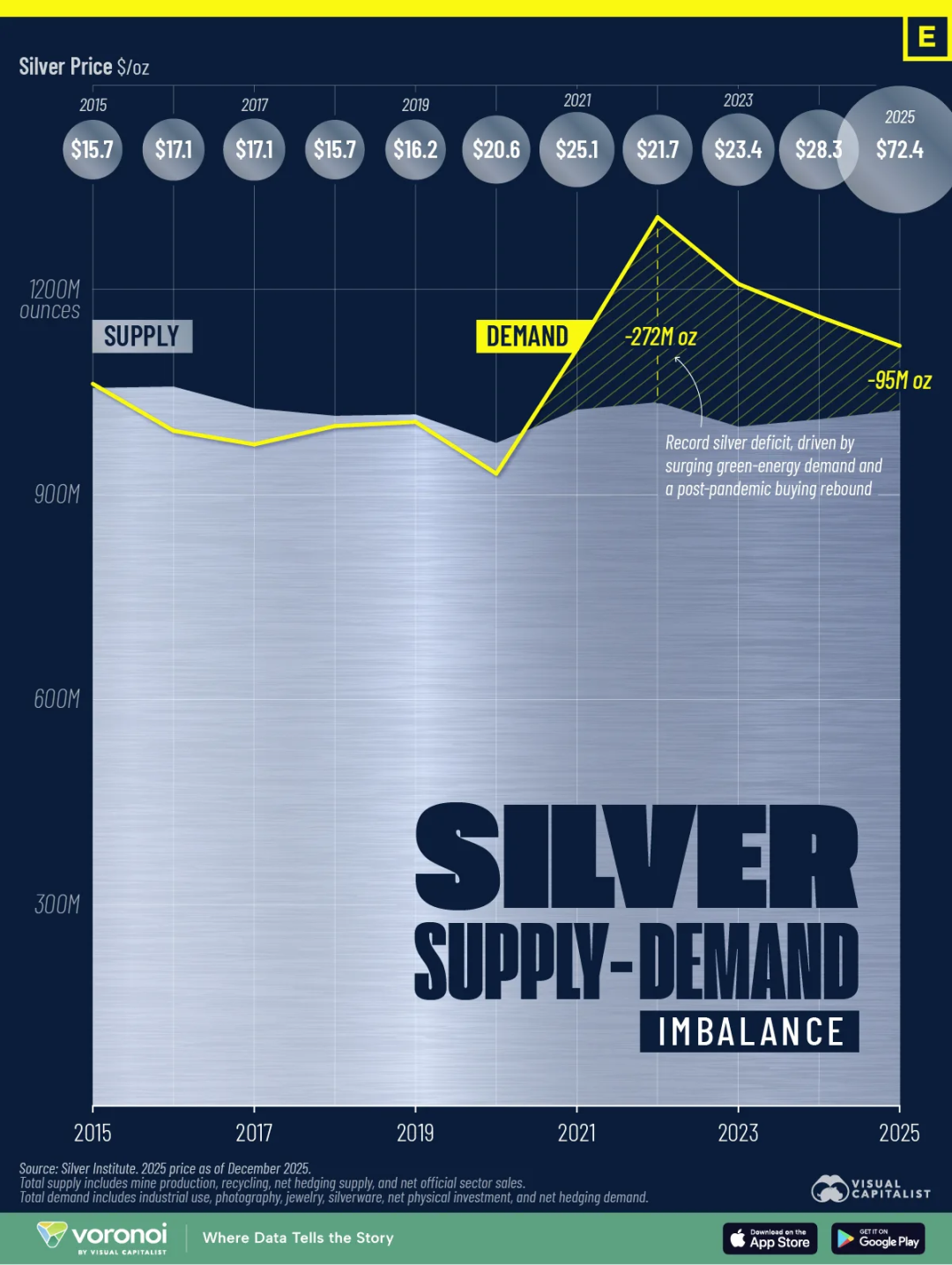
Meanwhile, silver inventories are also bottoming out. The London Bullion Market Association's deliverable silver inventory has dropped to only 155 million ounces. The silver lease rate has surged from the normal 0.3%-0.5% to 8%, meaning someone is willing to pay an 8% annualized cost just to secure physical silver.

There's also a new variable. Starting January 1, 2026, China implemented export restrictions on refined silver, with only state-owned large factories with an annual production capacity of over 80 tons able to obtain export licenses. Small and medium-sized exporters are directly shut out.

In the era of the Hunt brothers, miners and holders could use increased production and selling to smash the price.

This time, the supply side might be running out of bullets.

Speculation, but also Rigid Demand

When the Hunt brothers hoarded silver, silver was a monetary speculation. Buyers thought: the price will rise, hoard it and wait to sell.

The driving force behind the 2025 silver rally is completely different.

First, look at some data. According to the World Silver Survey 2025 report, industrial demand for silver reached 680.5 million ounces in 2024, a historical high. This number accounts for over 60% of total global demand.
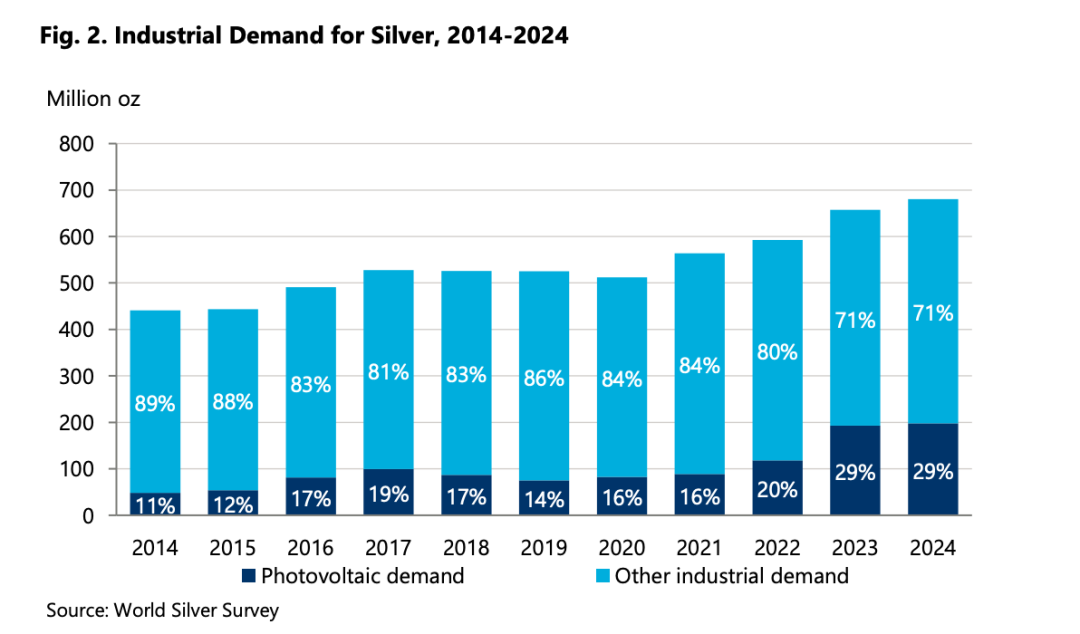
What is industrial demand buying?

Photovoltaics (PV). Every solar panel requires silver paste for its conductive layer. The International Energy Agency predicts global PV installed capacity will quadruple by 2030. The PV industry is already the single largest industrial buyer of silver.

Electric Vehicles (EVs). A traditional internal combustion engine vehicle uses about 15-28 grams of silver. An electric vehicle uses 25-50 grams, with high-end models using even more. Battery management systems, motor controllers, charging interfaces—silver is needed everywhere.

AI and Data Centers. Servers, chip packaging, high-frequency connectors—silver's conductivity and thermal conductivity are irreplaceable. This demand began accelerating in 2024, and the Silver Institute specifically listed "AI-related applications" in its report.

In 2025, the U.S. Department of the Interior listed silver on its "Critical Minerals" list. The last time this list was updated, lithium and rare earths were added.

Of course, sustained high silver prices will bring about a "silver thrifting" effect, such as some PV manufacturers already reducing the amount of silver paste per panel. But the Silver Institute's prediction is that even considering thrifting, industrial demand will remain near record levels for the next 1-2 years.

This is essentially rigid demand, a variable that Saifedean might not have foreseen when writing "The Bitcoin Standard."

A Book Can Also Provide Psychological Comfort

Bitcoin's "digital gold" narrative has recently been muted in the face of actual gold and silver.

The market has dubbed this year the "Debasement Trade": a weakening dollar, rising inflation expectations, geopolitical tensions, funds flowing into hard assets for safety. But this wave of safe-haven money chose gold and silver, not Bitcoin.

For Bitcoin maximalists, this requires an explanation.

Hence, the aforementioned book becomes a kind of classical reference for an answer and a defense of their position: silver is rising now because it's a bubble, wait for it to crash, then you'll know who was right.

This is more like a narrative self-rescue.

When the asset you hold underperforms the market for a whole year, you need a framework to explain "why I'm still right."

Short-term price doesn't matter, long-term logic does. Silver's logic is wrong, Bitcoin's logic is right, so Bitcoin must outperform, it's just a matter of time.

Is this logic consistent? Yes. Can it be falsified? Difficult.

Because you can always say "not enough time has passed."

The problem is, the real world doesn't wait. Brothers holding Bitcoin and altcoins, still坚守加密圈 (holding fast to the crypto circle), are really anxious.

A Bitcoin theory written 8 years ago cannot automatically cover the reality of not rising 8 years later.

Silver is still soaring, and we sincerely wish Bitcoin good luck.


Twitter:https://twitter.com/BitpushNewsCN

Bitpush TG Discussion Group:https://t.me/BitPushCommunity

Bitpush TG Subscription: https://t.me/bitpush

Original link:https://www.bitpush.news/articles/7606661

Related Questions

QWhat is the core argument of 'The Bitcoin Standard' regarding Bitcoin and gold?

AThe core argument of 'The Bitcoin Standard' is that Bitcoin is a harder form of 'hard currency' than gold, based on its superior stock-to-flow ratio and algorithmic scarcity.

QAccording to the book, why is silver not considered a reliable store of value?

AThe book argues that silver is not a reliable store of value because its supply is highly elastic; when prices rise, miners can easily increase production, leading to price crashes and loss of wealth for savers.

QWhat historical example does the author use to illustrate the risk of silver speculation?

AThe author uses the example of the Hunt brothers in the late 1970s, who attempted to corner the silver market but ultimately went bankrupt after miners increased supply and exchanges raised margin requirements, causing prices to collapse.

QHow has the supply dynamics of silver changed since the book was written, challenging its original thesis?

ASince the book was written, silver production has declined despite rising prices, due to structural factors like silver being a byproduct of other metals and long lead times for new mines, resulting in a sustained supply deficit.

QWhat new industrial demands are driving silver's current price surge, according to the article?

ACurrent industrial demands driving silver's price surge include its use in photovoltaic solar panels, electric vehicles, and AI/data center applications, which account for over 60% of global demand and create rigid, non-speculative needs.

Related Reads

You Bet on the News, the Pros Read the Rules: The True Cognitive Gap in Losing Money on Polymarket

The article explains that the key to profiting on Polymarket, a prediction market platform, lies not just predicting real-world events correctly, but in meticulously understanding the specific rules that govern how each market will be resolved. It illustrates this with examples, such as a market on Venezuela's 2026 leader, where the official rules defining "officially holds" the office overruled the intuitive answer of who was in practical control. Other examples include debates over the definition of a "token" or what constitutes an "agreement." The core argument is that a "reality vs. rules" gap creates pricing discrepancies that savvy traders ("车头" or "whales") exploit. The platform has a formal dispute resolution process managed by UMA token holders to settle ambiguous outcomes. This process involves proposal submission, a challenge window, a discussion period, and a final vote. However, the article highlights a critical flaw in this system compared to a traditional court: the lack of separation between the arbiters (UMA voters) and the interested parties (traders with financial stakes in the outcome). This conflict of interest undermines the discussion phase, leads to herd mentality, and results in opaque final decisions without explanatory rulings. Consequently, the system lacks a body of precedent, making it difficult for users to learn from past disputes. The ultimate takeaway is that success on Polymarket requires a lawyer-like scrutiny of the rules to identify and capitalize on the cognitive gap between how events appear and how they are contractually defined for settlement.

marsbit26m ago

You Bet on the News, the Pros Read the Rules: The True Cognitive Gap in Losing Money on Polymarket

marsbit26m ago

Will the Fed Still Cut Interest Rates? Tonight's Data Is Crucial

The core debate surrounding the Federal Reserve's potential interest rate cuts is intensifying amid geopolitical conflict and rebounding inflation. The key question is whether high energy prices will cause persistent inflation or weaken consumer demand enough to force the Fed to cut rates. Citigroup presents a bullish case for cuts, arguing that oil supply disruptions from the Strait of Hormuz are temporary and will not lead to lasting inflationary pressure. They point to receding bond yields and oil prices as evidence the market is pricing in a short-lived shock. Citi's data also shows tightening financial conditions, a stabilizing labor market, and healthy tax returns, supporting their view that the path to lower rates remains open. Conversely, Deutsche Bank offers a starkly contrasting, more hawkish outlook. They argue the Fed's current policy is already neutral and expect rates to remain unchanged indefinitely. Their view is based on stalled disinflation progress and a shift toward more hawkish rhetoric from key Fed officials like Waller, who cited risks from prolonged Middle East conflict and tariffs. Other officials, including Williams and Hammack, signaled rates would likely stay on hold for a "considerable time." The market pricing has shifted dramatically, now forecasting zero cuts in 2026. The imminent release of the March retail sales "control group" data is highlighted as a critical test. This metric, which excludes gas station sales, will reveal if high gasoline prices are eroding consumer spending in other areas. A weak reading could support the case for imminent rate cuts, while a strong one would bolster the argument for the Fed to hold steady. This data is pivotal for determining the near-term policy path.

marsbit46m ago

Will the Fed Still Cut Interest Rates? Tonight's Data Is Crucial

marsbit46m ago

Trading

Spot
Futures

Hot Articles

What is $BITCOIN

DIGITAL GOLD ($BITCOIN): A Comprehensive Analysis Introduction to DIGITAL GOLD ($BITCOIN) DIGITAL GOLD ($BITCOIN) is a blockchain-based project operating on the Solana network, which aims to combine the characteristics of traditional precious metals with the innovation of decentralized technologies. While it shares a name with Bitcoin, often referred to as “digital gold” due to its perception as a store of value, DIGITAL GOLD is a separate token designed to create a unique ecosystem within the Web3 landscape. Its goal is to position itself as a viable alternative digital asset, although specifics regarding its applications and functionalities are still developing. What is DIGITAL GOLD ($BITCOIN)? DIGITAL GOLD ($BITCOIN) is a cryptocurrency token explicitly designed for use on the Solana blockchain. In contrast to Bitcoin, which provides a widely recognized value storage role, this token appears to focus on broader applications and characteristics. Notable aspects include: Blockchain Infrastructure: The token is built on the Solana blockchain, known for its capacity to handle high-speed and low-cost transactions. Supply Dynamics: DIGITAL GOLD has a maximum supply capped at 100 quadrillion tokens (100P $BITCOIN), although details regarding its circulating supply are currently undisclosed. Utility: While precise functionalities are not explicitly outlined, there are indications that the token could be utilized for various applications, potentially involving decentralized applications (dApps) or asset tokenization strategies. Who is the Creator of DIGITAL GOLD ($BITCOIN)? At present, the identity of the creators and development team behind DIGITAL GOLD ($BITCOIN) remains unknown. This situation is typical among many innovative projects within the blockchain space, particularly those aligning with decentralized finance and meme coin phenomena. While such anonymity may foster a community-driven culture, it intensifies concerns about governance and accountability. Who are the Investors of DIGITAL GOLD ($BITCOIN)? The available information indicates that DIGITAL GOLD ($BITCOIN) does not have any known institutional backers or prominent venture capital investments. The project seems to operate on a peer-to-peer model focused on community support and adoption rather than traditional funding routes. Its activity and liquidity are primarily situated on decentralized exchanges (DEXs), such as PumpSwap, rather than established centralized trading platforms, further highlighting its grassroots approach. How DIGITAL GOLD ($BITCOIN) Works The operational mechanics of DIGITAL GOLD ($BITCOIN) can be elaborated on based on its blockchain design and network attributes: Consensus Mechanism: By leveraging Solana’s unique proof-of-history (PoH) combined with a proof-of-stake (PoS) model, the project ensures efficient transaction validation contributing to the network's high performance. Tokenomics: While specific deflationary mechanisms have not been extensively detailed, the vast maximum token supply implies that it may cater to microtransactions or niche use cases that are still to be defined. Interoperability: There exists the potential for integration with Solana’s broader ecosystem, including various decentralized finance (DeFi) platforms. However, the details regarding specific integrations remain unspecified. Timeline of Key Events Here is a timeline that highlights significant milestones concerning DIGITAL GOLD ($BITCOIN): 2023: The initial deployment of the token occurs on the Solana blockchain, marked by its contract address. 2024: DIGITAL GOLD gains visibility as it becomes available for trading on decentralized exchanges like PumpSwap, allowing users to trade it against SOL. 2025: The project witnesses sporadic trading activity and potential interest in community-led engagements, although no noteworthy partnerships or technical advancements have been documented as of yet. Critical Analysis Strengths Scalability: The underlying Solana infrastructure supports high transaction volumes, which could enhance the utility of $BITCOIN in various transaction scenarios. Accessibility: The potential low trading price per token could attract retail investors, facilitating wider participation due to fractional ownership opportunities. Risks Lack of Transparency: The absence of publicly known backers, developers, or an audit process may yield skepticism regarding the project's sustainability and trustworthiness. Market Volatility: The trading activity is heavily reliant on speculative behavior, which can result in significant price volatility and uncertainty for investors. Conclusion DIGITAL GOLD ($BITCOIN) emerges as an intriguing yet ambiguous project within the rapidly evolving Solana ecosystem. While it attempts to leverage the “digital gold” narrative, its departure from Bitcoin's established role as a store of value underscores the need for a clearer differentiation of its intended utility and governance structure. Future acceptance and adoption will likely depend on addressing the current opacity and defining its operational and economic strategies more explicitly. Note: This report encompasses synthesised information available as of October 2023, and developments may have transpired beyond the research period.

363 Total ViewsPublished 2025.05.13Updated 2025.05.13

What is $BITCOIN

Discussions

Welcome to the HTX Community. Here, you can stay informed about the latest platform developments and gain access to professional market insights. Users' opinions on the price of BTC (BTC) are presented below.

活动图片