When OpenClaw Founder Advises Young People to Stay Away from Crypto

Odaily星球日报Published on 2026-03-01Last updated on 2026-03-01

Abstract

A prominent AI founder, Peter Steinberger of OpenClaw, recently advised young people to "not waste time on crypto," a statement that resonated deeply and sparked self-reflection within the cryptocurrency industry. This sentiment highlights a growing anxiety: crypto may no longer be the optimal path for the next generation. The article details a significant migration of talent, capital, and attention from crypto to AI. Key industry figures, including Cobo's CEO Shenyu and Multicoin Capital's Kyle Samani, are publicly focusing on or transitioning to AI. Native crypto venture capital firms like Paradigm are also raising new funds dedicated to AI and robotics, signaling a strategic shift as the crypto sector faces a downturn in innovative, high-potential early-stage projects. Furthermore, the crypto community's engagement with AI has evolved from merely creating crypto-themed AI memes to genuinely adopting AI tools like OpenClaw to enhance personal productivity. This shift is driven by AI's superior efficiency gains and its current status as a source of technological excitement, filling a void left by a crypto market lacking in native innovation and significant wealth effect. The piece concludes that the core issue is a reallocation of time and resources. In an era where AI is dramatically compressing the time required to solve problems and generate output, the future may belong to those who focus on building uniquely human skills: judgment, creativity, and the pursuit of mean...

Original | Odaily Planet Daily (@OdailyChina)

Author | Golem (@web 3_golem)

On February 27, when a user on platform X asked Peter Steinberger, the founder of OpenClaw, for "the best advice for 20-year-olds," Peter Steinberger bluntly stated, "Don't waste your time on cryptocurrency." As the founder of one of the hottest AI products currently, Peter Steinberger has not hidden his disdain for cryptocurrency. He has warned cryptocurrency practitioners not to harass him, and even mentioning Bitcoin in OpenClaw's Discord could result in a ban.

This sharp remark sparked collective memes and self-mockery in the crypto community. However, unlike the market downturn where crypto practitioners chant "crypto is dead," when "don't waste your time on cryptocurrency" is given as advice to young people by a top AI entrepreneur, it stung the crypto industry.

It laid the anxiety right before our eyes—crypto is no longer the optimal solution for young people in the current era.

Looking back to 2011, the advice from crypto OG and Babbitt founder Chang Jia, who suggested a college student invest all 6,000 yuan in Bitcoin, was once considered one of the strongest examples of the crypto industry's long-termism and suitability for young people to join. However, Chang Jia himself did not remain in the crypto industry indefinitely. In 2023, Babbitt stopped publishing cryptocurrency-related content and shifted to covering AI, the metaverse, and other fields. In 2024, after turning to AI entrepreneurship, Chang Jia completely disappeared from the crypto circle.
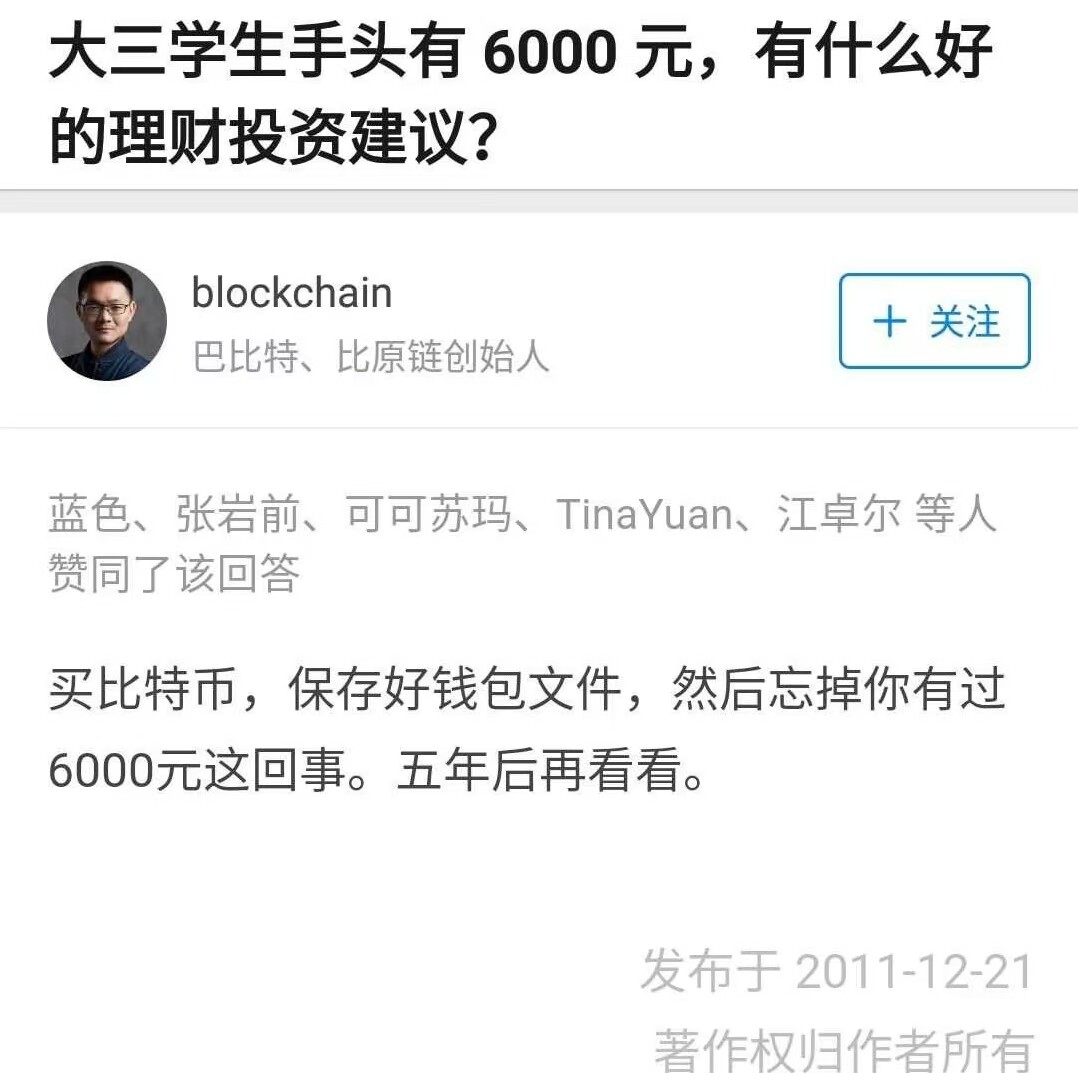
Chang Jia, who was ahead of the curve, once drew much criticism, but now the siphoning of the crypto circle by AI has become an indisputable fact. Talent is migrating, capital is being reallocated, and attention is shifting.

Talent Migration: OGs Are Becoming AI Bloggers

Another crypto OG, Shen Yu, co-founder and CEO of Cobo, is also a representative figure in the early Bitcoin mining circle. As a survivor of multiple cycles, Shen Yu often shares his understanding of market phases and investment insights on social media, which is well-received in the crypto community.

However, recently, Shen Yu has transformed from a crypto OG into an AI blogger. Over the past month, over 80% of his social media content has been about OpenClaw, with very little related to crypto. Shen Yu himself has jokingly claimed a successful transformation.

Shen Yu's exploration and focus on AI remain at a personal level, as his company's business and personal career are still primarily crypto-focused. Therefore, we can temporarily interpret his obsession with AI as a good habit of actively improving himself and keeping up with the cutting edge during "market garbage time." However, the migration of talent from crypto to AI is indeed happening.

Anthony Rose, an executive at zkSync, announced on February 4 that after working at Matter Labs for four years, he would leave and likely turn to AI. Nader Dabit, Developer Advocacy Director at EigenLayer, also announced on February 5 that he was leaving EigenLayer to become Growth Lead at an AI company, stating that "he joined the future."

The most notable recent example of leaving the circle is Multicoin Capital co-founder Kyle Samani announcing his departure from crypto to focus on AI, robotics, and other fields. Kyle Samani is known for his early bet on Solana, so his exit dealt a blow to the crypto community's confidence. Even more离谱的是, on the day he left, Kyle Samani disparaged the crypto industry, saying, "Crypto just isn't as interesting as many people (including myself) once thought."

Recommended reading: "Is There More to Kyle Samani's Exit?"

Capital Migration: Native Crypto VCs Begin Allocating to AI

Native crypto VCs are also unwilling to waste more time on the crypto industry.

On February 28, according to the Wall Street Journal, crypto venture capital firm Paradigm is planning to raise a new fund focused on AI and robotics, with a target size of up to approximately $1.5 billion. Paradigm is one of the purest crypto-native capitals. It gained fame in 2019 by investing in and incubating Uniswap. Subsequent early investments in other crypto projects (such as Lido, Optimism, dYdX, Blur) were also successful, making this "research-driven" VC an institution on par with a16z crypto.

Precisely because of this, Paradigm's shift is of symbolic significance.

If crypto were still in a period of rapid innovation, continuously generating projects capable of bearing billion-dollar-level investments, Paradigm would not need to establish a heavily weighted fund specifically for AI. But the reality is that the infrastructure narrative in the crypto industry (e.g., L1, L2, DEX, etc.) is highly saturated, and the number of truly "paradigm-shifting" quality early-stage projects is few and far between.

The entire crypto VC sector has few good projects to invest in. The data is more直观: over the past four years, the number of venture capital deals in the crypto industry has declined year by year. In 2022, there were 1,639 financing deals in the crypto primary market, which dropped to 829 deals in 2025, with the proportion of early-stage financing also falling from 50% to below 35%.
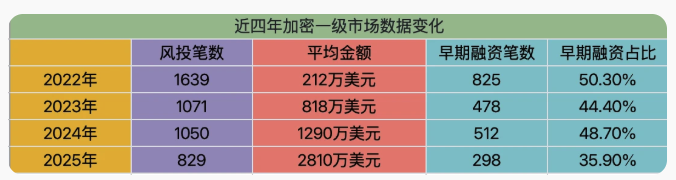
Source: What Can the Crypto Market Still Trade in a Year?

When there's nothing left to invest in within the crypto industry, AI, as a booming sector, naturally becomes the best destination for crypto capital. From foundational large models to AI Agents, from computing power chips to the robotics industry, AI can not only absorb capital规模 but also continuously create growth stories, making it the largest reservoir for global capital today.

For a VC managing over $12.7 billion in assets, the core proposition is never "whether faith is shaken" but "whether the return function still holds." When the number of projects the crypto industry can support decreases, a sole focus on crypto means increased portfolio risk and reduced收益弹性. In this context, continuing to insist on being "crypto-native" becomes irrational.

Therefore, Paradigm's active expansion into AI is also forced by the trends of the times. This is not a strategic issue for个别机构 but a signal of the industry's stage.

Attention Migration: When Crypto Players Become Obsessed with AI

In terms of market attention, Crypto is an industry that is best at蹭热点. Whether it's political hotspots, technological frontiers, or social headlines, any火爆 event总能 find related hyped projects or Memes in the crypto circle. In the past, every time the AI industry experienced a technological upgrade or product innovation, the crypto circle would see related "Crypto+AI" projects or Meme coin speculation, attracting market attention.

After OpenClaw became popular, although the crypto circle immediately found angles to蹭, such as炒作同名 Meme coins, commanding OpenClaw to trade tokens automatically, and predicting markets to make bets for profit, crypto players later became more纯粹, shifting from "how to crypto-fy OpenClaw" to "how to actually use OpenClaw."

Many crypto researchers began continuously producing OpenClaw installation and usage tutorials, publicly sharing their AI workflows, even detailing how to train personal AI Agents to help write code, conduct research, generate content, etc. Some crypto KOLs even started side businesses charging fees to install OpenClaw for beginners.

Offline AI exchange events organized by the crypto circle are also "packed." Recently, the most popular offline event was the "Web4 China Tour" promoted by crypto OG Kong Jianping. The event ran from February 25 to March 8, held offline in five Chinese cities, with main topics being OpenClaw and Agent,几乎没有加密相关.

This is no longer蹭热点 but a genuine migration of attention. Crypto players who pride themselves on progressive thinking are开始害怕 falling behind in the AI era.

Crypto circle AI offline event现场座无虚席

Why are crypto practitioners so obsessed with AI?

The crypto circle inherently has the highest concentration of "super individuals," with many independent developers, traders, and content creators. These people naturally pursue improvements in tool efficiency to compensate for limitations in personal efficiency. Therefore, when AI can significantly amplify individual productivity, crypto players are among the first to embrace it.

Furthermore, the core of crypto culture has a strong geek spirit and technology worship. Although the "technology narrative" has been diluted in recent years, most crypto players still believe that "underlying technology can change the world." and如今 AI possesses more of a technological revolutionary气质 than blockchain, hence it naturally attracts the疯狂追捧 of crypto players.

Of course, the more realistic reason is the crypto market's idle period. AI is continuously creating "new things," while Crypto has been重组旧叙事. Without native crypto innovation, without significant wealth effects, the entire crypto circle is barely hanging on by a thread with the little externality brought by prediction markets and RWA. At this time, the new discussion topics and cognitive stimulation provided by the AI industry, rather than seizing crypto attention, are filling the spiritual void of crypto players after the market节奏放缓.

Time to Talk About Things Beyond Crypto and AI

Finally, returning to the beginning of this article, the reason the OpenClaw founder's statement caught the crypto circle's attention is not because it was dismissive, but because it vocalized what many crypto people are quietly验证 with their actions—the smartest people are重新分配 their time.

We are now facing a period of declining wealth generation rates and exploding technological productivity.

On one hand, as the crypto cycle slows, Alpha contracts, and wealth growth curves flatten, the marginal returns of the past year's behavior of simply "scraping information—chasing hotspots—gambling for returns" through枯坐 are diminishing for crypto players. On the other hand, AI is compressing the "time required to solve problems." Tasks that previously required significant time investments, such as writing code and creating content, can now be completed by models in minutes, with problem-solving efficiency far exceeding that of individual humans.

When the "process volume of seeking results" is highly concentrated by AI, then perhaps we反而拥有 more free time to do things not aimed at efficiency and making money—to seek "carbon-based meaning," to experience the world, to build cognitive systems independent of market fluctuations, and to construct our own value coordinates.

In the AI future, what will truly differentiate people might be aesthetics, independent judgment, and the construction of personal meaning.


Related Questions

QWhat was the controversial advice given by OpenClaw founder Peter Steinberger to young people, and why did it cause a stir in the crypto community?

APeter Steinberger advised young people to 'not waste time on cryptocurrency.' This caused a stir because it came from a prominent AI founder during a period of market stagnation, highlighting a perceived shift where crypto is no longer seen as the optimal path for young talent, which stung the industry's pride.

QAccording to the article, what are the three main areas where a significant migration from crypto to AI is occurring?

AThe three main areas of migration from crypto to AI are: 1. Talent Migration, with key figures and developers leaving crypto for AI; 2. Capital Migration, where native crypto VCs like Paradigm are raising new funds for AI; and 3. Attention Migration, where the community's focus is shifting from crypto-native projects to purely using and discussing AI tools.

QWhich prominent crypto venture capital firm is mentioned as planning to raise a new fund for AI and robotics, and what does this signify?

AThe crypto-native firm Paradigm is planning to raise a new fund of up to $1.5 billion for AI and robotics. This signifies a major strategic shift, indicating that the crypto industry may lack enough high-quality, 'paradigm-shifting' early-stage projects to invest in, forcing even dedicated crypto VCs to seek returns in the AI sector.

QHow does the article explain the change in how the crypto community engages with AI trend, specifically regarding OpenClaw?

AInitially, the crypto community tried to 'crypto-fy' AI trends like OpenClaw by creating related meme coins and speculative projects. However, the engagement has shifted towards purely using OpenClaw and other tools, with community members sharing detailed tutorials on installation, usage, and AI workflow optimization, indicating a genuine migration of attention rather than just蹭热点 (riding the hype).

QWhat underlying reason does the article suggest is causing crypto players to become so enamored with AI beyond just the hype?

ABeyond the hype, crypto players are drawn to AI because the crypto market is in a lull with little native innovation or significant wealth effect, while AI is continuously producing 'new things.' Furthermore, the community's inherent geek spirit and belief in foundational technology that can change the world find a stronger embodiment in current AI advancements than in crypto's recurring old narratives.

Related Reads

It Took Me a Year to See the Bitter Truth About Agent Payments

After a year building infrastructure for the Agent economy, engaging with major players like Stripe, Visa, and Coinbase, the author shares a sobering analysis of the current state of Agent payments. The core finding is a stark lack of genuine, immediate demand across most envisioned use cases. The article breaks down four key market segments: 1. **Agent-to-Merchant (Consumer Shopping):** For most product categories (e.g., clothing, electronics), conversational AI shopping is a step backwards from visual e-commerce interfaces. While agents excel at understanding needs, they can't replace side-by-side product comparison. Real merchant interest is defensive "Agent Engine Optimization," not driven by current customer demand. Potential exists for high-frequency, low-decision purchases (like food delivery) or navigating complex store UIs, but these require massive B2C distribution channels dominated by giants like Amazon. 2. **Agent-to-API (Developer Services):** Developers already have subscriptions and billing relationships for APIs (compute, data). Prepaid balances solve micro-payment issues for low transaction volumes. A deeper structural problem is that major SaaS vendors' business models rely on enterprise contracts, resisting granular pay-per-call pricing. While protocols like MPP and x402 serve the long tail of niche services, this market is small and developers are historically low-willingness-to-pay. 3. **Agent-to-Agent:** This remains largely theoretical with minimal transaction volume. While it represents a long-term bet on a fundamentally new transaction infrastructure (sub-second, micro-penny to million-dollar, multi-party settlements), it does not constitute a present market. 4. **Agent-to-Finance:** This is the only category with existing, paying demand. Integrating AI into financial workflows (trading, portfolio management) is a natural evolution and enables new capabilities like autonomous rebalancing. However, competition favors established, regulated institutions. The "real problem" is not moving money between agents, but the broader challenge of **coordination**—orchestrating work between agents and humans, verifying outcomes, and settling results. Payment is just one component of settlement, which is itself part of coordination. Companies that solve the coordination layer will subsume payment, not the other way around. While well-funded incumbents build defensively for a long-term future, startups must find where the market is today—which, for the author's team, lies outside these four categories in an area of real, growing, and underserved activity.

marsbit11m ago

It Took Me a Year to See the Bitter Truth About Agent Payments

marsbit11m ago

It Took Me a Year to See the Hard Truth About Agent Payments

**Title: It Took Me a Year to See the Hard Truth About Agent Payments** Over the past year, I've worked on infrastructure for the Agent economy, engaging with major players like Stripe, Visa, Coinbase, and numerous startups. The findings reveal a stark reality: genuine, widespread demand for Agent-based payments does not yet exist. **Key Observations:** * **Agent-to-Merchant (Shopping):** The user experience for AI shopping often falls short, especially for visual product discovery. While AI excels at understanding needs, conversational interfaces can't yet replace browsing and comparing multiple products visually. Current merchant interest is largely defensive ("Agent Engine Optimization") for a future that hasn't arrived. High-frequency, low-friction purchases (like food delivery) are potential fits, but lack open APIs and face high AI inference costs. Simpler, more affordable, or cross-language interactions for complex UIs are a niche opportunity but require massive consumer distribution to scale. * **Agent-to-API (Developer Tools):** Developer payment needs for APIs (computing, data, models) are already met through subscriptions and prepaid credits. The core challenge is not payment friction but supplier economics: most large SaaS providers prefer enterprise contracts over micropayments for API calls. Protocols like MPP and x402 suit the long-tail of smaller services but cater to a developer market historically reluctant to pay for these tools. Major infrastructure needs at the top of the stack are already being addressed. * **Agent-to-Agent (Machine Commerce):** This is a long-term vision with almost no current transaction volume. While a future with high-speed, high-frequency, multi-party machine-to-machine transactions would require novel infrastructure, it remains theoretical. The market is not here yet. * **Agent-to-Finance:** This is the only category with clear, present demand. Financial professionals and DeFi users already pay for tools, and AI augmentation is a natural evolution. Autonomous AI agents can enable entirely new financial strategies. However, competition is fierce from established, regulated incumbents who can more easily layer AI onto their existing products. **The Core Insight:** Companies, especially giants with long time horizons, are building defensively for a potential future of mass machine commerce. For them, early investment is a low-cost hedge. For startups, the current market reality is different. The primary challenge isn't just moving money between agents (payments). The larger, unsolved problem is **orchestration** – coordinating work between agents and humans, verifying outcomes, and then settling. Payment is just a part of settlement, which is just a part of orchestration. Companies that solve the orchestration problem will subsume payments, not the other way around. After a year of building, we see the real, growing, and underserved market opportunity lies in this broader domain of orchestration.

链捕手35m ago

It Took Me a Year to See the Hard Truth About Agent Payments

链捕手35m ago

Claude Opus 4.8 Finds a $4.5 Billion Bug: The AI Era is Mass-Producing Hackers

A researcher discovered a critical "infinite mint" vulnerability in the Zcash cryptocurrency's Orchard protocol using Claude Opus 4.8, leading to a swift fix but also a 50% market drop, erasing billions in value. This incident highlights a new era where powerful, accessible AI models are dramatically lowering the barrier to finding software vulnerabilities. Previously, the security community feared specialized models like Claude Mythos Preview, capable of finding decades-old zero-day exploits. The Zcash case, however, involved a publicly available, general-purpose model. This shift makes advanced security auditing—and attack capabilities—accessible to far more people, not just experts. The mass democratization of vulnerability discovery brings a dual challenge: a flood of low-quality, AI-generated false reports that overwhelm maintainers, and the real, rapid uncovering of deep, dangerous bugs. Open-source projects, often understaffed and unfunded, are particularly vulnerable to this "attention DDoS." The article cites examples like curl shutting down its bug bounty program due to the unsustainable workload. Our perceived digital safety has often been luck, relying on the high cost and effort required to find deeply hidden flaws in complex systems, as seen with historical vulnerabilities like Heartbleed or Baron Samedit. AI changes this cost structure, effectively "mass-producing flashlights" to illuminate every corner of our codebase. While large companies operate extensive security chains involving external white-hat hackers and massive defensive operations, the global cybersecurity workforce faces a severe shortage, especially of experienced personnel capable of analyzing complex threats and coordinating fixes. The core dilemma emerges: AI makes *finding* bugs cheap and scalable, but *fixing* them remains a slow, expensive, and human-intensive process. The article concludes that AI won't destroy the internet but acts as a bright light, revealing that our digital existence is not inherently secure but is precariously maintained by ongoing human effort. The true cost in the AI era may not be discovery, but whether there will be enough people left willing and able to do the hard work of repair.

marsbit1h ago

Claude Opus 4.8 Finds a $4.5 Billion Bug: The AI Era is Mass-Producing Hackers

marsbit1h ago

Codex Goal Mode Usage Guide: How to Make AI Continuously Pursue a Specific Objective

"Codex Goal Mode: How to Make AI Work Continuously Toward a Specific Goal" OpenAI's Codex "goal mode" (/goal) transforms the AI from a reactive code assistant into a proactive execution agent capable of working autonomously for hours or even days to achieve a defined objective. To maximize its effectiveness, follow these key principles: 1. **Define Clear, Verifiable Exit Criteria:** The goal prompt should be a concise, measurable success condition, not a lengthy specification. Use quantifiable metrics like "reduce build time by 30%" or "achieve 100% test parity." 2. **Provide Initial Guidance and Tools:** Direct Codex toward likely problem areas and specify available tools (e.g., browsers, testing environments) to prevent it from exploring unproductive paths. 3. **Enable Progress Measurement:** Equip Codex with ways to track advancement, such as creating comparison tools for visual tasks or evaluation sets, ensuring it can gauge its own progress. 4. **Use a Realistic Execution Environment:** For tasks like performance optimization, provide access to environments that closely mimic production (e.g., similar configs, databases) to yield valid results. 5. **Be Cautious with Visual Goals:** Avoid vague "pixel-perfect" instructions. Instead, supplement visual references with functional checklists or design system specifications to prevent Codex from obsessing over minor details. 6. **Implement Progress Tracking:** For long-running tasks, have Codex commit code to draft PRs, update progress documents, or send Slack updates to maintain visibility into its work. 7. **Review and Consolidate Results:** Once the goal is met, instruct Codex to review its work, clean up ineffective experimental code, and reflect on what strategies succeeded or failed. Ultimately, using goal mode shifts the developer's role from writing prompts to managing a persistent engineering agent—defining objectives, establishing metrics, configuring environments, and conducting final reviews.

marsbit2h ago

Codex Goal Mode Usage Guide: How to Make AI Continuously Pursue a Specific Objective

marsbit2h ago

Trading

Spot
Futures

Hot Articles

How to Buy PEOPLE

Welcome to HTX.com! We've made purchasing ConstitutionDAO (PEOPLE) simple and convenient. Follow our step-by-step guide to embark on your crypto journey.Step 1: Create Your HTX AccountUse your email or phone number to sign up for a free account on HTX. Experience a hassle-free registration journey and unlock all features.Get My AccountStep 2: Go to Buy Crypto and Choose Your Payment MethodCredit/Debit Card: Use your Visa or Mastercard to buy ConstitutionDAO (PEOPLE) instantly.Balance: Use funds from your HTX account balance to trade seamlessly.Third Parties: We've added popular payment methods such as Google Pay and Apple Pay to enhance convenience.P2P: Trade directly with other users on HTX.Over-the-Counter (OTC): We offer tailor-made services and competitive exchange rates for traders.Step 3: Store Your ConstitutionDAO (PEOPLE)After purchasing your ConstitutionDAO (PEOPLE), store it in your HTX account. Alternatively, you can send it elsewhere via blockchain transfer or use it to trade other cryptocurrencies.Step 4: Trade ConstitutionDAO (PEOPLE)Easily trade ConstitutionDAO (PEOPLE) on HTX's spot market. Simply access your account, select your trading pair, execute your trades, and monitor in real-time. We offer a user-friendly experience for both beginners and seasoned traders.

7.0k Total ViewsPublished 2024.03.29Updated 2026.06.02

How to Buy PEOPLE

Discussions

Welcome to the HTX Community. Here, you can stay informed about the latest platform developments and gain access to professional market insights. Users' opinions on the price of PEOPLE (PEOPLE) are presented below.

活动图片