What’s Behind Bitcoin’s Drop To $81K? Glassnode Provides On-Chain Insights

bitcoinistPublished on 2026-01-31Last updated on 2026-01-31

Abstract

Following a brief rebound to $90,000, Bitcoin experienced a sharp decline to $81,000, driven by several on-chain factors. According to Glassnode, long-term holders distributed an average of 12,000 BTC daily over the past month, creating significant selling pressure. This was compounded by net outflows from US spot Bitcoin ETFs, reducing institutional demand to absorb the sell-off. Miners also contributed by consistently sending BTC to exchanges, indicating structural weakness. Additionally, over $300 million in long positions were liquidated, amplifying downside momentum. With subdued spot demand and defensive options market sentiment, Bitcoin faces challenges below key resistance levels until significant demand returns. Currently, Bitcoin trades at $84,095, up over 1% in 24 hours.

Following a brief price rebound from $86,000 to $90,000 early in the week, it appeared that Bitcoin was experiencing its routine movement within the consolidation range. However, the market is on edge with curiosity about what is happening with the flagship cryptocurrency, especially after its swift decline to $81,000. A couple of fresh on-chain perspectives have emerged, delving into the underlying dynamics of the BTC market.

On-Chain Signals Behind Bitcoin’s Bearish Move

In a recent post on the social media platform X, crypto analytics firm Glassnode outlined a confluence of on-chain events justifying Bitcoin’s impulsive move to the downside. The analysis began with results from the Spent Volume by LTH/STH metric.

This metric has shown that, over the past 30 days, Bitcoin’s Long-term holders have been heavily distributing their share of BTC. According to Glassnode’s data, over 12,000 BTC per day (on average) has been distributed over the past 30 days — an equivalent of 370,000 BTC per month. Expectedly, distributing large amounts of BTC, in turn, reflected on the price as considerable selling pressure.

However, distribution among LTHs is not the only event that happened; US spot Bitcoin ETFs also added to the bearish setup, as they have recorded multiple net outflows over the past few weeks. This means that there has been less institutional demand to cushion the LTH sell-off.
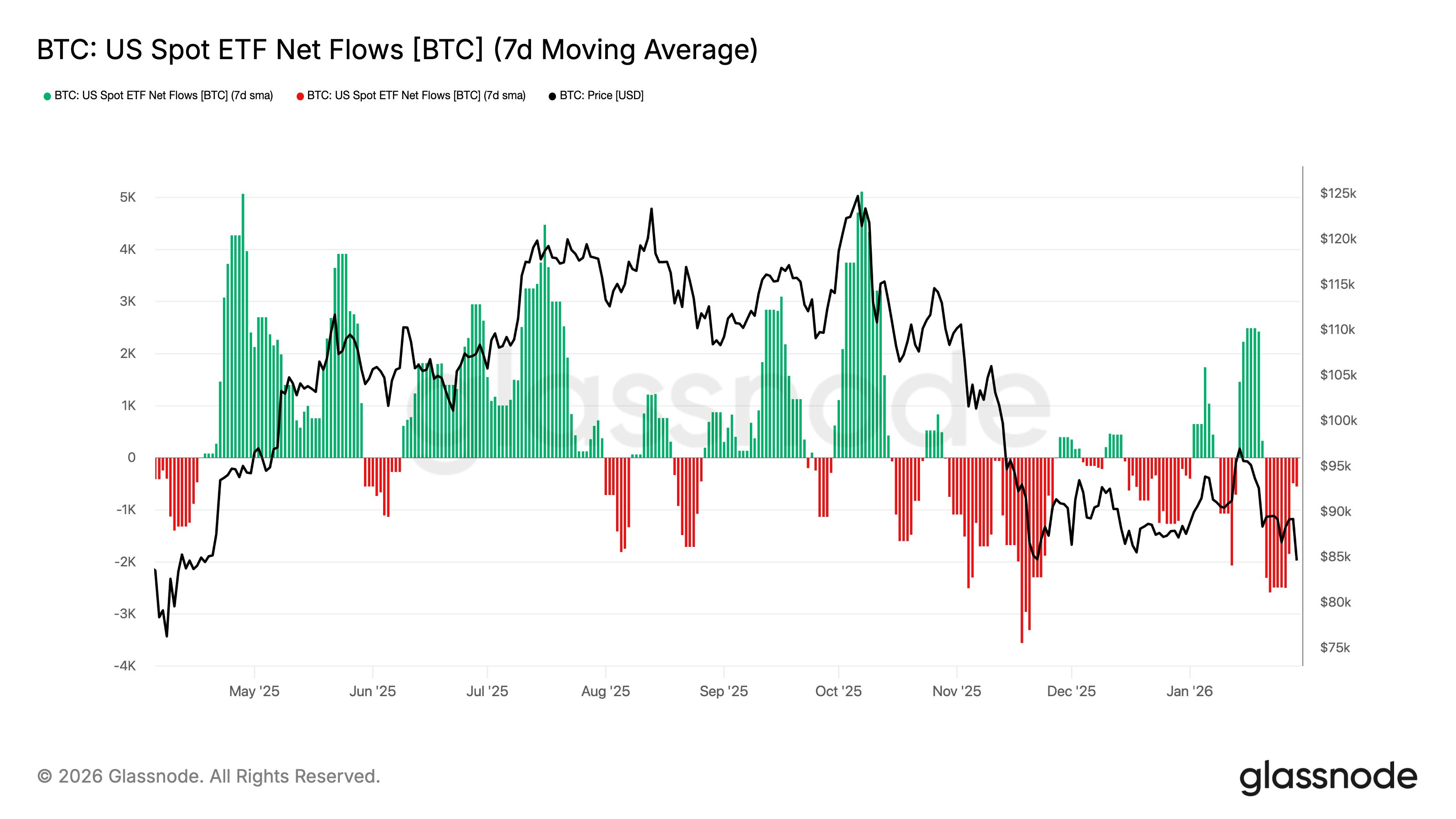
Source: @glassnode on X

When demand gaps appear amid ongoing LTH-selloffs, the BTC price can be expected to fall freely, especially in the event that bearish momentum enters the market. Hence, this could have played a role in the recent move to the downside.

The long-term holders are not the only ones who sold; the Net Transfer Volume From/To Miners metric shows that Bitcoin’s miner behavior also reinforces the weakness of the market structure. Glassnode reported that miners have been consistently sending their BTC to exchanges, adding to the structural bearish pressure, as positive exchange inflows often signal growing interest in offloading assets.

Derivatives market dynamics also played their role in intensifying the BTC price decline. As the flagship cryptocurrency lost its previous footing, there was a wave of long liquidations that followed suit. Glassnode highlighted that more than $300 million was liquidated in this move. When long positions are forcefully closed, as in this cycle, downside momentum is usually amplified, further pushing prices downwards.

With options market defensive rather than optimistic in their speculation, and spot demand subdued, it is safe to conclude that the Bitcoin market stands at a critical phase. Until significant demand enters the market, it is likely that Bitcoin may face troubles beneath key resistance levels in the days to come.

Bitcoin Price At A Glance

At the time of writing, Bitcoin is valued at $84,095, reflecting an over 1% price jump in the past 24 hours.

The price of BTC on the daily timeframe | Source: BTCUSDT chart on TradingView


Related Questions

QWhat are the main on-chain factors behind Bitcoin's recent drop to $81,000 according to Glassnode?

AAccording to Glassnode, the main on-chain factors are: heavy distribution by Long-Term Holders (over 12,000 BTC per day), net outflows from US spot Bitcoin ETFs reducing institutional demand, miners sending BTC to exchanges, and a wave of long liquidations in the derivatives market amplifying the downward momentum.

QHow much Bitcoin have Long-Term Holders (LTHs) been distributing on average per day over the past 30 days?

ALong-Term Holders have been distributing over 12,000 BTC per day on average over the past 30 days, which is equivalent to 370,000 BTC per month.

QWhat role did Bitcoin miners play in the recent market weakness?

AMiners reinforced the market's weakness by consistently sending their BTC to exchanges, which added to the structural bearish pressure, as positive exchange inflows often signal a growing interest in selling assets.

QHow much was the value of long positions liquidated during this price decline?

AMore than $300 million in long positions were liquidated during this price decline.

QWhat was Bitcoin's price at the time of writing, and what was its 24-hour performance?

AAt the time of writing, Bitcoin price was $84,095, reflecting an over 1% price increase in the past 24 hours.

Related Reads

How Many Tokens Away Is Yang Zhilin from the 'Moon Chasing the Light'?

The article explores the intense competition between two leading Chinese AI companies, DeepSeek and Kimi (Moon Dark Side), and the mounting pressure on Yang Zhilin, the founder of Kimi. While DeepSeek re-emerged after 15 months of silence with its powerful V4 model—boasting 1.6 trillion parameters and low-cost, long-context capabilities—Kimi has been focusing on long-context processing and multi-agent systems with its K2.6 model. Yang faces a threefold challenge: technological rivalry, commercialization pressure, and investor expectations. Despite Kimi’s high valuation (reaching $18 billion), its revenue heavily relies on a single product with low paid conversion rates, while DeepSeek’s strategic silence and open-source influence have strengthened its market position and valuation prospects, now targeting over $20 billion. Both companies reflect broader trends in China’s AI ecosystem: Kimi aims for global influence through open-source contributions and agent-based advancements, while DeepSeek prioritizes foundational innovation and hardware independence, notably shifting to Huawei’s chips. Their competition is seen as vital for China’s AI progress, with the gap between top Chinese and U.S. models narrowing to just 2.7% on the Elo rating scale. Ultimately, the article argues that this rivalry, though anxiety-inducing for leaders like Zhilin, is essential for driving innovation and solidifying China’s role in the global AI landscape.

marsbit2h ago

How Many Tokens Away Is Yang Zhilin from the 'Moon Chasing the Light'?

marsbit2h ago

TechFlow Intelligence Bureau: ChatGPT Helps Amateur Mathematician Crack 60-Year-Old Problem, CFTC Sues New York Regulator Over Coinbase and Gemini

An amateur mathematician, with the assistance of ChatGPT, has solved a combinatorial mathematics puzzle originally proposed by Hungarian mathematician Paul Erdős in the 1960s. This marks another milestone in AI-aided mathematical research, demonstrating the evolving capabilities of large language models in formal reasoning. In other AI developments, OpenAI introduced a new privacy filter tool for enterprise API usage, automatically screening sensitive data. Meanwhile, the Qwen3.6-27B model achieved 100 tokens per second on a single RTX 5090 GPU using quantization, significantly lowering the cost barrier for local AI deployment. In crypto and Web3, the U.S. CFTC sued New York’s financial regulator, challenging its oversight of Coinbase and Gemini—a first-of-its-kind federal-state regulatory clash. Following a vulnerability, KelpDAO and major DeFi protocols established a recovery fund. Tether froze $344 million in assets linked to Iran’s central bank upon U.S. Treasury request, highlighting the centralized control risks in stablecoins. Separately, Litecoin underwent a 3-hour chain reorganization to undo a privacy-layer exploit. In the U.S., former President Trump invoked the Defense Production Act to address power grid bottlenecks affecting AI data centers and dismissed the entire National Science Board, raising concerns over research independence. A retail trader gained 250% on a $600k Intel options bet amid AI-related speculation. Xiaomi announced its first performance electric vehicle, targeting rivals like Tesla. Meanwhile, iPhone users reported devices automatically reinstalling a hidden app daily, suspected to be MDM-related. A Chinese securities report noted that A-share institutional crowding has reached its second-longest streak since 2007, signaling high valuations and potential style rotation. The day’s developments reflect a dual narrative: AI is enabling unprecedented individual breakthroughs, while centralized power structures—whether governmental or corporate—are becoming more assertive, underscoring that decentralization is as much a political-economic challenge as a technical one.

marsbit2h ago

TechFlow Intelligence Bureau: ChatGPT Helps Amateur Mathematician Crack 60-Year-Old Problem, CFTC Sues New York Regulator Over Coinbase and Gemini

marsbit2h ago

Trading

Spot
Futures

Hot Articles

Discussions

Welcome to the HTX Community. Here, you can stay informed about the latest platform developments and gain access to professional market insights. Users' opinions on the price of S (S) are presented below.

活动图片