What’s Behind Bitcoin’s Drop To $81K? Glassnode Provides On-Chain Insights

bitcoinistPublished on 2026-01-31Last updated on 2026-01-31

Abstract

Following a brief rebound to $90,000, Bitcoin experienced a sharp decline to $81,000, driven by several on-chain factors. According to Glassnode, long-term holders distributed an average of 12,000 BTC daily over the past month, creating significant selling pressure. This was compounded by net outflows from US spot Bitcoin ETFs, reducing institutional demand to absorb the sell-off. Miners also contributed by consistently sending BTC to exchanges, indicating structural weakness. Additionally, over $300 million in long positions were liquidated, amplifying downside momentum. With subdued spot demand and defensive options market sentiment, Bitcoin faces challenges below key resistance levels until significant demand returns. Currently, Bitcoin trades at $84,095, up over 1% in 24 hours.

Following a brief price rebound from $86,000 to $90,000 early in the week, it appeared that Bitcoin was experiencing its routine movement within the consolidation range. However, the market is on edge with curiosity about what is happening with the flagship cryptocurrency, especially after its swift decline to $81,000. A couple of fresh on-chain perspectives have emerged, delving into the underlying dynamics of the BTC market.

On-Chain Signals Behind Bitcoin’s Bearish Move

In a recent post on the social media platform X, crypto analytics firm Glassnode outlined a confluence of on-chain events justifying Bitcoin’s impulsive move to the downside. The analysis began with results from the Spent Volume by LTH/STH metric.

This metric has shown that, over the past 30 days, Bitcoin’s Long-term holders have been heavily distributing their share of BTC. According to Glassnode’s data, over 12,000 BTC per day (on average) has been distributed over the past 30 days — an equivalent of 370,000 BTC per month. Expectedly, distributing large amounts of BTC, in turn, reflected on the price as considerable selling pressure.

However, distribution among LTHs is not the only event that happened; US spot Bitcoin ETFs also added to the bearish setup, as they have recorded multiple net outflows over the past few weeks. This means that there has been less institutional demand to cushion the LTH sell-off.
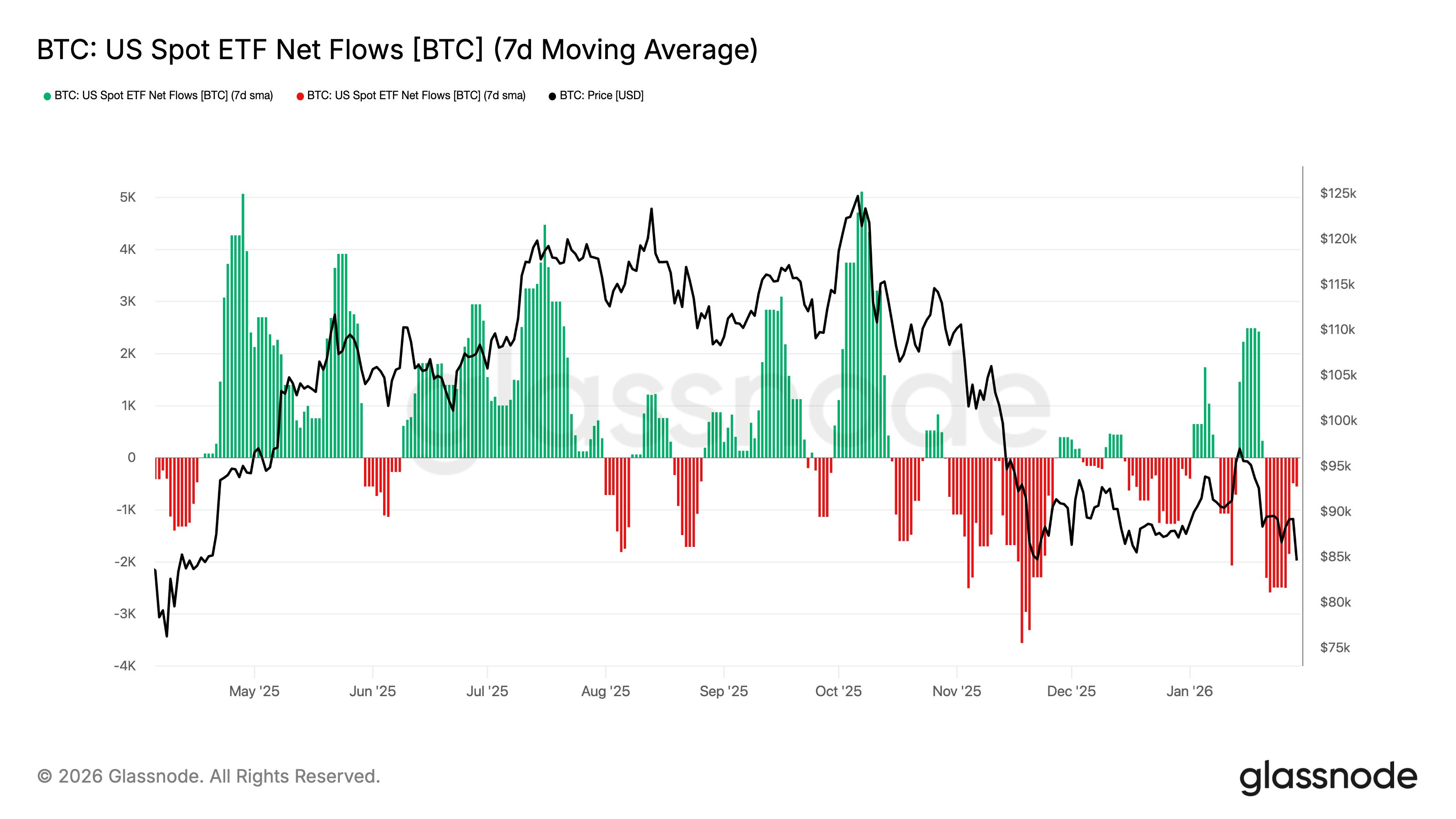
Source: @glassnode on X

When demand gaps appear amid ongoing LTH-selloffs, the BTC price can be expected to fall freely, especially in the event that bearish momentum enters the market. Hence, this could have played a role in the recent move to the downside.

The long-term holders are not the only ones who sold; the Net Transfer Volume From/To Miners metric shows that Bitcoin’s miner behavior also reinforces the weakness of the market structure. Glassnode reported that miners have been consistently sending their BTC to exchanges, adding to the structural bearish pressure, as positive exchange inflows often signal growing interest in offloading assets.

Derivatives market dynamics also played their role in intensifying the BTC price decline. As the flagship cryptocurrency lost its previous footing, there was a wave of long liquidations that followed suit. Glassnode highlighted that more than $300 million was liquidated in this move. When long positions are forcefully closed, as in this cycle, downside momentum is usually amplified, further pushing prices downwards.

With options market defensive rather than optimistic in their speculation, and spot demand subdued, it is safe to conclude that the Bitcoin market stands at a critical phase. Until significant demand enters the market, it is likely that Bitcoin may face troubles beneath key resistance levels in the days to come.

Bitcoin Price At A Glance

At the time of writing, Bitcoin is valued at $84,095, reflecting an over 1% price jump in the past 24 hours.

The price of BTC on the daily timeframe | Source: BTCUSDT chart on TradingView


Related Questions

QWhat are the main on-chain factors behind Bitcoin's recent drop to $81,000 according to Glassnode?

AAccording to Glassnode, the main on-chain factors are: heavy distribution by Long-Term Holders (over 12,000 BTC per day), net outflows from US spot Bitcoin ETFs reducing institutional demand, miners sending BTC to exchanges, and a wave of long liquidations in the derivatives market amplifying the downward momentum.

QHow much Bitcoin have Long-Term Holders (LTHs) been distributing on average per day over the past 30 days?

ALong-Term Holders have been distributing over 12,000 BTC per day on average over the past 30 days, which is equivalent to 370,000 BTC per month.

QWhat role did Bitcoin miners play in the recent market weakness?

AMiners reinforced the market's weakness by consistently sending their BTC to exchanges, which added to the structural bearish pressure, as positive exchange inflows often signal a growing interest in selling assets.

QHow much was the value of long positions liquidated during this price decline?

AMore than $300 million in long positions were liquidated during this price decline.

QWhat was Bitcoin's price at the time of writing, and what was its 24-hour performance?

AAt the time of writing, Bitcoin price was $84,095, reflecting an over 1% price increase in the past 24 hours.

Related Reads

Not Speculation but a Necessity: The 4 Unique Values of Prediction Markets

Polymarket's recent $4 billion funding round and soaring valuation of $15 billion highlight the explosive growth of prediction markets, with trading volume reaching $25.7 billion in March 2026—a 10.6% monthly increase. This analysis argues that prediction markets serve critical non-speculative functions, positioning them as essential tools rather than mere gambling platforms. Prediction markets offer four unique values: entertainment consumption, insurance-like protection, risk hedging, and truth discovery. Firstly, they stimulate economic activity by engaging users in event-based betting, similar to the broader sports industry. Secondly, they act as a form of decentralized insurance, allowing users to hedge against specific, well-defined risks (e.g., weather events) transparently and without traditional overhead costs. Thirdly, institutions and individuals use these markets to hedge against geopolitical and commodity price risks, as demonstrated during the U.S.-Iran conflict and the launch of 24/7 commodity markets on platforms like Kalshi. Finally, prediction markets counter media bias by aggregating crowd-sourced information, often achieving 30% higher accuracy than surveys due to users' vested interests. Experts like Bitwise’s Jeff Park and SIG’s Jeff Yass emphasize the markets' role in risk transfer and financial innovation. As these platforms evolve, they are poised to become trillion-dollar markets, offering more reliable, decentralized mechanisms for information pricing and risk management.

marsbit2h ago

Not Speculation but a Necessity: The 4 Unique Values of Prediction Markets

marsbit2h ago

Trading

Spot
Futures

Hot Articles

Discussions

Welcome to the HTX Community. Here, you can stay informed about the latest platform developments and gain access to professional market insights. Users' opinions on the price of S (S) are presented below.

活动图片