US, UK Advance Stablecoin Rules as GENIUS Act Moves Into Implementation

TheNewsCryptoPublished on 2026-08-05Last updated on 2026-08-05

Abstract

US and UK regulators held a high-level meeting in London to advance stablecoin regulations and promote international cooperation. The 13th session of the Financial Regulatory Working Group, involving officials from both countries' treasuries, central banks, and major financial regulators, focused on aligning principles rather than proposing specific rules. Discussions centered on implementing the US's GENIUS Act to establish a federal framework for payment stablecoins and the UK's progress on its Wholesale Financial Markets Digital Strategy. Both nations committed to responsible digital asset development, consumer protection, and supporting stablecoins backed one-for-one with liquid assets. The Bank of England has relaxed certain proposed stablecoin rules, including removing individual holding limits and setting a temporary annual issuance cap of £40 billion for systemic stablecoins. It also adjusted reserve requirements, allowing a higher proportion to be held in UK government bonds, bringing the UK's approach closer to a new transatlantic regulatory alignment.

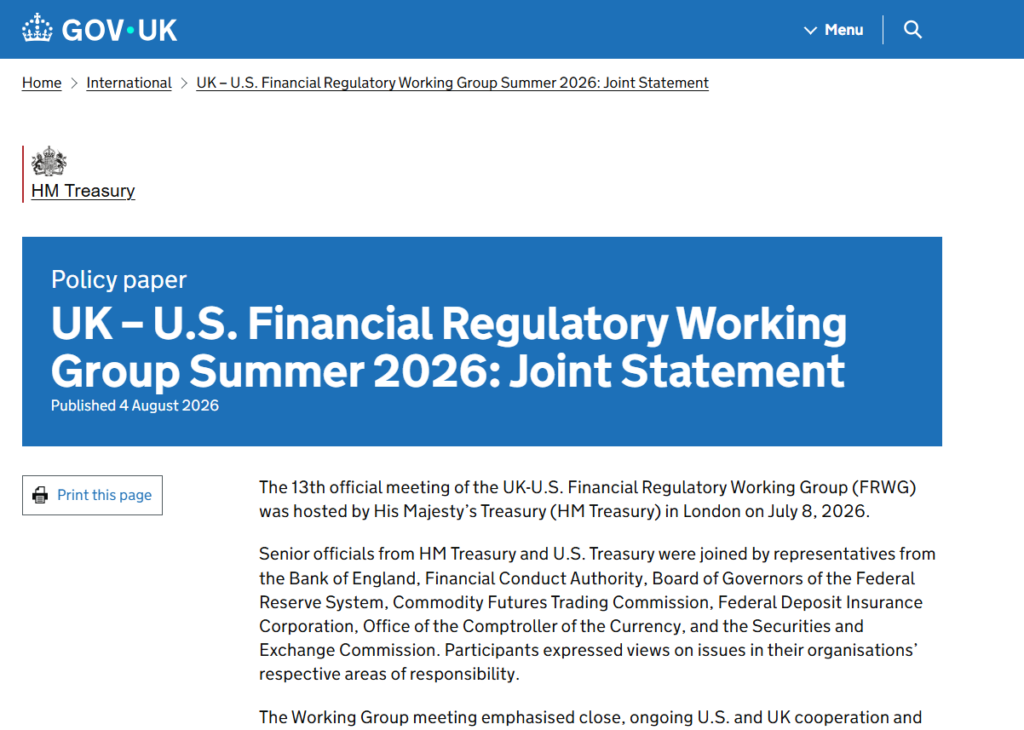
The two countries have been ramping up their efforts related to the regulation of stablecoins because both countries are in the process of refining their regulations concerning digital assets. A delegation from HM Treasury and US Treasury met in London on July 8 for the 13th session of the Financial Regulatory Working Group between the UK and US. The participants in this meeting included members from the Bank of England, FCA, Federal Reserve, SEC, CFTC, FDIC, and OCC. No proposals of rules were made in this meeting, only alignment of regulatory principles.
Stablecoins Go from Law to International Cooperation

Digital finance continued to be at the heart of the London summit of US and UK regulators. Where US regulators provided an update on the implementation of the GENIUS Act. This introduces the federal framework for payment stablecoins, as well as broader digital assets market reform. The British regulators provided information on the progress made in the development of Wholesale Financial Markets Digital Strategy, as well as the designation of Christopher Woolard as Wholesale Digital Markets Champion.

The regulators also discussed tokenization, payment innovations, and G20 Cross-Border Payments Roadmap. Both countries confirmed their commitment to responsible development of digital assets and consumer protection and financial stability in this area. At the same time, they support stablecoins backed one-for-one with liquid assets.

Restrictions Relaxed by Bank of England

Although the UK is still working on its stablecoin regulations, the Bank of England has already made some changes based on consultations with the industry. For instance, it decided to abandon the initial proposal to place limits on the number of coins an individual user could hold. Moreover, the Bank of England decided to implement a temporary cap on issuance of systemic stablecoins at £40 billion per year.

In addition, it changed the proportion of assets that should be kept as non-interest-bearing deposits at central banks. Initially, it was proposed to hold 40% of assets in this way; now the amount is 30%. Thus, 70% of reserves could be held in UK government bonds. These regulatory changes make the UK closer to the new transatlantic approach to stablecoin regulation.

Highlighted Crypto News:
FBI Agent Charged in $1M Crypto Theft After Allegedly Using ChatGPT to Plan Escape


TagsBlockchainCryptocurrencyGENIUSGenius ACTStablecoinstablecoinsU.SU.S.UKUK CRYPTO

Trending Cryptos

Related Questions

QWhat was the main purpose of the meeting between the US and UK financial regulatory working groups in London on July 8?

AThe meeting aimed to align regulatory principles concerning digital assets and stablecoins, not to propose specific new rules.

QWhat key US legislative development did regulators discuss regarding stablecoins at the London summit?

AUS regulators provided an update on the implementation of the GENIUS Act, which establishes a federal framework for payment stablecoins and broader digital assets market reform.

QWhat specific changes has the Bank of England made to its proposed stablecoin regulations based on industry consultations?

AThe Bank of England abandoned proposed limits on individual user holdings, set a temporary annual issuance cap of £40 billion for systemic stablecoins, and reduced the required proportion of non-interest-bearing deposits at central banks from 40% to 30% of reserves.

QAccording to the article, what common commitment did both the US and UK confirm in the area of digital assets?

ABoth countries confirmed their commitment to the responsible development of digital assets, consumer protection, financial stability, and support for stablecoins backed one-for-one with liquid assets.

QWhat role was Christopher Woolard designated to play in the UK's digital finance strategy?

AChristopher Woolard was designated as the Wholesale Digital Markets Champion in the UK.

Related Reads

Avalanche Price Forecast for August 2026: Can AVAX Break Above $7 When Kenya Launches on the Network?

Avalanche (AVAX) Price Forecast for August 2026: Key Factors and Levels Avalanche (AVAX) is trading at $6.782 on August 4, showing signs of a potential breakout after consolidating between $5.50 and $7 since June. The price has recently moved above its 20-day and 50-day EMAs, with the Parabolic SAR turning bullish for the first time in months. Key resistance levels are $7 (range top), $7.483 (100-day EMA), and $9.368 (200-day EMA). Support lies at $6.775 (50-day EMA), $6.532 (20-day EMA), $6.040 (Parabolic SAR), and $5.50 (range bottom). Historically, August is AVAX's strongest month with an average return of +25.1%, though median returns are more modest. The token enters August from a low base after a significant June sell-off. Fundamentally, the network is seeing increased institutional adoption. Kenya's National Examinations Council (KNEC) has placed over 15 million academic records on Avalanche. Other developments include Securitize tokenizing ~$300M, Progmat migrating $2.7B+ in securities, Aave V4 expanding to Avalanche, and Hyundai launching a stablecoin payment pilot. The Avalanche Payments Collective has also launched with 29 members. The weekly forecast suggests a range between $6.60-$8.50 for the month, with a close above the 100-day EMA at $7.483 being a key bullish target. The bearish risk involves a rejection at $7 and a fall back towards the $5.50 range low. The progress of the U.S. CLARITY Act by August 7 is noted as a potential macro catalyst.

cryptonews.ru4m ago

Avalanche Price Forecast for August 2026: Can AVAX Break Above $7 When Kenya Launches on the Network?

cryptonews.ru4m ago

The Ethereum Community Is in an Uproar! Who Stands to Lose with EIP-8363?

The Ethereum community is deeply divided over the controversial EIP-8363 proposal, which aims to introduce a "tapered issuance burn" to curb the growth of ETH staking. Authored by researchers including Jérôme de Tychey and Justin Drake, the proposal would gradually reduce and eventually eliminate the consensus-layer issuance rewards for validators when the total staked ETH approaches 50% of the total supply (approximately 60.25 million ETH). This is intended to discourage excessive staking concentration among large institutional providers and reduce the dilution pressure on non-staking ETH holders, potentially strengthening native ETH as a neutral asset. Currently, even at 100% staking, validators have a theoretical minimum reward of about 1.5%. EIP-8363 would implement a burn mechanism based on the staking ratio, making net consensus rewards approach zero at the 50% threshold, though execution-layer rewards (priority fees, MEV) remain unaffected. At the current ~33% staking ratio, annual consensus yield would drop from ~2.6% to ~1.2%. An 18-month transition period is proposed to soften the impact. The community reaction has been largely negative. Critics, including Aave founder Stani Kulechov and ether.fi CEO Mike Silagadze, argue it undermines predictable cash flows for institutional investors, hurts solo stakers by making their operations less viable against fixed costs, and could destabilize the DeFi ecosystem built around Liquid Staking Tokens (LSTs). They also fear it could lead to further centralization, as low rewards might push out small validators while large, cost-insensitive entities remain. Supporters counter that it addresses long-term security and dilution concerns. The proposal is currently an early-stage Core EIP draft under review and has not yet been officially included in the upcoming Hegotá upgrade. The debate highlights a fundamental tension within Ethereum: balancing ETH's roles as a yield-generating "internet bond" versus a neutral store of value.

marsbit7m ago

The Ethereum Community Is in an Uproar! Who Stands to Lose with EIP-8363?

marsbit7m ago

US Senators Target Wildfire Betting in New Push Against CFTC Rules

A group of nine U.S. senators has urged the Commodity Futures Trading Commission (CFTC) to restrict wildfire prediction contracts, arguing they allow traders to profit from disasters. In an August 3rd letter led by Sen. Jeff Merkley (D-Ore.), the lawmakers requested answers from CFTC Chair Rostin Behnam by August 14th. The senators, representing states impacted by recent wildfires, expressed concern that betting on fires' duration, spread, or property damage trivializes community suffering and creates a perverse incentive for arson. They cited over $1.2 million in trading volume on contracts related to California's Palisades and Eaton fires on the Polymarket platform as a catalyst for their inquiry. While acknowledging no confirmed cases of arson linked to such markets, the letter draws a parallel to insider trading risks. Polymarket defended its markets as sources of timely information for understanding evolving events, not causes of tragedy. The senators questioned if the CFTC, currently developing new rules, plans to ban wildfire contracts as contrary to the public interest, given its authority to prohibit contracts on terrorism, assassination, or gambling. Although wildfires aren't explicitly mentioned in law, the lawmakers seek a preemptive move, warning it's only a matter of time before U.S.-based markets offer similar contracts. This follows a prior, broader request from Merkley in April to ban election and war-related contracts, which the CFTC did not adopt, instead proposing a case-by-case review process in June.

cryptonews.ru7m ago

US Senators Target Wildfire Betting in New Push Against CFTC Rules

cryptonews.ru7m ago

Reflections After the Coldcard Incident: Why Did Korean Users Escape Unscathed While the English-Speaking Community Suffered Heavily?

An incident involving a security flaw in Coldcard hardware wallets revealed a stark contrast in outcomes between the Korean and English-speaking Bitcoin communities. While many experienced users in the English-speaking world suffered significant losses, the Korean Bitcoin community reportedly avoided any direct financial impact. This divergence is attributed not to a gap in technical skill, but to deeper structural issues within the communities. Korean influencers and leaders strongly advocated for secure self-custody practices, specifically urging users to generate their seed phrases manually (e.g., by rolling physical dice) rather than relying on any wallet manufacturer's random number generator. This "don't trust, verify" approach was widely adopted, protecting users. In contrast, the English-speaking community saw its discourse and trust influenced by prominent influencers and podcasters who often had sponsorship ties or personal relationships with Coldcard's parent company, Coinkite. This created a "reverberation chamber" effect, where overconfidence in the product's security was amplified, leading followers to overlook potential risks. The incident underscores a critical need to extend Bitcoin's core principle of "Don't Trust, Verify" beyond code to the consumption of information itself. It highlights the dangers of over-reliance on influencers and the importance of maintaining neutrality by critically assessing the financial and relational biases of information sources. The Korean community's success serves as a lesson for the broader ecosystem to reflect on these dynamics to prevent future losses.

marsbit11m ago

Reflections After the Coldcard Incident: Why Did Korean Users Escape Unscathed While the English-Speaking Community Suffered Heavily?

marsbit11m ago

Trading

Spot

Hot Articles

How to Buy GENIUS

Welcome to HTX.com! We've made purchasing Genius (GENIUS) simple and convenient. Follow our step-by-step guide to embark on your crypto journey.Step 1: Create Your HTX AccountUse your email or phone number to sign up for a free account on HTX. Experience a hassle-free registration journey and unlock all features.Get My AccountStep 2: Go to Buy Crypto and Choose Your Payment MethodCredit/Debit Card: Use your Visa or Mastercard to buy Genius (GENIUS) instantly.Balance: Use funds from your HTX account balance to trade seamlessly.Third Parties: We've added popular payment methods such as Google Pay and Apple Pay to enhance convenience.P2P: Trade directly with other users on HTX.Over-the-Counter (OTC): We offer tailor-made services and competitive exchange rates for traders.Step 3: Store Your Genius (GENIUS)After purchasing your Genius (GENIUS), store it in your HTX account. Alternatively, you can send it elsewhere via blockchain transfer or use it to trade other cryptocurrencies.Step 4: Trade Genius (GENIUS)Easily trade Genius (GENIUS) on HTX's spot market. Simply access your account, select your trading pair, execute your trades, and monitor in real-time. We offer a user-friendly experience for both beginners and seasoned traders.

4.5k Total ViewsPublished 2026.04.29Updated 2026.06.02

How to Buy GENIUS

Discussions

Welcome to the HTX Community. Here, you can stay informed about the latest platform developments and gain access to professional market insights. Users' opinions on the price of GENIUS (GENIUS) are presented below.

活动图片