U.S. Stocks Dip on First Trading Day After Holiday, Precious Metals 'Go Wild' with Silver Surging 10%, Peace Prospects Plunge Oil Prices, Bitcoin Overlooked

华尔街日报Published on 2025-12-26Last updated on 2025-12-26

Abstract

US stocks edged lower in post-Christmas trading, with major indices showing minimal movement as the S&P 500 closed nearly flat. However, precious metals surged dramatically—silver jumped 10%, while gold, platinum, and copper all hit record highs. Oil prices fell sharply, with WTI crude dropping over 2.7%, driven by hopes of a Russia-Ukraine peace deal that could bring more supply to the market. The dollar weakened further, supporting the rally in metals. Tech stocks were mixed: Nvidia rose 1%, while Tesla fell 2%. Chinese equities advanced, with the Nasdaq Golden Dragon China Index up 0.72%. Bond yields were stable, and the VIX volatility index declined.

On the first trading day after Christmas, the U.S. stock market traded sideways with light volume near historical highs, continuing the mild tone of the 'Santa Claus rally,' while funds flooded into the precious metals sector. Silver soared 10% in a single day, joining gold in hitting new historical records, while a glimmer of peace in the Russia-Ukraine conflict dealt a 'Black Friday' blow to oil bulls.

Precious metals erupted again after the holiday, becoming the most eye-catching trading theme in the global market that day. Spot gold rose over 1%, hitting a new intraday high above $4550; silver continued its climb from the previous day, breaking through the $79 mark; platinum also reached a new high, and copper prices remained strong.
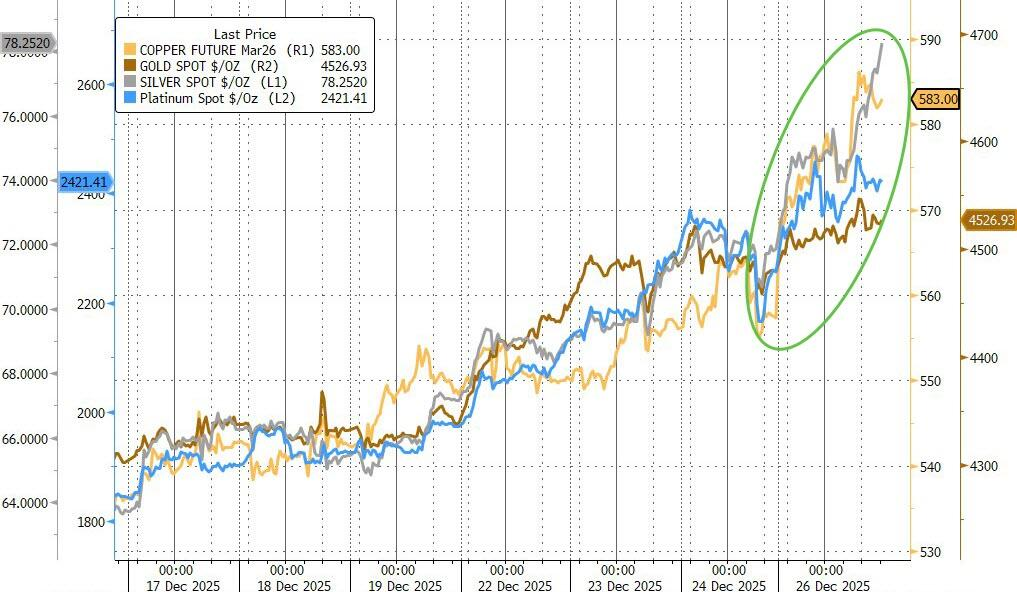
(Gold, Silver, Copper, and Platinum All Soar to Record Highs)

Compared to the sharp swings in commodities, U.S. stocks were relatively calm. The S&P 500 index fluctuated slightly throughout the day, closing almost unchanged, but this still locked in its best weekly performance in a month. The Russell small-cap index fell 0.5%, with analysts suggesting that the short-squeeze momentum from earlier in the week had exhausted. Defensive sectors regained favor, while cyclical sectors lagged.
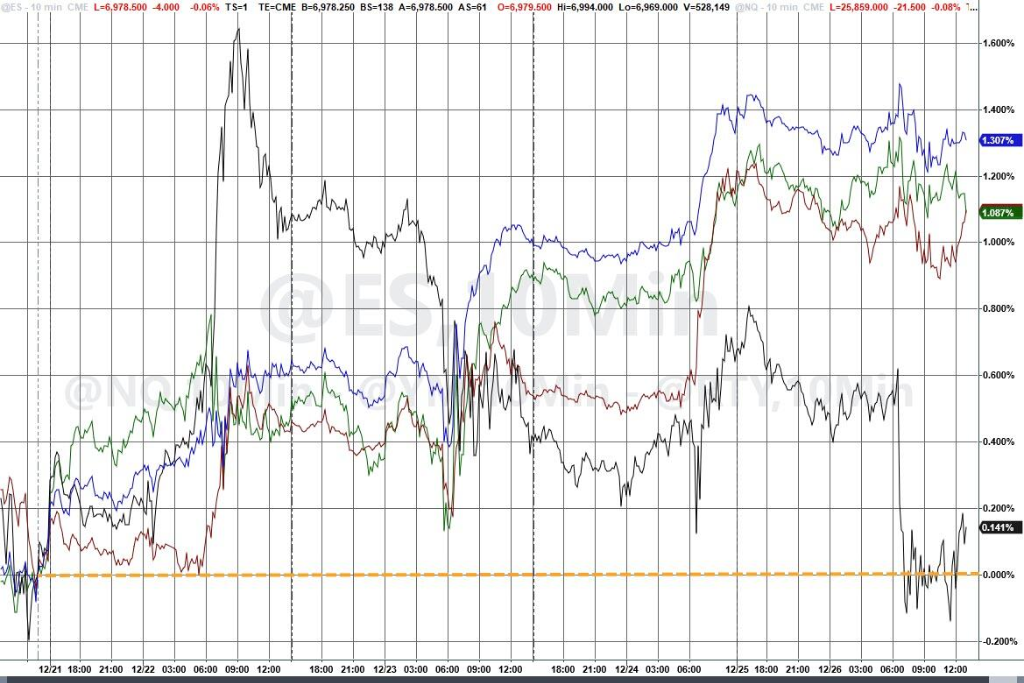
(Intraday Movement of U.S. Stock Benchmark Indices)

In the bond market, U.S. Treasuries were generally subdued. The 10-year Treasury yield was largely flat around 4.13%, while the 2-year yield edged lower. Overall, the bond market was more 'passively stable,' not showing a clear hedging reaction to the sharp moves in precious metals.

The U.S. dollar index also saw little change, but on a weekly basis, the dollar has been weakening continuously, posting its worst weekly performance since June, which has been a key backdrop supporting the precious metals rally.

As mentioned by Wall Street News, Zelensky stated that he would meet with Trump on Sunday, with a peace framework agreement 'almost ready.' Investors quickly began pricing in the potential consequences of a 'peace deal': if sanctions are lifted, a significant amount of Russian oil could return to an already oversupplied global market.

On Friday, the three major U.S. stock indices edged lower, with the Russell small-cap index leading the losses. The VIX fear index further contracted, closing at 13.47. Tesla fell 2.10%, while Meta, Google A, Apple, and Microsoft dropped up to 0.64%. Amazon edged up 0.06%, and Nvidia gained 1.02%.

U.S. Stock Benchmark Indices:

  • The S&P 500 index closed marginally lower by less than 0.01% at 6929.94 points. It gained about 1.4% for the week.

  • The Dow Jones Industrial Average fell 20.19 points, or 0.04%, to 48710.97 points. It rose 1.1% for the week.

  • The Nasdaq Composite declined 20.21 points, or 0.09%, to 23593.10 points. It advanced 1.2% for the week.

  • The Russell 2000 index dropped 0.54% to 2534.35 points. It gained 1.06% for the week.

  • The VIX fear index fell 3.79% to 13.47.

U.S. Stock Sector ETFs:

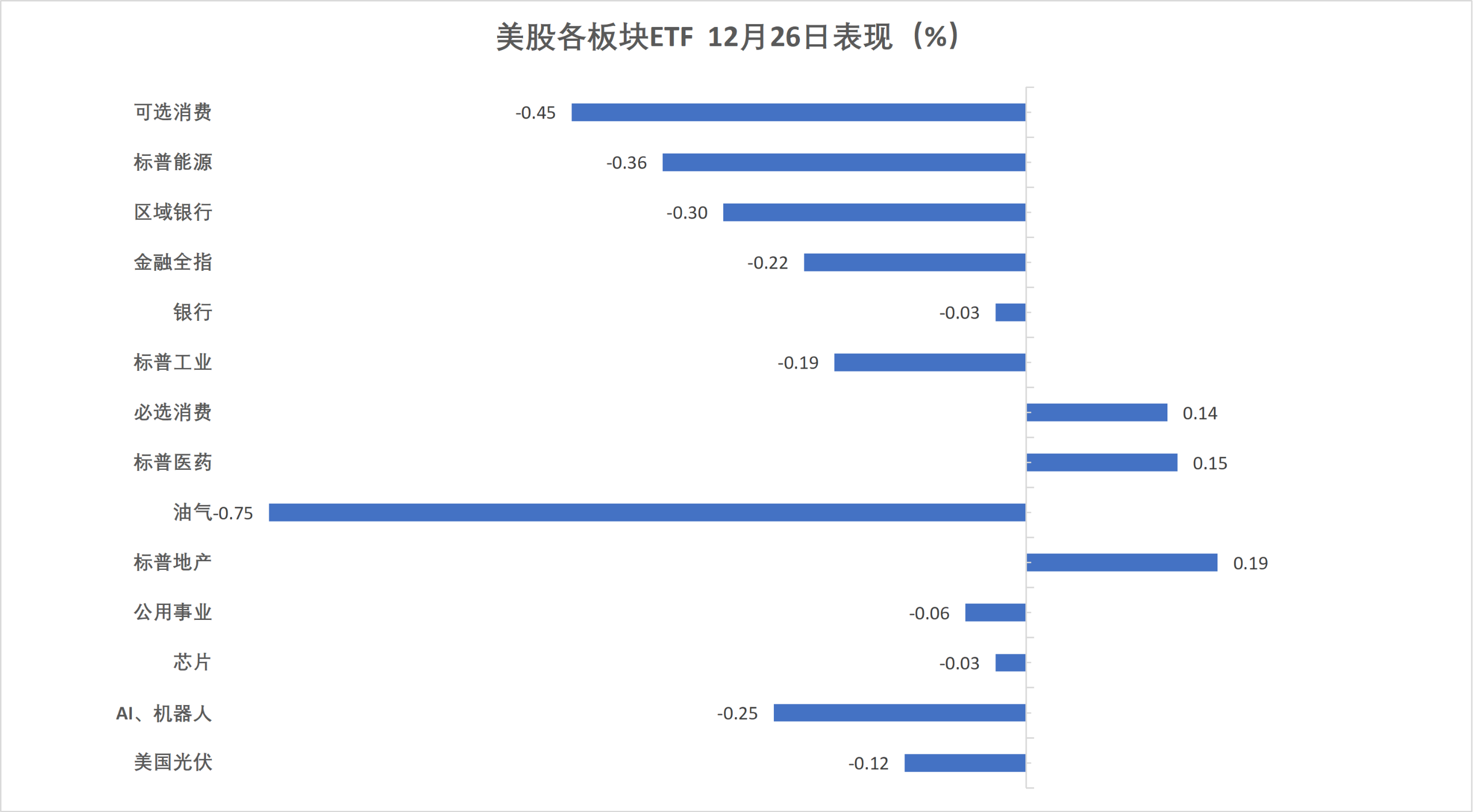
  • Oil & Gas fell 0.75%, while Consumer Discretionary, Energy, Financials, Telecommunications, and other sectors declined by up to 0.4%.

(U.S. Stock Sector ETFs on December 26)

Magnificent 7 Tech Stocks:

  • The Magnificent 7 index dipped 0.02% to 210.09 points, rising 1.73% for the week, continuing its overall upward trend.

  • Tesla closed down 2.10%. Meta, Google A, Apple, and Microsoft fell by up to 0.64%. Amazon edged up 0.06%, and Nvidia gained 1.02%.

Chip Stocks:

  • The Philadelphia Semiconductor Index fell 0.39% to 5696.21 points.

  • AMD slipped 0.02%, while TSMC advanced 1.35%.

Chinese Stocks:

  • The Nasdaq Golden Dragon China Index rose 0.72% to 7688.52 points.

  • Among popular Chinese stocks, XPeng gained 6.2%, Nio rose 4.1%, Li Auto increased 3.9%, Xiaomi advanced 2.1%, and Alibaba climbed 1.4%.

Other Individual Stocks:

  • Berkshire Hathaway Class B shares fell 0.61%, while Eli Lilly edged up 0.07%.

  • Qualcomm was flat with a 0.02% gain, Adobe rose 0.23%, Oracle advanced 0.25%, Salesforce increased 0.31%, Broadcom gained 0.55%, and Netflix climbed 0.89%.
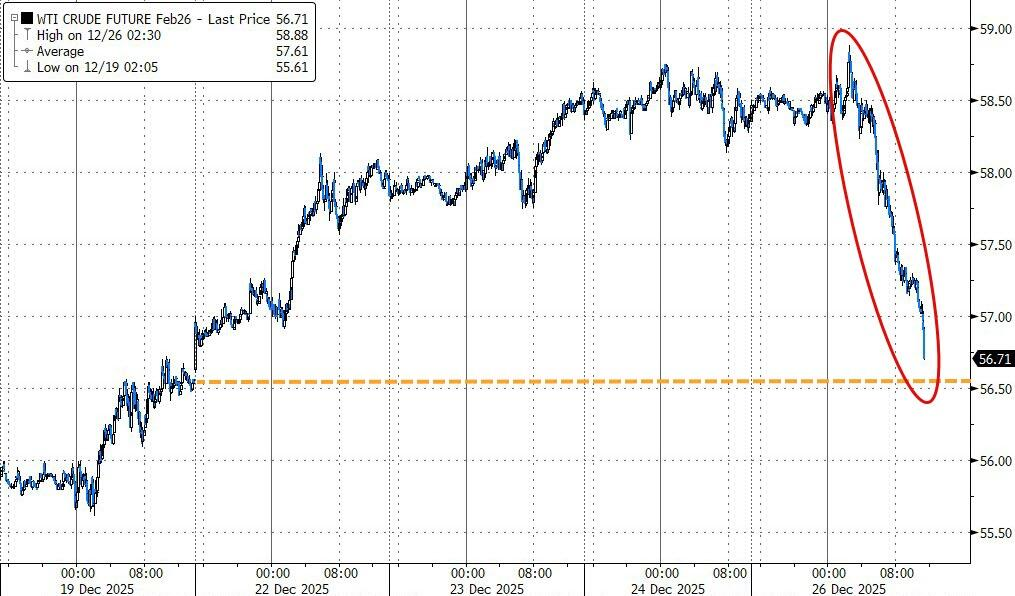
Crude oil fell sharply, with WTI crude dropping over 2.7%.

Crude Oil:

  • WTI February crude futures fell $1.61, or 2.76%, to settle at $56.74 per barrel.

(Sharp Decline in WTI Crude Futures)

  • Brent February crude futures fell 2.57% to settle at $60.64 per barrel.

Natural Gas:

  • NYMEX January natural gas futures settled at $4.3660 per million British thermal units.
Trending Cryptos

Related Questions

QWhat was the most notable market movement on the first trading day after the holiday, and by how much did it surge?

AThe most notable movement was in the precious metals sector, with silver surging by 10%.

QWhy did crude oil prices experience a significant drop, falling over 2.7%?

ACrude oil prices dropped due to the prospect of a peace agreement in the Russia-Ukraine conflict, which could lead to the lifting of sanctions and a return of Russian oil to an already oversupplied global market.

QHow did the major U.S. stock indices (S&P 500, Dow Jones, Nasdaq) perform at the close?

AThe S&P 500 fell less than 0.01%, the Dow Jones Industrial Average fell 0.04%, and the Nasdaq fell 0.09%.

QWhich precious metal reached a new all-time high above $4550?

AGold reached a new all-time high above $4550.

QWhat was the performance of the Nasdaq Golden Dragon China Index, which tracks major Chinese companies listed in the U.S.?

AThe Nasdaq Golden Dragon China Index rose 0.72%.

Related Reads

In Conversation with Ray Dalio: We Are Currently in an AI Bubble, with 1% of My Portfolio in Bitcoin

Ray Dalio, founder of Bridgewater Associates, warns in an interview that the current AI boom shows classic bubble characteristics, which could lead to significant economic downturns as seen in past cycles like 1929 or 2000. He explains that speculative enthusiasm, fueled by debt and overvaluation, often precedes a crash when rising rates or taxation force asset sales, causing widespread losses and recession. Dalio also outlines his "Big Cycle" theory, describing an approximate 80-year pattern where widening wealth gaps, massive government deficits, and shifting geopolitical power (like China's rise) create internal conflict and global instability. He emphasizes that we are in a late-cycle, transitional phase where traditional powers like the US and UK face decline. For personal wealth protection, Dalio advises diversification beyond cash into assets like stocks, bonds, real estate, and particularly gold, which he prefers over Bitcoin. While he holds about 1% of his portfolio in Bitcoin as a non-printable hard asset, he views gold as more secure from technological or governmental threats. Regarding AI's impact, Dalio believes it will disproportionately benefit capital owners, worsening inequality by replacing both physical and cognitive labor. He suggests that human intuition and emotional intelligence, combined with AI, will be key for future workers. On taxation, Dalio argues that wealth taxes are impractical and risk triggering asset sell-offs, reducing productive investment. He points to the UK as a cautionary example of debt, low productivity, and political strife. Geopolitically, Dalio foresees a more regionalized world, with the US showing weakness in prolonged conflicts like with Iran, akin to past imperial declines. The ideal outcome, he suggests, is coexisting powerful blocs (e.g., Americas, China-Asia Pacific) without major war.

marsbit3h ago

In Conversation with Ray Dalio: We Are Currently in an AI Bubble, with 1% of My Portfolio in Bitcoin

marsbit3h ago

Daily 7.2 Trillion KRW: Foreign Capital's Record Net Buying on Friday! Wall Street Says Headwinds for Korean Stock Fund Flows Have Subsided

South Korean stock market sees a dramatic shift in fund flows. On July 31, foreign investors made a record net purchase of approximately KRW 7.2 trillion in KOSPI stocks, marking a fundamental reversal from the persistent large-scale net outflows seen in previous months. This contributed to a significant narrowing of foreign net selling in July to KRW 9.8 trillion, down sharply from KRW 48.4 trillion in June and KRW 44.5 trillion in May. Simultaneously, domestic institutional pressure eased. South Korean pension funds and asset managers turned to a net buying position in July, purchasing KRW 1.0 trillion worth of KOSPI shares, contrasting with net sales in May and June. Market volatility is expected to be dampened by new financial regulations. Effective July 31, the Financial Services Commission tightened access for retail investors to single-stock leveraged ETFs by raising the minimum cash deposit requirement. Trading volumes for these products subsequently dropped to about 50% of their monthly average. Citigroup Research maintains its year-end KOSPI target of 10,000 points. The firm cites several supportive factors: the substantial easing of headwinds from capital outflows, a robust fundamental outlook for the semiconductor sector, historically low market valuations, strong economic fundamentals, and the potential for policy support from financial authorities if needed.

marsbit3h ago

Daily 7.2 Trillion KRW: Foreign Capital's Record Net Buying on Friday! Wall Street Says Headwinds for Korean Stock Fund Flows Have Subsided

marsbit3h ago

Thanks to Dice Rolls, Bitcoin Keys Are Stored Offline, But Not Everyone Will Do It

The article discusses using dice rolls to generate secure Bitcoin wallet seeds, providing entropy independent of potentially flawed hardware random number generators. It explains that each fair dice roll offers about 2.585 bits of entropy, with around 50 rolls needed for a standard 12-word seed phrase and 99+ recommended for higher security. This method gained attention after a vulnerability was revealed in some Coldcard hardware wallets, where a faulty firmware RNG (dating back to 2021) compromised generated keys. The analysis notes that while a dice-generated main seed was safe from this specific flaw, other Coldcard functions (like creating paper wallets, backup keys, or passwords) could still be vulnerable if they used the defective RNG. The piece argues that while dice-based entropy is technically robust, the manual process is error-prone, tedious, and unrealistic for most new users, who might make mistakes in recording or inputting rolls. It concludes that while manual entropy generation should remain an option for advanced users, the long-term goal is to develop reliable, user-friendly hardware and software that securely generates randomness without requiring specialized knowledge. Coldcard users are advised to check their firmware version and replace any secondary secrets (like paper wallet keys) created with vulnerable devices, while also considering multi-signature setups with devices from different manufacturers for added security.

cryptonews.ru9h ago

Thanks to Dice Rolls, Bitcoin Keys Are Stored Offline, But Not Everyone Will Do It

cryptonews.ru9h ago

Trading

Spot

Hot Articles

Discussions

Welcome to the HTX Community. Here, you can stay informed about the latest platform developments and gain access to professional market insights. Users' opinions on the price of S (S) are presented below.

活动图片