US Prosecutors Reject Tornado Cash Founder’s Defense Amid Push For October Retrial

bitcoinistPublished on 2026-04-08Last updated on 2026-04-08

Abstract

US prosecutors have rejected Tornado Cash co-founder Roman Storm's defense, claiming his arguments for dismissal are not applicable. They refuted his comparison to a Supreme Court case involving an internet service provider, arguing Storm intentionally implemented weak measures to counter criminal use of the crypto mixer. Prosecutors are pushing for a retrial in October 2026 on two deadlocked charges from his initial trial, where he was found guilty of operating an unlicensed money-transmitting business. A key hearing on Storm's motion for acquittal is scheduled for April 9.

US Southern District of New York (SDNY) prosecutors have pushed back on the Tornado Cash co-founder’s defense, claiming that his arguments for dismissal lack applicability ahead of a crucial hearing later this week.

DOJ Says Tornado Cash Founder’s Defense Is ‘Not Applicable’

On Tuesday, US Attorney for the Southern District of New York Jay Clayton sent a letter to Judge Katherine Failla rejecting Tornado Cash co-founder Roman Storm’s recent letter in support of his motion for a judgment of acquittal.

Clayton’s response addressed an April 2 motion filed by Storm’s defense, which claimed that a 2026 Supreme Court case, Cox Communications, Inc. v. Sony Music Entertainment, supported his pending Rule 29 motion.

The Cox case involved a civil liability of an internet service provider for its subscribers engaging in copyright infringement. The Supreme Court found that Cox was not contributorily liable for copyright infringement on its users’ accounts, as it did not induce its users’ infringement nor provide a service tailored to infringement.

In the Tuesday filing, the US attorney argued that “The defendant and the Tornado Cash service are a far cry from Cox,” affirming that “Even if Cox had some applicability here, its reasoning offers no help to the defendant given the strikingly different facts at issue.”
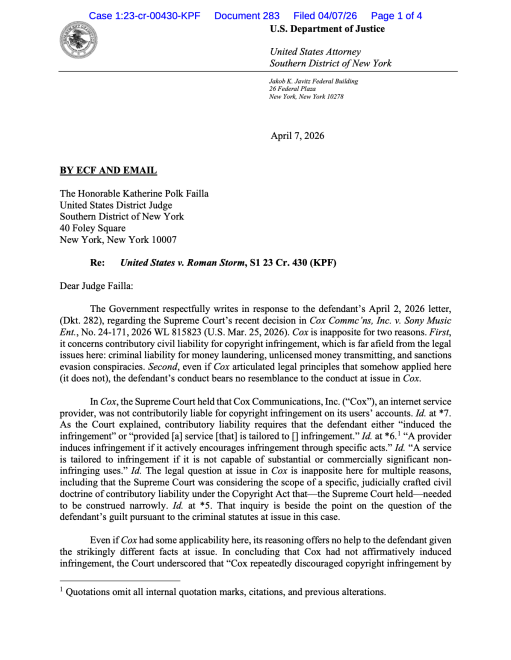
Prosecutors file letter pushing back on Storm's defense. Source: Inner City Press on X

“As set forth in detail in the Government’s response to the defendant’s Rule 29 motion— and in contrast to Cox’s robust system for responding to infringement—the defendant intentionally implemented mere half-measures that he said were ‘easy to bypass’ to counter criminal use of the Tornado Cash service, and his purpose in doing so was to distract law enforcement,” the document read.

Clayton added that Storm’s use of the crypto mixer “was window dressing at best and outright misdirection at worst,” as there was no evidence that the Tornado Cash founders put in place effective anti-money-laundering (AML) measures.

It’s worth noting that the US Department of the Treasury’s Office of Foreign Assets Control (OFAC) sanctioned Tornado Cash in August 2022 for failing to impose effective controls to prevent malicious actors from laundering funds through the protocol, including $455 million by the North Korea-linked hacking group, Lazarus Group.

However, the sanctions were overturned in March 2025 after the Court of Appeals ruled in November 2024 that OFAC had overstepped its authority by sanctioning immutable, decentralized smart contracts rather than a legal entity.

US Prosecutors Seek Roman Storm Retrial

The prosecutors’ latest move follows his March letter seeking a retrial of the Tornado Cash co-founder on the two counts where jurors were deadlocked last August. In the letter, Clayton asked Judge Failla to schedule a retrial for Roman Storm, pushing for trial dates between October 5 and 12, 2026.

For context, Storm was detained and indicted following the Tornado Cash sanctions and charged with conspiracy to commit money laundering, conspiracy to commit sanctions violations, and conspiracy to operate an unlicensed money-transmitting business.

The jury found Storm guilty of one count of conspiracy to operate an unlicensed money transmitting business, but was unable to come to a unanimous decision regarding the two other charges. Nonetheless, a hung jury does not constitute an acquittal, which opened the door to a potential retrial on those charges.

In September, Storm filed a motion for acquittal, which asks the trial judge to throw out charges or a verdict because the prosecution’s evidence is legally insufficient. The Tornado Cash founder’s lawyers argued that the government never proved he meant to help bad actors launder money through the platform, which would invalidate the grounds for his conviction based on negligent inaction.

Now, prosecutors and Storm’s defense attorneys are scheduled to meet on April 9 for an oral argument on the pending Rule 29 motion, which could shape the course of this key legal battle.
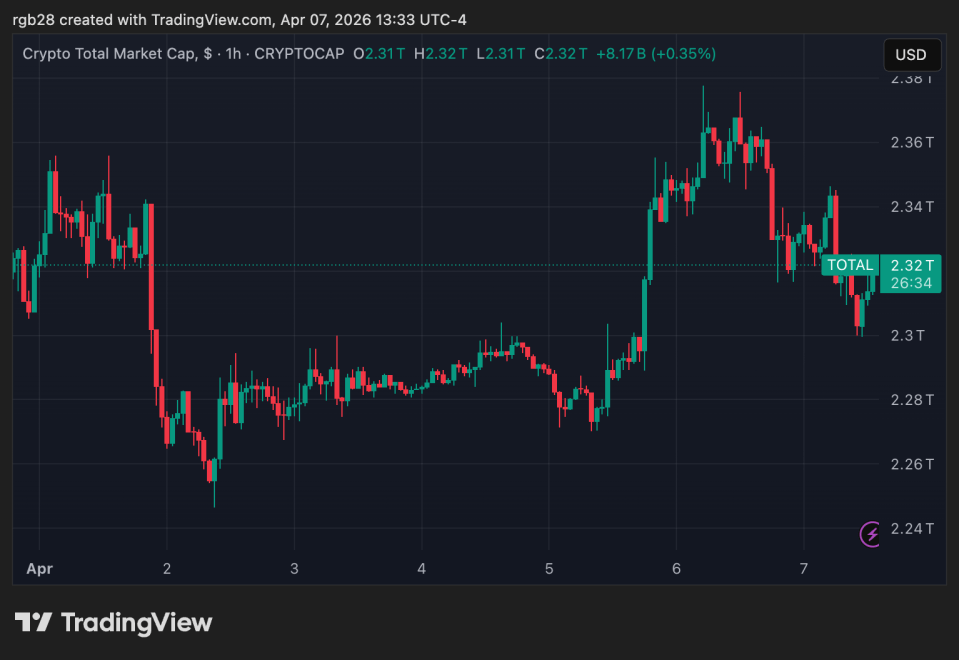
The total crypto market capitalization sits at $2.32 trillion on the one-week chart. Source: TOTAL on TradingView


Related Questions

QWhat is the core argument made by US prosecutors against Roman Storm's defense based on the Cox Communications case?

AProsecutors argued that the Cox Communications case is 'not applicable' because Tornado Cash and its founders are fundamentally different from an internet service provider like Cox. They claimed Storm implemented intentionally weak, bypassable measures as 'window dressing' to distract law enforcement, unlike Cox which had a robust system to respond to infringement.

QWhat was the outcome of Roman Storm's initial trial in August, and what charges is he currently facing a retrial for?

AThe jury found Storm guilty of one count of conspiracy to operate an unlicensed money transmitting business. However, the jury was deadlocked and could not reach a unanimous verdict on the two other charges: conspiracy to commit money laundering and conspiracy to commit sanctions violations. The prosecution is seeking a retrial specifically on these two deadlocked counts.

QWhy was Tornado Cash sanctioned by OFAC in 2022, and what was the eventual outcome of those sanctions?

AThe US Treasury's OFAC sanctioned Tornado Cash in August 2022 for failing to impose effective controls to prevent malicious actors from laundering funds, including $455 million by the North Korea-linked Lazarus Group. However, the sanctions were overturned in March 2025 after a Court of Appeals ruled that OFAC had overstepped its authority by sanctioning immutable, decentralized smart contracts instead of a legal entity.

QWhat is the purpose of the upcoming April 9 hearing between prosecutors and Storm's defense attorneys?

AThe hearing on April 9 is for an oral argument on Storm's pending Rule 29 motion for a judgment of acquittal. This motion asks the judge to throw out the charges or verdict based on the argument that the prosecution's evidence was legally insufficient to prove his intent to help bad actors launder money.

QWhat specific time frame have prosecutors proposed for Roman Storm's retrial?

AIn a letter to Judge Katherine Failla, US Attorney Jay Clayton pushed for the retrial to be scheduled for dates between October 5 and 12, 2026.

Related Reads

North Korean Hackers Loot $500 Million in a Single Month, Becoming the Top Threat to Crypto Security

North Korean hackers, particularly the notorious Lazarus Group and its subgroup TraderTraitor, have stolen over $500 million from cryptocurrency DeFi platforms in less than three weeks, bringing their total theft for the year to over $700 million. Recent major attacks on Drift Protocol and KelpDAO, resulting in losses of approximately $286 million and $290 million respectively, highlight a strategic shift: instead of targeting core smart contracts, attackers are now exploiting vulnerabilities in peripheral infrastructure. For instance, the KelpDAO attack involved compromising downstream RPC infrastructure used by LayerZero's decentralized validation network (DVN), allowing manipulation without breaching core cryptography. This sophisticated approach mirrors advanced corporate cyber-espionage. Additionally, North Korea has systematically infiltrated the global crypto workforce, with an estimated 100 operatives using fake identities to gain employment at blockchain companies, enabling long-term access to sensitive systems and facilitating large-scale thefts. According to Chainalysis, North Korean-linked hackers stole a record $2 billion in 2025, accounting for 60% of all global crypto theft that year. Their total historical crypto theft has reached $6.75 billion. Post-theft, they employ specialized money laundering methods, heavily relying on Chinese OTC brokers and cross-chain mixing services rather than standard decentralized exchanges. Security experts, while acknowledging the increased sophistication, emphasize that many attacks still exploit fundamental weaknesses like poor access controls and centralized operational risks. Strengthening private key management, limiting privileged access, and enhancing coordination among exchanges, analysts, and law enforcement immediately after an attack are critical to improving defense and fund recovery chances. The industry's challenge now extends beyond secure smart contracts to safeguarding operational security at the infrastructure level.

marsbit34m ago

North Korean Hackers Loot $500 Million in a Single Month, Becoming the Top Threat to Crypto Security

marsbit34m ago

Circle CEO's Seoul Visit: No Korean Won Stablecoin Issuance, But Met All Major Korean Banks

Circle CEO Jeremy Allaire's recent activities in Seoul indicate a strategic shift for the company, moving away from issuing a Korean won-backed stablecoin and instead focusing on embedding itself as a key infrastructure provider within Korea’s financial and crypto ecosystem. Despite Korea accounting for nearly 30% of global crypto trading volume—with a market characterized by high retail participation and altcoin dominance—Circle has chosen not to compete for the role of stablecoin issuer. Instead, Allaire met with major Korean banks (including Shinhan, KB, and Woori), financial groups, leading exchanges (Upbit, Bithumb, Coinone), and tech firms like Kakao. This approach reflects a broader industry transition: the core of stablecoin competition is shifting from issuance rights to systemic positioning. With Korean regulators still debating whether banks or tech companies should issue stablecoins, Circle is avoiding regulatory uncertainty by strengthening its role as a service and technology partner. The company is deepening integration with trading platforms, building connections, and promoting stablecoin infrastructure. This positions Circle to benefit regardless of which entity eventually issues a won stablecoin. Allaire also noted the potential for a Chinese yuan stablecoin in the next 3–5 years, underscoring a regional trend of stablecoins becoming more regulated and integrated with traditional finance. Ultimately, Circle’s strategy highlights that future influence in the stablecoin market will belong not necessarily to the issuers, but to the foundational infrastructure layers that enable cross-system transactions.

marsbit1h ago

Circle CEO's Seoul Visit: No Korean Won Stablecoin Issuance, But Met All Major Korean Banks

marsbit1h ago

SpaceX Ties Up with Cursor: A High-Stakes AI Gambit of 'Lock First, Acquire Later'

SpaceX has secured an option to acquire AI programming company Cursor for $60 billion, with an alternative clause requiring a $10 billion collaboration fee if the acquisition does not proceed. This structure is not merely a potential acquisition but a strategic move to control core access points in the AI era. The deal is designed as a flexible, dual-path arrangement, allowing SpaceX to either fully acquire Cursor or maintain a binding partnership through high-cost collaboration. This "option-style" approach minimizes immediate regulatory and integration risks while ensuring long-term alignment between the two companies. At its core, the transaction exchanges critical AI-era resources: SpaceX provides its Colossus supercomputing cluster—one of the world’s most powerful AI training infrastructures—while Cursor contributes its AI-native developer environment and strong product adoption. This synergy connects compute power, models, and application layers, forming a closed-loop AI capability stack. Cursor, founded in 2022, has achieved rapid growth with over $1 billion in annual revenue and widespread enterprise adoption. Its value lies in transforming software development through AI agents capable of coding, debugging, and system design—positioning it as a gateway to future software production. For SpaceX, this move is part of a broader strategy to evolve from a aerospace company into an AI infrastructure empire, integrating xAI, supercomputing, and chip manufacturing. Controlling Cursor fills a gap in its developer tooling layer, strengthening its AI narrative ahead of a potential IPO. The deal reflects a shift in AI competition from model superiority to ecosystem and entry-point control. With programming tools as a key battleground, securing developer loyalty becomes crucial for dominating the software production landscape. Risks include questions around Cursor’s valuation, technical integration challenges, and potential regulatory scrutiny. Nevertheless, the deal underscores a strategic bet: controlling both compute and software development access may redefine power dynamics in the AI-driven future.

marsbit1h ago

SpaceX Ties Up with Cursor: A High-Stakes AI Gambit of 'Lock First, Acquire Later'

marsbit1h ago

Trading

Spot
Futures

Hot Articles

Discussions

Welcome to the HTX Community. Here, you can stay informed about the latest platform developments and gain access to professional market insights. Users' opinions on the price of S (S) are presented below.

活动图片














