US Banks’ Push To Ban Stablecoin Rewards Could Hand Global Advantage To China, Execs Warn

bitcoinistPublished on 2026-01-01Last updated on 2026-01-01

Abstract

Crypto industry leaders warn that U.S. banks' efforts to ban interest payments on stablecoins could undermine the competitiveness of the U.S. dollar and hand a strategic advantage to global rivals like China. This follows China's announcement that it will pay interest on its Digital Yuan (e-CNY) starting in 2026, granting it similar status to bank deposits. Coinbase’s Chief Policy Officer, Faryar Shirzad, cautioned that such a prohibition could weaken the impact of the recently passed GENIUS Act, which aims to solidify the dominance of U.S. dollar stablecoins. Other executives, including Coinbase CEO Brian Armstrong and Variant CLO Jake Chervinsky, echoed that this is not just a regulatory issue but a matter of national security, arguing that limiting stablecoin rewards could diminish the global role of the dollar and strengthen China's position in the digital currency landscape.

After China’s latest move with its Digital Yuan, multiple crypto industry executives have cautioned that the US banks’ push to prohibit all interest payments on stablecoins could give a major advantage to their global rivals.

US Risks Giving China A Major Global Advantage

On Tuesday, Coinbase’s Chief Policy Officer (CPO), Faryar Shirzad, warned the US Congress that banning interest payments on the digital assets could risk diminishing the legislative efforts and victories obtained this year with the Guiding and Establishing National Innovation for U.S. Stablecoins (GENIUS) Act.

In an X post, Shirzad affirmed that “tokenization is the future and the GENIUS Act was a visionary move by POTUS and Congress to ensure US dollar stablecoins issued under US rules would be the primary settlement instrument of the future.”

However, Shirzad noted that the “sobering and timely” announcement by the People’s Bank of China of its plan to pay interest on the Digital Yuan could pose a bigger problem to the US than investors think.

As reported by Bitcoinist, China is about to start paying interest on its Digital Yuan (e-CNY). Deputy Governor at the People’s Bank of China, Lu Lei, recently shared a new framework that will redefine the rules of virtual currency, giving it the same legal status as deposits held at banks.

Under the new framework, commercial banks that manage Digital Yuan wallets will be able to pay interest to clients based on the amount of e-CNY they hold, starting from January 1, 2026.

Based on this, Shirzad cautioned that “If this issue is mishandled in Senate negotiations on the market structure bill, it could hand our global rivals a big assist in giving non-US stablecoins and CBDCs a critical competitive advantage at the worst possible time.”

Stablecoin Rewards: A ‘Matter Of National Security’

Coinbase’s CPO added that although “lobbyists for entrenched incumbents will always fight change,” it’s crucial for Congress to “protect the primacy of the US dollar and the US financial system, “not just incumbent interests.”

Similarly, other crypto executives agreed with Shirzad’s statement, including Coinbase’s Chief Executive Officer (CEO) Brian Armstrong and Variant’s Chief Legal Officer (CLO) Jake Chervinsky.

Armstrong emphasized that US “stablecoins must remain competitive on a global stage. Meanwhile, Chervinsky asserted that banks’ push to ban stablecoin rewards “isn’t just a matter of incumbents seeking a regulatory moat. It’s a matter of national security.”

To the lawyer, revisiting the issue of interest payments on USD-pegged tokens would weaken the victory that the GENIUS Act gave to US dollar dominance worldwide and “hand that win to China.”

Notably, the banking sector has criticized the US’s landmark stablecoin legislation over the past few months, arguing that it has loopholes that could pose risks to the financial system.

The crypto framework, which was signed into law by President Trump in July, prohibits interest payments on the holding or use of payment-purpose stablecoins. Nonetheless, the prohibition only addresses issuers, meaning that it could be “easily circumvented” by exchanges or affiliates providing rewards.

Earlier this year, multiple banking associations across the US sent a joint letter to the Senate Banking Committee urging Congress to amend the law. The banking groups claimed that interest payments would distort market dynamics and could affect credit creation. Therefore, they suggested extending the prohibition to include digital asset exchanges, brokers, dealers, and related entities.

Shirzad, alongside multiple crypto industry players, has rejected these concerns over the past several months, stating that the banking sector’s proposals could threaten to create an uncompetitive environment for USD-denominated tokens.

In October, Coinbase’s CPO slammed the financial institution’s narrative that stablecoins would destroy bank lending, concluding that it “ignores reality” and misreads the crucial moment.
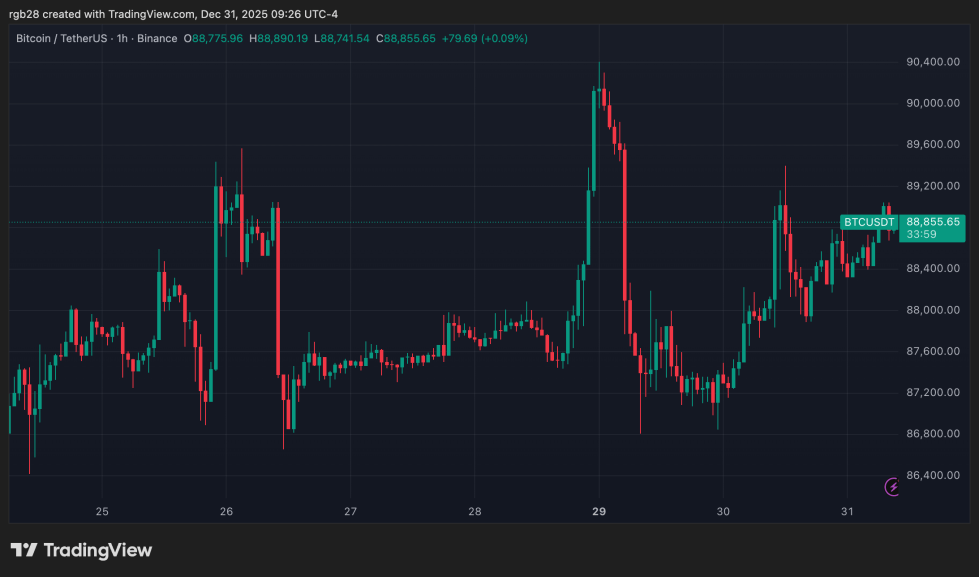
Bitcoin (BTC) trades at $88,855 in the one-week chart. Source: BTCUSDT on TradingView.

Related Questions

QWhat is the main concern raised by crypto industry executives regarding the US banks' push to ban stablecoin interest payments?

ACrypto industry executives warn that the US banks' push to ban all interest payments on stablecoins could hand a major global advantage to rivals like China, potentially undermining the US dollar's primacy and the competitiveness of US financial systems.

QWhat specific action did the People's Bank of China announce that is seen as a competitive threat?

AThe People's Bank of China announced a plan to pay interest on the Digital Yuan (e-CNY), giving it the same legal status as bank deposits and allowing commercial banks to pay interest based on the amount held, starting from January 1, 2026.

QWhy do banking associations in the US want to extend the prohibition on interest payments to include exchanges and related entities?

ABanking associations argue that interest payments on stablecoins could distort market dynamics, affect credit creation, and pose risks to the financial system, so they want to extend the ban to digital asset exchanges, brokers, dealers, and related entities to prevent circumvention.

QHow does Coinbase's CPO, Faryar Shirzad, view the GENIUS Act and its relation to US dollar stablecoins?

AFaryar Shirzad views the GENIUS Act as a visionary move to ensure that US dollar stablecoins issued under US rules become the primary settlement instrument of the future, reinforcing the dominance of the US dollar globally.

QWhat is Jake Chervinsky's perspective on the push to ban stablecoin rewards?

AJake Chervinsky, Variant's Chief Legal Officer, asserts that the push to ban stablecoin rewards is not just about incumbents seeking a regulatory advantage but is a matter of national security, as it could weaken US dollar dominance and benefit rivals like China.

Related Reads

OpenAI Goes Left, DeepSeek Goes Right

On April 24, 2026, DeepSeek released V4, a Chinese large language model offering a free "million-token context window," enabling it to process vast amounts of data like entire books or years of corporate documents in one go. In contrast, OpenAI’s GPT-5.5, released around the same time, is more powerful but significantly more expensive, charging up to $180 per million output tokens. DeepSeek’s strategy represents a shift from a pure AI research firm to a heavy-infrastructure player, building data centers in Inner Mongolia’s Ulanqab to bypass U.S. chip export restrictions. This move, supported by Huawei’s Ascend chips and China’s cheap green electricity, highlights a fundamental divergence in AI development models: U.S. firms focus on high-cost, high-margin services, while Chinese players like DeepSeek prioritize accessibility and affordability. Facing intense talent poaching from tech giants, DeepSeek is seeking a $44 billion valuation funding round to retain researchers and scale infrastructure. Meanwhile, Chinese manufacturers are compressing AI models to run on smartphones, making AI accessible offline and across the Global South. Through open-source models and localized solutions, Chinese AI is empowering non-English speakers and low-income users, driving a form of "digital equality." While Silicon Valley builds walled gardens, DeepSeek and others are turning AI into a public utility—like tap water—flowing freely to those previously left behind.

marsbit19m ago

OpenAI Goes Left, DeepSeek Goes Right

marsbit19m ago

$292 Million KelpDAO Cross-Chain Bridge Hack: Who Should Foot the Bill?

On April 18, 2026, an attacker stole 116,500 rsETH (worth ~$292M) from KelpDAO’s cross-chain bridge in 46 minutes—the largest DeFi exploit of 2026. The stolen assets were deposited into Aave V3 as collateral, causing $177–200M in bad debt and triggering a cascade of losses across nine DeFi protocols. Aave’s TVL dropped by ~$6B overnight. This legal analysis argues that KelpDAO and LayerZero Labs share concurrent liability, with fault apportioned 60%/40%. KelpDAO negligently configured its bridge with a 1-of-1 decentralized verifier network (DVN)—a single point of failure—despite LayerZero’s explicit recommendation of a 2-of-3 setup. LayerZero, which operated the compromised DVN, failed to secure its RPC infrastructure against a known poisoning attack vector. Both protocols’ terms of service cap liability at $200 (KelpDAO) or $50 (LayerZero), but these limits are likely unenforceable due to unconscionability, gross negligence exceptions, and potential securities law invalidation (if rsETH is deemed a security under the Howey test). Aave’s governance also faces fiduciary duty claims for raising rsETH’s loan-to-value ratio to 93%—far above competitors’ 72–75%—without adequately assessing bridge risks, amplifying the systemic fallout. Practical recovery targets include LayerZero Labs (a registered Canadian entity), KelpDAO’s founders, auditors, and identifiable Aave governance delegates. The incident underscores escalating legal risks for DeFi protocols, infrastructure providers, and governance participants.

marsbit1h ago

$292 Million KelpDAO Cross-Chain Bridge Hack: Who Should Foot the Bill?

marsbit1h ago

Insider Trading in War: 5 People Involved, the Highest Earner Was Arrested

On April 24, the U.S. Department of Justice arrested U.S. Army Special Forces Staff Sergeant Gannon Ken Van Dyke for insider trading related to the capture of Venezuelan President Nicolás Maduro on January 3. Van Dyke allegedly profited over $400,000 by placing bets on a prediction market, Polymarket, using insider knowledge of the covert operation. According to the indictment, Van Dyke registered an account (0x31a5) on December 26 and made a series of bets predicting Maduro’s capture and U.S. military involvement in Venezuela. He withdrew most of his funds on the day of the operation and attempted to obscure his tracks by transferring assets through crypto and brokerage accounts. This case marks the first time the DOJ has prosecuted insider trading on Polymarket. PolyBeats had previously identified five suspicious accounts, including Van Dyke’s—the highest earner—in January. The other accounts, with profits ranging from $34,000 to $145,000, remain under unofficial scrutiny but have not been charged. Their lower profits, indirect access to information, and unclear legal boundaries may complicate prosecution. Polymarket has since strengthened its market integrity rules, explicitly prohibiting trading based on confidential or insider information. Van Dyke’s arrest, nearly four months after his trades, signals increased regulatory attention and the persistent traceability of blockchain-based transactions.

marsbit1h ago

Insider Trading in War: 5 People Involved, the Highest Earner Was Arrested

marsbit1h ago

Trading

Spot
Futures

Hot Articles

How to Buy PUSH

Welcome to HTX.com! We've made purchasing Push Protocol (PUSH) simple and convenient. Follow our step-by-step guide to embark on your crypto journey.Step 1: Create Your HTX AccountUse your email or phone number to sign up for a free account on HTX. Experience a hassle-free registration journey and unlock all features.Get My AccountStep 2: Go to Buy Crypto and Choose Your Payment MethodCredit/Debit Card: Use your Visa or Mastercard to buy Push Protocol (PUSH) instantly.Balance: Use funds from your HTX account balance to trade seamlessly.Third Parties: We've added popular payment methods such as Google Pay and Apple Pay to enhance convenience.P2P: Trade directly with other users on HTX.Over-the-Counter (OTC): We offer tailor-made services and competitive exchange rates for traders.Step 3: Store Your Push Protocol (PUSH)After purchasing your Push Protocol (PUSH), store it in your HTX account. Alternatively, you can send it elsewhere via blockchain transfer or use it to trade other cryptocurrencies.Step 4: Trade Push Protocol (PUSH)Easily trade Push Protocol (PUSH) on HTX's spot market. Simply access your account, select your trading pair, execute your trades, and monitor in real-time. We offer a user-friendly experience for both beginners and seasoned traders.

3.3k Total ViewsPublished 2024.03.29Updated 2025.04.02

How to Buy PUSH

Discussions

Welcome to the HTX Community. Here, you can stay informed about the latest platform developments and gain access to professional market insights. Users' opinions on the price of PUSH (PUSH) are presented below.

活动图片