Insider Trading in War: 5 People Involved, the Highest Earner Was Arrested

marsbitPublished on 2026-04-24Last updated on 2026-04-24

Abstract

On April 24, the U.S. Department of Justice arrested U.S. Army Special Forces Staff Sergeant Gannon Ken Van Dyke for insider trading related to the capture of Venezuelan President Nicolás Maduro on January 3. Van Dyke allegedly profited over $400,000 by placing bets on a prediction market, Polymarket, using insider knowledge of the covert operation. According to the indictment, Van Dyke registered an account (0x31a5) on December 26 and made a series of bets predicting Maduro’s capture and U.S. military involvement in Venezuela. He withdrew most of his funds on the day of the operation and attempted to obscure his tracks by transferring assets through crypto and brokerage accounts. This case marks the first time the DOJ has prosecuted insider trading on Polymarket. PolyBeats had previously identified five suspicious accounts, including Van Dyke’s—the highest earner—in January. The other accounts, with profits ranging from $34,000 to $145,000, remain under unofficial scrutiny but have not been charged. Their lower profits, indirect access to information, and unclear legal boundaries may complicate prosecution. Polymarket has since strengthened its market integrity rules, explicitly prohibiting trading based on confidential or insider information. Van Dyke’s arrest, nearly four months after his trades, signals increased regulatory attention and the persistent traceability of blockchain-based transactions.

On April 24, Eastern Time, the U.S. Department of Justice announced the arrest of active-duty Army Special Forces Staff Sergeant Gannon Ken Van Dyke.

The indictment released by the Department of Justice on the same day revealed that Van Dyke participated in the operation to capture Venezuelan President Nicolás Maduro from the Presidential Palace in Caracas on January 3 of this year.

According to reports, Van Dyke bet on Maduro's capture through a prediction market on the eve of the operation, earning over $400,000. Although the report did not disclose specific account information, by comparing the betting direction and profit amount mentioned, we identified account 0x31a5.
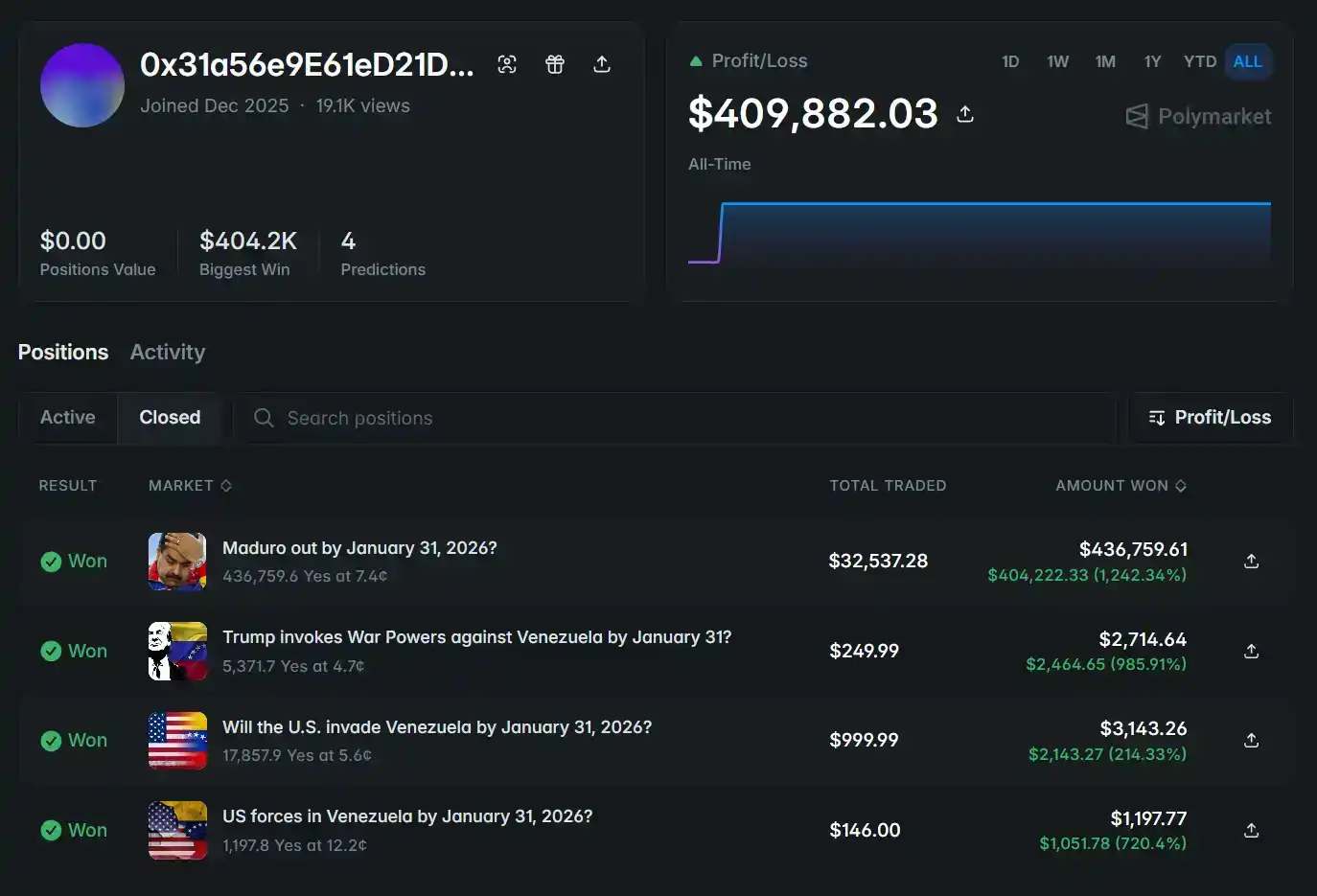
This is one of the five insider accounts点名ed by PolyBeats in two consecutive reports on January 4 and January 7.

Van Dyke Account Review

Let's rewind to January 4 of this year.

After the Maduro capture incident, PolyBeats immediately analyzed on-chain data,锁定ed five accounts, and completed public reporting within 24 hours after the operation ended. For details, see 《They Missed $2 Million Because Maduro Wasn't Supposed to Spend New Year at Home》
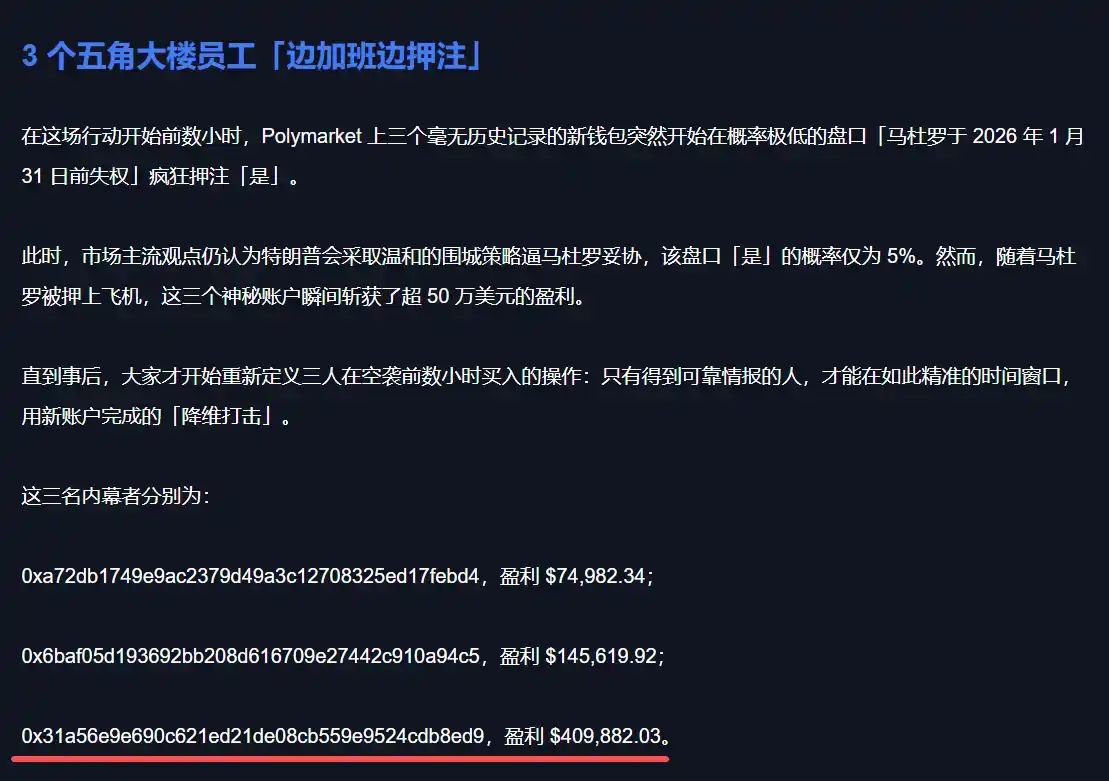
Among them, Van Dyke's account was the highest earner of the five. The account was registered on December 26, 2025, and subsequently placed a series of bets highly related to the capture operation, such as "Maduro's ouster" and "U.S. troops entering Venezuela," The total principal was approximately $30,000, with total profits exceeding $400,000.

On the day of the operation, the account withdrew most of its funds, transferred them to an overseas cryptocurrency account, and then deposited them into a newly opened brokerage account.

On January 6, three days after the operation ended, media began reporting abnormal trades related to this operation on Polymarket. On the same day, the account requested deletion from Polymarket, citing "inability to access the registered email." Simultaneously, he changed the registered email of the cryptocurrency exchange to an anonymous email secretly created as early as December 14.
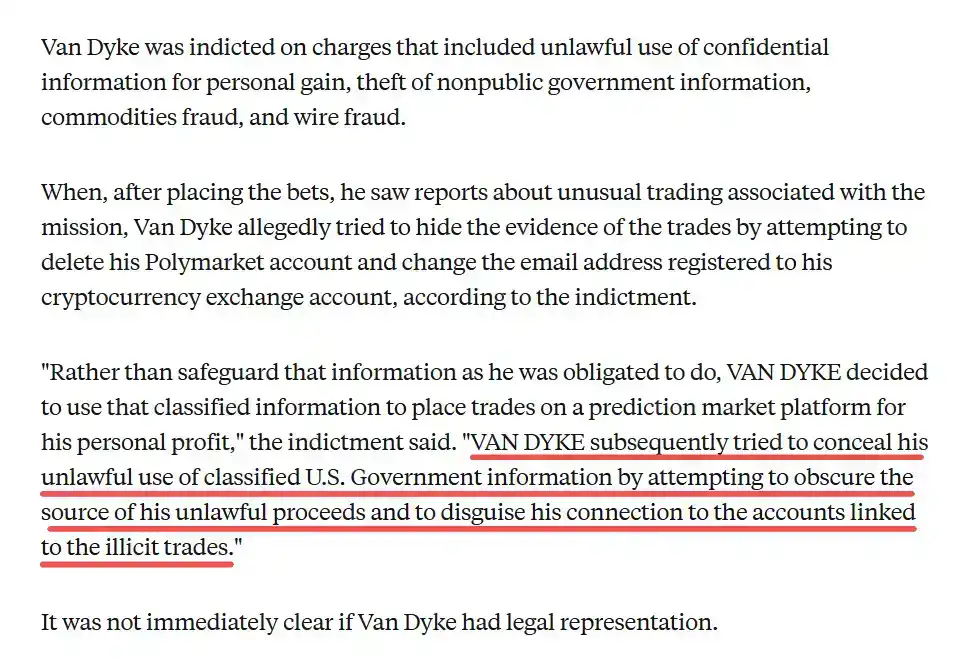
New account, precise positioning, withdrawal on the day of the incident, post-event痕迹 destruction—this set of operational procedures was the异常特征 we重点标记ed in the January review.

Today, the Department of Justice gave this address a name: Gannon Ken Van Dyke.

More Than One Person in the Story

Van Dyke's arrest is the first case of insider trading on Polymarket formally prosecuted by the DOJ. But this story never involved just him.

In the two January reports, PolyBeats标注ed a total of five accounts. Apart from Van Dyke, there has been no official investigation information regarding the other four:

0xa72db1749e9ac2379d49a3c12708325ed17febd4, profit $74,982;

0x6baf05d193692bb208d616709e27442c910a94c5, profit $145,619;

0x168b100d7a6620a2f49a455344c2c006eaf1714b, profit approx. $34,000;

0x168b100d7a6620a2f49a455344c2c006eaf1714b, profit approx. $54,000.
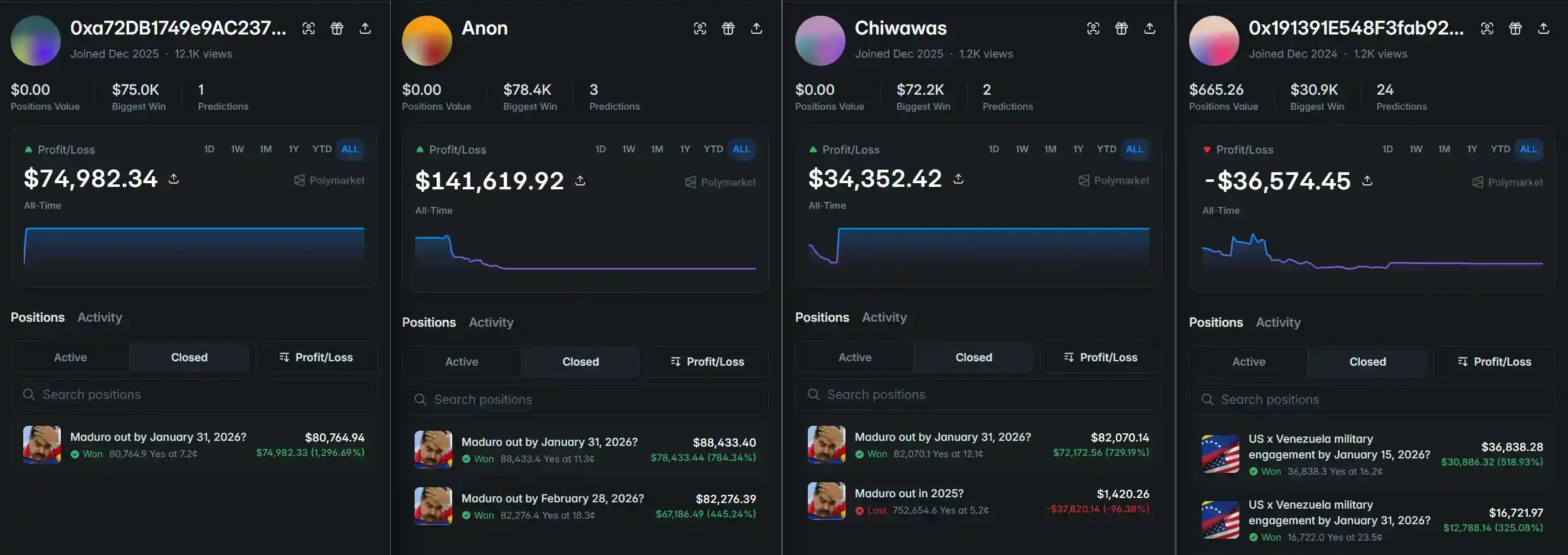
Why haven't these four accounts been arrested yet?

The most direct reason is the amount. Van Dyke's profit was nearly $410,000, the highest among the four accounts, making his执法优先级 most clear.

A more critical reason is identity. Van Dyke is an active-duty soldier, signed a confidentiality agreement, and was directly involved in action planning, making the identity verification path extremely short. The true identities and information sources of the other four accounts are still unclear. If they obtained second-hand information, the legal boundaries would be much模糊er, significantly increasing the difficulty of prosecution.

Another layer is Polymarket's own reporting boundaries. The platform claims they proactively discovered and reported Van Dyke to law enforcement, but the other four同样存在异常的 accounts were显然 not reported together. The platform has no explanation for this.

However, one thing is changing this situation.

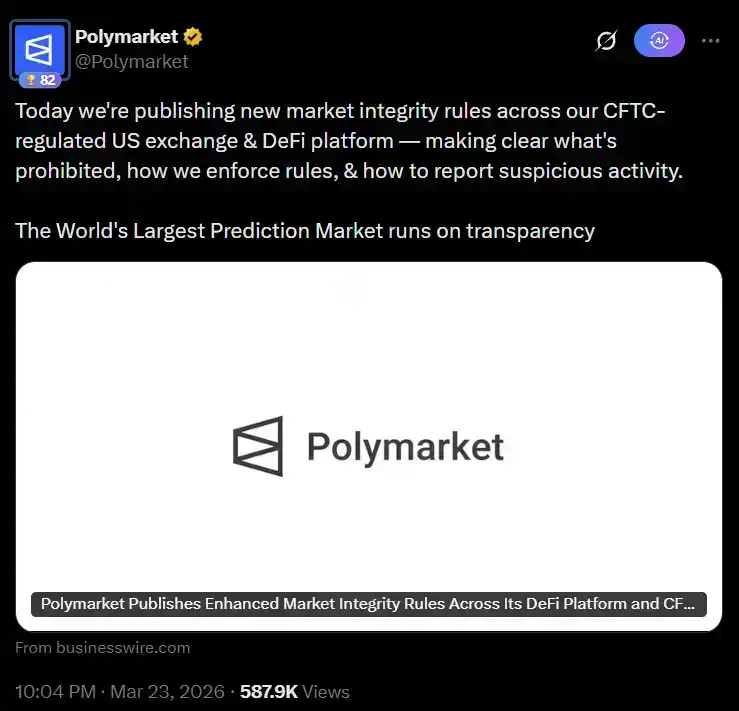
In March of this year, Polymarket released an enhanced market integrity rule, explicitly prohibiting three types of behavior: trading based on legally required confidential information, trading based on others' insider information, and participation in related markets by individuals with the power to influence event outcomes. As the rule was implemented, this indictment from the DOJ also sends the same signal to everyone: the platform is willing to cooperate with investigations, records on the blockchain will not disappear, and investigations themselves can last for months.
There was nearly a four-month gap between Van Dyke's positioning and his arrest. For the other four accounts, and for all those with information asymmetry attempting insider trading in prediction markets, this arrest may be just the beginning.


Related Questions

QWho was arrested by the U.S. Department of Justice on April 24th in connection with the Venezuelan presidential capture operation?

AGannon Ken Van Dyke, an active-duty U.S. Army Special Forces staff sergeant.

QHow much profit did Van Dyke allegedly make by betting on the capture of Venezuelan President Nicolás Maduro on the prediction market?

AOver $400,000.

QWhich platform was used for the insider trading bets related to the military operation, as identified by PolyBeats?

APolymarket.

QHow many insider trading accounts did PolyBeats originally identify in their January investigation?

AFive accounts.

QWhat was one of the key reasons Van Dyke was prioritized for arrest compared to the other four accounts?

AHe was an active-duty soldier who signed confidentiality agreements and was directly involved in the operation, making his identity and information trail easier to verify.

Related Reads

From Robinhood to Polymarket: Is the Era of Integrating All Assets on a Single Platform Coming?

From Robinhood to Polymarket: The Era of All-in-One Asset Platforms Is Coming Asset classes are rapidly converging. Platforms that once specialized in single categories—such as stocks, cryptocurrencies, or prediction markets—are now moving toward offering all three. Robinhood pioneered this model, starting with equities, adding crypto in 2018, and prediction markets in 2025. This strategy has proven resilient: when crypto revenues fell, other segments like options and stocks filled the gap. Now, prediction market leaders Polymarket and Kalshi are moving in the same direction, both announcing perpetual futures trading on April 21, 2026, pending regulatory approval. These futures will cover assets like Bitcoin, gold, and stocks such as Nvidia. This trend mirrors the consolidation seen in consumer tech, like smartphones replacing dedicated cameras and MP3 players. Younger users, accustomed to interacting with multiple asset types from an early age, will increasingly demand unified platforms. A key competitive advantage in prediction markets is collateral utilization—idle assets locked during betting periods. Polymarket’s move into perpetuals may be a strategy to generate yield from that capital, similar to earlier DeFi integrations like PolyAave. As the regulatory landscape evolves, traditional finance is also likely to incorporate crypto and prediction markets, further accelerating this convergence.

marsbit33m ago

From Robinhood to Polymarket: Is the Era of Integrating All Assets on a Single Platform Coming?

marsbit33m ago

OpenAI Goes Left, DeepSeek Goes Right

On April 24, 2026, DeepSeek released V4, a Chinese large language model offering a free "million-token context window," enabling it to process vast amounts of data like entire books or years of corporate documents in one go. In contrast, OpenAI’s GPT-5.5, released around the same time, is more powerful but significantly more expensive, charging up to $180 per million output tokens. DeepSeek’s strategy represents a shift from a pure AI research firm to a heavy-infrastructure player, building data centers in Inner Mongolia’s Ulanqab to bypass U.S. chip export restrictions. This move, supported by Huawei’s Ascend chips and China’s cheap green electricity, highlights a fundamental divergence in AI development models: U.S. firms focus on high-cost, high-margin services, while Chinese players like DeepSeek prioritize accessibility and affordability. Facing intense talent poaching from tech giants, DeepSeek is seeking a $44 billion valuation funding round to retain researchers and scale infrastructure. Meanwhile, Chinese manufacturers are compressing AI models to run on smartphones, making AI accessible offline and across the Global South. Through open-source models and localized solutions, Chinese AI is empowering non-English speakers and low-income users, driving a form of "digital equality." While Silicon Valley builds walled gardens, DeepSeek and others are turning AI into a public utility—like tap water—flowing freely to those previously left behind.

marsbit59m ago

OpenAI Goes Left, DeepSeek Goes Right

marsbit59m ago

Trading

Spot
Futures

Hot Articles

How to Buy PEOPLE

Welcome to HTX.com! We've made purchasing ConstitutionDAO (PEOPLE) simple and convenient. Follow our step-by-step guide to embark on your crypto journey.Step 1: Create Your HTX AccountUse your email or phone number to sign up for a free account on HTX. Experience a hassle-free registration journey and unlock all features.Get My AccountStep 2: Go to Buy Crypto and Choose Your Payment MethodCredit/Debit Card: Use your Visa or Mastercard to buy ConstitutionDAO (PEOPLE) instantly.Balance: Use funds from your HTX account balance to trade seamlessly.Third Parties: We've added popular payment methods such as Google Pay and Apple Pay to enhance convenience.P2P: Trade directly with other users on HTX.Over-the-Counter (OTC): We offer tailor-made services and competitive exchange rates for traders.Step 3: Store Your ConstitutionDAO (PEOPLE)After purchasing your ConstitutionDAO (PEOPLE), store it in your HTX account. Alternatively, you can send it elsewhere via blockchain transfer or use it to trade other cryptocurrencies.Step 4: Trade ConstitutionDAO (PEOPLE)Easily trade ConstitutionDAO (PEOPLE) on HTX's spot market. Simply access your account, select your trading pair, execute your trades, and monitor in real-time. We offer a user-friendly experience for both beginners and seasoned traders.

6.3k Total ViewsPublished 2024.03.29Updated 2025.03.21

How to Buy PEOPLE

Discussions

Welcome to the HTX Community. Here, you can stay informed about the latest platform developments and gain access to professional market insights. Users' opinions on the price of PEOPLE (PEOPLE) are presented below.

活动图片













