Unitree's IPO is getting closer.
Today (August 5th), Unitree began its IPO inquiry, with the preliminary inquiry period from 9:30 AM to 3:00 PM. The sponsor (lead underwriter) carried out verification of offline investors, and investors participating in the strategic placement paid subscription funds. The issue price will be determined on August 6th.
Next week, on August 10th, Unitree will be open for subscription.
This might be the "youngest" IPO on the A-share market this year—the founder, Wang Xingxing, was born in 1990; the core technical personnel listed in the prospectus are all post-90s. Even more notably, some Unitree employees will become the first batch of multimillionaires in the embodied AI track—and they are also very young.
We are about to witness a group of post-90s multimillionaires emerging from the robotics R&D workstations.
Unitree Employees: The Youngest Multimillionaire Team
The outside world pays more attention to the expected value realization of Unitree employees.
A strategic placement document revealed this hidden "wealth creation" narrative—Unitree Technology mentioned in its IPO issuance plan and preliminary inquiry announcement that it has established two special asset management plans to participate in the strategic placement, with a total subscription amount of 271.5 million yuan, and the maximum number of shares subscribed not exceeding 10% of this issuance scale.
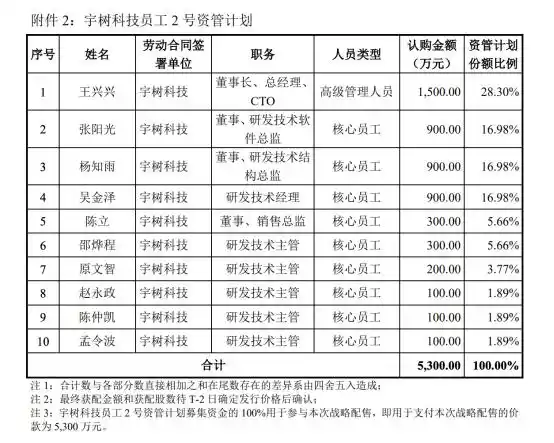
The participants are Unitree Technology Employee Asset Management Plan No. 1 and Unitree Technology Employee Asset Management Plan No. 2.
Specifically, Asset Management Plan No. 1 involves 161 employees, plans to raise 218.5 million yuan. The CFO Wang Feng and Board Secretary Fu Fenghua, listed at the top, each subscribed 7 million yuan. A large number of other technical supervisors, business backbones, R&D, production, and other employees contributed between 1 million and 4 million yuan, with a 12-month lock-up period.
Asset Management Plan No. 2 involves only 10 people, with a 36-month lock-up period, raising 53 million yuan—Wang Xingxing leads with a contribution of 15 million yuan, and the rest are almost all R&D backbones.
The technical roadmap cannot be swayed by short-term sentiment, which is perhaps the signal Wang Xingxing is sending with the longer lock-up period.
In fact, as early as 2017, Unitree initiated its employee equity incentive plan. According to the prospectus and announcements, in September 2017, Unitree signed "Option Agreements" with 17 employees, including Yang Zhiyu, at a price of 1 yuan/share. Equity incentives were implemented multiple times thereafter, managed uniformly through equity holding platforms like "Shanghai Yuyi."
Based on the expected issue price of 104 yuan/share, the early trust of core employees will translate into at least a hundredfold increase in book value.
According to the prospectus, Shanghai Yuyi directly holds 10.9414% of Unitree's shares pre-IPO. If calculated based on an expected market value of hundreds of billions, more employees will share the joy of the listing.
This will be the youngest multimillionaire group in A-share history. The prospectus discloses that as of the end of 2025, Unitree's total employee count was 516. Core technical personnel Wang Xingxing, Yang Zhiyu, and Zhang Yangguang are all post-90s. Even within the entire technical team, the proportion of post-90s is very high.
As the helmsman, Wang Xingxing is also about to receive his era coronation. The prospectus shows that Wang Xingxing directly holds 23.82% of Unitree's shares and indirectly holds 9.54% through Shanghai Yuyi, totaling approximately 33.36%. After a successful listing, with a net worth of tens of billions, he will become another post-90s, self-made founder on the STAR Market.
How Unitree Was Forged
Looking back over these years, Unitree has been a central narrative in China's embodied AI track.
Born in Ningbo, Zhejiang, Wang Xingxing had strong hands-on skills from a young age, often creating inventions from collected waste and scraps. He once recalled that during middle school, due to being severely biased in subjects, he was seen as a "poor student" by teachers. In 2009, Wang Xingxing was admitted to Zhejiang Sci-Tech University, where he became fascinated with robot manufacturing. During his freshman year, he independently built a bipedal humanoid robot.
However, due to unsatisfactory English scores in the postgraduate entrance exam, Wang Xingxing missed Zhejiang University and instead entered Shanghai University. It was during his postgraduate studies from 2013 to 2015 that he once again independently developed a low-cost, high-performance, purely electrically driven quadruped robot XDog, from the underlying motor driver board, the whole machine's mechanical structure, to the whole machine's motion control algorithm. After graduation, he briefly worked at DJI.
The gears of fate began to turn.
Wang Xingxing bid farewell to Shenzhen and DJI. In 2016, he embarked on the entrepreneurial journey, and Unitree Technology was born in Hangzhou.
Initially, Unitree targeted the quadruped robot field, successively launching the quadruped robot Laikago, AlienGo capable of backflips, and the consumer-grade accompanying bionic quadruped robot Go1. According to the prospectus, today Unitree holds 60% of the global consumer-grade legged robot market share.
But what truly brought Unitree into the public eye were humanoid robots.
In 2023, they released their first general-purpose humanoid robot H1, showcasing the team's technical accumulation in balance control and power systems with difficult moves like in-place backflips. The subsequently launched G1 humanoid robot, priced at 99,000 yuan, shattered the perception that "humanoid robots belong to high-end lab products" and quickly went viral.
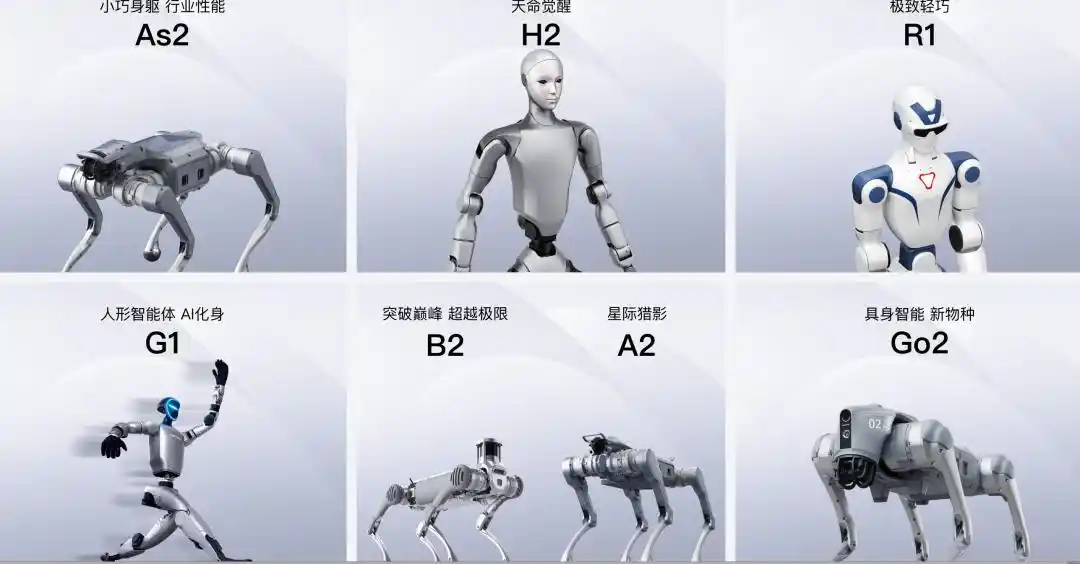
Over many years, Unitree gradually evolved from a small team of 1, then 3 people, into the large company of several hundred it is today. Among the most well-known milestones was Unitree's three appearances on the CCTV Spring Festival Gala, which let the outside world see the technological leaps and trends in the embodied AI industry.
This is one of the few profitable embodied AI enterprises in China. According to the prospectus, Unitree's revenue reached 1.699 billion yuan in 2025, with a two-year revenue compound growth rate exceeding 220%. It has been profitable for two consecutive years, with adjusted net profit of 78 million yuan in 2024, soaring to 591 million yuan in 2025. The latest data shows estimated revenue for the first half of 2026 is between 1.052 billion and 1.128 billion yuan.
In terms of revenue structure, humanoid robots account for 51.78%, with shipments of 5500 units. The quadruped robot holds a 60% global market share. The gross profit margin continues to rise, reaching 60.27% in 2025.
From a lab startup in 2016 to an important global player in robotics today, Unitree has completed the path of technology accumulation, product commercialization, and market leadership in 10 years. In this process, Wang Xingxing and his team assembled a long list of investors who will share the first wave of embodied AI listing dividends.
The Wave of Chinese Robotics Listings
At this moment, everyone is watching Unitree's IPO.
The significance of this listing goes far beyond the success of a single company; it's an industry bellwether—the "landing moment" for China's embodied AI has officially begun.
As we can feel, the embodied AI industry is in an IPO race.
Not long ago, Zhiyuan Robotics officially announced the initiation of its Hong Kong IPO process;
Also, Galaxy General will likely be among the first batch of listed embodied companies;
Yunshenchu's STAR Market IPO application has been accepted and is currently under review inquiry;
Leju Intelligent is the first embodied AI enterprise to apply under the fourth set of ChiNext listing standards officially enabled;
Additionally, Xinghai Tu, Zhuji Dongli, Zhongqing Robotics, Songyan Dongli, Xingdong Century, Xingchen Intelligent, and Fourier Intelligent have all completed shareholding reforms in preparation for subsequent IPOs;
There's also Cross-dimensional Intelligent, reportedly considering a Hong Kong IPO; according to Bloomberg, Zhizhipingfang is also considering a Hong Kong IPO and is working with advisors to prepare for the listing plan......
But everyone is waiting for a market answer: How much is an embodied AI company actually worth?
Currently, the embodied AI track is hot in financing, with unicorns born at an unprecedented pace, valuations of 10 billion, 20 billion yuan emerging one after another. But even investors admit that the industry still lacks validation standards in the public market. To some extent, Unitree's IPO will end this industry uncertainty and provide a crucial pricing anchor for the embodied AI industry—whether for subsequent financing or IPOs, there is now a key reference point.
Beyond the pricing system and listing standards, Unitree also sets an example for talent incentives and value realization. The mass "landing" of Unitree employees is not just a leap in personal wealth but also a formation of a talent value system for the entire embodied AI industry. Perhaps employees of other companies are waiting for Unitree's issue price to calculate their own distance.
Of course, Unitree's IPO also means accelerated industry reshuffling.
At the very least, STAR Market opportunities for embodied AI listings will become scarcer. After Unitree, the capital market's selection of embodied AI companies will become increasingly stringent, and this IPO path where thousands of troops cross a single-plank bridge is bound to become narrower. Such a scene evokes complex emotions.
Some are about to reap landing dividends, while others face life-and-death elimination. Behind the cruelty lies the inevitable law of industry maturation.
Now, we await the sound of Unitree's listing bell.
This article is from the WeChat public account "Investment Community" (ID: pedaily2012), author: Yang Jiyun