Unitree Robotics' IPO Hearing Countdown! Dissecting the 'Ice and Fire' in the Prospectus of the 'First Humanoid Robot Stock'

marsbitPublished on 2026-05-26Last updated on 2026-05-26

Abstract

Unitree Robotics, poised to become China's first publicly listed humanoid robot company, is set for its IPO review on the Shanghai Stock Exchange. Its prospectus reveals a company undergoing a rapid transformation. Once primarily a quadruped robot (robodog) maker, humanoids now account for over half of its revenue as of 2025, with the company selling approximately 5,500 units in that year—reportedly the highest global volume. Current demand, however, is heavily concentrated in research and education (74% of humanoid sales), while commercial and consumer use is largely for promotional "display" purposes. Industrial applications remain limited (~9% of sales), though quadruped robots see more mature use in industrial inspections. A key strength is Unitree's vertically integrated model, self-designing and manufacturing critical components like motors and actuators. This has driven manufacturing costs down and pushed gross margins up to nearly 60%—exceptionally high for a hardware company. Financially, revenue surged 335% to about $252 million in 2025, with the company achieving profitability. Its IPO targets a valuation of $6-7 billion, planning to invest nearly half the raised capital into AI model development. This includes funding for Vision-Language-Action (VLA) and World Model + Action (WMA) models, highlighting its strategic focus on building a software "brain" to complement its hardware leadership and secure a long-term competitive edge. The prospectus showcases Unitre...

Author: Tanay Jaipuria, Partner at Wing

Compiled by: Felix, PANews

Editor's Note: On May 25th, the Shanghai Stock Exchange website showed that Unitree Robotics' IPO on the STAR Market will undergo a review on June 1st, planning to raise $620 million, aiming to become the first A-share humanoid robot company.

Unitree's prospectus is highly noteworthy because it effectively presents the true current state of the robotics market development.

As the company with the highest global shipment volume of humanoid robots, Unitree is not only profitable but also maintaining rapid growth. This article will explore:

  • Unitree Robotics' products

  • The shift in revenue structure towards humanoid robots

  • Which companies are currently buying robots (and why)

  • The vertically integrated business model

  • Financial analysis

  • Model-layer development goals

Unitree Robotics' Products

Unitree Robotics was founded in 2016 in Hangzhou. Its founder, Wang Xingxing, is a self-taught robotics expert known for building the first quadruped robot in his apartment. The company currently has 480 employees, including about 175 R&D personnel.
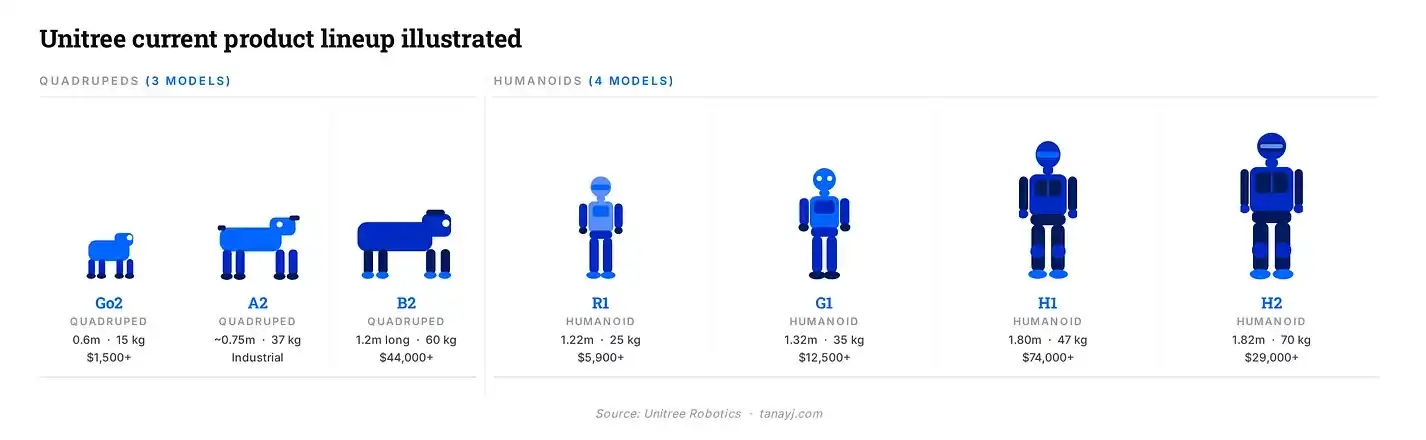
The company primarily sells two major product lines:

  • Quadruped Robots (Robotic Dogs): Go2 (consumer and research grade), B2 (industrial grade), and A2.

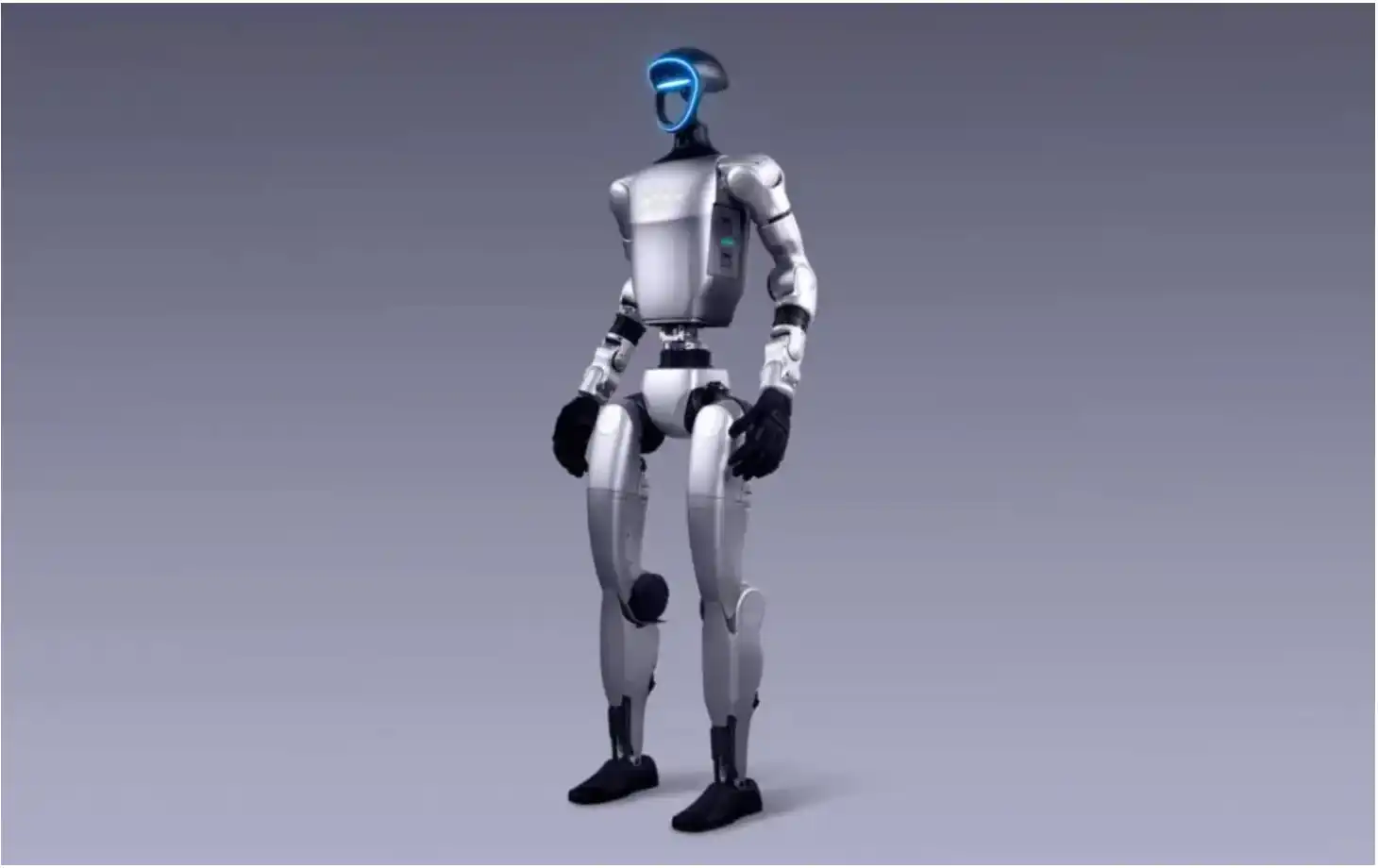
  • Humanoid Robots: H1, H2, G1, and R1. You might have seen G1 in viral videos online; it is 1.32 meters tall and weighs 35 kilograms.

The company began international operations in 2018. Over 35% of its revenue comes from outside China, including a significant customer base in the US academic sector.

Transition to Humanoid Robots

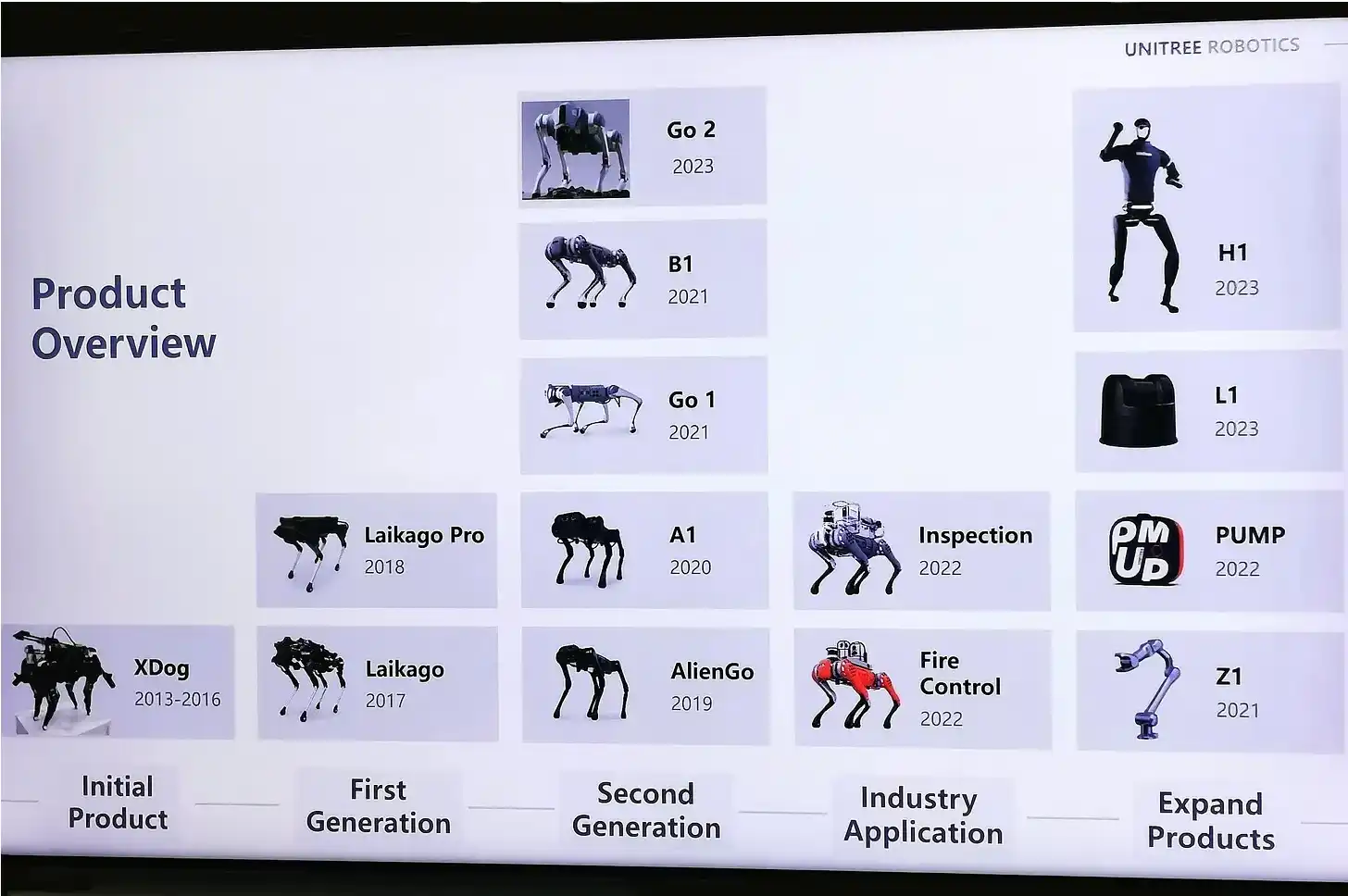
Two years ago, Unitree Robotics was essentially a robotic dog company, mainly selling quadruped robots. In 2023, humanoid robots accounted for only 1.9% of its revenue.

However, by the first three quarters of 2025, humanoid robots already made up over half of its revenue.
This shift was driven by product-market fit and aggressive marketing. The company's humanoid robots have appeared on CCTV's Spring Festival Gala for two consecutive years. In 2024, Jensen Huang also showcased a Unitree robot at the GTC conference.

Unitree robots performing on CCTV's Spring Festival Gala

This brand exposure has successfully translated into commercial and research demand—something most Chinese hardware companies have rarely achieved.

Unitree's shipment volume for humanoid robots is particularly impressive compared to other companies. Unitree sold approximately 5,500 humanoid robots in 2025, making it the world's largest seller of bipedal humanoid robots. AGIBot from China follows closely behind. In contrast, well-known US companies like Figure AI and Agility Robotics likely only sold a few hundred units each (or even less).
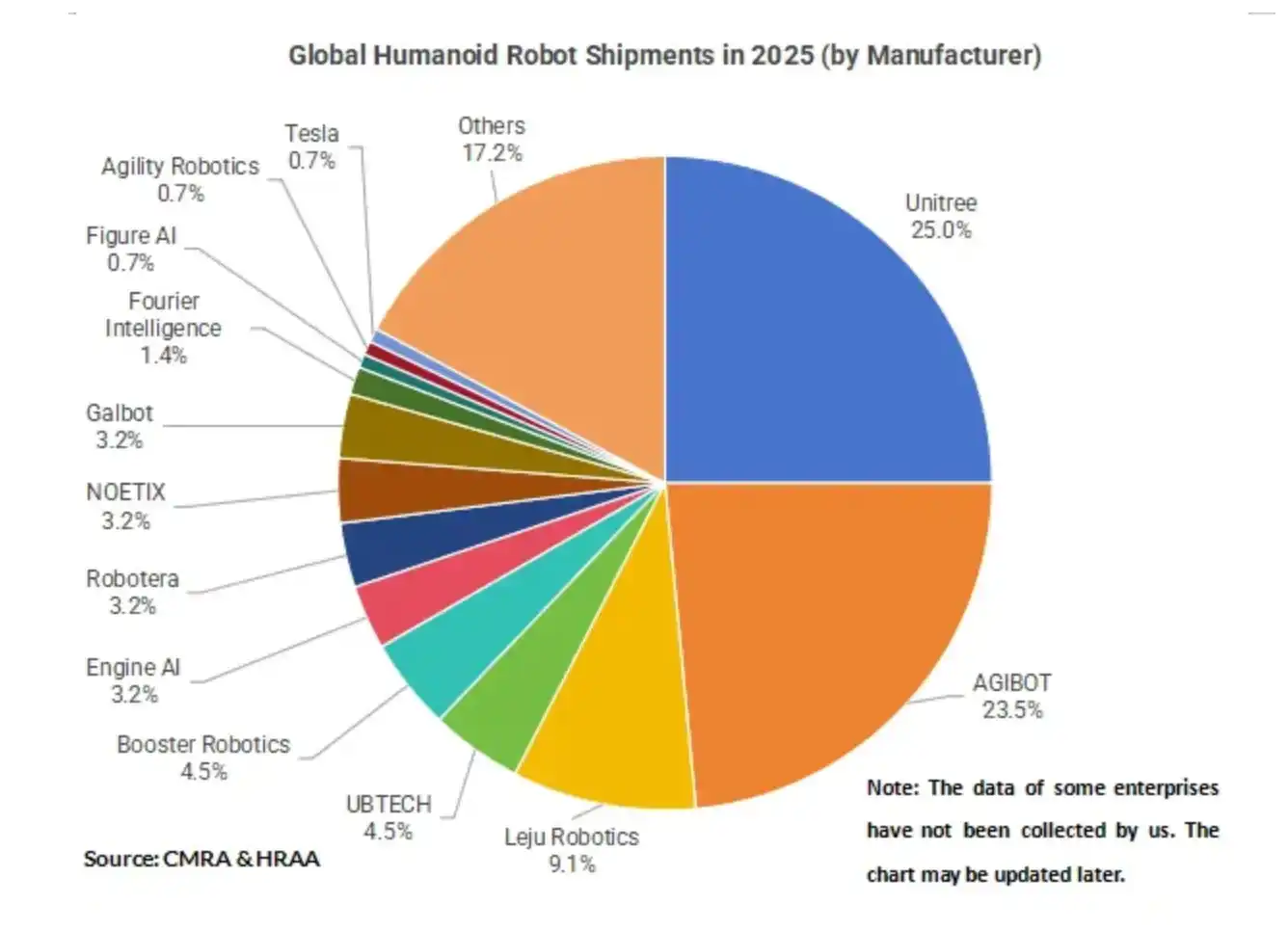
The prospectus sets a 5-year target of producing 75,000 humanoid robots and 115,000 quadruped robots annually. This is about 14 times the 2025 production volume for humanoid robots. This goal is ambitious but also highlights that the industry is still in its very early stages.

Who is Buying Robots

The prospectus categorizes buyers into three groups: Research & Education, Commercial & Consumer, and Industrial Applications.

The stark reality is that most current demand for humanoid robots is concentrated in research and education scenarios.
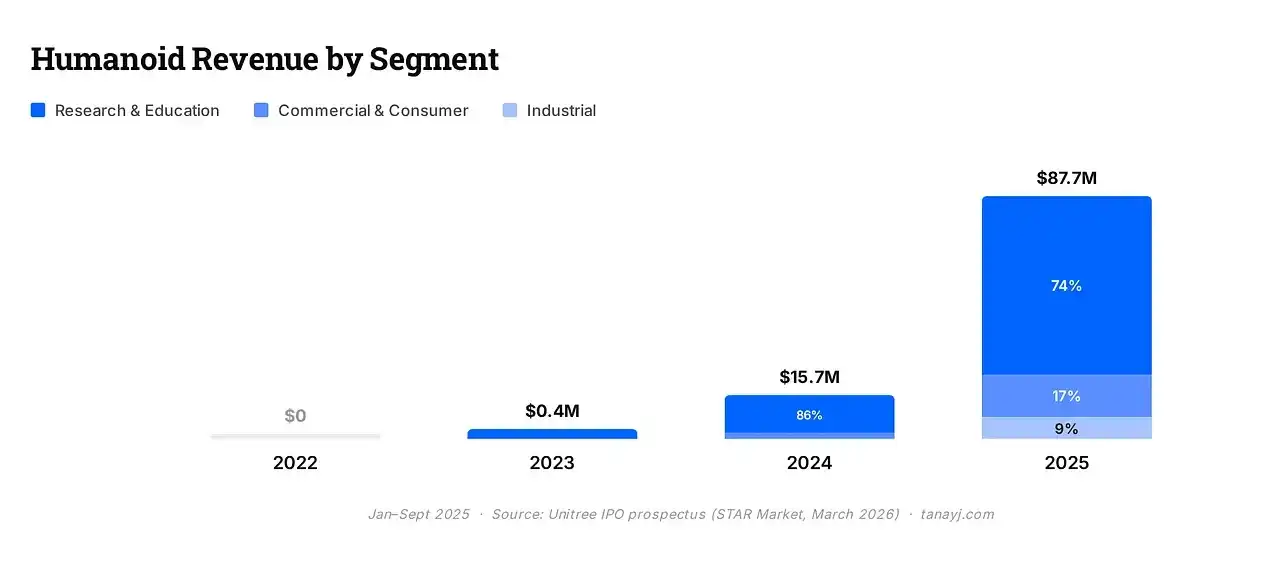
1. Research & Education: Accounts for 74% of humanoid robot revenue/unit sales. Academic buyers have been Unitree's primary customer segment since 2022 and remain the largest source of the company's total revenue.

2. Commercial & Consumer: Accounts for 17% of humanoid robot unit sales. Non-academic consumers buying these robots mostly use them for "display": acting as eye-catching promoters in retail spaces, tourist attractions, performances, and exhibitions. In the first nine months of 2025, consumer-level revenue increased nearly fourfold year-over-year, which sounds impressive but started from a very small base. Today, the most realistic application for a $25,000 humanoid robot seems to be standing at the entrance of a store in Shenzhen to attract customers.

3. Industrial Applications: Accounts for only 9% of humanoid robot unit sales. Unitree also acknowledges that industrial deployment is relatively limited due to immature technology, reflecting the current state of the art. Within this 9%, about 50%-70% is used for scenarios like corporate reception and tour guides. Therefore, comprehensively, the shipment volume of humanoid robots truly used for practical tasks like corporate reception and inspection constitutes only 3%-4%.

The prospects are more promising for quadruped robots (robotic dogs): only about one-third of sales come from research, over 40% from commercial use, and the remainder from industrial use. In this field, production application scenarios are already more mature. Its clients include State Grid, China Southern Power Grid, PetroChina, Sinopec, Baowu Group, and JD.com (JD.com is Unitree's largest customer). These companies use quadruped robots for genuine daily inspections of chemical plants, substations, coal mines, pipelines, etc.
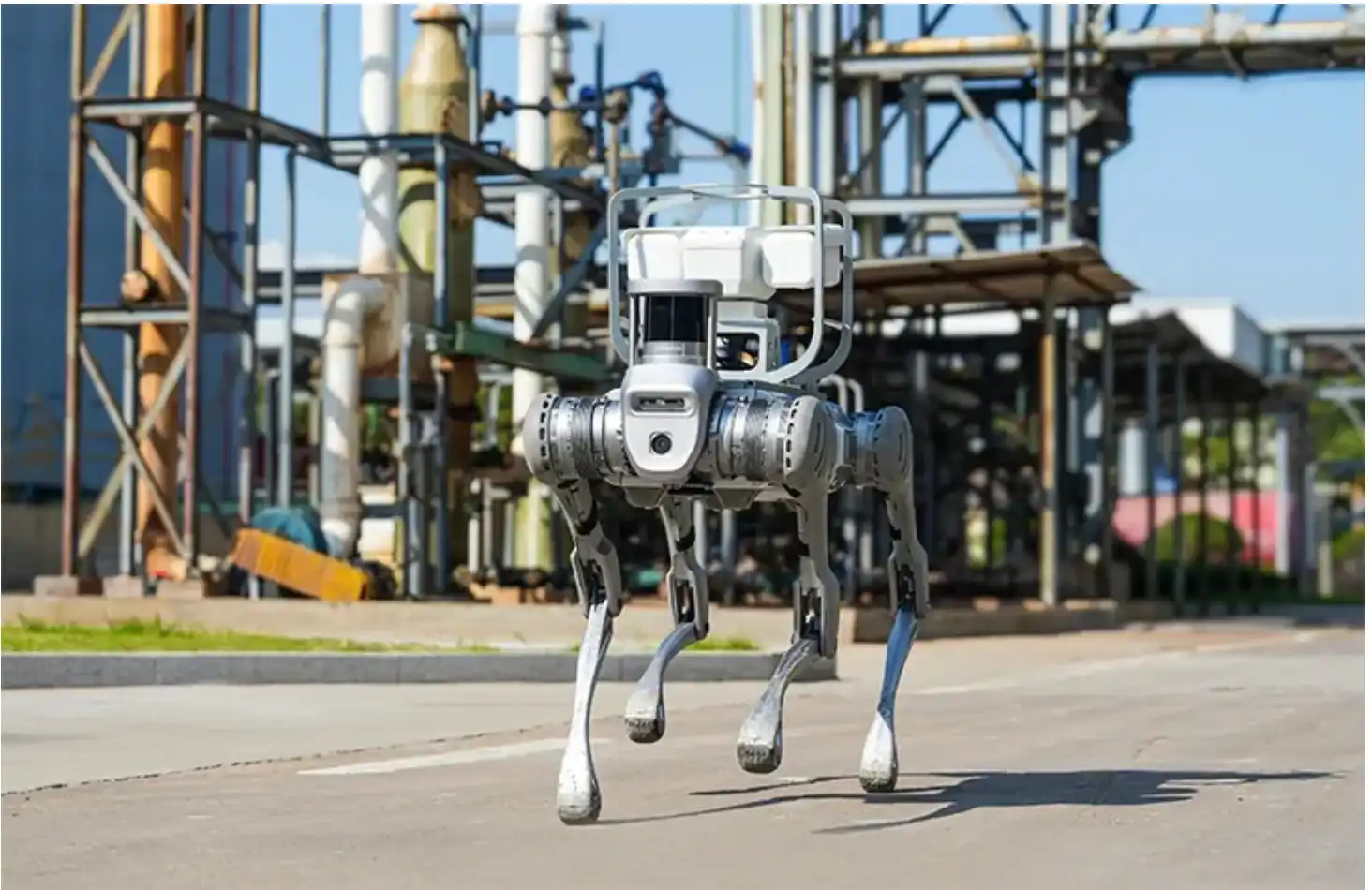
Unitree quadruped robots used for inspection tasks

Vertically Integrated Business Model

One of the unique aspects of Unitree Robotics is its ability to independently design and manufacture most core components: high-torque motors, precision reducers, encoders, joint modules, intelligent controllers, high-precision sensors, dexterous hands, LiDAR, and cameras. According to McKinsey data, actuators (i.e., motors, reducers, and joint systems that drive robot movement) typically account for 40%-60% of the total Bill of Materials (BOM) cost for a humanoid robot.

Most companies in this field rely on external sourcing, while Unitree manufactures in-house. Externally purchased components account for only about 14%-18% of its total cost. It outsources only generic parts like battery cells, flash memory, and differentiated components like core computing boards.

Thanks to this, the unit manufacturing cost for quadruped robots dropped from about $3,300 in 2022 to around $1,800 in mid-2025, a decrease of 46%. During the same period, the cost for humanoid robots also decreased from about $10,800 to $9,200.

Interestingly, as shown in the chart below, although the Average Selling Price (ASP) for both quadruped and humanoid robots has declined year by year, their gross margin has actually increased throughout the period due to their highly vertical integration strategy: soaring from around 45% in 2022-2023 to nearly 60% in 2025.
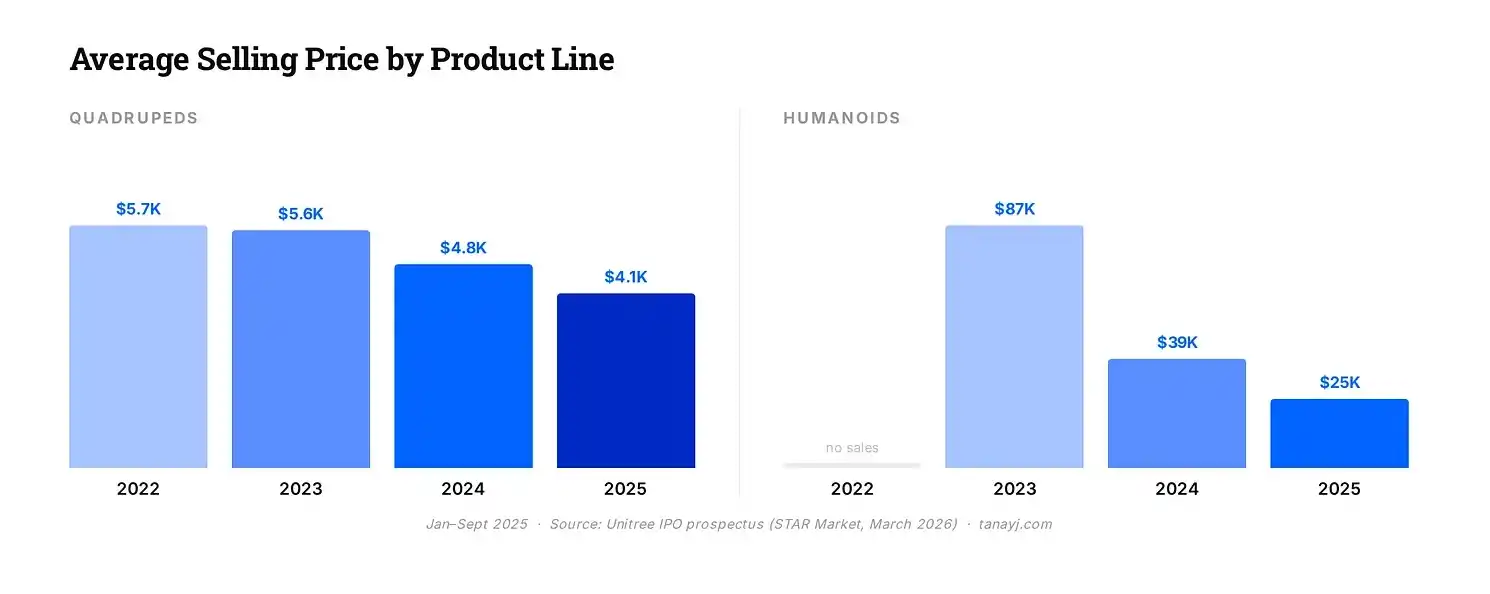
Note: Unitree sold only 5 humanoid robots in 2023, so the ASP for that year is not representative.

Financial Overview

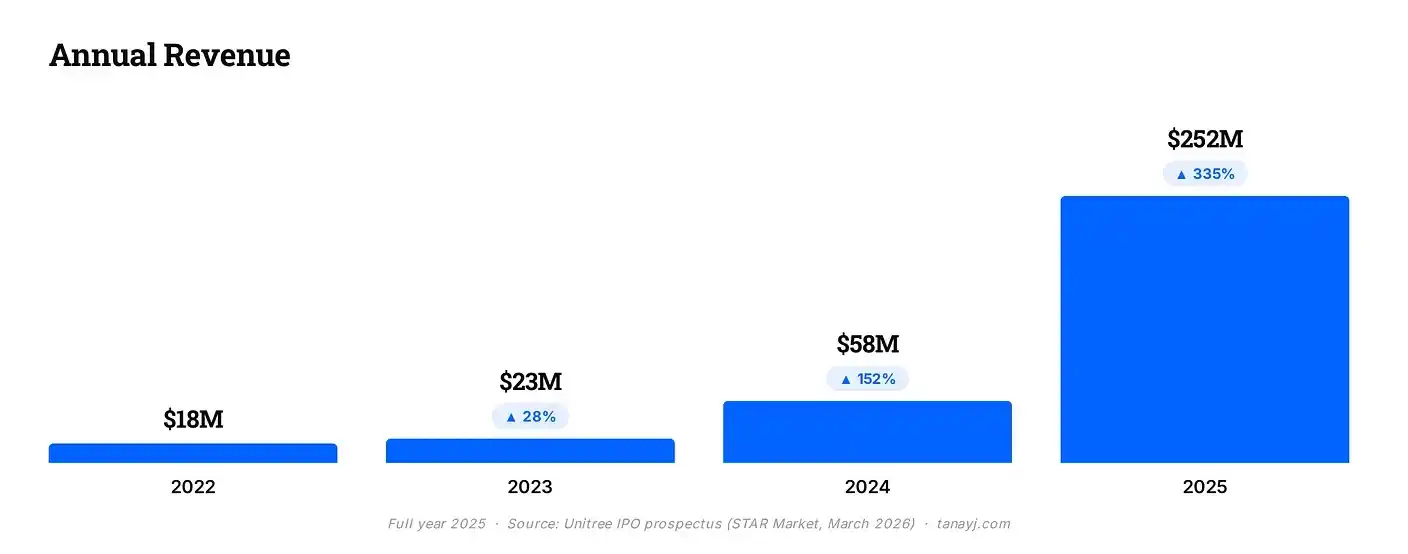
Driven by strong growth in the humanoid robot business, the company's revenue skyrocketed from $58 million in 2024 to approximately $252 million in 2025, an increase of 335%. For most of its history, international sales accounted for over 55% of revenue. In 2025, domestic Chinese market revenue surpassed exports for the first time, although overseas export revenue still doubled year-over-year in absolute terms.
The gross margin is close to 60% and has been increasing in recent years, as detailed below.
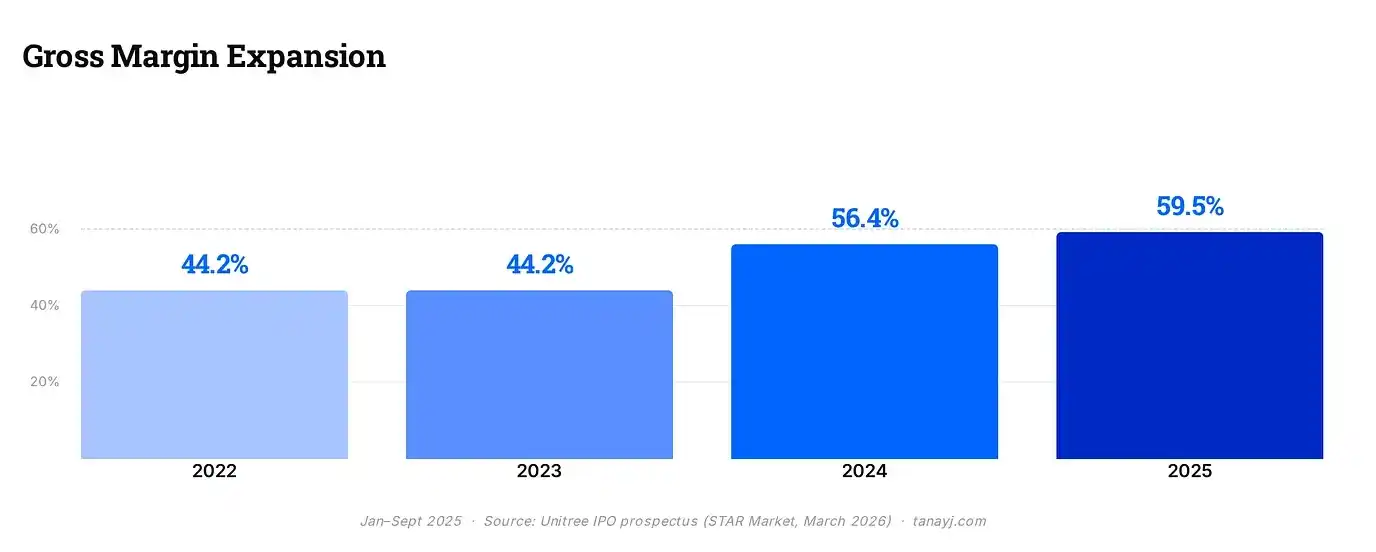
For comparison: most hardware companies have gross margins in the 30%-40% range, while software companies typically achieve 70%-80%. For a company selling physical robots, Unitree's gross margin is quite high, entirely thanks to their vertical integration model and the strong differentiation of their current products.

The company became profitable in 2024 (under US GAAP) with a profit margin of about 18%, and close to 35% on an adjusted basis.
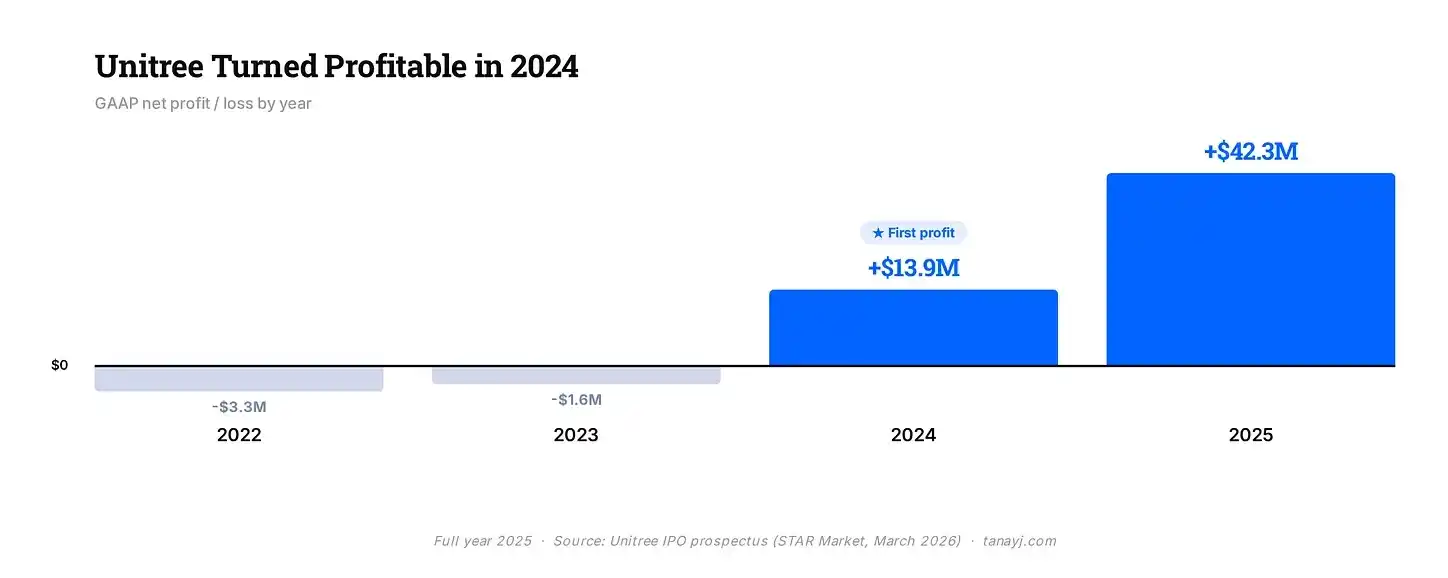
Unitree Robotics' target valuation in this IPO is approximately $6 to $7 billion.

Model-Layer Vision

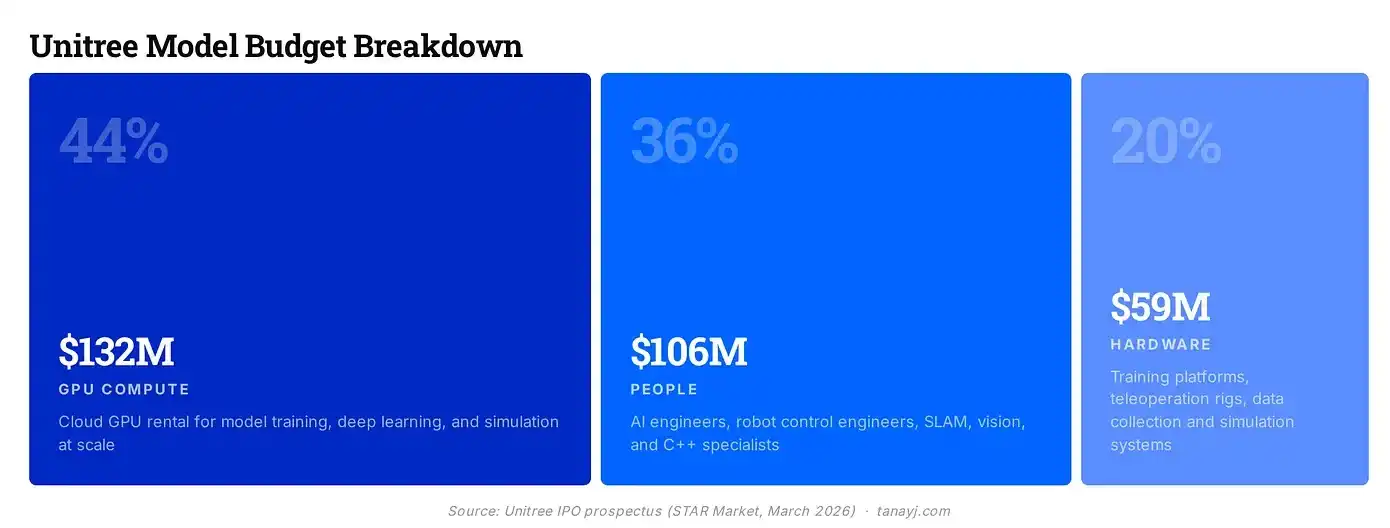
Unitree plans to invest nearly half of its IPO proceeds into software development. Of the $620 million raised, about $300 million is designated for AI model training over the next three years, equating to roughly $100 million per year for developing an "Embodied Large Model."

The prospectus describes two parallel model architectures:

  • The first is the VLA (Vision-Language-Action) Model: This model directly maps visual and language inputs to motion commands, enabling robots to generalize and handle unfamiliar tasks without manually written code instructions.

  • The second is the WMA (World Model + Action) Model: Unitree sees this as the more promising approach. The WMA model can construct internal simulations of physical reality. The robot predicts what will happen before taking action, rather than learning purely through trial and error.

Unitree has already released initial versions of these two models. In September 2025, Unitree open-sourced UnifoLM-WMA-0; in January 2026, it open-sourced UnifoLM-VLA-0.

Unitree also detailed the approximate expenditure breakdown for this model, as shown below:
Unitree's current lead in hardware is undeniable. However, the company recognizes that to maintain a lasting moat in robotics, it may be necessary to also control the model layer: the "brain" system that determines what the robot does and how it moves. Furthermore, its software ambitions serve as a hedge against hardware commoditization (low-price competition). Unitree has built a moat in hardware manufacturing.

However, if actuators and joint modules eventually become standardized components like batteries in electric vehicles, the industry's defenses and competitive barriers will inevitably shift to the model layer.

Conclusion

Unitree Robotics has a profitable hardware business, a solid manufacturing moat, and more humanoid robots than any other company, all at highly competitive prices. However, as reflected in the actual uses of humanoid robots, widespread commercial adoption is still in its infancy. "Display-type" applications dominate consumer demand, while industrial deployment remains relatively limited.

Unitree Robotics offers a glimpse into the current state of the robotics market, and more breakthroughs in models, hardware, and application scenarios are anticipated in the future.

Related Reading: An Overview of Over 30 Humanoid Robot Companies: Who Will Stand Out in 2026?

Related Questions

QWhat are the two main categories of robots sold by Unitree Robotics?

AUnitree Robotics primarily sells two categories of robots: Quadruped Robots (Robotic Dogs) such as Go2, B2, and A2, and Humanoid Robots including H1, H2, G1, and R1.

QHow has Unitree's revenue composition shifted from 2023 to 2025?

AUnitree's revenue has significantly shifted from quadruped robots to humanoid robots. In 2023, humanoid robots accounted for only 1.9% of revenue. By the first three quarters of 2025, they constituted over half of the company's revenue.

QWhat is the largest customer segment for Unitree's humanoid robots currently, and what are the main use cases for other segments?

ACurrently, the largest customer segment for Unitree's humanoid robots is Scientific Research & Education, accounting for 74% of sales. The Commercial & Consumer segment (17% of sales) primarily uses robots for promotional 'display' purposes. The Industrial Application segment (9% of sales) is still limited, with a significant portion within it used for enterprise reception and tour guidance rather than core operational tasks.

QWhat key factor contributes to Unitree's exceptionally high gross margin (nearly 60%) for a hardware company?

AUnitree's high gross margin is primarily attributed to its vertically integrated business model. The company designs and manufactures most of its core components in-house, such as motors, gear reducers, joint modules, and sensors. This level of control reduces reliance on external suppliers and allows for significant cost reductions, which has led to rising margins even as average selling prices have declined.

QWhat is a primary strategic reason for Unitree planning to invest heavily in AI model development with its IPO proceeds?

AA primary strategic reason for Unitree's planned heavy investment in AI model development is to build a lasting competitive moat in the software 'brain' layer. This is intended as a hedge against the potential future commoditization of hardware components. By controlling the embodied AI models that dictate robot actions, Unitree aims to maintain its competitive edge even if hardware like actuators eventually becomes standardized.

Related Reads

Near Returns to the AI Stage: Transformation into a Public Chain Due to 'Payroll Difficulties,' Agent and Privacy Emerge as New Growth Narratives

NEAR Returns to AI Origins: From Payroll Struggles to Blockchain, Now Focusing on AI Agents and Privacy NEAR Protocol's journey began not with grand blockchain ambitions, but from a practical hurdle: its AI startup founders, including Transformer paper co-author Illia Polosukhin, couldn't efficiently pay international developers in 2017. This led them to pivot and build a high-performance, scalable blockchain. After years navigating various crypto narratives like sharding and cross-chain interoperability, NEAR is now leveraging its AI roots to re-enter the AI arena. A key driver is its "NEAR Intents" layer, which abstracts complex cross-chain transactions. Users simply state their goal (e.g., swap BTC for ETH), and a solver network finds the optimal route. This system has processed over $20B in cross-chain volume, generating significant fee revenue. A major growth area is private transactions via "Confidential Intents/Swaps," which hide trade details until settlement to protect against MEV and front-running. Remarkably, private swaps recently accounted for over 40% of NEAR's transaction volume, highlighting strong demand but also potential regulatory scrutiny. With its AI-founder pedigree, NEAR is positioning itself at the intersection of blockchain, AI agents, and privacy, aiming to become infrastructure for the emerging agent economy while navigating the challenges of its rapid adoption.

marsbit47m ago

Near Returns to the AI Stage: Transformation into a Public Chain Due to 'Payroll Difficulties,' Agent and Privacy Emerge as New Growth Narratives

marsbit47m ago

From Ethereum to AI's 'CROPS': What Exactly is This Set of 'Slow Variables' That Vitalik Repeatedly Emphasizes?

In recent discussions, Vitalik Buterin has frequently emphasized the concept of "CROPS," a framework defining core values for Ethereum's development. CROPS stands for Censorship Resistance, Capture Resistance, Open Source, Privacy, and Security. Initially outlined in the Ethereum Foundation's "EF Mandate," it represents a commitment to user sovereignty, ensuring that the network resists external control, remains open, protects privacy, and prioritizes security. The relevance of CROPS extends beyond Ethereum's foundational principles, becoming crucial in the context of AI integration. As AI agents begin handling wallet operations and automated transactions, the risk increases that users may cede control over their digital assets, privacy, and intentions to centralized AI service providers. A "CROPS AI" would therefore emphasize local execution where possible, privacy-preserving remote model calls (e.g., using zero-knowledge proofs), and transparent, verifiable processes to maintain user agency. Vitalik highlights a significant convergence between "CROPS Ethereum access layer" and "CROPS AI." Both address the same fundamental challenge: how users can access powerful services—be it blockchain data via RPCs or AI models—without exposing sensitive information or relinquishing ultimate control. This intersection points toward a future digital entry point that is more private, secure, and user-controlled. Ultimately, CROPS is not merely an abstract ideal but a practical guidepost. It steers development—from protocol resilience and wallet design to AI agent safety—towards a future where users retain self-sovereignty even as digital systems grow more complex and powerful. In an era of accelerating AI adoption, these "slow variables" of censorship resistance, openness, privacy, and security may define Ethereum's enduring value.

marsbit58m ago

From Ethereum to AI's 'CROPS': What Exactly is This Set of 'Slow Variables' That Vitalik Repeatedly Emphasizes?

marsbit58m ago

Silicon Valley 'Startup Guru' Steve Hoffman: Web3 + AI Could Be a Trap

Silicon Valley investor and "Godfather of Startups" Steve Hoffman warns that combining Web3 with AI is likely a trap, not a promising venture. In an interview, Hoffman argues that while AI is a foundational technology touching all industries, Web3 adds complexity, friction, and regulatory risk without solving mainstream consumer or business needs. He advises founders to focus on deep, specialized applications where startups can out-iterate giants, rather than on generic features easily replicated by large tech companies. Hoffman observes that Silicon Valley will lead foundational AI research, while China excels at rapid, large-scale application and commercialization, particularly in robotics. He stresses that AI-driven autonomous agents capable of collaborative, multi-step tasks are 2-4 years away, which will cause significant job displacement. The solution is not to slow AI but to redesign business models around human-AI collaboration and reform social systems like education and retraining. For startups, Hoffman recommends focusing on vertical, expertise-heavy domains to build defensibility. He sees major opportunities in AI fraud detection and cybersecurity. Key founder mindsets include systemic thinking over feature-focus, relentless customer centricity, building adaptive teams, and deeply understanding AI's capabilities and limits. Hoffman is also leading a non-profit initiative to establish university centers aimed at training future leaders in responsible, human-value-aligned AI innovation.

marsbit2h ago

Silicon Valley 'Startup Guru' Steve Hoffman: Web3 + AI Could Be a Trap

marsbit2h ago

Token Inefficient, Economy Tokenless

The article "Tokens Aren't Economical, Economics Aren't Tokenized" analyzes a pivotal shift in the AI industry from a technology-driven narrative to one dominated by capital efficiency. It highlights two concurrent trends: a severe capital shortage due to the exorbitant and recurring costs of compute (e.g., OpenAI's high burn rate) and a wave of corporate spin-offs where major tech companies are separating their AI units (like Kuaishou's Kling and Baidu's Kunlunxin). The core argument is that AI's "anti-internet" business model, where user growth increases costs rather than profits, has created a disconnect between high valuations and actual cash flow. Spin-offs address this by allowing AI assets to be valued independently. Within a parent company, they are seen as cost centers, but as standalone entities, they are priced based on their growth potential and scarcity in the primary market, leading to massive valuation premiums (e.g., Kling's estimated value tripling post-spin-off). The industry is at an inflection point, moving from "model worship" to "value realization." The competition is evolving from a pure compute (GPU) race to a broader focus on systemic efficiency and full-stack engineering (involving CPUs and orchestration) to achieve viable commercialization. The year 2026 is framed as a critical moment where the industry must definitively answer how to economically translate AI capability into tangible business value, reshaping the sector's future power structure.

marsbit2h ago

Token Inefficient, Economy Tokenless

marsbit2h ago

Trading

Spot
Futures

Hot Articles

Discussions

Welcome to the HTX Community. Here, you can stay informed about the latest platform developments and gain access to professional market insights. Users' opinions on the price of S (S) are presented below.

活动图片