Trump's Playbook: Now Entering Step Nine

marsbitPublished on 2026-04-08Last updated on 2026-04-08

Abstract

The Kobeissi Letter reports that the U.S.-Iran-Israel two-week ceasefire agreement announced by Trump marks the arrival of Step 9 in a recurring "conflict playbook"—agreement and narrative framing. This follows a consistent pattern in Trump’s negotiation strategy: escalating pressure to force concessions, followed by a transactional resolution. The announcement, similar to the 90-day tariff pause in April 2025, signals a potential final deal involving regional security frameworks or sanctions relief tied to compliance. Step 10—violent market repricing—is expected in the coming weeks. Defensive positioning, including elevated energy exposure and compressed equity risk, may lead to rapid unwinding, causing a sharp rally in stocks and a drop in oil prices due to eased supply concerns. Historical precedents (April and August 2025, January 2026) show such announcements trigger abrupt, concentrated market moves. Pattern recognition remains highly profitable in this environment.

Original Author: Zhao Ying

Original Source: Wall Street News

The ceasefire agreement between the U.S. and Iran is unfolding precisely according to a repeatedly validated script.

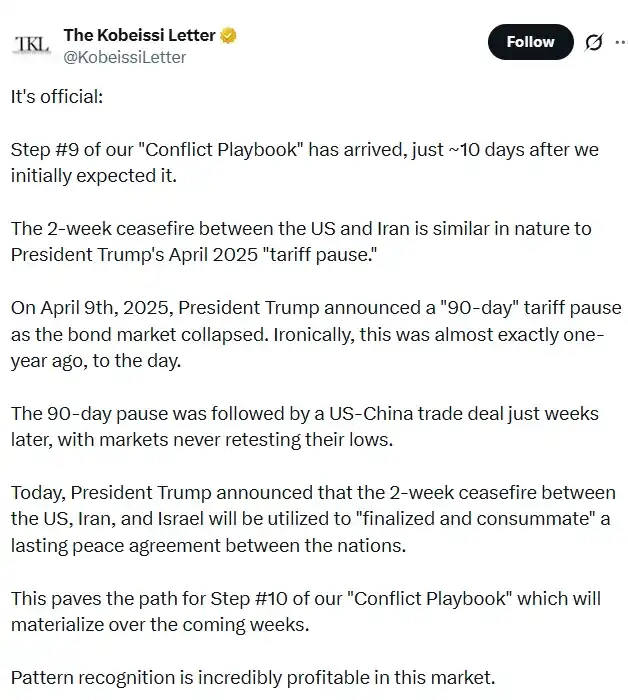
The independent U.S. macro research firm The Kobeissi Letter recently stated that with Trump's announcement of a two-week ceasefire agreement between the U.S., Iran, and Israel, the ninth step of the "conflict script" it has been tracking has officially arrived, namely the agreement's conclusion and the construction of a narrative framework. This arrival is about 10 days later than the firm's previous expectation.

The Kobeissi Letter stated that, according to Trump's playbook, every major confrontation within Trump's framework ultimately concludes with a narrative of "maximum pressure in exchange for concessions."

The potential impact of this development on the market cannot be ignored. The Kobeissi Letter pointed out that the tenth step—the violent market repricing following the formal announcement of the agreement—will arrive in the coming weeks. At that time, investors who have long held defensive positions will face pressure to rapidly close their positions, potentially leading to a sharp rally in stocks, while oil prices may plummet swiftly as expectations for the reopening of shipping routes solidify.
Ceasefire and Tariff Suspension: The Same Logic

According to CCTV News, a message from the Iranian side in the early hours of the 8th local time stated that Pakistani Prime Minister Shehbaz Sharif has invited Iranian and U.S. delegations to the capital, Islamabad, for negotiations. Shehbaz Sharif also stated that the ceasefire between Iran and the U.S. would take effect at 3:30 AM Iran time (8:00 AM Beijing time) on the 8th. Trump stated that this ceasefire window would be used to "finalize and facilitate" the signing of a lasting peace agreement among the parties.

The Kobeissi Letter compared this two-week U.S.-Iran ceasefire to Trump's announcement of a "90-day tariff suspension" in April 2025, noting that the two are highly similar in nature.

On April 9, 2025, against the backdrop of severe bond market turbulence, Trump announced a 90-day suspension of tariff increases on most trading partners. In the following weeks, the U.S.-China trade agreement was subsequently finalized, and the market did not retest its previous lows. The Kobeissi Letter pointed out that the timing of this ceasefire announcement is almost exactly one year apart from the aforementioned tariff suspension.

The firm believes this pattern is not coincidental. Since taking office in January 2025, Trump has followed a highly consistent negotiation logic in tariff wars, Venezuela, Greenland negotiations, and the Iran issue: verbal pressure, maximum pressure to extract concessions, ultimately concluding with a "deal."

Step Nine: Constructing the Agreement Narrative

According to the 10-step "conflict script" outlined by The Kobeissi Letter, the core of the ninth step is the agreement's conclusion and the construction of its narrative framework.

The firm pointed out that every major confrontation within Trump's framework ultimately concludes with the narrative of "maximum pressure in exchange for concessions." This pattern has been confirmed in trade agreements with the EU and India, corporate negotiations in sectors like Intel and rare earths, as well as the multiple conflicts Trump helped end in 2025.

Regarding the Iran issue, The Kobeissi Letter believes that if the Iranian government does not collapse, the final agreement might involve a ceasefire arrangement linked to the nuclear issue, a regional security framework with enforcement mechanisms, or a sanctions adjustment plan conditional on compliance benchmarks. The firm emphasized that "the specific architecture is far less important than the timing and the narrative framework."

Step Ten: Awaiting the Violent Repricing

The Kobeissi Letter warns investors that market repricing following an agreement announcement is often sudden, not gradual.

The reason is that current market participants are generally in defensive positions—energy exposure is high, stock risk has been compressed, and volatility remains elevated due to implicit uncertainty. Once this uncertainty abruptly dissipates, these positions will be closed rapidly, creating a concentrated market shock.

Citing historical cases from April, August, and October 2025, and January 2026, the firm pointed out that following the announcement of each tariff suspension or framework agreement, the stock market experienced significant sharp rallies, while oil prices plummeted swiftly as expectations for the reopening of shipping routes solidified. The Kobeissi Letter concluded: "Pattern recognition holds extremely high profit value in this market."

Related Questions

QWhat is the significance of the 'Step 9' in the Kobeissi Letter's conflict playbook according to the article?

AStep 9 signifies the formal arrival of an agreement and the construction of a narrative framework, which in this case is the announcement of a two-week ceasefire between the US and Israel.

QWhat market event does The Kobeissi Letter predict will follow the ceasefire announcement (Step 9)?

AThe Kobeissi Letter predicts that Step 10, a violent market repricing, will arrive in the coming weeks, characterized by a potential sharp rally in stocks and a rapid drop in oil prices.

QHow does the article compare the recent Iran-US ceasefire to a previous event from April 2025?

AThe article compares it to the '90-day tariff pause' announced in April 2025, noting they are highly similar in nature as both involved de-escalating pressure to secure concessions, followed by a market that did not retest its previous lows.

QWhat is the core negotiation logic that the article attributes to former President Trump across various conflicts?

AThe core logic is described as a pattern of verbal pressure, maximum pressure to extract concessions, and ultimately concluding with a 'deal' or transaction.

QWhy does the market repricing happen suddenly rather than gradually after such agreements, according to the analysis?

ABecause market participants are generally in defensive positions with high energy exposure, compressed equity risk, and elevated volatility. When uncertainty suddenly dissipates, these positions are forced to unwind quickly, creating a concentrated market shock.

Related Reads

WeChat Agent Issues a 'Heroic Summons,' Half of the Internet Responds

WeChat AI Agent is on the horizon. The WeChat Open Platform has issued a guide for developers, offering them ways to integrate into the WeChat AI ecosystem. This will enable mini-programs to be discovered and invoked by the AI. Meituan has already announced its integration, allowing users to access services like food delivery through WeChat AI. Other platforms like Ctrip and Tongcheng have followed suit. Furthermore, WeChat is collaborating with major smartphone manufacturers to enable their native AI assistants to perform actions within WeChat, such as initiating calls or sending messages, through a controlled protocol called Agent-to-Agent (A2A). Reports indicate the WeChat AI Agent will be accessible by swiping right on the main interface. It aims to understand user intent within the rich context of chats, groups, and past interactions, then automatically call upon relevant mini-programs to complete tasks like ordering coffee or booking restaurants. This positions it as a potential "super app" with direct access to WeChat's vast ecosystem of services, social connections, and payment systems. Technically, this is a complex endeavor. It requires advanced natural language understanding, a "world model" to predict interactions within mini-programs (UI-Oceanus), multi-model orchestration for cost efficiency, and careful coordination with millions of third-party service providers. Tencent's development follows a "Co-Design" approach, where product teams and the Hunyuan model team collaborate closely, allowing capabilities honed in other AI products (like Yuanbao for chat, ima for search, WorkBuddy for office tasks) to be transferred to the WeChat Agent. Tencent is strategically opting for the A2A protocol over GUI-based automation (which it has blocked in the past), maintaining control over its ecosystem. To manage the immense scale and cost of serving 1.4 billion monthly active users, Tencent is deepening its ties with DeepSeek, known for its cost-effective training, to secure a low-cost inference backbone. The ultimate goal is to solve practical, everyday problems for users within the WeChat ecosystem, moving beyond technical benchmarks to deliver real utility, which Tencent sees as the key to winning in the long-term AI game.

marsbit1h ago

WeChat Agent Issues a 'Heroic Summons,' Half of the Internet Responds

marsbit1h ago

Humanity Loses $31 Million in Attack, Token Price Plummets 90% Due to a Single Private Key

On June 9th, the digital identity project Humanity Protocol suffered a major security breach resulting in over $31 million in losses. According to on-chain analyst Specter, hundreds of wallets holding the project's H token were drained. The attack was confirmed by founder Terence Kwok to be caused by the compromise of a foundation member's private key. As a precaution, users are advised to avoid interacting with Humanity's cross-chain bridge or liquidity pools. The incident caused the H token price to crash over 90%, from around $0.70 to a low of $0.052, wiping its market cap from $2 billion to approximately $35.7 million. The attacker allegedly minted 100 million new H tokens and is selling them for BNB. This breach adds to existing controversies surrounding Humanity Protocol. Founded in 2024, it aimed to verify human users via palm-print biometrics and zero-knowledge proofs. However, a leaked conversation in 2025 revealed that only about 1 million of its 9 million claimed Human IDs had completed biometric verification, suggesting 88% might be bots. Furthermore, the project has faced allegations of being a repackaged product from a Chinese access control vendor, raising privacy and authenticity concerns. Founder Terence Kwok's previous venture, Tink Labs, a hotel smartphone startup that raised $170 million, failed and entered bankruptcy in 2020 after burning through its funding. The current attack highlights the persistent critical issue of private key management in crypto. Unlike smart contract exploits, a private key compromise bypasses all on-chain security mechanisms. With no user compensation plan announced yet, this $31 million breach may be a final blow to the project's credibility, already weakened by previous controversies and a heavily depreciated token.

marsbit2h ago

Humanity Loses $31 Million in Attack, Token Price Plummets 90% Due to a Single Private Key

marsbit2h ago

Trading

Spot
Futures

Hot Articles

Discussions

Welcome to the HTX Community. Here, you can stay informed about the latest platform developments and gain access to professional market insights. Users' opinions on the price of S (S) are presented below.

活动图片