Trading Moment: Crude Oil, US Dollar, and US Treasury Yields Rise Amid War, Bitcoin Holds Steady Above $70,000 Against Macro Headwinds

marsbitPublished on 2026-03-13Last updated on 2026-03-13

Abstract

Amid escalating US-Iran tensions, Brent crude oil surged past $100 per barrel, driving concerns over supply disruptions and inflationary pressures. This triggered a rise in the US dollar and Treasury yields, while US stock indices fell over 1.5%. The conflict has led to significant oil supply disruptions, with warnings that prices could exceed historical highs if the situation worsens. The Fed's rate cut expectations diminished, with traders pricing in less than one 25-basis-point cut for 2026. Despite macro headwinds, Bitcoin held above $70,000 for four consecutive days, consolidating within a $62,000–$72,000 range. Options data showed $1.8 billion in BTC options expiring, with a max pain point at $69,000. Technical indicators suggest support near short-term cost bases, though long-term holder selling pressure exists around $78,880. Market sentiment is mixed: bears warn of a potential drop below $60,000, while bulls highlight strong institutional buying and technical buy signals. Key data showed continued inflows into Bitcoin and Ethereum ETFs, while fear and greed index indicated extreme fear. Notable market events include a $50 million DeFi slippage incident on Aave and several upcoming token unlocks. Top gainers included Pi Network (up 29.7%) and AI-related tokens.

Daily key market review and trend analysis, produced by PANews.

Macro Market

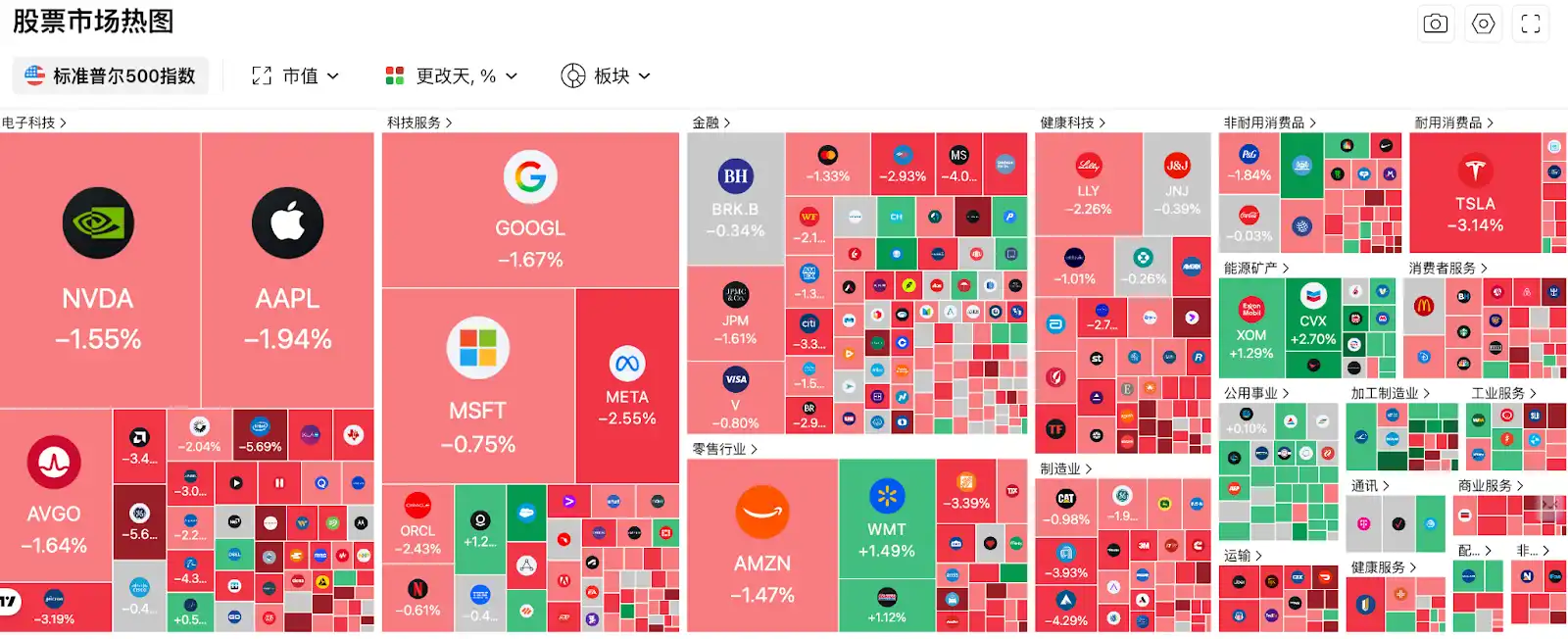
Brent crude oil prices have once again broken through $100 per barrel as the market reprices "supply disruption risks." Crude oil, the US dollar, and US Treasury yields have all risen to their highest levels since the US-Iran-Israel conflict began, while the three major US stock indices all fell by over 1.5%. With the exception of the energy sector, all other sectors are generally under pressure.

The market's main concern is a further escalation of the US-Iran conflict. Both Trump and Iran's new supreme leader have made strong statements, making de-escalation unlikely in the short term. Richard Dalton, the former UK ambassador to Iran, stated that the US-Israel conflict "lacks a clear plan" and could lead to a loss of control. Goldman Sachs warned that if the conflict continues, Brent crude prices could surpass the historical high of $147.50 per barrel set in 2008.

CME CEO Terry Duffy warned that if the US government intervenes in the oil futures market, it could trigger an "epic disaster." In response to soaring oil prices, US Treasury Secretary Besent urgently stated that the US Navy will escort oil tankers passing through the Strait of Hormuz and temporarily allow countries to purchase stranded Russian crude oil to stabilize prices. The International Energy Agency (IEA) pointed out that the war in Iran has caused the largest oil supply disruption in history, further pushing up global inflation expectations.

As oil prices surge and inflationary pressures rise, expectations for Federal Reserve rate cuts have been shattered. Traders are pricing in less than one 25 basis point cut for 2026, and market confidence in the Fed restarting an easing cycle has further weakened. Analysis suggests that rising energy and food prices will have a greater impact on future inflation data, forcing the Fed to maintain high interest rates to address risks.

Amplified by the "weekend effect," market volatility has increased further. Investors, worried about unexpected weekend events, are choosing to exit the market, leading to significant capital outflows. The dual pressures of high oil prices and rising Treasury yields may reshape market trading logic, with the energy sector being sought after while risk assets remain under pressure. Analysts warn that if oil prices remain above $100 for an extended period, trading strategies from the past two years could be completely rewritten.

Bitcoin Market

Bitcoin has been consolidating in the $62,000 to $72,000 range for over a month. Despite the spread of the US-Iran war and 1.85 million continuing US jobless claims adding to macro gloom, Bitcoin has defied macro headwinds and geopolitical turmoil, maintaining its price above $70,000 for four consecutive days.

In terms of options, data from [email protected] shows that $1.8 billion worth of BTC options expired today, with a max pain point of $69,000. Notably, today's expiring options account for only 6% of the total open interest, the lowest level in recent years, indicating extremely low Bitcoin trading activity. However, this week's max pain point did not continue to decline, marking the first rebound in the downward trend seen over recent months.

The current BTC price is stuck between the realized price of $54,400 and the true market average price of $78,000. After rebounding 17% from below $60,000, the 1 to 4-week short-term cost line has found temporary support. However, there is selling pressure from 2.42 million coins held by long-term holders (1-2 years) at the $78,880 level. The options market has accumulated $180 million in Gamma risk (an options risk indicator) at the $74,000 level for March 20th.

The miner shutdown price range of $62,000 to $70,000 is being severely tested, with macro support from the 200-week moving average ($68,000) and the 300-week moving average ($57,000) in jeopardy. However, the BTC/Gold ratio is showing a bullish divergence at the key support level of 12-13. Coupled with the historical pattern of the S&P 500 rebounding 19% after a 16% pullback in US midterm election years and BTC rebounding 54% after a 56% crash, CryptoQuant's Bull Market Score Index has jumped from 10 to 30, suggesting the market is brewing hopes for a reversal amid panic.

Bearish Views

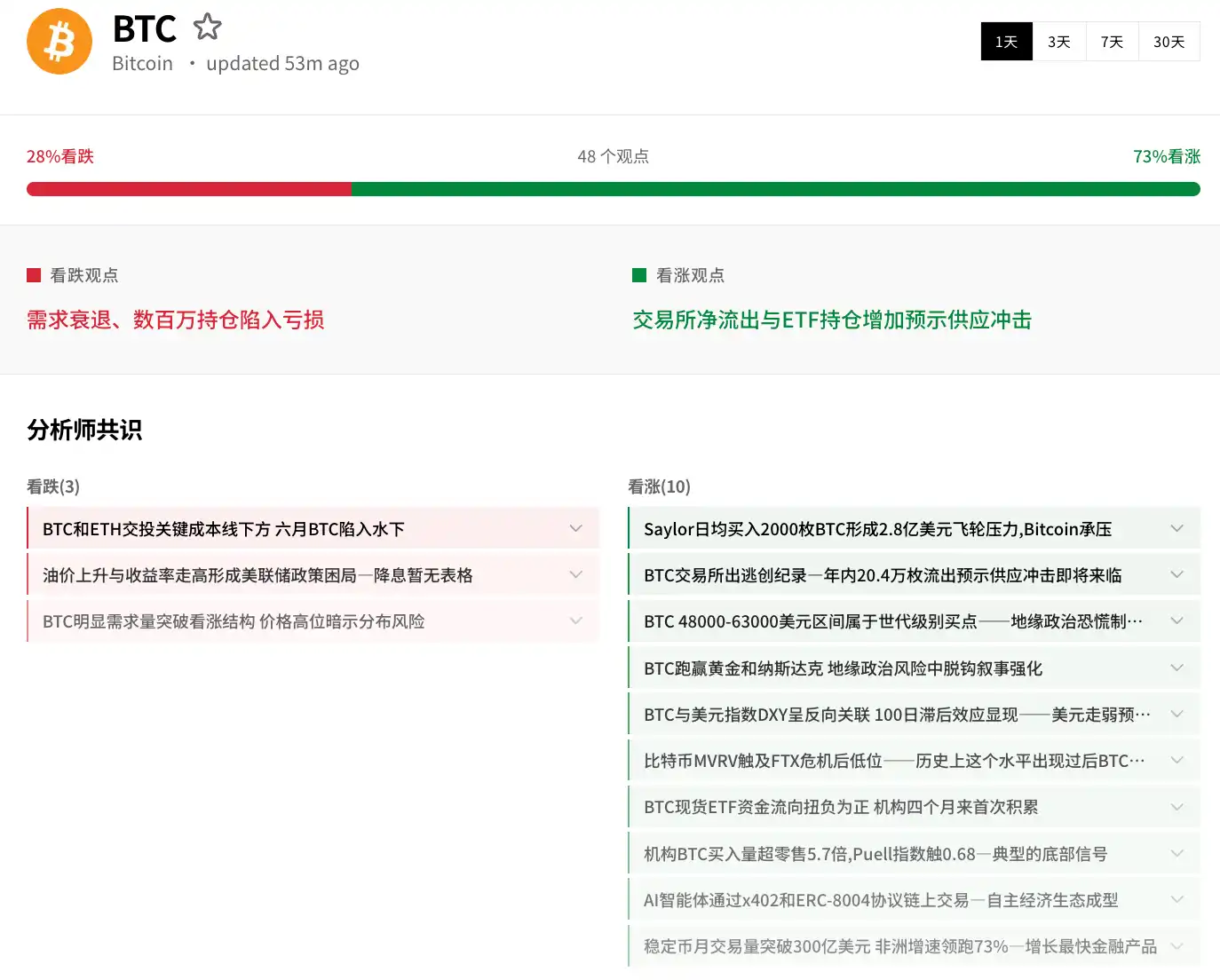
The core logic of the bear camp is that the current rise is merely a dead cat bounce and liquidity sweep, miners are in a dire state of bleeding, and the macro downtrend has not reversed.

  • KillaXBT warns that if key support cannot be held, the market will inevitably bleed lower, with a macro target pointing squarely below 60K.

  • Murphy expects the weak rebound to peak between $74,000 and $79,000 and plans to short decisively when that range is touched.

  • Greeny points out that miners' survival line is being breached, the 200-week MA is an extremely dangerous false support, and breaking to lower levels is only a matter of time.

  • Donaxbt直言当前走势是典型的“死猫反弹”,预计在触及上方阻力后将继续顺应宏观趋势下跌。 (Donaxbt states plainly that the current price action is a typical "dead cat bounce" and expects it to continue falling in line with the macro trend after hitting resistance above.)

  • LP_NXT observes significant selling pressure above and believes the market is more likely to test deeper liquidity on the downside.

Bullish Views

The core logic of the bull camp is that technicals are showing rare strong buy signals, and institutional spot buying is aggressively accumulating regardless of price.

  • Shang notes that TradFi buying has强势回归 (强势回归 - strongly returned), with geopolitical避险资金 (避险资金 - risk-off capital) voting with their feet, shifting massively from traditional safe-haven assets to the crypto market.

  • Sykodelic emphasizes that the current move is绝非2022年的翻版 (绝非2022年的翻版 - definitely not a repeat of 2022), with multiple technical indicators forming golden crosses and buy signals, inevitably pushing prices higher.

  • Daan Crypto Trades says the market has seen its first solid weekly green candle in nearly two months, indicating bottom support has emerged.

  • Titan of Crypto asserts that a strong break above the resistance zone of the true market average price will彻底终结下跌趋势,迎来宏观反转 (彻底终结下跌趋势,迎来宏观反转 - completely end the downtrend and usher in a macro reversal).

Market Dynamics

Yesterday, a whale attempted to exchange $50 million USDT for AAVE on the Aave interface but ignored the slippage warning, ultimately receiving only 324 AAVE, resulting in nearly $50 million evaporating. This slippage disaster sparked intense debate within the industry about DeFi safety rails. Aave founder Stani.eth urgently responded, confirming the system had fulfilled its warning obligations but, out of sympathy, promised to refund $600,000 in transaction fees and called for the industry to establish better user protection mechanisms.

Key Data (As of March 13, 13:00 HKT)

(Data sources: CoinAnk, Upbit, SoSoValue, CryptoBubbles)

  • Bitcoin ETF: +$53.8681 million, net inflows for 4 consecutive days

  • Ethereum ETF: +$72.3677 million, net inflows for 3 consecutive days

  • XRP ETF: -$6.0806 million

    SOL ETF: +$3.9248 million

  • Fear & Greed Index: 15 (Extreme Fear)

  • Upbit 24h Trading Volume Ranking: XRP, BTC, ETH, ENSO, NOM

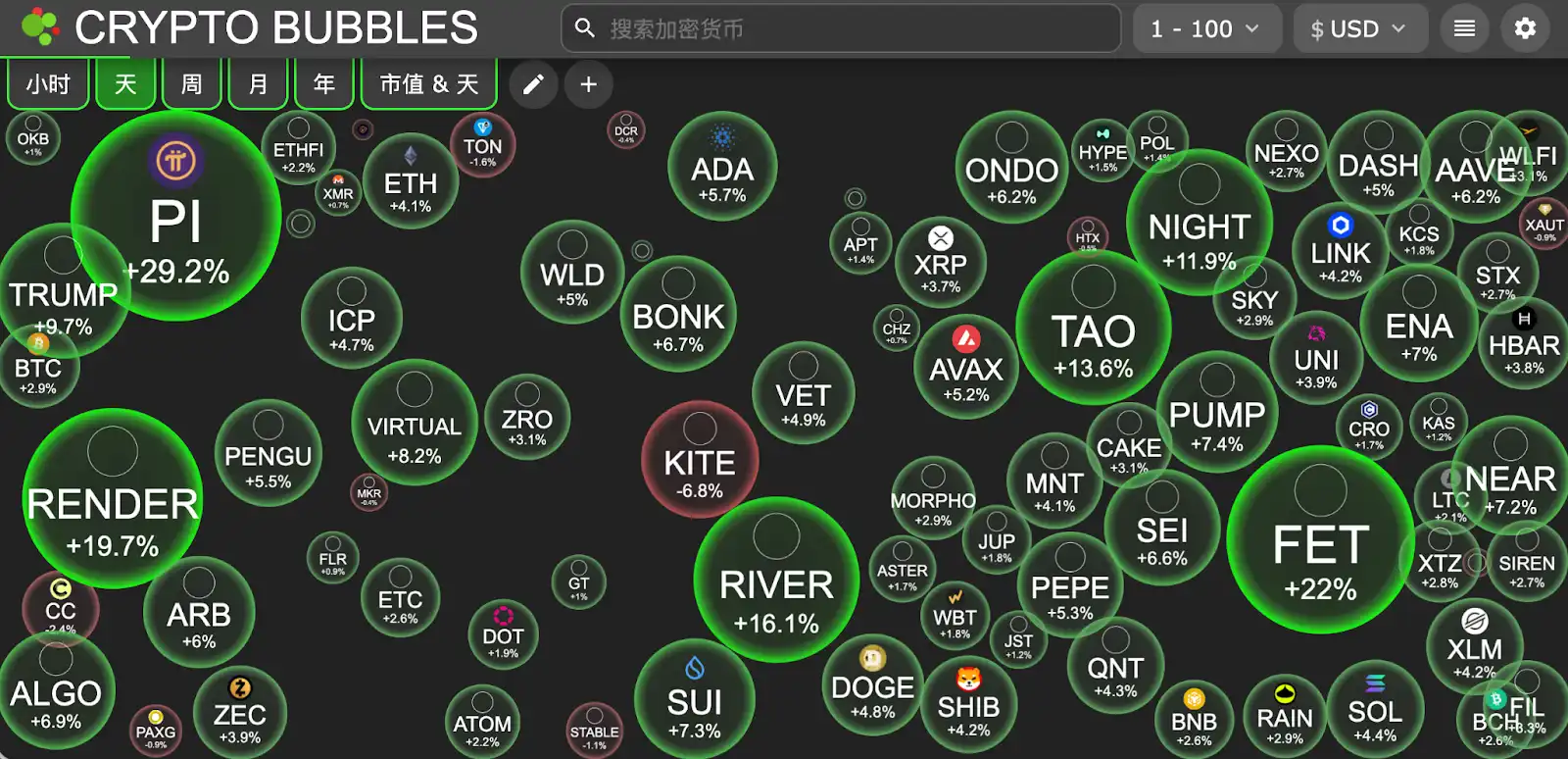
  • Sector Performance: Crypto sectors generally rose, AI sector led gains exceeding 7%

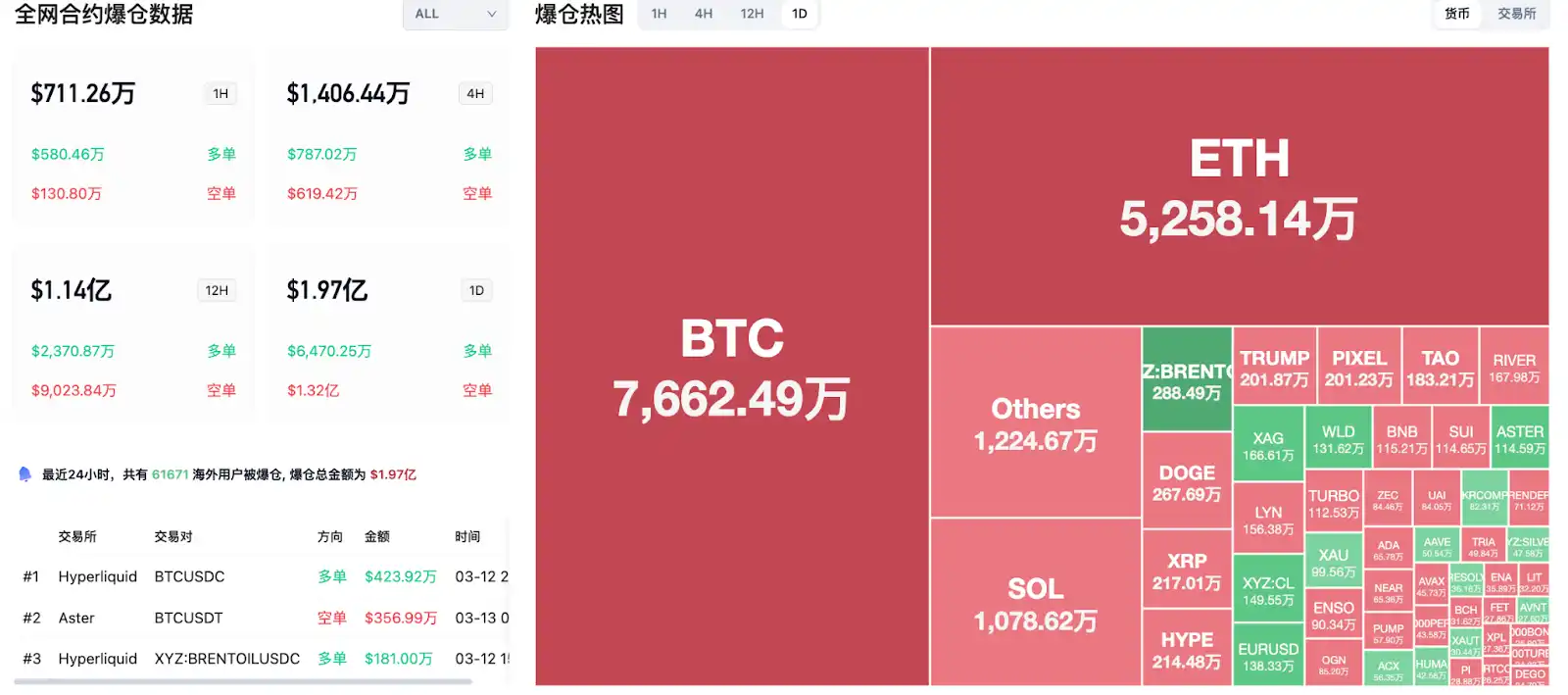
24-Hour Liquidation Data: 61,671 people were liquidated globally, with total liquidations amounting to $197 million, including BTC liquidations of $76.62 million, ETH liquidations of $52.58 million, and SOL liquidations of $10.78 million.

Today's Outlook

  • Upbit will delist Solar (SXP) and Oasys (OAS) on March 13

  • Binance Wallet will launch Unitas Labs (UP) subscription on March 13

  • ROBO token claims will end on March 13

  • Coinbase adds Billions (BILL) to its listing roadmap

  • Binance will launch EWYUSDT USDT-margined perpetual contract tracking the Korean stock market ETF

  • Aptos (APT) will unlock approximately 11.31 million tokens worth about $10.5 million on March 13

  • WBT will unlock approximately 81.5 million tokens worth about $4.12 billion on March 13

  • Sei (SEI) will unlock approximately 55.56 million tokens worth about $3.6 million on March 15

  • Starknet (STRK) will unlock approximately 127 million tokens worth about $4.8 million on March 15

  • CONX will unlock approximately 1.32 million tokens worth about $15.27 million on March 15

Top 100 coins by market cap, biggest gainers today: Pi Network up 29.7%, ASI Alliance up 22.6%, Render up 20.1%, River up 17.3%, Bittensor up 14%.

Hot News

  • Analyst: The whale who lost $50 million due to high slippage is suspected to be linked to Garrett Jin

  • Fed to initiate a 90-day comment period for Basel III proposal, Bitcoin faces 1250% risk weight

  • A whale, dormant for four months, spent 20.058 million sUSDS to open a long ETH position on-chain

  • Bitmine疑似今日再次买入3万枚ETH,约合6189万美元 (Bitmine疑似 - suspected to have bought another 30,000 ETH today, approx. $61.89 million)

  • 疑似Trend Research钱包4小时前借币卖空2.7万枚ETH (疑似 - Suspected Trend Research wallet borrowed and shorted 27,000 ETH 4 hours ago)

  • 某巨鲸再次从Kraken提出10421枚ETH,近3日累计囤积73744.98枚ETH (A whale again withdrew 10,421 ETH from Kraken, accumulating 73,744.98 ETH in the past 3 days)

  • US Senator: Expect crypto market structure bill will not pass before April

  • Binance Alpha to remove MIRROR, SHARDS, FST, and other tokens from the recommended list

Related Questions

QWhat are the main reasons for the simultaneous rise in crude oil, the US dollar, and US Treasury yields mentioned in the article?

AThe main reasons are the escalating US-Iran conflict, which has increased supply disruption risks in the oil market, and rising inflation expectations. This has led to a repricing of risk, with investors fleeing to traditional safe-havens like the dollar and Treasuries, while also causing the Federal Reserve's rate cut expectations to diminish, supporting higher yields.

QDespite macro headwinds, how has Bitcoin's price performed according to the report?

ABitcoin has defied the macro headwinds and geopolitical tensions, maintaining its price above $70,000 for four consecutive days. It has been consolidating within a range of $62,000 to $72,000 for over a month.

QWhat was the significant event involving a whale on Aave that sparked industry debate?

AA whale attempted to swap $50 million USDT for AAVE on the Aave interface but ignored a slippage warning. The transaction resulted in them receiving only 324 AAVE tokens, effectively losing nearly $50 million. This incident sparked a debate on DeFi safety mechanisms.

QWhat is the 'maximum pain' point for the Bitcoin options that expired on the day the article was written?

AThe maximum pain point for the Bitcoin options expiring that day was $69,000.

QWhat contrasting views do bears and bulls have on Bitcoin's future price movement?

ABears believe the current price action is a dead cat bounce within a continued macro downtrend, with key support levels at risk of breaking and targets below $60,000. Bulls argue that strong technical buy signals are flashing, institutional spot buying is intense, and a breakout above key resistance could lead to a macro trend reversal.

Related Reads

ETFs Are Just the Ticket: The True Institutionalization of Bitcoin Is Happening Where You Can't See It

Beyond the Bitcoin ETF spotlight, a deeper institutionalization is underway, leveraging Bitcoin as a foundational financial primitive. Institutions are using Bitcoin for purposes long reserved for assets like U.S. Treasuries and gold: as collateral for loans, insurance reserves, and the backbone of rated bonds. Examples include a Barbados-based insurer capitalizing with $40M in Bitcoin reserves and Ledn's $188M securitization of Bitcoin-backed loans, which received the first-ever investment-grade rating (BBB-) from S&P for a digital asset-backed security. This structure was stress-tested during a 27% price drop in early 2026, triggering automatic liquidations that functioned as designed but revealed the systemic risk of synchronized selling across leveraged positions. Infrastructure is evolving to support this, with platforms like Anchorage Digital's Atlas network enabling secure, institutional-grade settlement and collateral management. Strategies like basis trades and corporate treasuries (exemplified by companies like MicroStrategy issuing billions in equity and debt to fund Bitcoin acquisitions) further integrate Bitcoin into financial mechanics. While ETFs solved "how to own" Bitcoin, these developments answer "what to do with it," embedding the asset into the working machinery of finance—as collateral upon which loans, derivatives, and structured products are built. The real, enduring institutional shift is happening in these largely invisible plumbing and financing systems.

marsbit2m ago

ETFs Are Just the Ticket: The True Institutionalization of Bitcoin Is Happening Where You Can't See It

marsbit2m ago

ZEC Co-Founder Responds to Orchard Vulnerability: No Signs of Theft, Orchard Pool to Be Sealed

ZEC Co-Founder Addresses Orchard Vulnerability: No Signs of Theft, Plans to Sunset Orchard Pool A security vulnerability was recently discovered in Zcash's Orchard shielded pool, raising key concerns. The primary questions are whether the flaw was exploited, if user funds are safe, whether users can verify the total ZEC supply, and if other similar vulnerabilities exist. Analysis suggests the vulnerability was likely not exploited prior to its discovery. It was found proactively by a researcher using specialized tools, not due to an active breach. The development team and mining pools acted quickly to contain the issue. Typical financially-motivated attacks would likely have left visible on-chain evidence, which has not been observed. User funds in Orchard are considered safe and should be recoverable, assuming no prior exploitation. If the flaw was never used, all legitimate funds can be withdrawn. The article outlines risks associated with moving funds to transparent addresses or other pools, but concludes that leaving assets in place is a reasonable option. Currently, users cannot independently verify that the total ZEC supply hasn't been inflated due to this bug. However, the planned Ironwood network upgrade is designed to resolve this. It will permanently close the Orchard pool to new deposits and internal transfers, allowing only withdrawals. This mechanism will cap total withdrawals at the amount of legitimately deposited funds, enabling anyone to cryptographically verify the supply post-upgrade. Multiple teams, including Shielded Labs, have conducted extensive audits focused on counterfeiting vulnerabilities, assisted by advanced AI tools. No additional flaws of this type have been found so far, increasing confidence that no other similar undisclosed vulnerabilities exist. In summary, evidence indicates the Orchard bug was probably not used, user funds are secure, and no other counterfeiting flaws are currently known. The upcoming Ironwood upgrade will restore users' ability to independently verify the total ZEC supply, closing this chapter.

Foresight News7m ago

ZEC Co-Founder Responds to Orchard Vulnerability: No Signs of Theft, Orchard Pool to Be Sealed

Foresight News7m ago

Microsoft Announces Commercial-Grade Quantum Computer to be Completed in Three Years: Will the Boots Land?

Microsoft announces plans to build a commercially viable quantum computer by 2029, a significant acceleration from the previous industry consensus of a decade. The breakthrough is fueled by their new Majorana 2 quantum chip, which boasts a record-breaking average qubit lifetime of 20 seconds—a 1,000-fold reliability improvement over its predecessor. This leap was achieved by leveraging topological qubits, a theoretically more stable technology using Majorana zero modes, and switching the core superconducting material from aluminum to lead. Crucially, Microsoft's "Discovery" agentic AI platform accelerated the R&D process. AI agents autonomously analyzed vast experimental data, optimized manufacturing parameters (like the lead alloy composition), and solved issues like "ghost noise," dramatically speeding up experimentation. While the 20-second coherence time is a landmark, challenges remain: scaling from 12 qubits to the millions needed for practical applications, managing compilation costs, and verifying quantum results. Skeptics call for peer-reviewed data, and questions persist about whether even 20 seconds is sufficient for complex algorithms like breaking RSA encryption. The race is on with other approaches (superconducting, trapped ions), but Microsoft's confidence in its topological roadmap signals a potential shortcut to a scalable quantum future.

marsbit26m ago

Microsoft Announces Commercial-Grade Quantum Computer to be Completed in Three Years: Will the Boots Land?

marsbit26m ago

Trading

Spot
Futures

Hot Articles

What is $BITCOIN

DIGITAL GOLD ($BITCOIN): A Comprehensive Analysis Introduction to DIGITAL GOLD ($BITCOIN) DIGITAL GOLD ($BITCOIN) is a blockchain-based project operating on the Solana network, which aims to combine the characteristics of traditional precious metals with the innovation of decentralized technologies. While it shares a name with Bitcoin, often referred to as “digital gold” due to its perception as a store of value, DIGITAL GOLD is a separate token designed to create a unique ecosystem within the Web3 landscape. Its goal is to position itself as a viable alternative digital asset, although specifics regarding its applications and functionalities are still developing. What is DIGITAL GOLD ($BITCOIN)? DIGITAL GOLD ($BITCOIN) is a cryptocurrency token explicitly designed for use on the Solana blockchain. In contrast to Bitcoin, which provides a widely recognized value storage role, this token appears to focus on broader applications and characteristics. Notable aspects include: Blockchain Infrastructure: The token is built on the Solana blockchain, known for its capacity to handle high-speed and low-cost transactions. Supply Dynamics: DIGITAL GOLD has a maximum supply capped at 100 quadrillion tokens (100P $BITCOIN), although details regarding its circulating supply are currently undisclosed. Utility: While precise functionalities are not explicitly outlined, there are indications that the token could be utilized for various applications, potentially involving decentralized applications (dApps) or asset tokenization strategies. Who is the Creator of DIGITAL GOLD ($BITCOIN)? At present, the identity of the creators and development team behind DIGITAL GOLD ($BITCOIN) remains unknown. This situation is typical among many innovative projects within the blockchain space, particularly those aligning with decentralized finance and meme coin phenomena. While such anonymity may foster a community-driven culture, it intensifies concerns about governance and accountability. Who are the Investors of DIGITAL GOLD ($BITCOIN)? The available information indicates that DIGITAL GOLD ($BITCOIN) does not have any known institutional backers or prominent venture capital investments. The project seems to operate on a peer-to-peer model focused on community support and adoption rather than traditional funding routes. Its activity and liquidity are primarily situated on decentralized exchanges (DEXs), such as PumpSwap, rather than established centralized trading platforms, further highlighting its grassroots approach. How DIGITAL GOLD ($BITCOIN) Works The operational mechanics of DIGITAL GOLD ($BITCOIN) can be elaborated on based on its blockchain design and network attributes: Consensus Mechanism: By leveraging Solana’s unique proof-of-history (PoH) combined with a proof-of-stake (PoS) model, the project ensures efficient transaction validation contributing to the network's high performance. Tokenomics: While specific deflationary mechanisms have not been extensively detailed, the vast maximum token supply implies that it may cater to microtransactions or niche use cases that are still to be defined. Interoperability: There exists the potential for integration with Solana’s broader ecosystem, including various decentralized finance (DeFi) platforms. However, the details regarding specific integrations remain unspecified. Timeline of Key Events Here is a timeline that highlights significant milestones concerning DIGITAL GOLD ($BITCOIN): 2023: The initial deployment of the token occurs on the Solana blockchain, marked by its contract address. 2024: DIGITAL GOLD gains visibility as it becomes available for trading on decentralized exchanges like PumpSwap, allowing users to trade it against SOL. 2025: The project witnesses sporadic trading activity and potential interest in community-led engagements, although no noteworthy partnerships or technical advancements have been documented as of yet. Critical Analysis Strengths Scalability: The underlying Solana infrastructure supports high transaction volumes, which could enhance the utility of $BITCOIN in various transaction scenarios. Accessibility: The potential low trading price per token could attract retail investors, facilitating wider participation due to fractional ownership opportunities. Risks Lack of Transparency: The absence of publicly known backers, developers, or an audit process may yield skepticism regarding the project's sustainability and trustworthiness. Market Volatility: The trading activity is heavily reliant on speculative behavior, which can result in significant price volatility and uncertainty for investors. Conclusion DIGITAL GOLD ($BITCOIN) emerges as an intriguing yet ambiguous project within the rapidly evolving Solana ecosystem. While it attempts to leverage the “digital gold” narrative, its departure from Bitcoin's established role as a store of value underscores the need for a clearer differentiation of its intended utility and governance structure. Future acceptance and adoption will likely depend on addressing the current opacity and defining its operational and economic strategies more explicitly. Note: This report encompasses synthesised information available as of October 2023, and developments may have transpired beyond the research period.

363 Total ViewsPublished 2025.05.13Updated 2025.05.13

What is $BITCOIN

Discussions

Welcome to the HTX Community. Here, you can stay informed about the latest platform developments and gain access to professional market insights. Users' opinions on the price of BTC (BTC) are presented below.

活动图片