Author: Nancy, PANews
A dark horse has emerged in the open-source world. In just three months, OpenClaw has become the most popular and fastest-growing open-source project in history, a new favorite among developers.
This intelligent agent tsunami, sparked by Peter Steinberger, has not only made him a top AI influencer but also won him a large number of "lobster believers" worldwide. This highly sought-after lobster godfather, however, strongly rejects the crypto world and has repeatedly publicly criticized it. Such a stance undoubtedly brings more negative舆论 to cryptocurrency.
Topping GitHub's Star Ranking, Urgently "Distancing" from Crypto Projects
There is no doubt that AI has become the golden narrative for capital and talent migration. Its rapid rise has led many to see AI as the hope for revitalizing the crypto industry, becoming a new opportunity for many in the circle to蹭流量 or seek investment.
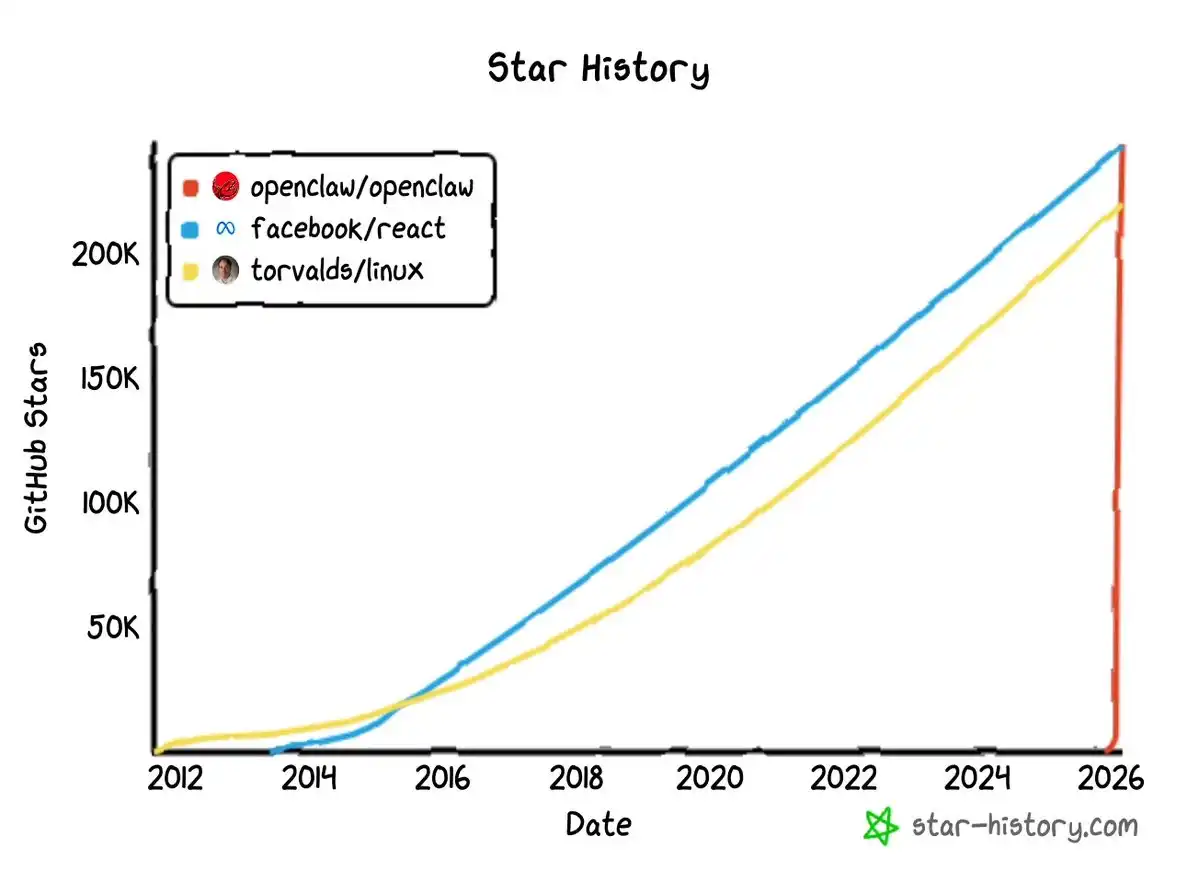
Especially the recently trending OpenClaw. According to the latest data, OpenClaw's star count on the GitHub platform has exceeded 250,000, surpassing Linux and React to become one of the most popular open-source projects and setting the record for the fastest growth in open-source history.
As "raising lobsters" becomes popular globally, tutorials,变现 cases, and user experiences around OpenClaw continue to emerge. Some even make a profit by offering on-site OpenClaw installation services. From independent developers to large companies to offline services, the "shovel-selling" business for OpenClaw is booming.
The crypto market naturally wouldn't miss this hotspot. Recently, Venice, an AI project on the Base chain, became a recommended model provider for OpenClaw, and the only crypto-native project. With the加持 of the top AI project's popularity, the Venice token surged, its market cap once exceeding $900 million. This news quickly caught the attention of crypto industry practitioners and was widely shared.

It is reported that Venice is a generative AI project focused on privacy protection and content censorship resistance. Its底层 integrates various open-source large models and was founded in 2024 by crypto OG and ShapeShift founder Erik Voorhees. It has recently gained attention due to the Agent privacy trend.
However, Steinberger clearly did not agree with this kind of捆绑炒作. He immediately publicly clarified, "This was an oversight in a previous document. We want to remain neutral on this matter." Simultaneously, OpenClaw promptly deleted the related recommendation content.
In other words, OpenClaw's "distancing" this time is not否定 or贬低ing the actual value and technical advantages of the Venice project, but rather proactively deleting the "official key recommendation" label that could lead to over-interpretation, to avoid unnecessary narrative绑架 and利益猜测. Especially as an open-source Agent framework, and with the founder having joined OpenAI, OpenClaw needs to maintain technical neutrality and avoid any suspicion of利益冲突.
Choosing to Sever Ties Due to Crypto "Piggybacking," Once Considered Abandoning the Project
Unlike AI leaders like OpenAI founder Sam Altman and xAI co-founder Musk, who hold positive or even open attitudes towards crypto, Steinberger adopts a stance of "fans only, no disturbances." This attitude of avoidance inevitably leaves the币圈 feeling "破防" (disheartened/offended).
In fact, Steinberger, who is not interested in crypto, is very排斥 the "piggybacking" phenomenon in the crypto circle. Since last year, he has issued dozens of public statements expressing strong dissatisfaction with crypto speculation culture, even直言 (stating bluntly) "don't come near."
Especially after OpenClaw became popular. In January of this year, OpenClaw's popularity rose, but its original name, Clawdbot, encountered a trademark dispute with Anthropic's AI model Claude and received a cease-and-desist notice from their legal team. Subsequently, Steinberger renamed the project twice,最终 settling on the name OpenClaw.
However, this renaming风波 was exploited by crypto speculators for抢注 (domain squatting) and炒作.
During the renaming process, snipers used automated scripts to quickly hijack accounts, impersonate the official team, and趁机 issue fake tokens, such as CLAWD. The market cap of some of these tokens once soared to tens of millions of dollars, attracting a large number of investors.
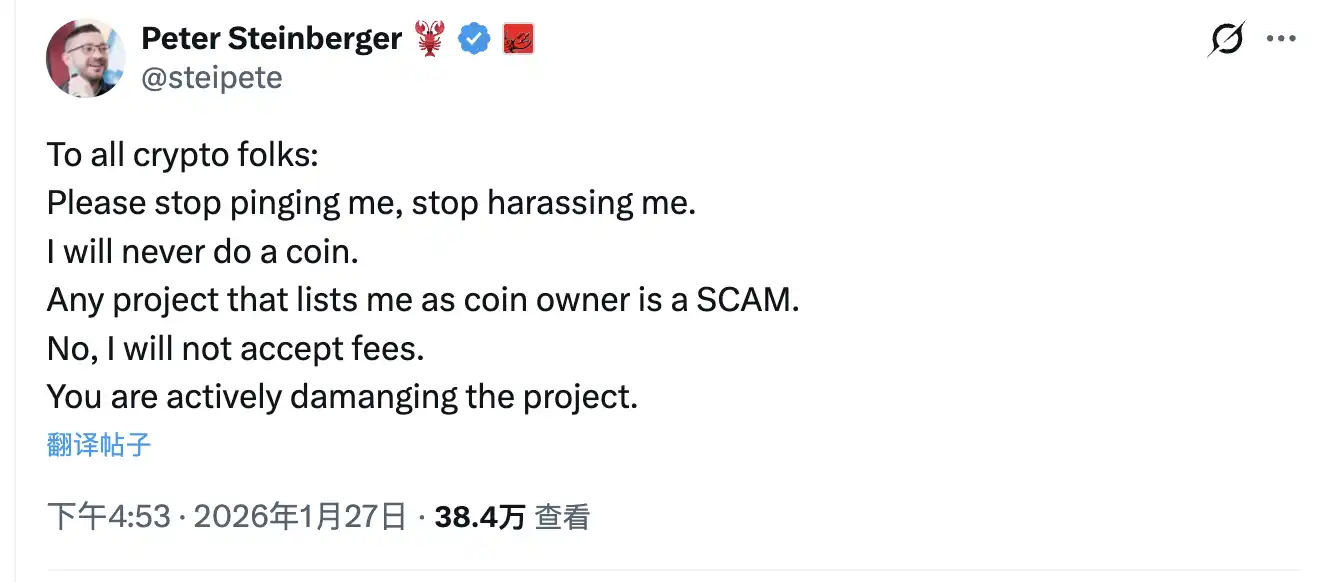
Faced with market speculation, Steinberger quickly publicly stated that he would never issue a token and emphasized that any project issuing tokens in his name is a scam. This caused the prices of these tokens to plummet, resulting in significant losses for many retail investors.
If this crypto闹剧 (farce) only made Steinberger反感 (disgusted), then the damage to the community ecology made him愤怒 (angry).
As OpenClaw continued to gain popularity, a large number of crypto players flooded into related communities, with some radicals even maliciously submitting code, sending abusive private messages, demanding Steinberger claim transaction fees or crypto-fy the project.
As a result, the official OpenClaw Discord server began completely banning mentions of keywords like Bitcoin, Crypto, etc., even neutral technical discussions were not exempt. Some users were removed for quoting Bitcoin block heights as benchmark tests.
"I underestimated these people," Steinberger said bluntly in a recent interview, pointing out that the crypto community is a very particular subculture that quickly tokenizes any hot topic. But he had already achieved financial freedom economically and simply did not want to support this (crypto) thing. The crypto noise made it almost impossible for him to see any real project discussion; the related speculative炒作 was harming the project.
It was precisely because of the "harassment" from the crypto community that this天才开发者 (genius developer) admitted he had even briefly considered abandoning the entire project. He very much did not want the project to become a tool for crypto speculation.
Just recently, Steinberger also publicly advised young people, "Don't waste your time on cryptocurrency." These remarks further exposed his dissatisfaction with the crypto industry.
This unexpected clash between the open-source world and the币圈 is not just a act of "self-preservation" by a hit project; it更折射出 (reflects even more) the difficult-to-reconcile矛盾 (contradiction) between technical purity and capital炒作 (hype/speculation) in the current AI wave.