The Economic Calculus Behind Polymarket's Exit from Polygon

marsbitPublished on 2025-12-23Last updated on 2025-12-23

Abstract

Polymarket, a leading prediction market platform, has announced plans to migrate from the Polygon network to its own Ethereum Layer 2 solution, named POLY. This move, confirmed by a team member on Discord, is driven by both product and economic motivations. Product-wise, the migration aims to provide a more stable and customizable infrastructure tailored to Polymarket’s specific needs, addressing limitations posed by Polygon’s occasional network instability. Economically, Polymarket seeks to capture and retain the full value of its ecosystem, preventing economic spillover to external networks. Data highlights Polymarket’s significant contribution to Polygon’s ecosystem: it accounts for approximately one-quarter of Polygon’s total value locked (~$326M vs. $1.19B) and around 23% of its gas consumption. The platform also drives substantial USDC liquidity and user activity on Polygon. The timing of the migration appears strategic, coinciding with Polymarket’s anticipated token generation event (TGE). Moving before token issuance reduces complexity and allows the project to reposition itself as a full-stack “app + chain” system, potentially unlocking higher valuation and narrative appeal. This shift reflects a broader trend where top-tier applications, having achieved scale and economic independence, may choose to decouple from underlying networks that no longer provide sufficient added value.

Author|Azuma(@azuma_eth)

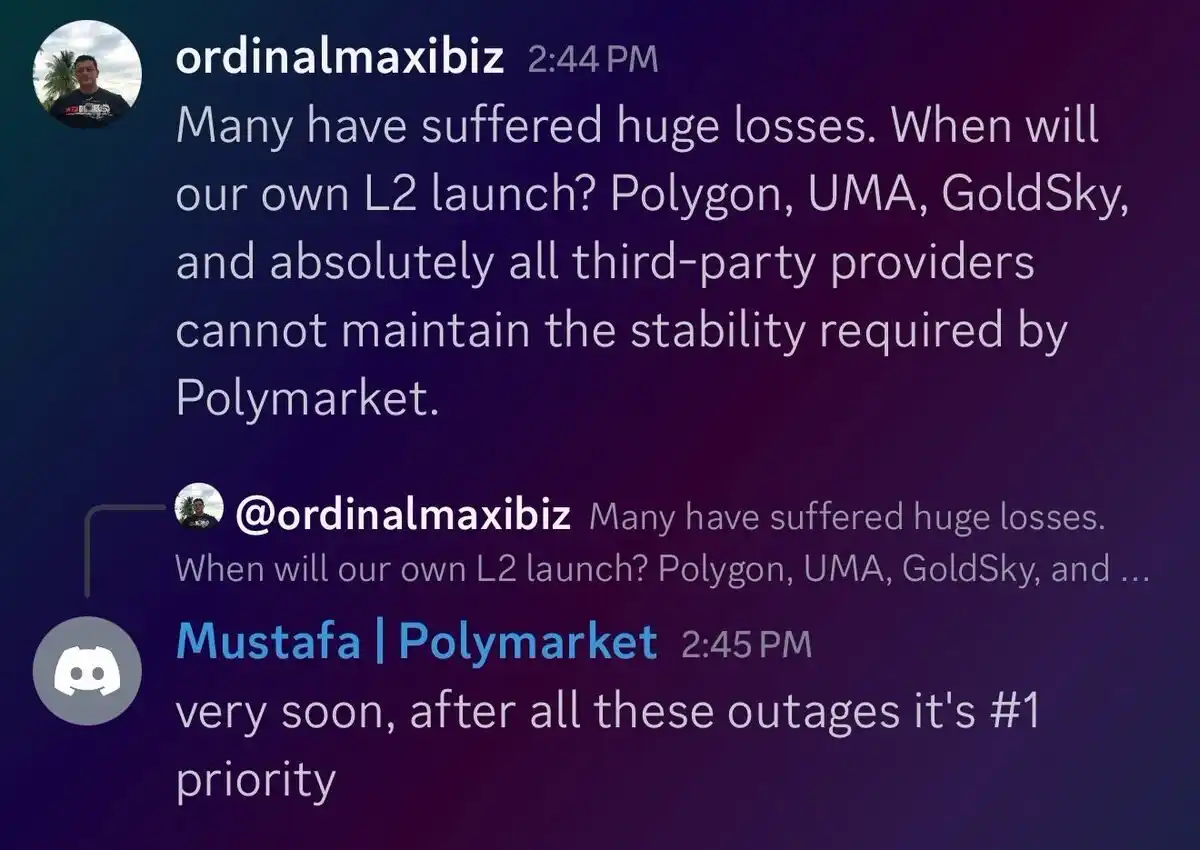
On December 22, news about the prediction market leader Polymarket sparked widespread attention — Mustafa, a team member of Polymarket, confirmed in the Discord community that Polymarket plans to migrate from Polygon and launch an Ethereum Layer2 network named POLY, which is the project's current top priority.
A Not-So-Surprising "Breakup"

Polymarket's decision to leave Polygon is not entirely unexpected. One is a red-hot application layer representative, the other is a gradually declining old infrastructure; the market heat and value expectations between the two were somewhat mismatched. As Polymarket gradually grows into a new behemoth, Polygon's relatively unstable network performance (the latest outage occurred on December 18) and relatively weak ecosystem have objectively become limitations for the former.

For Polymarket, building its own portal means a win-win choice in both product and economic dimensions.

In terms of product, besides seeking a more stable operating environment, building its own Layer2 network can help Polymarket tailor underlying features according to its platform needs, thereby more flexibly adapting to future upgrades and iterations of the platform.

The more significant meaning, however, lies in the economic aspect. Building its own network means Polymarket can bring the economic activities and peripheral services derived from its platform into its own system, preventing related value from spilling over to external networks, and instead gradually solidifying it into its own systemic advantages.

Explicit and Implicit Economic Contributions

As an application layer, Polymarket's explosive growth once brought substantial direct economic contributions to Polygon. Data history compiled by analyst dash on Dune shows:

  • Polymarket's monthly active users this month were 419,309, with a historical total of 1,766,193 users;
  • Total transactions this month were 19.63 million, with a historical total of 115 million transactions;
  • Total trading volume this month was $1.538 billion, with a historical total of $14.3 billion.

As for how to assess the proportion of Polymarket's contribution to the Polygon ecosystem's economy, Odaily Planet Daily discovered a rather coincidental ratio when compiling data from both.

  • First, in terms of deposited funds, Defillama data shows that the total value of positions on the Polymarket platform is currently about $326 million, accounting for about a quarter of Polygon's total network TVL of $1.19 billion;
  • Second, regarding gas consumption, Coin Metrics reported last October that transactions related to Polymarket were estimated to consume 25% of Polygon's total network gas;
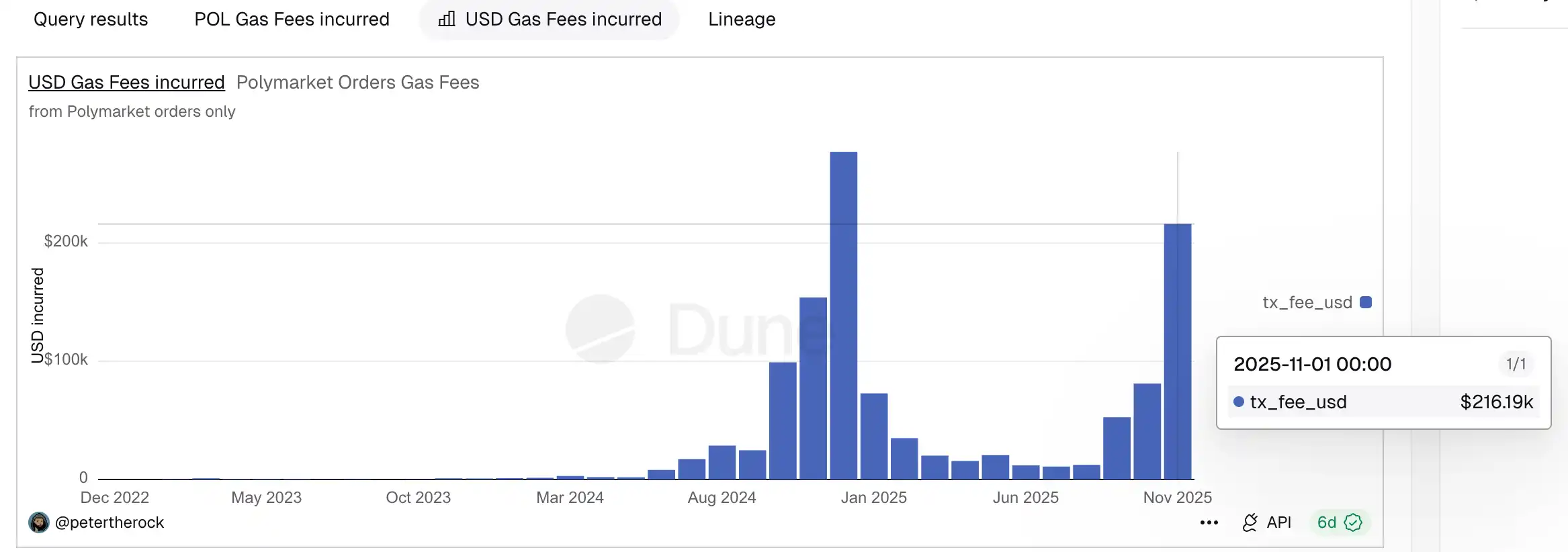
  • Considering this data is relatively old, we checked recent changes. Statistics charted by analyst petertherock on Dune show that in November, transactions related to Polymarket consumed about $216,000 in gas, while Token Terminal statistics show that Polygon's total network gas consumption that month was about $939,000, a ratio also close to a quarter (about 23%).

While this might be a coincidence due to statistical calibers and time windows, similar results across dimensions can serve as an estimated reference for measuring Polymarket's economic significance to Polygon.
Beyond quantifiable metrics like active users, deposited funds, transaction volume, and gas contributions, Polymarket's economic significance to Polygon is also reflected in a series of implicit contributions that are harder to measure directly but equally real.

First is the activation of stablecoin liquidity. All Polymarket transactions are settled in USDC. Its high-frequency, continuous trading behavior objectively significantly increases the circulation demand and usage scenarios for USDC on the Polygon network. Second is the附带价值 (fùdài jiàzhí -附带价值) of retained users'附带行为. Beyond the prediction market itself, these users might also turn to using other products on the Polygon ecosystem, such as DeFi, for convenience, thereby enhancing the overall ecological value of the Polygon network. These contributions are difficult to quantify with specific data but constitute the "real demand" that underlying networks value most and find most scarce.

Why Now? The Answer Isn't Hard to Guess

In fact, judging solely by user scale, data performance, and market presence, Polymarket is already fully confident to stand on its own. This is no longer a question of "should we leave," but rather "when to leave."

The core reason for choosing this particular moment to initiate the migration likely lies in the approaching Polymarket TGE (Token Generation Event). On one hand, once Polymarket completes its token issuance, its governance structure, incentive system, and economic model will become relatively solidified, making the cost and complexity of a subsequent底层迁移 (dǐcéng qiānyí - underlying migration) significantly higher; on the other hand, upgrading from a "single application" to a "application + infrastructure" full-stack system itself implies a change in valuation logic. Building its own Layer2 undoubtedly opens a higher ceiling for Polymarket in terms of narrative and capital.

In summary, Polymarket's departure from Polygon is essentially not just a simple underlying migration, but a microcosm of structural changes in the crypto industry. When top-tier applications begin to possess the ability to independently carry users, traffic, and economic activity, underlying networks that cannot provide additional value will inevitably be "betrayed."

Nothing more, just profit-seeking nature.

Related Questions

QWhy is Polymarket planning to migrate from Polygon to its own Layer2 network?

APolymarket is migrating to its own Layer2 network, named POLY, to achieve a more stable operating environment, customize the underlying infrastructure to better suit its platform's needs, and capture the economic value generated by its activities within its own ecosystem rather than allowing it to spill over to an external network like Polygon.

QWhat were some of the key economic contributions Polymarket made to the Polygon ecosystem?

APolymarket contributed significantly to Polygon's economy, accounting for approximately one-quarter of its total value locked (TVL) and gas consumption. It also drove substantial user activity, transaction volume, and helped vitalize USDC liquidity on the network.

QWhat specific data points illustrate Polymarket's user and transaction scale?

AAs of the article's data, Polymarket had 419,309 monthly active users and over 1.76 million historical users. It processed 19.63 million transactions in a month, with a total historical transaction count of 115 million, and a monthly transaction volume of $1.538 billion, accumulating to $14.3 billion historically.

QWhat is a major reason cited for Polymarket's decision to migrate at this particular time?

AA core reason for the timing of the migration is the impending Token Generation Event (TGE). Migrating before the token launch avoids the increased complexity and cost of doing so afterward and allows Polymarket to upgrade its valuation narrative from a single application to a full-stack 'app + chain' system.

QWhat does the author suggest is the broader implication of Polymarket's move for the crypto industry?

AThe author suggests that Polymarket's move is a microcosm of structural change in the crypto industry, where top-tier applications with the ability to independently support users, traffic, and economic activity will migrate away from underlying networks if those networks fail to provide additional value, driven primarily by the pursuit of greater economic benefit.

Related Reads

The Value Distribution of Stablecoins

**Summary: The Value Distribution of Stablecoins** The article argues that stablecoins are evolving from mere trading tools into broader channels for dollar access. It divides the stablecoin ecosystem into four layers to analyze how value is distributed: 1. **Issuance Layer:** Mints stablecoins, holds reserve assets, and captures the spread between reserve yield and user costs (e.g., Tether, Circle). This layer currently earns the largest profit margin. 2. **Infrastructure Layer:** Connects stablecoins to the traditional financial system, handling fiat on/off-ramps, banking integration, compliance (KYC/AML), and asset management (e.g., Bridge, BVNK). This is the "unglamorous" but critical work, building the essential bridges between crypto and real-world finance. 3. **Acquiring/Distribution Layer:** Integrates stablecoins into merchant systems, manages payment flows, and provides enterprise financial software (e.g., Stripe, Coinbase). They act as the access point for businesses. 4. **Application Layer:** The end-users and businesses that ultimately use stablecoins for payments, settlements, or as a store of value. They benefit from convenience but have little pricing power. The core thesis is that while the issuance layer currently dominates profits, the often-overlooked **infrastructure layer holds significant long-term potential**. The real challenge and barrier to mass adoption is not the on-chain transfer of stablecoins (which is simple), but the complex "last mile" integration into existing business workflows, banking systems, and regulatory frameworks across different countries. Companies in this layer are currently in a "land grab" phase, investing heavily to build networks, secure bank partnerships, and establish compliance pathways. While their position is currently pressured by the profitable issuers above and distribution platforms below, the article suggests that if stablecoins become a default financial rail for businesses, the infrastructure providers who have done the hard work of integration will ultimately gain strong pricing power and become entrenched, essential players.

marsbit2h ago

The Value Distribution of Stablecoins

marsbit2h ago

The Value Distribution of Stablecoins

The Value Distribution of Stablecoins The article argues that stablecoins are evolving from a mere trading tool into a broad "dollar channel." It analyzes the industry's value chain through four layers: 1. **Issuance Layer (e.g., Tether, Circle):** The top layer that mints stablecoins, holds reserve assets, and captures the thickest interest rate spread. 2. **Infrastructure Layer (e.g., Bridge, BVNK):** Connects stablecoins to the traditional financial system, handling critical but complex "dirty work" like fiat on/off-ramps, banking integration, compliance (KYC/AML), and cross-border settlement. 3. **Acquiring/Distribution Layer (e.g., Stripe, Coinbase):** Embeds stablecoins into merchant systems, manages payment flows, and integrates with enterprise software. 4. **Application Layer:** End-users and businesses that ultimately use stablecoins for payments, settlement, or storing value. The author posits that while the issuance layer currently captures the most profit, the most overlooked and potentially critical layer is infrastructure. The core challenge for stablecoin adoption isn't the on-chain transfer (which is simple), but bridging the gap between blockchain and the real-world financial system. This involves solving practical problems for businesses: fiat conversion, reconciliation, tax handling, and user onboarding. Infrastructure companies are currently in a difficult "land-grab" phase—building networks, securing banking relationships, and achieving compliance country-by-country. They face pressure from both the profitable issuance layer above and distribution platforms below. However, the author suggests this layer is building a crucial moat. Once stablecoins become a default business rail, the infrastructure players who have done the hard work of integration may gain significant, durable value and pricing power.

链捕手2h ago

The Value Distribution of Stablecoins

链捕手2h ago

How to Do Research Well: Deliberately Practice the Real Skills That Matter

No one truly teaches you how to do research. You're often given a desk, a pre-selected problem, and vague instructions to "create something new." Consequently, many people reverse-engineer the job based on visible outputs—papers, posts, announcements—learning only how to *appear* like a researcher rather than how to *become* one. True research capability is built from stacking small, trainable skills, nearly all of which can be developed through deliberate practice. **Pick Your Own Problem:** Most researchers absorb problems from advisors or trends, lacking the underlying reasoning. Choosing a problem you genuinely care about, as John Schulman advises, leads to original work. Develop "taste" like a muscle: predict experiment outcomes, guess paper results from methods, and track which findings remain important over time. **Upgrade Your Inputs:** Relying on shared reading lists (arXiv hot lists, filtered group chats) leads to unoriginal conclusions. Undervalued old literature often holds crucial insights (e.g., MoE, LSTM, backpropagation). Richard Sutton's "The Bitter Lesson" or Claude Shannon's 1952 talk on creative thinking are more predictive than lengthy modern surveys. Breadth matters as much as depth: draw from neuroscience, mechanism design, hardware knowledge, and honest statistics. Read papers directly, especially appendices and limitations sections. **Write Everything Down:** As Paul Graham noted, writing exposes flaws in seemingly mature ideas. Writing is the cheapest defense against self-deception. Following Feynman's principle, Darwin programmatically wrote down facts contradicting his theory to combat memory bias. Maintain a detailed log of hypotheses, setups, predictions, results, and updated understandings. Reviewing past logs fosters essential humility.

marsbit4h ago

How to Do Research Well: Deliberately Practice the Real Skills That Matter

marsbit4h ago

Trading

Spot
Futures

Hot Articles

Discussions

Welcome to the HTX Community. Here, you can stay informed about the latest platform developments and gain access to professional market insights. Users' opinions on the price of S (S) are presented below.

活动图片