The Bitcoin 400-Day Cycle: Historical Performance Shows How Low The Bottom Goes

bitcoinistPublished on 2026-06-11Last updated on 2026-06-11

Abstract

A crypto analyst forecasts a continued Bitcoin bear market, predicting a potential price bottom around October 2026 based on a historical 400-day cycle pattern. The analysis suggests Bitcoin is currently 252 days into a bear phase that typically lasts 364-400 days, indicating another 112-148 days of downward pressure. The projected cycle low could be around $30,000, representing a more than 75% decline from recent all-time highs near $126,000. The analyst dismisses arguments that current market factors like ETFs make this cycle different, noting the pattern has held for over a decade. Another expert aligns, forecasting a bottom between $30,000-$40,000 by late Q3 or early Q4 2026 and rejecting the possibility of Bitcoin reaching $100,000 this year.

A crypto analyst has projected just how low Bitcoin (BTC) could fall during this market cycle, sharing a timeline for a potential price bottom. The expert has based his bearish outlook on the Bitcoin 400-day cycle, a recurring pattern that has consistently appeared across multiple market phases. Drawing from this historical trend, he suggested that BTC could still face further downside in its current bear market before any long-term recovery stage begins.

Analyst Says Bitcoin Final Cycle Bottom Is In October

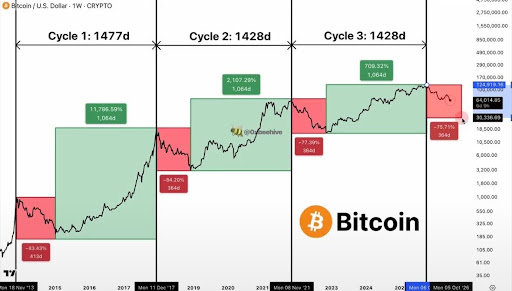
Crypto market analyst Bee has provided a definitive timeline for the end of the current Bitcoin bear market based on strict historical market trends. His analysis, shared on X, relies on a specific 400-day cycle pattern that has successfully guided market tops and bottoms across 13 years of BTC’s trading history.

Based on this framework, Bitcoin is now 252 days into its cyclical bear phase that historically lasts between 364 and 400 days. This suggests that the leading cryptocurrency market still faces an extra 112 to 148 days of severe downward pressure before a true recovery can begin.

Based on the timeline of this historical setup, Bee estimates that BTC’s absolute price bottom for this cycle could be in October 2026. His calculations, highlighted on his accompanying chart, suggest that Bitcoin could decline as low as $30,000 by the first week of the month. This would represent a more than 75% decline from current all-time highs near $126,000, marking the likely floor before the next recovery.
Source: X

Notably, Bee mentioned that the historical 400-day bear market typically follows a bull run lasting about 1,064 days. This suggests that once a final cycle bottom is reached, the market could reset, potentially paving the way for a fresh bull market.

The analyst also warned that many investors may argue that the current market is different from past market trends due to Exchange-Traded Funds (ETFs), institutional involvement, or large players like BlackRock, the world’s largest Bitcoin ETF provider. However, Bee countered, noting that each past cycle had its own reasons for being “different,” yet the historical 400-day pattern persisted.

He emphasized that this recurring structure has played out without a single deviation for over a decade. The analyst also pointed out that the structure has consistently held through changing narratives and broader market developments, so there is no reason to believe the current cycle will be any different.

Expert Predicts Next Bottom And Rejects $100,000 BTC In 2026

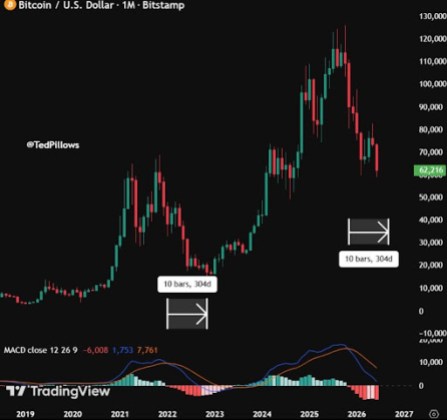
In a separate but similarly bearish post, crypto analyst Ted Pillows has forecasted the timeline for Bitcoin’s bear market bottom. Pillows noted that Bitcoin took about 10 months to bottom after the monthly Moving Average Convergence Divergence (MACD) bearish cross emerged in 2022.
Source: X

He noted that if a similar trend occurs again, then he expects BTC to reach its final price floor either by the end of the third quarter (Q3) of 2026 or the beginning of the fourth quarter (Q4). His chart pointed toward a likely bottom target between $30,000 and $40,000. Meanwhile, the analyst has crushed hopes for a long-term rebound this year, projecting that a bullish run back toward $100,000 is highly unlikely in 2026.

BTC begins another recovery trend | Source: BTCUSD on Tradingview.com

Trending Cryptos

Related Questions

QWhat is the Bitcoin 400-day cycle, and what does it predict according to the analyst Bee?

AThe Bitcoin 400-day cycle is a recurring pattern that has consistently marked market tops and bottoms over 13 years of Bitcoin's trading history. According to analyst Bee, it predicts that Bitcoin is currently 252 days into a bear phase, which historically lasts 364 to 400 days. He suggests there are 112 to 148 days left of downward pressure, with the absolute price bottom potentially occurring in October 2026 around $30,000.

QAccording to the article, what price does analyst Bee predict for Bitcoin's cycle bottom, and when?

AAnalyst Bee predicts Bitcoin's absolute price bottom for this cycle could be around $30,000, likely in October 2026.

QWhy does analyst Bee believe the current market cycle is not fundamentally different from past cycles, despite new factors like ETFs?

AAnalyst Bee acknowledges that factors like ETFs and institutional involvement make the current market seem different. However, he counters that every past cycle also had its own unique reasons to be considered 'different,' yet the historical 400-day pattern persisted without deviation for over a decade through various narratives and developments.

QWhat is analyst Ted Pillows' prediction for Bitcoin's bear market bottom, based on what indicator?

ABased on the timing after the monthly Moving Average Convergence Divergence (MACD) bearish cross, analyst Ted Pillows predicts Bitcoin will reach its final price floor by the end of Q3 or beginning of Q4 2026, with a likely bottom target between $30,000 and $40,000.

QDo the analysts cited in the article expect Bitcoin to reach $100,000 in 2026?

ANo, they do not. Analyst Ted Pillows specifically projects that a bullish run back toward $100,000 is highly unlikely in 2026.

Related Reads

Analyzing the Impact of AI on Economic Growth and Productivity

**Title: Analyzing AI's Impact on Economic Growth and Productivity** This article examines three contrasting views on AI's influence on economic growth and productivity. **The Optimistic View** posits that AI, especially through automating R&D ("recursive self-improvement"), could dramatically accelerate growth, even triggering a technological "singularity" with explosive, potentially infinite, economic expansion. **The Moderate/Mainstream View** acknowledges AI's productivity benefits but emphasizes significant real-world constraints that could limit its impact. These include: limited cost savings per task, structural ceilings on which jobs and industries are "exposed" to AI, adoption bottlenecks (e.g., compute, energy, regulatory hurdles), and the "weak link" effect where non-automatable tasks cap overall gains. Consequently, the realized AI dividend may be far lower than optimistic projections, with estimates typically ranging from 0.1% to 1.3% annual productivity growth. **The Pessimistic View** stems from two strands. The first aligns with the moderate view but applies extremely conservative assumptions about task exposure and efficiency gains, yielding minimal projected impact. The second introduces a demand-side critique: if AI primarily replaces rather than augments labor, it could depress labor's share of income, weaken consumer demand, and create a "demand trap" that ultimately stifles growth, unless offset by redistribution policies. **The authors' assessment** is nuanced: * **Short-term (1-2 years):** AI will support growth primarily through investment spending, not significant productivity gains. * **Medium-term (3-5 years):** Three potential paths emerge based on AI demand and bottleneck severity: 1. **"Optimistic Path":** High demand, few bottlenecks. Rapid productivity gains but risk of major job displacement and social conflict without redistribution. 2. **"Moderate Path" (most likely):** High demand but significant, surmountable bottlenecks. Leads to moderate productivity gains, financial market volatility (K-shaped returns), and sectoral job losses. 3. **"Pessimistic Path":** Low demand or severe bottlenecks. Minimal productivity and growth impact, triggering financial market corrections but allowing a smoother societal transition with less labor disruption. * **Long-term:** AI holds potential for a major productivity revolution and prosperity. The conclusion stresses that no path is smooth. Technologically "optimistic" outcomes could be socially detrimental, while "pessimistic" technological diffusion might be more socially stable. Policymakers must monitor developments and prepare balanced responses to manage economic, financial, and social sustainability.

marsbit22m ago

Analyzing the Impact of AI on Economic Growth and Productivity

marsbit22m ago

The New Cold War is a Tech Stock War

The New Cold War is a Tech Stock War The article argues that the contemporary geopolitical and economic rivalry between the US and China represents a "New Cold War," but one fundamentally fought through technology and financial markets, not physical barriers or conventional trade. Historically, US dominance was secured through financial systems. The Soviet Union, reliant on the rigid "Transferable Ruble," was ultimately undermined by its dependency on the US dollar for oil trade. Later, Japan's semiconductor challenge was countered not just by tariffs (e.g., Plaza Accord, 301 investigations) but by binding it to US Treasury bonds. China presents a more complex, "embedded" challenger. While it holds vast dollar reserves and US debt like Japan, its industrial base is stronger and more diversified than the Soviet Union's. Surviving the initial 2018 trade war phase, the conflict has evolved into a "tech-financial war." The core battlefield is now the stock market. US tech stocks (AI, semiconductors) are treated as sovereign assets, buoyed by bipartisan national will. China is pushing to strengthen its own financial markets to convert industrial strength into financial power and fund its tech ambitions. Companies like ChangXin (semiconductors), Moonshot AI, and DJI compete not just for market share but as financial proxies for their respective systems. The new paradigm is moving from globally efficient monopolies (Apple, Google) towards companies that achieve monopolistic profits within their respective geopolitical spheres. This competition over "pricing power" and financial valuation in segmented markets defines the current era, making the stock market the primary arena for this tech-centric struggle.

marsbit31m ago

The New Cold War is a Tech Stock War

marsbit31m ago

RWA Weekly: Ten European Financial Institutions Establish Tokenized Asset Cooperative; Ondo Launches New Execution Network Ondo Network

RWA Weekly: European Banks Form Tokenized Asset Cooperative; Ondo Launches New Execution Network Ondo Network Covering July 24-31, 2026, the RWA sector saw a steady on-chain total value locked (TVL) of $36.8 billion, with holder count hitting a record high. However, stablecoin transfer volumes fell sharply (~30%), indicating low on-chain settlement demand. Key regulatory moves include South Korea advancing stablecoin legislation and a push to scrap crypto taxes, Kenya lowering capital requirements for stablecoin issuers, and Zimbabwe approving seven projects for its crypto sandbox. In project developments, BIS-led Project Agorá successfully tested cross-border payments with tokenized funds across six currencies. Ten major European financial institutions formed the RL1 blockchain cooperative to build tokenized asset infrastructure. Other notable updates: Aviva launched a tokenized dollar liquidity fund on XRPL, POSCO International tokenized commercial invoices on Injective, and a Brazilian farmer used tokenized cattle as collateral for a loan. Additional progress includes BNY Mellon migrating its core transfer agent operations to blockchain, Securitize gaining SEC investment advisor registration, and Tether’s compliant stablecoin USA₮ launching on Celo. Ondo Finance introduced Ondo Network, a new execution layer focused on speed and privacy, moving away from its initial chain plans. An analysis highlights that despite the growing scale of on-chain RWAs (~$32B), approximately 90% remain underutilized in DeFi, pointing to a critical challenge in unlocking liquidity and fostering real-world application beyond mere issuance.

marsbit31m ago

RWA Weekly: Ten European Financial Institutions Establish Tokenized Asset Cooperative; Ondo Launches New Execution Network Ondo Network

marsbit31m ago

Trading

Spot

Hot Articles

What is $BITCOIN

DIGITAL GOLD ($BITCOIN): A Comprehensive Analysis Introduction to DIGITAL GOLD ($BITCOIN) DIGITAL GOLD ($BITCOIN) is a blockchain-based project operating on the Solana network, which aims to combine the characteristics of traditional precious metals with the innovation of decentralized technologies. While it shares a name with Bitcoin, often referred to as “digital gold” due to its perception as a store of value, DIGITAL GOLD is a separate token designed to create a unique ecosystem within the Web3 landscape. Its goal is to position itself as a viable alternative digital asset, although specifics regarding its applications and functionalities are still developing. What is DIGITAL GOLD ($BITCOIN)? DIGITAL GOLD ($BITCOIN) is a cryptocurrency token explicitly designed for use on the Solana blockchain. In contrast to Bitcoin, which provides a widely recognized value storage role, this token appears to focus on broader applications and characteristics. Notable aspects include: Blockchain Infrastructure: The token is built on the Solana blockchain, known for its capacity to handle high-speed and low-cost transactions. Supply Dynamics: DIGITAL GOLD has a maximum supply capped at 100 quadrillion tokens (100P $BITCOIN), although details regarding its circulating supply are currently undisclosed. Utility: While precise functionalities are not explicitly outlined, there are indications that the token could be utilized for various applications, potentially involving decentralized applications (dApps) or asset tokenization strategies. Who is the Creator of DIGITAL GOLD ($BITCOIN)? At present, the identity of the creators and development team behind DIGITAL GOLD ($BITCOIN) remains unknown. This situation is typical among many innovative projects within the blockchain space, particularly those aligning with decentralized finance and meme coin phenomena. While such anonymity may foster a community-driven culture, it intensifies concerns about governance and accountability. Who are the Investors of DIGITAL GOLD ($BITCOIN)? The available information indicates that DIGITAL GOLD ($BITCOIN) does not have any known institutional backers or prominent venture capital investments. The project seems to operate on a peer-to-peer model focused on community support and adoption rather than traditional funding routes. Its activity and liquidity are primarily situated on decentralized exchanges (DEXs), such as PumpSwap, rather than established centralized trading platforms, further highlighting its grassroots approach. How DIGITAL GOLD ($BITCOIN) Works The operational mechanics of DIGITAL GOLD ($BITCOIN) can be elaborated on based on its blockchain design and network attributes: Consensus Mechanism: By leveraging Solana’s unique proof-of-history (PoH) combined with a proof-of-stake (PoS) model, the project ensures efficient transaction validation contributing to the network's high performance. Tokenomics: While specific deflationary mechanisms have not been extensively detailed, the vast maximum token supply implies that it may cater to microtransactions or niche use cases that are still to be defined. Interoperability: There exists the potential for integration with Solana’s broader ecosystem, including various decentralized finance (DeFi) platforms. However, the details regarding specific integrations remain unspecified. Timeline of Key Events Here is a timeline that highlights significant milestones concerning DIGITAL GOLD ($BITCOIN): 2023: The initial deployment of the token occurs on the Solana blockchain, marked by its contract address. 2024: DIGITAL GOLD gains visibility as it becomes available for trading on decentralized exchanges like PumpSwap, allowing users to trade it against SOL. 2025: The project witnesses sporadic trading activity and potential interest in community-led engagements, although no noteworthy partnerships or technical advancements have been documented as of yet. Critical Analysis Strengths Scalability: The underlying Solana infrastructure supports high transaction volumes, which could enhance the utility of $BITCOIN in various transaction scenarios. Accessibility: The potential low trading price per token could attract retail investors, facilitating wider participation due to fractional ownership opportunities. Risks Lack of Transparency: The absence of publicly known backers, developers, or an audit process may yield skepticism regarding the project's sustainability and trustworthiness. Market Volatility: The trading activity is heavily reliant on speculative behavior, which can result in significant price volatility and uncertainty for investors. Conclusion DIGITAL GOLD ($BITCOIN) emerges as an intriguing yet ambiguous project within the rapidly evolving Solana ecosystem. While it attempts to leverage the “digital gold” narrative, its departure from Bitcoin's established role as a store of value underscores the need for a clearer differentiation of its intended utility and governance structure. Future acceptance and adoption will likely depend on addressing the current opacity and defining its operational and economic strategies more explicitly. Note: This report encompasses synthesised information available as of October 2023, and developments may have transpired beyond the research period.

1.2k Total ViewsPublished 2025.05.13Updated 2025.05.13

What is $BITCOIN

Discussions

Welcome to the HTX Community. Here, you can stay informed about the latest platform developments and gain access to professional market insights. Users' opinions on the price of BTC (BTC) are presented below.

活动图片