Written by: 100y.eth
Compiled by: Saoirse, Foresight News
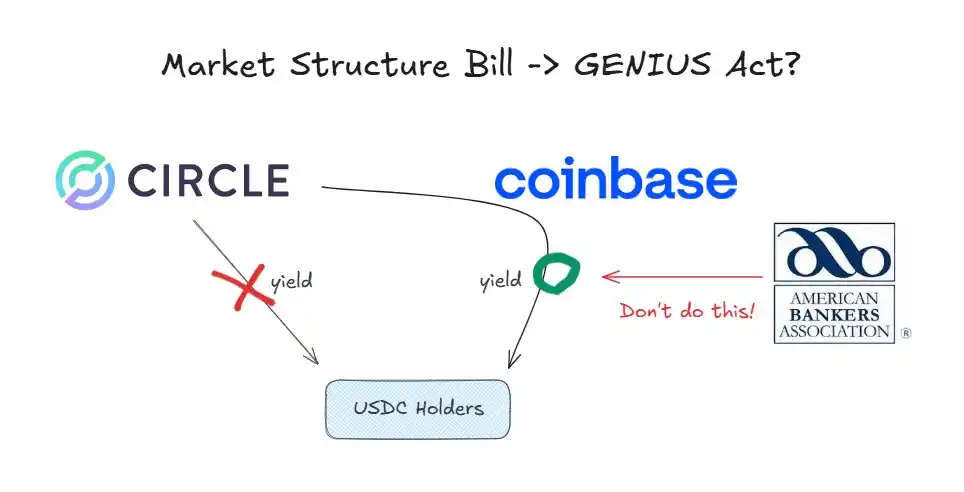
According to the GENIUS Act, stablecoin issuers are prohibited from paying interest to stablecoin holders.
However, Coinbase is currently offering a 3.35% reward to users holding USDC on its platform. This is possible because the GENIUS Act only prohibits issuers from paying interest and does not impose restrictions on distributors.
Yet, ahead of the review of the Crypto Market Structure Act (which aims to systematize cryptocurrency regulation) by the relevant U.S. Senate committee on January 15, a debate over "whether the stablecoin interest payment ban should be extended to the distribution level" has fully erupted.
Strong Opposition from the Banking Industry
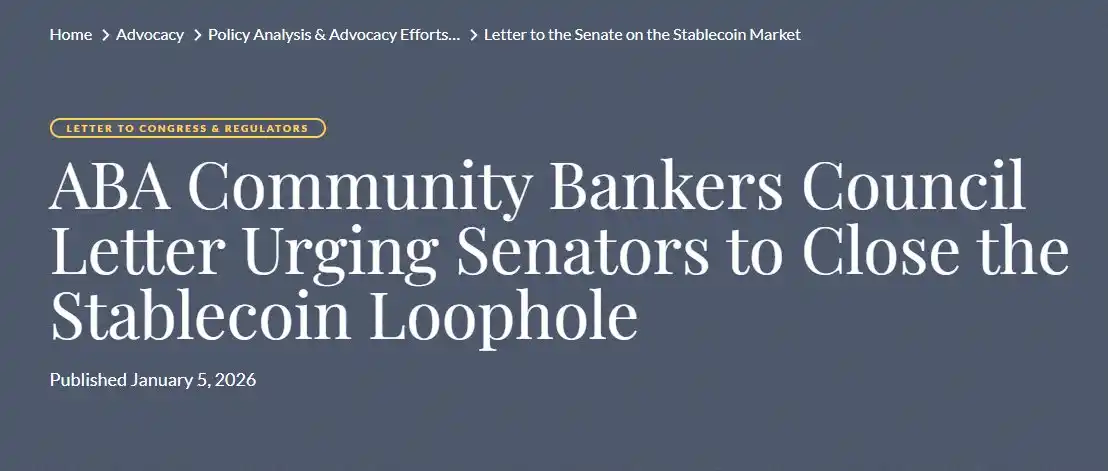
The American Bankers Association (ABA) is the primary group calling for a comprehensive ban on stablecoin interest payments. In a public letter released on January 5, the association argued that the interest payment ban in the GENIUS Act should not only apply to issuers but should also be broadly interpreted to extend to affiliated parties. They are pushing for this interpretation to be explicitly written into the Crypto Market Structure Act.
The Reasons Behind the Banking Industry's Firm Opposition
The banking industry's determination to completely ban stablecoin interest payments is quite simple:
- Concern over deposit outflows;
- Reduced deposits mean diminished lending capacity;
- Stablecoins are not protected by Federal Deposit Insurance Corporation (FDIC) insurance.
Ultimately, stablecoins are threatening the stable and highly profitable business model that the banking industry has relied on for decades.
The Crypto Industry's Counterattack
From the perspective of the crypto industry, this move by the banking sector is a major problem. If the restrictions of the GENIUS Act are expanded through the Crypto Market Structure Act due to banking lobbying pressure, it would effectively rewrite and narrow the scope of this already passed act. Unsurprisingly, this has sparked strong opposition from the crypto industry.
Coinbase's Stance
Coinbase Chief Policy Officer Faryar Shirzad countered, citing relevant research indicating that stablecoins have not caused substantial outflows of bank deposits. He also used news about the digital yuan paying interest as a new argument in this debate.
Paradigm's Perspective
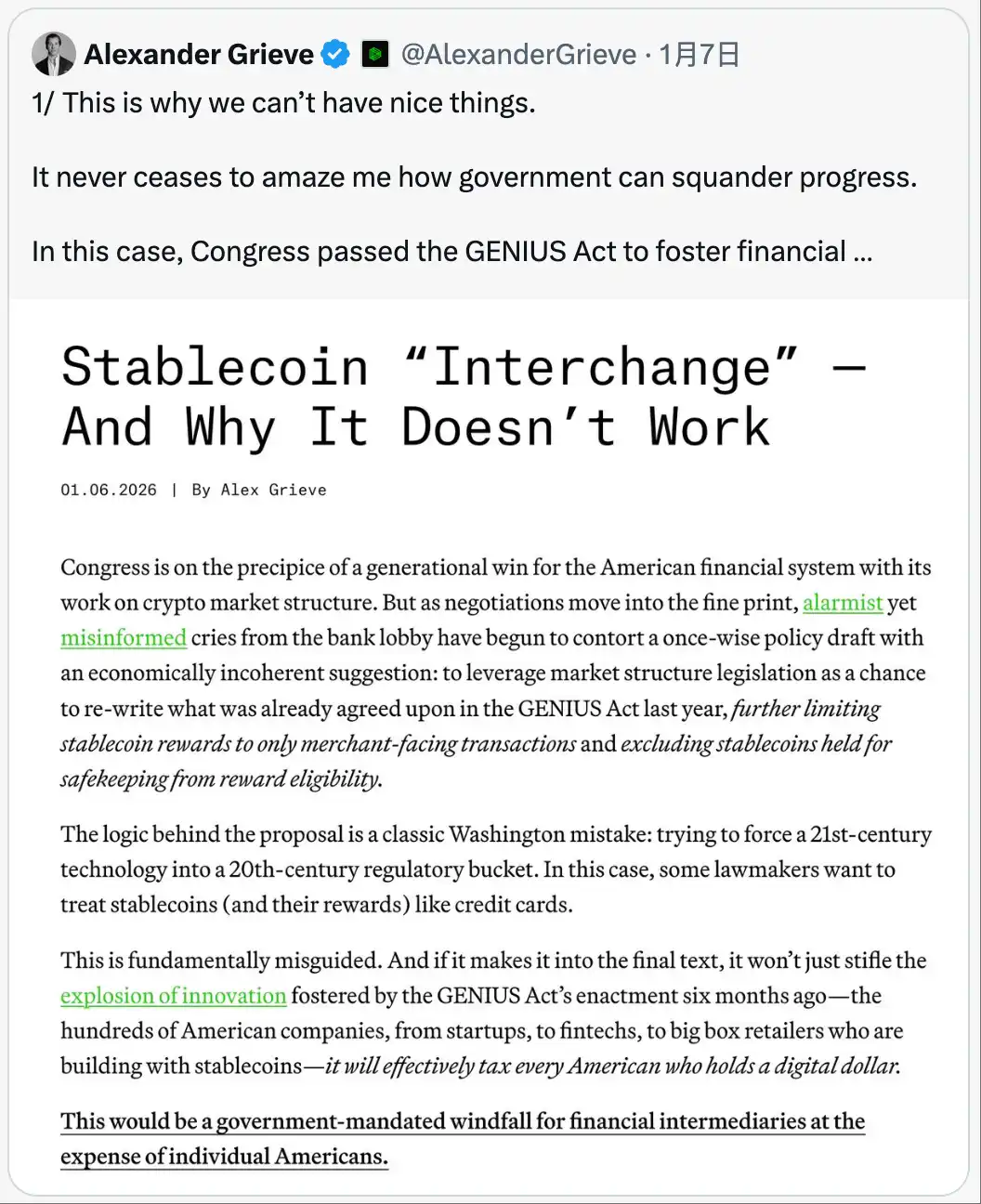
Alexander Grieve, Vice President of Government Affairs at crypto investment firm Paradigm, offered another viewpoint. He argued that even if interest payments are only allowed for stablecoins used in payment scenarios, it would effectively equate to a "holding tax" for consumers.
What About China and South Korea?
Although China and South Korea have not advanced cryptocurrency-related policies as rapidly as some other Asian countries, both have recently introduced a series of new measures surrounding Central Bank Digital Currencies (CBDCs) and stablecoin policies. The differences in their approaches to interest payments are particularly noteworthy:
The People's Bank of China has decided to pay interest on the digital yuan, treating it the same as ordinary bank deposits, to promote its adoption.
South Korea's policy direction is closer to that of the U.S.: it prohibits issuers from paying interest but does not explicitly ban distributors from doing so.
From a macro perspective, China's aggressive policy stance is understandable. The digital yuan is not a private stablecoin but a法定数字货币 (fiat digital currency) issued directly by the central bank. Promoting the digital yuan can both counterbalance the dominance of private platforms like Alipay and WeChat Pay and strengthen the financial system centered around the central bank.
Conclusion
New technologies give rise to new industries, and the rise of new industries often poses a threat to traditional ones.
Traditional financial institutions, represented by banks, are facing the irreversible trend of transitioning to the stablecoin era. At this juncture, resisting change is more harmful than beneficial; embracing change and exploring new opportunities is the wiser choice.
In fact, even for existing market participants, the stablecoin industry holds immense opportunities. Many banks have already begun to actively position themselves:
- The Bank of New York Mellon is developing its business around stablecoin reserve custody;
- Cross River Bank acts as an intermediary for Circle's USDC fiat on-ramp channels through Application Programming Interfaces (APIs);
- JPMorgan Chase is experimenting with tokenized deposits.
Major card networks also have vested interests at stake. As on-chain payment volumes grow, the business of traditional card networks may shrink. However, companies like Visa and Mastercard have chosen not to fight this trend but instead actively support stablecoin payment settlements, seeking new growth opportunities顺势.
Asset management firms are also entering the fray. Funds like BlackRock are actively advancing the tokenization of various investment funds.
If the banking industry's lobbying succeeds and a comprehensive ban on stablecoin interest payments is written into the Crypto Market Structure Act, the crypto industry will suffer a heavy blow.
As a practitioner in the crypto industry, I can only hope that the Crypto Market Structure Act will not include provisions that effectively nullify the GENIUS Act.






