Texas targets crypto, gambling loopholes amid prediction market concerns

ambcryptoPublished on 2026-04-01Last updated on 2026-04-01

Abstract

Prediction markets have gained significant attention, particularly during the U.S. election cycle, but the rise of gambling within these markets has eroded public trust. In response, Texas Lieutenant Governor Dan Patrick is pushing for legislative changes to close gambling loopholes. He aims to prevent the exploitation of federal regulations, such as those of the CFTC, to bypass state gambling prohibitions. The goal is to ensure the integrity of elections and sports in Texas. Additionally, Patrick advocates for assessing the state’s approach to emerging financial technologies, including crypto, while prioritizing consumer protection and addressing issues like crypto ATM scams. The move coincides with a decline in public interest in prediction market gambling, as shown by Google Trends data.

Prediction markets have gained a lot of attention in the past two years. Zooming in, the rise in these markets escalated in Q4 2024 as the U.S. election started to heat up. However, on the flip side, gambling also became an integral part of the prediction markets’ growth cycle.

These began to undermine people’s trust in the prediction market. Hence, to combat this problem and to regain trust, Dan Patrick, Lieutenant Governor of Texas, came up with some legislative changes.

Under the State Affairs Committee category, Patrick underlined plans to close the gambling loopholes. In this push, the governor urged the lawmakers to,

Study the sudden inundation of prediction market gambling and the exploitation of federal law to circumvent Texas gambling prohibitions by allowing users to place bets on the outcome of elections and other events.

The reason behind this crackdown?

Needless to say, this move is intended to protect and reinforce the regulatory oversight of the Commodity Futures Trading Commission (CFTC). Patrick believes that the prediction markets are now exploiting the CFTC regulations just to bypass Texas state gambling prohibitions.

With clear intentions to have fair elections and corruption-free sports in Texas, Patrick added,

Make recommendations to ensure the integrity of Texas elections and Texas sports.

Echoing similar sentiments at the broader level, David Miller, enforcement director of CFTC, in his first public remark after joining, added,

We are aware of the speculation about insider trading. We are watching.

This comes as the Google Trends data saw a drop in the “prediction market gambling” keyword as of writing.
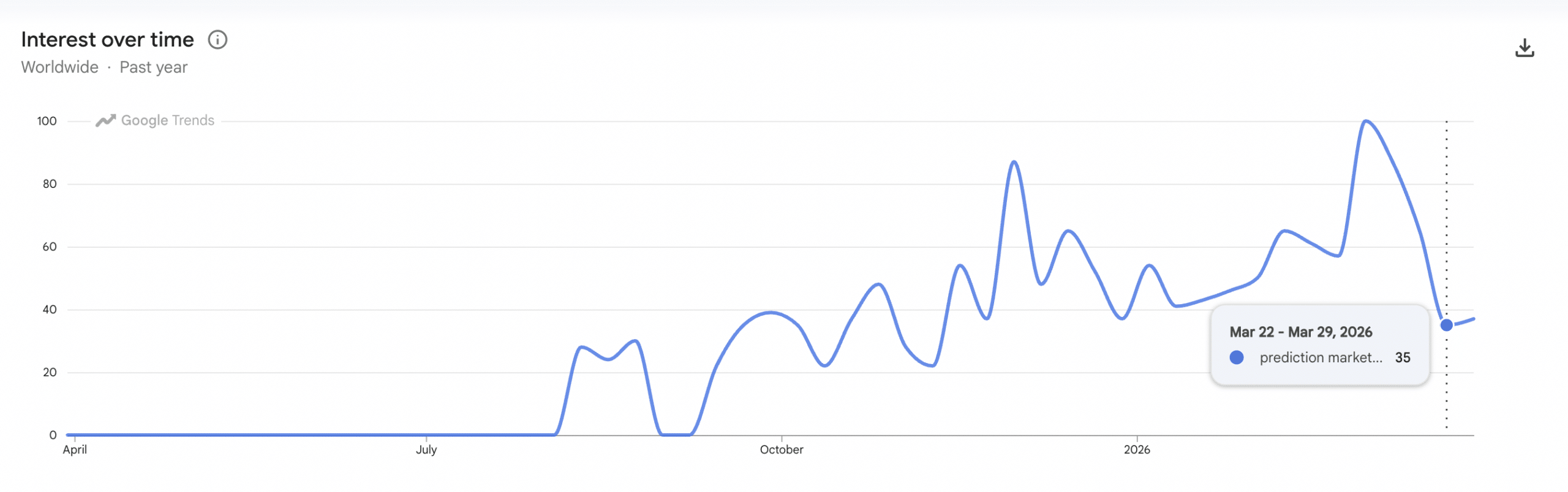
Source: Google Trends

As per the chart, the keyword had peaked to a Google Search score of 100 in early March. However, by the end of Q1 2026, the score stood at 35.

Besides prediction market reforms, Patrick has also come up with a plan to expand the future of crypto in Texas. He urged the lawmakers to:

Assess how the state’s financial regulatory agencies respond to emerging financial technologies and business models, while prioritizing the protection of consumers.

In fact, he also stressed the loopholes of scams surrounding the growing scale of crypto ATMs (virtual currency kiosks).

Lastly, the governor made a point to the lawmakers to look into Senate Bill 21 and how effectively it’s being implemented and whether it’s achieving its goal. For those unaware, Senate Bill 21 of Texas refers to the Texas Strategic Bitcoin Reserve bill implemented on the 20th of June, 2025.

This coincided with Polymarket recently coming up with its updated rulebook across its DeFi platform and CFTC-regulated U.S. exchange.


Final Summary

  • Prediction markets are growing, but with this growth, gambling has taken center stage, raising credibility issues.
  • David Patrick’s push for blockchain technology underlines how individual states are stepping up their crypto game as the U.S.-Iran war continues.


Related Questions

QWhat is the main concern that prompted Texas Lieutenant Governor Dan Patrick to propose legislative changes regarding prediction markets?

AThe main concern is that gambling has become an integral part of prediction markets, which began to undermine people's trust in them. This includes the use of crypto to circumvent Texas gambling prohibitions by allowing bets on elections and other events.

QWhich regulatory body's oversight does Dan Patrick aim to reinforce with his proposed crackdown on prediction markets?

ADan Patrick aims to reinforce the regulatory oversight of the Commodity Futures Trading Commission (CFTC).

QBesides prediction market reforms, what other emerging technology did Dan Patrick urge lawmakers to assess in relation to consumer protection?

ADan Patrick urged lawmakers to assess how the state's financial regulatory agencies respond to emerging financial technologies and business models, specifically mentioning the need to prioritize consumer protection in the context of crypto and the growing scale of crypto ATMs.

QWhat specific Texas bill, related to Bitcoin, did Dan Patrick ask lawmakers to review for effective implementation?

ADan Patrick asked lawmakers to look into Senate Bill 21, which is the Texas Strategic Bitcoin Reserve bill implemented on June 20, 2025.

QAccording to the Google Trends data mentioned in the article, what was the search score for 'prediction market gambling' by the end of Q1 2026?

AThe Google Search score for 'prediction market gambling' stood at 35 by the end of Q1 2026, down from a peak of 100 in early March.

Related Reads

Cook's Curtain Call and Ternus Takes the Helm: The Disruption and Reboot of Apple's 4 Trillion Dollar Empire

Tim Cook has officially announced he will step down as CEO of Apple in September, transitioning to executive chairman after a 15-year tenure during which he grew the company’s market value from around $350 billion to nearly $4 trillion. He will be succeeded by John Ternus, a 50-year-old hardware engineering veteran who has been groomed for the role through increasing public visibility and internal responsibility. Ternus’s appointment signals a strategic shift toward hardware and engineering leadership, with Johny Srouji—head of Apple Silicon—taking on an expanded role as Chief Hardware Officer. This consolidation aims to strengthen Apple’s core technological capabilities. However, Cook’s departure highlights a significant unresolved issue: Apple’s delayed and fragmented approach to artificial intelligence. Despite early efforts, such as hiring John Giannandrea from Google in 2018, Apple’s AI initiatives—particularly around Siri—have struggled with internal restructuring and reliance on external partnerships, including with Google. The transition comes at a critical moment as Apple faces paradigm shifts with the rise of artificial general intelligence (ASI). The company’s closed ecosystem of hardware, software, and services—once a major advantage—now presents challenges in adapting to an AI-centric world where intelligence may matter more than the device itself. Ternus must quickly articulate a clear AI strategy, possibly starting at WWDC, to reassure markets and redefine Apple’s role in a new technological era. His task is not only to maintain Apple’s operational excellence but also to reinvigorate its capacity to innovate and lead in the age of AI.

marsbit42m ago

Cook's Curtain Call and Ternus Takes the Helm: The Disruption and Reboot of Apple's 4 Trillion Dollar Empire

marsbit42m ago

Trading

Spot
Futures
活动图片