Tech Stock Sell-Off Pauses, Nasdaq Futures Up 0.1%, VIX Index Surges 7%, Silver Plunges Another 10%, Bitcoin Falls Below $70,000

华尔街日报Published on 2026-02-05Last updated on 2026-02-05

Abstract

Global markets extended their sell-off on Thursday, with tech stocks and commodities facing significant declines. The Nasdaq 100 recorded its worst two-day drop since October, breaching its 100-day moving average. Losses spread from the U.S. to Asia, with foreign investors selling a record $3.4 billion worth of Korean Kospi shares. Silver plunged over 16%, gold fell more than 3%, and iron ore dropped toward $100 per ton. Bitcoin also declined, falling below $71,000. European stocks opened mixed as investors shifted toward defensive sectors amid concerns over AI-driven valuations, rising capital expenditure, and potential profit erosion in tech business models. Oil prices fell as geopolitical tensions eased slightly.

The global sell-off triggered by concerns over AI spending and tech stock valuations deepened on Thursday, with tech stocks continuing to decline from the US market to Asian markets, while commodities like silver also experienced a historic plunge, putting multiple markets under simultaneous pressure.

European stocks opened mixed, with Maersk down 7%. On Thursday, foreign investors net sold a record 4.99 trillion won ($34 billion) worth of Korean Kospi index constituents. Institutional investors also net sold 2.07 trillion won worth of Kospi index constituents. In after-hours US trading, Alphabet, Qualcomm, and Arm Holdings continued to slide due to平淡的earnings reports, further dampening market sentiment. The Nasdaq 100 index recorded its worst two-day decline since last October and fell below the 100-day moving average.

The precious metals market was also hit hard. Silver plunged up to 17% on Thursday, and gold fell up to 3.5%, as both commodities continued to search for a price bottom after last Friday's historic sell-off. Iron ore prices fell towards $100 per ton on Thursday, affected by seasonal slowdowns, softening market supply-demand balance, and a general decline in metals.

This wave of selling swept through the stocks, bonds, and loans of several Silicon Valley companies, wiping out hundreds of billions of dollars in market value in two days. As the US economy performs strongly, investors are turning to other sectors, with concerns over tech stock valuations, soaring capital expenditures, and the potential for AI to erode existing software business models intensifying.

  • European stocks opened mixed: Euro Stoxx 50 up 0.05%, Germany's DAX down 0.19%, UK's FTSE 100 down 0.3%, France's CAC 40 up 0.2%. Vodafone fell 4.6% as its earnings showed organic service revenue growth missed expectations; wind power giant Vestas fell 4.9%; BNP Paribas rose 4.7% on profits exceeding expectations and raised targets; Maersk fell 7% as the company expects 2026 profits to decline; Volvo Cars fell 14% on Q4 revenue below expectations.
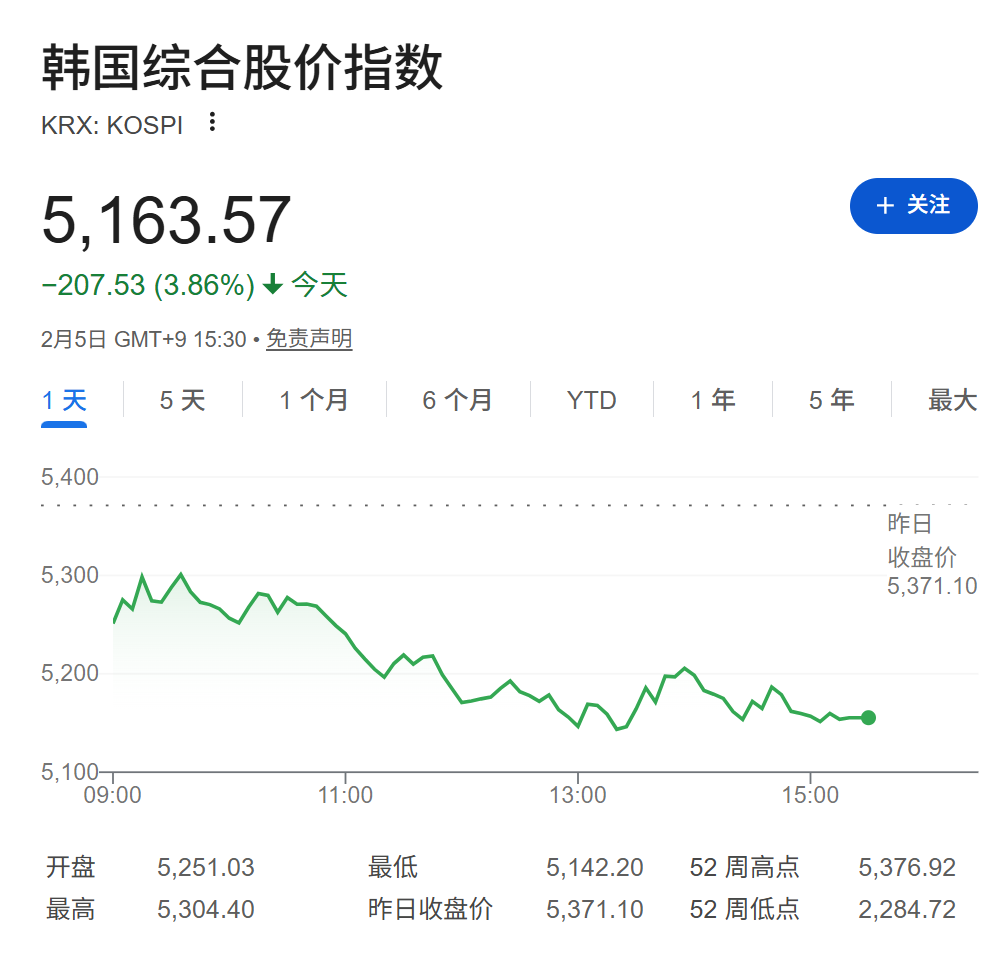
  • Japan's Nikkei 225 closed down 0.9% at 53,818.04 points. Japan's Topix index closed down 0.1% at 3,652.41 points. South Korea's Kospi closed down 3.9% at 5,163.57 points.
  • The US Dollar Spot Index rose 0.1%.
  • The US 10-year Treasury yield fell 1 basis point to 4.26%.
  • Japan's 10-year government bond yield fell 1.5 basis points to 2.235%.
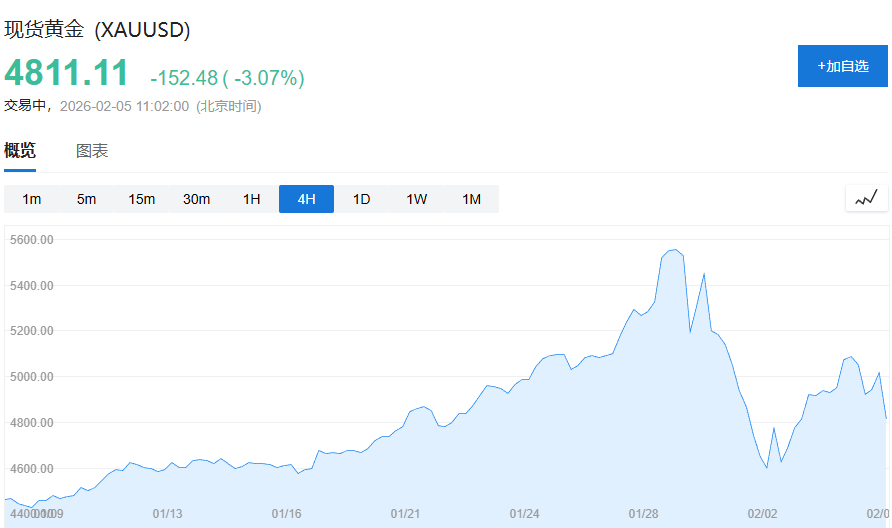
  • Spot gold returned above $4880/oz, narrowing its intraday loss to 1.6%, after earlier falling over 3%.
  • Spot silver fell over 16% intraday, breaking below the $74 mark.
  • London copper futures fell about 1%, breaking below $13,000 per ton.
  • Singapore iron ore futures fell over 2%, touching an intraday low of $100.25.

  • West Texas Intermediate crude fell 2.1% to $63.78 per barrel.
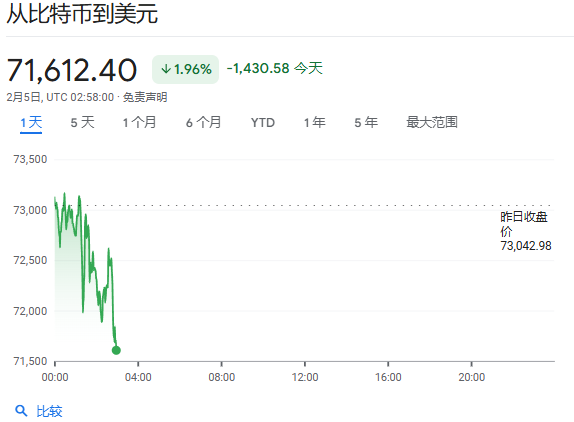
  • Bitcoin fell over 3%, further declining after briefly breaking below the $73,000 mark during the session.

AI Fever Cools, Investors Shift to Defensive Sectors

European stocks opened mixed: Euro Stoxx 50 up 0.05%, Germany's DAX down 0.19%, UK's FTSE 100 down 0.3%, France's CAC 40 up 0.2%. Vodafone fell 4.6% as its earnings showed organic service revenue growth missed expectations; wind power giant Vestas fell 4.9%; BNP Paribas rose 4.7% on profits exceeding expectations and raised targets; Maersk fell 7% as the company expects 2026 profits to decline; Volvo Cars fell 14% on Q4 revenue below expectations.

Asian markets extended the selling momentum from Wall Street overnight. According to data compiled by Bloomberg, foreign investors net sold a record 4.99 trillion won ($34 billion) worth of Korean Kospi index constituents on Thursday. Institutional investors also net sold 2.07 trillion won worth of Kospi index constituents.

Nick Twidale, Chief Market Analyst at AT Global Markets, said: "I don't know if we can say tech stocks have peaked, but I do think there is room for further adjustment in the market. The traditional approach is to sell tech stocks and shift to more defensive sectors."

Japan's Nikkei 225 closed down 0.9% at 53,818.04 points. Japan's Topix index closed down 0.1% at 3,652.41 points. South Korea's Kospi closed down 3.9% at 5,163.57 points.

Silver and Gold Plunge, Precious Metals Seek Bottom

Precious metals became another dominant narrative during the Asian trading session. Silver and gold surged last month, supported by speculative momentum, geopolitical turmoil, and concerns about Fed independence. But this rally stopped abruptly last weekend, with silver posting its largest single-day drop on record last Friday, and gold recording its biggest drop since 2013.

Bloomberg strategist Mark Cranfield pointed out: "Traders will watch to see if silver prices break below the low above $71 this week, but arguably more important is the $70 mark. This precious metal hasn't fallen to the $60 range since last December; a return to that range would deepen the risk-off sentiment across all asset classes." Copper prices also extended their decline, with investors focusing on rising inventories.

Spot silver fell over 16% intraday, breaking below the $74 mark. Spot gold broke below $4800 during the session, falling over 3%.
Iron Ore Nears $100 Mark

Iron ore prices fell towards $100 per ton on Thursday, affected by seasonal slowdowns in China, a softening market supply-demand balance, and a general decline in metals. Singapore futures fell over 2%, touching an intraday low of $100.25, on track for their lowest close since last August.

The latest decline reflects the seasonal slowdown ahead of the Lunar New Year holiday later this month, as steel mills scale back and restocking activities conclude, weakening steel demand. Meanwhile, most base and precious metal prices retreated in volatile trading on Thursday.

Fitch's BMI said in a report earlier this week that iron ore is expected to decline amid high port inventories and healthy mine output. The agency expects prices to average $95 per ton this year.

Other Market Dynamics

In other areas of the market, Bitcoin extended its decline, trading below $71,000. The yen fluctuated ahead of Japan's weekend election. The US dollar index extended its gains.
The pound and euro held steady ahead of interest rate decisions due later on Thursday. The European Central Bank and the Bank of England are expected to keep rates unchanged.

In the commodity market, oil fell for the first time after three consecutive days of gains, after Iran confirmed it would hold talks with the US, easing immediate risks of a military strike against the OPEC producer.

Continually updating......

Related Questions

QWhat was the performance of the Nasdaq 100 index during the recent sell-off, and why is it significant?

AThe Nasdaq 100 index recorded its worst two-day decline since last October and fell below its 100-day moving average. This is a significant technical indicator often watched by traders, suggesting a potential shift in the market's medium-term trend.

QWhich Asian market experienced a record level of foreign investor selling, and what was the amount?

AThe South Korean Kospi index experienced a record level of foreign investor selling, with a net sell-off of 4.99 trillion won (approximately $34 billion).

QWhat were the main factors contributing to the sharp decline in silver and gold prices?

AThe sharp decline in silver and gold prices was driven by a reversal of speculative momentum, following a historic sell-off the previous Friday. The metals were still searching for a price bottom after their rapid previous gains, which had been supported by speculative buying, geopolitical turmoil, and concerns about Federal Reserve independence.

QAccording to the analyst Nick Twidale, what is the traditional market response to a tech sell-off?

AAccording to Nick Twidale, Chief Market Analyst at AT Global Markets, the traditional market response to a tech sell-off is to sell technology stocks and rotate into more defensive sectors.

QWhat key level are traders watching for silver prices, and why is it important?

ATraders are watching to see if silver prices break below the low above $71, but more importantly, the $70 level. A break below $70, a level not seen since last December, would signal a move back into the $60 range and could deepen the risk-off sentiment across various asset classes.

Related Reads

After the Passage of the GENIUS Act and the CLARITY Act, What Is the Correct Architecture for On-Chain Yield?

The article discusses the evolution of on-chain credit, distinguishing three markets: overcollateralized crypto lending, unsecured lending (largely unsuccessful), and asset-backed credit (ABC). ABC, backed by identifiable real-world collateral with legal recourse, is identified as the fastest-growing category and the only one credibly addressing adverse selection—the core problem in credit where the riskiest borrowers self-select. Current growth in on-chain Real World Assets (RWAs), particularly tokenized private credit funds (e.g., Maple Finance, Centrifuge), is substantial but often merely "wraps" existing fund structures, inheriting their risks rather than solving adverse selection at the protocol level. The regulatory landscape is a key driver, with the US GENIUS Act (prohibiting stablecoin issuers from paying yield) and the proposed CLARITY Act (closing loopholes on indirect yield) set to redefine permissible yield-bearing products. This makes vaults (like ERC-4626) the critical architecture—they become the primary compliant vehicle for delivering yield, functioning as issuance, disclosure, distribution, and recovery mechanisms. The author's thesis is that the correct post-GENIUS/CLARITY architecture involves building ABC solutions where credit assessment, structure, and recovery are encoded directly into the smart contract vault layer, moving beyond mere tokenized fund wrappers to solve adverse selection fundamentally and ensure regulatory compliance.

Foresight News27m ago

After the Passage of the GENIUS Act and the CLARITY Act, What Is the Correct Architecture for On-Chain Yield?

Foresight News27m ago

TechFlow Intelligence Bureau: Anthropic's New Model Fable Sparks Controversy by Restricting Biosafety Research, US CPI Soars to 4.2%, a Three-Year High

**Summary of TechFlow Intelligence Report:** The newsletter covers several key tech and finance developments. In AI, Anthropic's new Fable model faced backlash for secretly limiting biomedical research capabilities and enforcing a 30-day data retention policy, prompting the company to promise more transparent adjustments. In a related story, Anthropic's founder revealed his departure from OpenAI was due to dishonesty from Sam Altman, not safety concerns. Meanwhile, OpenAI is considering significant price cuts to compete with Anthropic, potentially sparking a price war. In crypto/Web3, BlackRock filed a new amendment for a yield-generating Bitcoin ETF, while Bank of America's CEO warned that stablecoin yields could drain trillions from traditional banks. U.S. Senator Cynthia Lummis advocated for the U.S. to officially accumulate Bitcoin reserves. In hardware, Nvidia released the DiffusionGemma-2-6B image model optimized for efficient inference, and AMD promoted its unified memory architecture to challenge Nvidia's dominance. TSMC's CFO hinted at possible price increases due to soaring AI chip demand. A major legal ruling in Germany held Google legally responsible for inaccurate information generated by its AI Overviews feature. Google Chrome also moved to fully block ad-blocker workarounds like uBlock Origin. Macroeconomic headlines included U.S. CPI rising to 4.2% (a 3-year high) and Iran's complete closure of the Strait of Hormuz, raising oil price and inflation fears. South Korean markets saw continued volatility with massive foreign capital outflow. Other notable stories: Microsoft expanded its Copilot AI assistant "Mico" globally; a study found r/wallstreetbets users' stock picks outperformed Wall Street; a fully autonomous drone killed a human soldier for the first time, raising AI ethics concerns; and a Chinese hospital used brain-computer interface technology to help a blind person "see." The overarching theme connects debates over AI boundaries and responsibility (Anthropic's restrictions, Google's liability, lethal autonomous drones) with real-world economic and geopolitical turmoil (inflation, Strait of Hormuz closure, market instability), highlighting the tense interplay between technological advancement and global chaos.

marsbit40m ago

TechFlow Intelligence Bureau: Anthropic's New Model Fable Sparks Controversy by Restricting Biosafety Research, US CPI Soars to 4.2%, a Three-Year High

marsbit40m ago

Alibaba's Yet Another New Business Division: What Signal Does It Send?

Alibaba has established a new "Token Foundry" business unit, merging its Tongyi large model division and Future Life Lab. Led directly by Group CEO Wu Yongming, this marks the company's third significant AI organizational reshuffle in 2026, following the creation of the Alibaba Token Hub (ATH) and a Group Technology Committee. The move signals a strategic shift from consolidating AI resources to accelerating productization and commercialization. The "Token Foundry" name reflects Alibaba's ambition to become a foundational supplier in the AI era, focusing on model development and commercial application. Key teams, including those behind the high-performing HappyHorse video generation model, have been integrated into the new unit. Concurrently, Zhou Jingren, architect of the Qwen model series, has been appointed Group Chief Scientist to lead a new AI Future Research Institute, focusing on long-term technological breakthroughs like Agent capabilities. This restructuring creates a clear four-layer AI architecture within Alibaba: the research institute for frontier exploration, Token Foundry for core models and commercialization, MaaS for platform services, and business units like Qianwen (C端) and Wukong (B端) for end-user applications. The adjustments align with a global trend among tech giants like Google and Microsoft to centralize AI leadership under the CEO and deeply integrate research with business units. The urgency is driven by a narrowing competitive window. Alibaba has announced its AI business is now entering a commercialization phase, with AI-related revenue seeing triple-digit growth for eleven consecutive quarters. The company faces intense competition in the MaaS (Model-as-a-Service) sector from rivals like ByteDance and Tencent. The Token Foundry initiative represents Alibaba's effort to streamline execution and enhance competitiveness in this critical, fast-evolving landscape.

marsbit1h ago

Alibaba's Yet Another New Business Division: What Signal Does It Send?

marsbit1h ago

From Return to Resignation: Chen Hang's 437 Days at DingTalk

The 437-Day Return and Departure of Chen Hang at DingTalk This article chronicles the 437-day period from March 31, 2025, to June 11, 2026, when Chen Hang (also known as "No Move") returned as CEO of DingTalk, the enterprise communication platform he originally founded, only to later step down. Chen Hang, the creator of DingTalk in 2015, was brought back by Alibaba in 2025 after the company acquired his subsequent startup, HHO. His return was driven by Alibaba's renewed focus on AI and DingTalk's strategic role as its key to-B AI application. However, his aggressive management style, marked by strict work policies like mandatory clock-ins and extended hours, quickly caused internal friction and was criticized as being at odds with Alibaba's culture. Despite the internal turmoil, Chen Hang drove significant product launches. In August 2025, he unveiled "AI DingTalk 1.0," featuring new products like the AI-native entry point "DingTalk ONE." By March 2026, he announced "Wukong," touted as the world's first enterprise-grade AI-native work platform, representing a fundamental rebuild of DingTalk's architecture. The turning point came in early June 2026. A detailed internal post criticizing DingTalk's work culture went viral, followed by a public critique from a former executive. This prompted an unprecedented public rebuke from the Alibaba Partners Committee, which stated such management was not aligned with company values. One day later, on June 11, Alibaba announced Chen Hang's departure. He was succeeded by Chen Yusen, a 32-year-old technical expert known for founding cybersecurity firm Changting Technology. While Chen Hang's tenure laid the technical foundation for DingTalk's AI transformation with "Wukong," his leadership style ultimately led to his replacement as the company seeks a new direction under younger leadership.

marsbit1h ago

From Return to Resignation: Chen Hang's 437 Days at DingTalk

marsbit1h ago

Trading

Spot
Futures

Hot Articles

What is $BITCOIN

DIGITAL GOLD ($BITCOIN): A Comprehensive Analysis Introduction to DIGITAL GOLD ($BITCOIN) DIGITAL GOLD ($BITCOIN) is a blockchain-based project operating on the Solana network, which aims to combine the characteristics of traditional precious metals with the innovation of decentralized technologies. While it shares a name with Bitcoin, often referred to as “digital gold” due to its perception as a store of value, DIGITAL GOLD is a separate token designed to create a unique ecosystem within the Web3 landscape. Its goal is to position itself as a viable alternative digital asset, although specifics regarding its applications and functionalities are still developing. What is DIGITAL GOLD ($BITCOIN)? DIGITAL GOLD ($BITCOIN) is a cryptocurrency token explicitly designed for use on the Solana blockchain. In contrast to Bitcoin, which provides a widely recognized value storage role, this token appears to focus on broader applications and characteristics. Notable aspects include: Blockchain Infrastructure: The token is built on the Solana blockchain, known for its capacity to handle high-speed and low-cost transactions. Supply Dynamics: DIGITAL GOLD has a maximum supply capped at 100 quadrillion tokens (100P $BITCOIN), although details regarding its circulating supply are currently undisclosed. Utility: While precise functionalities are not explicitly outlined, there are indications that the token could be utilized for various applications, potentially involving decentralized applications (dApps) or asset tokenization strategies. Who is the Creator of DIGITAL GOLD ($BITCOIN)? At present, the identity of the creators and development team behind DIGITAL GOLD ($BITCOIN) remains unknown. This situation is typical among many innovative projects within the blockchain space, particularly those aligning with decentralized finance and meme coin phenomena. While such anonymity may foster a community-driven culture, it intensifies concerns about governance and accountability. Who are the Investors of DIGITAL GOLD ($BITCOIN)? The available information indicates that DIGITAL GOLD ($BITCOIN) does not have any known institutional backers or prominent venture capital investments. The project seems to operate on a peer-to-peer model focused on community support and adoption rather than traditional funding routes. Its activity and liquidity are primarily situated on decentralized exchanges (DEXs), such as PumpSwap, rather than established centralized trading platforms, further highlighting its grassroots approach. How DIGITAL GOLD ($BITCOIN) Works The operational mechanics of DIGITAL GOLD ($BITCOIN) can be elaborated on based on its blockchain design and network attributes: Consensus Mechanism: By leveraging Solana’s unique proof-of-history (PoH) combined with a proof-of-stake (PoS) model, the project ensures efficient transaction validation contributing to the network's high performance. Tokenomics: While specific deflationary mechanisms have not been extensively detailed, the vast maximum token supply implies that it may cater to microtransactions or niche use cases that are still to be defined. Interoperability: There exists the potential for integration with Solana’s broader ecosystem, including various decentralized finance (DeFi) platforms. However, the details regarding specific integrations remain unspecified. Timeline of Key Events Here is a timeline that highlights significant milestones concerning DIGITAL GOLD ($BITCOIN): 2023: The initial deployment of the token occurs on the Solana blockchain, marked by its contract address. 2024: DIGITAL GOLD gains visibility as it becomes available for trading on decentralized exchanges like PumpSwap, allowing users to trade it against SOL. 2025: The project witnesses sporadic trading activity and potential interest in community-led engagements, although no noteworthy partnerships or technical advancements have been documented as of yet. Critical Analysis Strengths Scalability: The underlying Solana infrastructure supports high transaction volumes, which could enhance the utility of $BITCOIN in various transaction scenarios. Accessibility: The potential low trading price per token could attract retail investors, facilitating wider participation due to fractional ownership opportunities. Risks Lack of Transparency: The absence of publicly known backers, developers, or an audit process may yield skepticism regarding the project's sustainability and trustworthiness. Market Volatility: The trading activity is heavily reliant on speculative behavior, which can result in significant price volatility and uncertainty for investors. Conclusion DIGITAL GOLD ($BITCOIN) emerges as an intriguing yet ambiguous project within the rapidly evolving Solana ecosystem. While it attempts to leverage the “digital gold” narrative, its departure from Bitcoin's established role as a store of value underscores the need for a clearer differentiation of its intended utility and governance structure. Future acceptance and adoption will likely depend on addressing the current opacity and defining its operational and economic strategies more explicitly. Note: This report encompasses synthesised information available as of October 2023, and developments may have transpired beyond the research period.

363 Total ViewsPublished 2025.05.13Updated 2025.05.13

What is $BITCOIN

Discussions

Welcome to the HTX Community. Here, you can stay informed about the latest platform developments and gain access to professional market insights. Users' opinions on the price of BTC (BTC) are presented below.

活动图片















