‘Tax headache eased?’ IRS extends crypto relief to end of 2026

ambcryptoPublished on 2026-03-19Last updated on 2026-03-19

Abstract

The U.S. IRS has extended temporary tax relief for cryptocurrency investors until the end of 2026, allowing them to use alternative methods to calculate capital gains instead of relying solely on broker-submitted reports. This is the second such extension and aims to reduce tax burdens for investors. Previously, the mandatory FIFO (first-in, first-out) method often resulted in higher taxes by requiring the sale of older, more appreciated coins first. The alternative methods enable investors to potentially report more recent, lower-gain or loss-making sales. The relief also addresses operational challenges for crypto exchanges, which faced significant compliance burdens under the stricter reporting rules. The IRS is gradually phasing in reporting requirements and has proposed making electronic submission the default for tax documents.

The U.S. tax season is here, and there is some sigh of relief for crypto holders using centralized exchanges.

In its latest guidance, the U.S. Internal Revenue Service (IRS) gave crypto holders a free pass to use alternative methods to identify crypto sales for tax purposes instead of relying on their broker-submitted reports.

This is the second time the watchdog has extended the relief, and it could again help lower the tax bill for crypto investors. Initially, the agency mandated crypto exchanges to adopt the FIFO (first-in, first-out) method to track investors’ buy and sell prices for each coin.

For users, this meant that the oldest coins, which were acquired cheaply and have since appreciated significantly, should be reported first. This would result in a higher tax bill due to a higher capital gains tax.

With alternative reporting methods, however, you could include the most recently acquired coins that haven’t rallied much or are in the red.
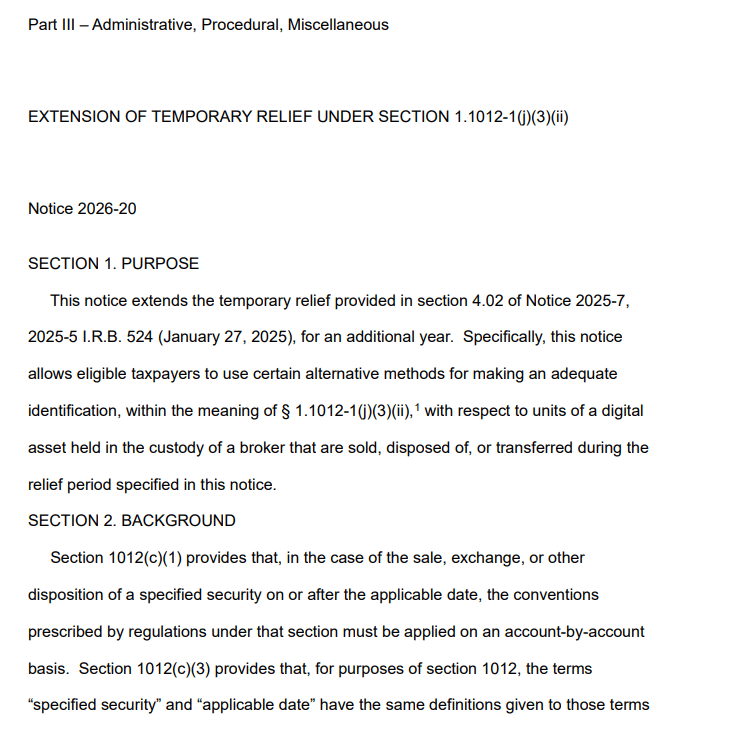
Source: IRS

U.S. crypto tax compliance burden

According to Shehan Chandrasekera, head of tax at Coin Tracker, the IRS guidance will offer incredible relief to investors, albeit with a few friction points.

He said,

The IRS just quietly saved crypto investors from a massive tax headache by issuing Notice 2026-20.

The temporary relief will be extended up to the end of 2026. But the move isn’t out of just goodwill from the taxman.

Its strict crypto reporting regime has a compliance burden on operators. Notably, crypto exchanges must report the cost basis for each coin bought by each investor to the IRS, along with other data.

At the same time, a duplicate of the report should be given to the customer or physically mailed if the customer hasn’t opted for digital copies. Most brokers have complained that this would be a massive operational burden.

To alleviate this, the agency opted for phased-in reports, starting with only gross proceeds or total crypto sales in reports submitted in 2025. For crypto assets bought in 2026, cost basis data was included in the submitted reports (Form 1099-DA).

Earlier this month, the IRS proposed scrapping physical copies sent to customers and making ‘electronic submission’ the default for tax reports.


Final Summary

  • The IRS will allow crypto investors to use their reporting methods for crypto taxes until the end of the year, rather than relying on the strict broker-submitted reports.
  • The move comes as the agency grapples with ways of lowering tax compliance burdens for crypto investors and brokers.


Related Questions

QWhat relief has the IRS extended to crypto holders until the end of 2026?

AThe IRS has extended temporary relief allowing crypto holders to use alternative methods to identify crypto sales for tax purposes instead of relying strictly on broker-submitted reports.

QWhy was the FIFO method problematic for crypto investors?

AThe FIFO method required reporting the oldest coins first, which were often acquired cheaply and had appreciated significantly, resulting in higher capital gains taxes.

QWhat is the IRS's motivation for extending this relief, according to the article?

AThe move isn't just out of goodwill; the strict crypto reporting regime places a significant compliance burden on both operators (exchanges) and investors, and the IRS is grappling with ways to reduce these burdens.

QWhat change did the IRS propose earlier this month regarding tax report delivery?

AThe IRS proposed scrapping physical copies of tax reports sent to customers and making 'electronic submission' the default method.

QWhat did Shehan Chandrasekera say about IRS Notice 2026-20?

AShehan Chandrasekera stated that 'The IRS just quietly saved crypto investors from a massive tax headache by issuing Notice 2026-20.'

Related Reads

How Many Tokens Away Is Yang Zhilin from the 'Moon Chasing the Light'?

The article explores the intense competition between two leading Chinese AI companies, DeepSeek and Kimi (Moon Dark Side), and the mounting pressure on Yang Zhilin, the founder of Kimi. While DeepSeek re-emerged after 15 months of silence with its powerful V4 model—boasting 1.6 trillion parameters and low-cost, long-context capabilities—Kimi has been focusing on long-context processing and multi-agent systems with its K2.6 model. Yang faces a threefold challenge: technological rivalry, commercialization pressure, and investor expectations. Despite Kimi’s high valuation (reaching $18 billion), its revenue heavily relies on a single product with low paid conversion rates, while DeepSeek’s strategic silence and open-source influence have strengthened its market position and valuation prospects, now targeting over $20 billion. Both companies reflect broader trends in China’s AI ecosystem: Kimi aims for global influence through open-source contributions and agent-based advancements, while DeepSeek prioritizes foundational innovation and hardware independence, notably shifting to Huawei’s chips. Their competition is seen as vital for China’s AI progress, with the gap between top Chinese and U.S. models narrowing to just 2.7% on the Elo rating scale. Ultimately, the article argues that this rivalry, though anxiety-inducing for leaders like Zhilin, is essential for driving innovation and solidifying China’s role in the global AI landscape.

marsbit9h ago

How Many Tokens Away Is Yang Zhilin from the 'Moon Chasing the Light'?

marsbit9h ago

Trading

Spot
Futures
活动图片