# Volatility Related Articles

HTX News Center provides the latest articles and in-depth analysis on "Volatility", covering market trends, project updates, tech developments, and regulatory policies in the crypto industry.

On the Eve of the Bank of Japan's Interest Rate Hike, Why Did Bitcoin Fall First?

On December 15, Bitcoin fell over 5% to $85,616, while gold remained almost unchanged. The drop was not driven by crypto-specific news but by expectations of the Bank of Japan (BOJ) raising interest rates on December 19—its highest rate in 30 years. The decline is linked to the unwinding of the "yen carry trade," where investors borrowed cheap yen to invest in higher-yielding assets like Bitcoin. BOJ rate hikes increase borrowing costs and strengthen the yen, forcing global funds to sell assets—including Bitcoin—to repay loans. Historically, Bitcoin has seen significant sell-offs following BOJ tightening moves, as it is often liquidated first due to its high liquidity and volatility. Bitcoin’s correlation with risk assets like the Nasdaq has risen sharply since the approval of U.S. spot Bitcoin ETFs, integrating it into traditional risk management frameworks. This has diminished its role as "digital gold" or a safe-haven asset, instead positioning it as a high-beta risk asset sensitive to global macro liquidity. While markets have largely priced in the expected rate hike, the BOJ’s forward guidance could determine the severity of further impacts. If the BOJ signals ongoing tightening, Bitcoin may face continued pressure. However, some analysts suggest the sell-off could be less severe than in previous instances due to shifted market positioning and broader Federal Reserve easing. In the ETF era, Bitcoin’s price is increasingly influenced by global macroeconomic events—making it more exposed to decisions made in Tokyo or Washington than to crypto-native factors.

深潮12/17 06:27

On the Eve of the Bank of Japan's Interest Rate Hike, Why Did Bitcoin Fall First?

深潮12/17 06:27

Intraday Quantitative Sentiment Fluctuation Analysis Report — December 17, 2025

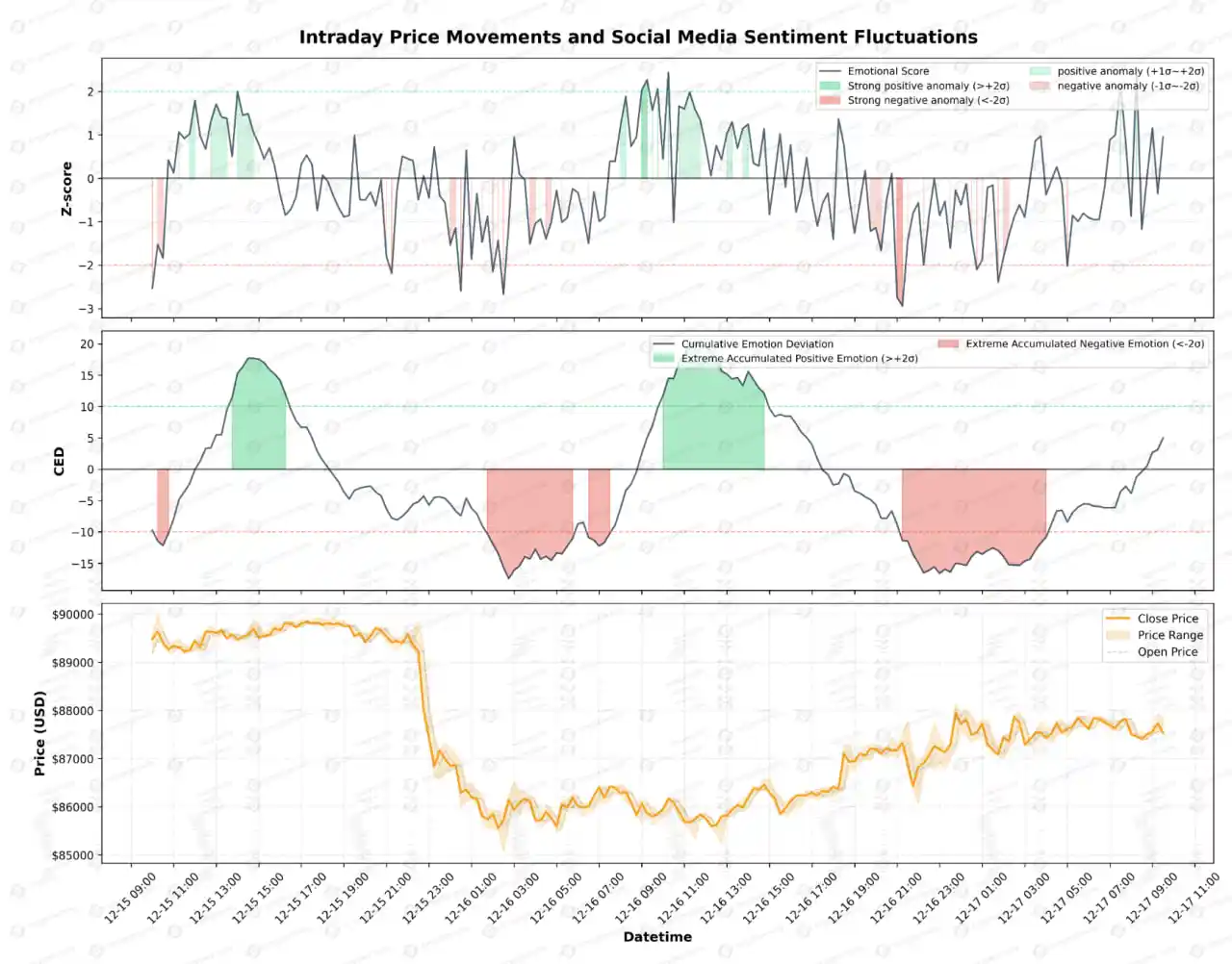
BTC Market Sentiment Analysis Report — 2025.12.17 Over the past 24 hours, BTC market sentiment showed a pattern of initial rise, subsequent decline, and eventual stabilization. Overall sentiment gradually retreated from high positive levels into negative territory, with signs of stabilization by the end of the session, though momentum remained weak. Key情绪 (sentiment) extreme points (where |CED| > 10) were observed. The session began with a sharp rise in sentiment to an extreme positive value (CED peak: +19.80) between 09:45-12:00, though price failed to follow, showing a clear divergence. From 12:00-18:00, sentiment gradually declined while prices moved within a narrow range. During the evening (18:00-24:00), sentiment turned negative, with CED dropping to -16.63, accompanied by significant price volatility. From midnight to early morning (00:00-09:45), sentiment oscillated within negative levels before converging, with prices stabilizing. During periods of extreme sentiment (|CED| > 10), price volatility increased significantly, with a higher probability of declines during negative sentiment phases. Neutral sentiment periods corresponded to relatively stable price action and balanced market forces. Notably, extreme positive sentiment often preceded price corrections, indicating that excessive optimism tended to signal adjustments. The market completed a V-shaped emotional cycle, moving from extreme positivity through deep negativity back to neutrality, suggesting a full release of sentiment. Price resilience was evident around the $87,000–88,000 support zone. In the short term, sentiment momentum remains weak with no clear directional catalyst, suggesting continued consolidation. A sustained CED above +5 coupled with a volume-backed break above $88,000 may signal the start of a new upward trend.

marsbit12/17 02:12

Intraday Quantitative Sentiment Fluctuation Analysis Report — December 17, 2025

marsbit12/17 02:12

Bitcoin is a 'Digital Labubu'. Is the Crypto Market One Big Meme?

Bitcoin is often described as a "digital Labubu" (a collectible toy), raising the question of whether the entire crypto market is essentially one big meme. The article argues that crypto prices are driven not only by fundamentals but also by crowd sentiment, as seen in Bitcoin's recent volatility around $85,000. Vanguard’s John Amoris recently criticized Bitcoin, comparing it to a speculative digital toy. During uncertain market periods, meme coins tend to perform notably well. Retail traders, seeking engaging narratives rather than "ideal assets," are drawn to projects that turn trading into a game and community participation into a sense of belonging. Meme tokens like Maxi Doge are gaining attention by packaging high-risk trading into a competitive, viral format. The meme coin sector has seen significant activity, with daily trading volumes regularly exceeding $5 billion. These tokens compete through various strategies—some rely on humor and visuals, while others incorporate gamification, tournaments, and social mechanics. Maxi Doge, for example, emphasizes a competitive trading community with leaderboard rankings and rewards. The project has attracted notable interest, with its pre-sale raising $4.3 million and tokens priced at $0.000273. Large transactions, including a $251K purchase, indicate growing engagement. Maxi Doge appeals to those looking for meme projects that combine discipline, tournaments, and trading culture—transforming speculation into structured, community-driven activity.

bitcoinist12/15 19:04

Bitcoin is a 'Digital Labubu'. Is the Crypto Market One Big Meme?

bitcoinist12/15 19:04

Imbalance in Returns Amid High Correlation: Why is Capital Being 'Squeezed Out' of Altcoins?

Over the past year, a stark divergence has emerged between cryptocurrency and U.S. equity markets. While the S&P 500 and Nasdaq 100 have posted significant gains, altcoins have experienced a severe downturn, indicating a structural shift of capital toward higher-quality assets. Major indices like the S&P 500 and Nasdaq 100 rose substantially in 2024 and 2025 with relatively low drawdowns. In contrast, the CoinDesk 80 Index, tracking altcoins outside the top 20 cryptocurrencies, plummeted over 46% in Q1 2025 and was down 38% year-to-date by mid-July. A key driver is the "return imbalance under high correlation." Despite a correlation of 0.9 between major cryptocurrencies (CoinDesk 5 Index) and altcoins (CoinDesk 80), their returns diverged drastically. The former gained 12-13%, while the latter fell nearly 40%. The risk-adjusted return gap is even wider. Altcoin indices showed volatility similar to or higher than equities but delivered deeply negative returns and negative Sharpe ratios. Over five years, a small-cap crypto index returned -8%, while a large-cap index surged 380%. Trading data shows capital is not exiting crypto but flowing up the quality curve. Volume is concentrating in the top 10 altcoins and "institutional-grade" assets like Solana and XRP with regulatory clarity. Bitcoin and Ethereum ETFs are attracting sustained institutional inflows. Consequently, diversification into altcoins has lost its appeal. Their high correlation with major cryptos negates diversification benefits while adding risk. The market's logic has shifted: capital is now focused on regulated, liquid assets, squeezing out lower-quality altcoins.

marsbit12/15 09:08

Imbalance in Returns Amid High Correlation: Why is Capital Being 'Squeezed Out' of Altcoins?

marsbit12/15 09:08

活动图片